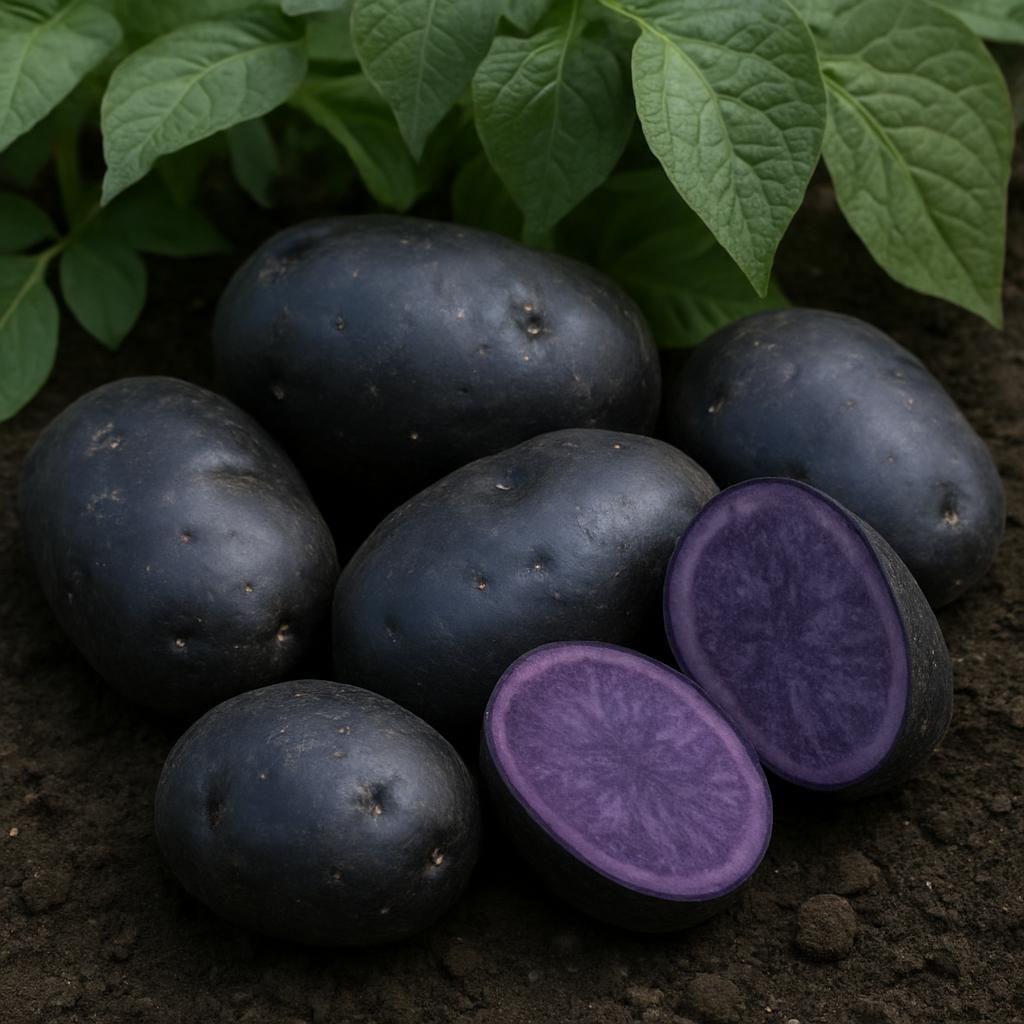
Introduction to Potato (Adirondack Blue)
Adirondack Blue is a specialty potato cultivar developed at Cornell University and released for its exceptional nutritional profile and vibrant coloration. Unlike standard white or russet varieties, the intense anthocyanin pigments throughout the flesh deliver powerful antioxidant benefits while maintaining firm texture when baked, boiled, or roasted. Home gardeners and small-scale commercial growers value its relatively early maturity (approximately 80–90 days) and strong resistance to common scab. Because the variety performs best in cool, moist conditions typical of northern latitudes, it has become a favorite for short-season climates and high-elevation gardens.
Beyond its culinary appeal, Adirondack Blue contributes to soil health when included in rotation systems. Its dense canopy shades the soil, reducing erosion and suppressing weeds. The variety stores exceptionally well when properly cured, retaining both color and flavor for up to six months under ideal conditions. This guide provides comprehensive, research-based recommendations for successful cultivation from seed selection through storage.
Botanical Profile of Potato (Adirondack Blue)
Adirondack Blue belongs to the nightshade family (Solanaceae) and shares the same genetic lineage as all cultivated potatoes. The plant produces compound leaves with five to seven leaflets and bears clusters of lavender flowers that rarely set true seed. Underground, the stolons swell to form tubers with smooth, deep-blue skin and uniformly pigmented flesh. Typical tuber size ranges from 4–8 ounces, with a slightly oval to oblong shape. The variety exhibits moderate vine vigor, reaching 24–30 inches in height, and demonstrates good tolerance to light frost once established.
Soil, pH, and Climate Requirements for Potato (Adirondack Blue)
Successful production begins with well-drained, fertile loam or sandy loam soils. Heavy clay soils should be amended with organic matter to improve structure and prevent waterlogging. Potatoes prefer slightly acidic conditions that also help suppress common scab.
| Parameter | Ideal Range | Notes |
|---|---|---|
| Soil pH | 5.2 – 6.0 | Prevents common scab; test and amend annually |
| Soil Texture | Loam to sandy loam | Excellent drainage essential |
| Organic Matter | 3 – 5 % | Incorporate well-rotted compost |
| Soil Temperature at Planting | 45 – 55 °F (7 – 13 °C) | Use soil thermometer at 4-inch depth |
| Air Temperature Range | 60 – 70 °F daytime | Cool nights (50 – 55 °F) optimize tuber set |
| Frost Tolerance | Light frost to 28 °F | Protect new shoots with row cover if needed |
| Elevation | Up to 8,000 ft | Performs well in high-elevation gardens |
Step-by-Step Planting & Propagation
- Source certified disease-free seed potatoes of Adirondack Blue. Avoid grocery-store tubers that may carry viruses.
- Approximately 4–6 weeks before planting, place seed tubers in a bright, cool (50–60 °F) location to encourage sprouting (chitting).
- Cut larger tubers into pieces containing at least two eyes; allow cut surfaces to suberize for 24–48 hours.
- Prepare planting trenches 4–6 inches deep and 30–36 inches apart. Rows should be spaced 36 inches apart to allow hilling.
- Plant seed pieces 10–12 inches apart within the row, eyes facing upward, and cover with 2–3 inches of soil.
- As vines emerge and reach 6–8 inches, begin hilling soil around the stems to promote additional tuber formation and protect developing potatoes from sunlight.
- Maintain consistent moisture during tuber initiation (flowering stage) to prevent hollow heart and knobby tubers.
Care & Maintenance regimes for Potato (Adirondack Blue)
Consistent cultural practices ensure high-quality, uniformly sized tubers. Monitor soil moisture with a tensiometer or finger test; never allow the soil to dry below 50 % field capacity during tuber bulking.
| Growth Stage | Watering Schedule | Fertilizer Application | Pruning / Hilling Notes |
|---|---|---|---|
| Pre-Plant | Bring soil to field capacity | Incorporate 2–3 lbs balanced organic fertilizer (e.g., 5-5-5) per 100 sq ft | Remove weeds; incorporate compost |
| Emergence to Flowering | 1–1.5 inches per week | Side-dress with 1 lb high-nitrogen fertilizer at 6-inch height | Hill soil when vines reach 8 inches |
| Tuber Bulking | Maintain even moisture; avoid fluctuations | Apply 0.5 lb potassium-rich fertilizer (e.g., 2-0-6) per 100 sq ft at flowering | Second hilling when vines reach 12–15 inches |
| Late Season | Reduce watering 2 weeks before harvest | No additional fertilizer | Cease hilling; allow vines to senesce naturally |
Pests, Diseases & Organic Management
Adirondack Blue is moderately resistant to common scab but remains susceptible to Colorado potato beetle, aphids, and late blight. Scout weekly beginning at emergence.
- Colorado potato beetle: Handpick adults and larvae; apply Bacillus thuringiensis var. tenebrionis when larvae are small.
- Aphids: Release lady beetles or lacewings; spray insecticidal soap or neem oil at first sign of infestation.
- Late blight: Remove and destroy infected foliage immediately; apply copper-based fungicides preventively during cool, wet weather.
- Potato cyst nematodes: Rotate with non-host crops for at least three years; consider biofumigation with mustard cover crops.
- Wireworms: Avoid planting in recently plowed sod; use bait traps to monitor populations.
Harvesting, Curing & Optimal Storage
Begin harvest when vines start to yellow and skins have set (usually 80–90 days after planting). Use a garden fork to gently lift tubers, taking care not to bruise the blue skin. Cure harvested potatoes in a dark, well-ventilated area at 50–60 °F and 85–90 % relative humidity for 10–14 days. After curing, move to long-term storage at 38–42 °F with 90–95 % humidity. Properly cured Adirondack Blue tubers maintain quality for 5–6 months. Check monthly and remove any sprouted or soft tubers.
Companion Planting for Potato (Adirondack Blue)
Strategic companions improve pest management and nutrient cycling. Plant marigold and nasturtium between rows to repel Colorado potato beetles. Clover living mulch fixes nitrogen and suppresses weeds without competing heavily for moisture. Avoid planting near tomato, eggplant, or pepper to reduce shared disease pressure. Garlic and onion deter aphids when interplanted at the row edges.