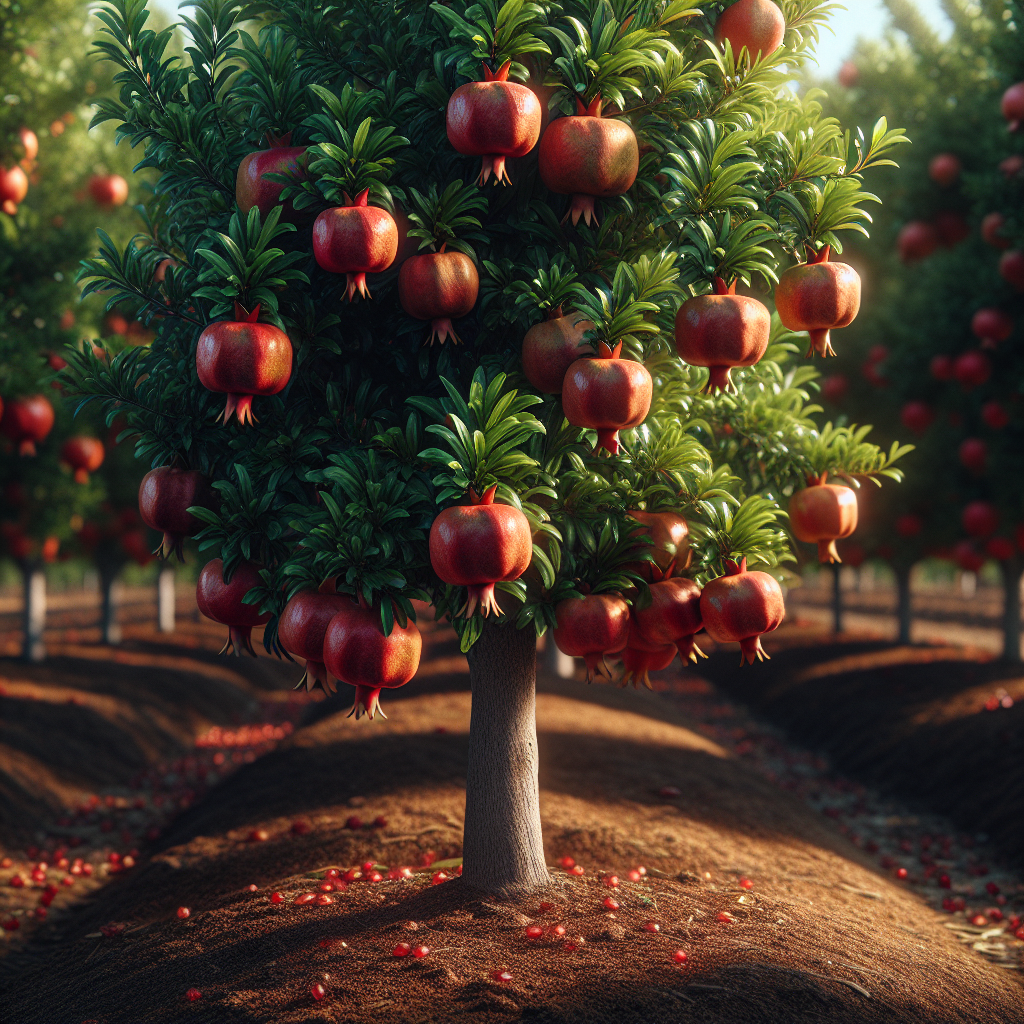
Introduction to Pomegranate (Parfianka)
Originating from the broader pomegranate lineage of Central and Western Asia, this cultivar has earned a strong reputation among specialty fruit growers for combining excellent flavor with ornamental value. Parfianka is widely appreciated for producing large, glossy fruit with vivid red skin and deeply colored arils that balance sweetness and acidity more elegantly than many commercial processing types. Compared with firmer-seeded cultivars, its seeds are relatively soft, which improves the eating experience and makes it especially desirable for fresh market sales, juice, and garnish use.
This is a deciduous fruiting shrub or small tree that performs best where summers are hot, dry, and bright. It can be grown as a multi-stem bush or trained to a small single-trunk tree, usually maturing at 8-12 feet tall under managed conditions, though it can grow larger in ideal sites. Like many pomegranates, it tolerates drought better than many orchard fruits once established, but premium fruit quality depends on consistent moisture during flowering and fruit fill. If you want a variety that sits in the upper tier for flavor while also being productive and visually striking, Parfianka deserves serious consideration. For broader species context, see the general Pomegranate guide.
Botanical Profile of Pomegranate (Parfianka)
Parfianka belongs to the Lythraceae family and is botanically classified as Punica granatum. The plant naturally tends toward a suckering, many-stemmed architecture, with narrow, glossy, opposite to sub-opposite leaves and showy orange-red flowers borne on current season growth. Flowers may be both functional male and bisexual; successful fruiting depends on the presence of fertile flowers and favorable pollination conditions during bloom.
Fruit are technically specialized berries with a leathery exocarp and a chambered interior filled with arils. In Parfianka, the rind is typically bright red to red-orange at maturity, and the arils are richly pigmented, juicy, and pleasantly balanced in flavor. Fruit size is generally medium to large, especially when crop load is thinned and irrigation is kept even. The crown-like calyx remains prominent at the blossom end.
Several characteristics distinguish this cultivar from standard commercial pomegranates. First, the seed hardness is lower than many processing varieties, so chewing the arils is more pleasant. Second, flavor tends to be more complex and less one-dimensionally sweet, which is why it is frequently ranked highly in tasting trials. Third, color development is strong in hot climates, but full external redness should not be used as the only harvest index; internal maturity, sugar-acid balance, and the metallic ringing sound of mature fruit are also important.
Parfianka is generally self-fruitful, so a single plant can set a crop. Even so, fruit set may improve in mixed plantings with other pomegranates due to increased insect activity and overlapping bloom stimulation. The species flowers on new growth, which means pruning practices must preserve a balance between vegetative renewal and fruiting wood.
Soil, pH, and Climate Requirements for Pomegranate (Parfianka)
This cultivar is highly adaptable but reaches its best commercial quality in deep, well-drained loam or sandy loam soils. It can tolerate poorer and even somewhat gravelly soils better than many fruit crops, but the difference between survival and premium production is substantial. For top fruit size, juice content, and reduced splitting, aim for a soil profile that drains freely yet retains moderate available moisture at root depth.
An ideal soil pH is 5.5 to 7.2, with 6.0 to 6.8 being especially suitable for balanced nutrient availability. It can tolerate mildly alkaline conditions, often up to around pH 7.5, but micronutrient issues such as iron chlorosis become more likely in calcareous soils. If young leaves emerge pale with green veins, especially on high-pH ground, suspect iron unavailability rather than a lack of total iron in the soil.
Drainage is critical. Parfianka dislikes chronically saturated soils and will decline in sites where water stands after rain or irrigation. Root oxygen deprivation can lead to reduced vigor, yellowing foliage, poor flowering, root disease, and fruit drop. A healthy root zone should feel slightly moist but never swampy; when squeezed, soil should hold together lightly without oozing water. If the top 2-3 inches remain wet for days in warm weather, drainage is insufficient.
Climate-wise, Parfianka is best suited to Mediterranean, subtropical dry-summer, and warm temperate regions. It needs a long, warm growing season for full fruit ripening and sugar development. Summer heat is beneficial, and daytime temperatures of 85-95°F (29-35°C) during active growth are excellent. Mature plAnts tolerate high heat well if roots are not drought-stressed. Winter cold tolerance is moderate; plAnts can withstand light to moderate frosts once dormant, often into the upper teens °F for short periods, but prolonged freezes, sudden Arctic events, and cold winds can damage wood and flower buds.
Rainfall timing matters as much as total rainfall. Wet conditions during bloom can reduce pollinator activity and fruit set, while erratic watering or heavy rain near maturity often increases fruit splitting. In humid climates, canopy thinning and wider spacing become more important to reduce disease pressure. In low-rainfall regions, regulated irrigation usually produces superior fruit consistency and fewer defects.
For growers improving orchard soils before planting, organic matter incorporation and surface mulching are especially useful. A general soil-building framework can be adapted from practices used across perennial systems; see soil health strategies.
Step-by-Step Planting & Propagation
Choose a site with full sun for at least 8 hours daily. Reduced sunlight lowers flower initiation, weakens coloration, and can increase vegetative growth at the expense of cropping. Avoid frost pockets, low spots with cold air accumulation, and areas exposed to persistent standing moisture.
Before planting, test soil for pH, organic matter, salinity, and macronutrients. Pomegranates tolerate some salinity better than many fruits, but high salts still reduce growth and fruit quality over time. If drainage is marginal, plant on raised berms 12-18 inches high and at least 3 feet wide.
Container-grown nursery plAnts are the easiest and most reliable starting material. Plant in early spring after severe frost risk has passed, or in mild-winter climates in early fall so roots establish before summer heat. Dig a hole two to three times the width of the root ball but no deeper than the root ball height. Set the crown at or slightly above finished soil grade. Backfill mostly with native soil rather than a heavily amended pocket, which can discourage outward root growth.
Water the planting hole thoroughly to settle soil and remove air pockets. Then apply 2-4 inches of coarse organic mulch, such as wood chips, keeping it 4-6 inches away from the trunk to prevent crown rot and rodent damage. In hot inland sites, white trunk guards or diluted interior white latex paint can reduce southwest injury and bark sunscald on newly trained single-trunk trees.
Spacing depends on training system. For home orchard bushes, 10-12 feet between plAnts is common. For small tree form, 12-15 feet allows light penetration and harvest access. Hedgerow or high-density systems are possible but require more precise pruning and irrigation.
Propagation is most commonly done from hardwood cuttings because seed does not reproduce cultivar traits reliably. Take pencil-thick dormant cuttings 8-12 inches long from healthy one-year wood in late winter. Insert cuttings so that two-thirds of their length is below media or field soil, keeping at least one bud above the surface. Rooting is improved with bottom warmth, consistent moisture, and, in nursery settings, rooting hormone. Cuttings should remain moist but never soggy; overwatering encourages rot before roots form.
Suckers can also be used for propagation if they are vigorous and attached to healthy crown tissue, though cuttings are generally preferred for uniformity. Grafting is uncommon for pomegranates compared with other fruit trees.
In the first year after planting, remove flowers if the plant is weak or underdeveloped so energy goes into root establishment. On strong nursery stock, a light first crop may be allowed, but avoid overbearing while the framework is still forming.
Care & Maintenance regimes for Pomegranate (Parfianka)
Irrigation should be deliberate rather than frequent and shallow. During establishment, water deeply 1-2 times per week depending on soil texture and weather. Sandy soils may need more frequent irrigation, while loams need fewer but deeper events. The objective is to wet the active root zone to roughly 12-24 inches deep, then allow the upper few inches to partially dry before the next irrigation.
For mature plAnts, moisture consistency matters more than constant wetness. During active shoot growth and bloom, moderate soil moisture should be maintained. During fruit enlargement, avoid oscillating between drought and saturation, as this is one of the chief causes of splitting. A practical target is soil that feels cool and slightly damp at 4-6 inches deep, not powder dry and not sticky-saturated. Leaf curl with midday wilt that does not recover by evening can indicate water stress; yellow leaves, soft lush growth, and a sour smell in the root zone suggest overwatering.
Fertilization should be restrained but consistent. Excess nitrogen produces vigorous shoots, delayed ripening, reduced color, and greater pest susceptibility. In young plAnts, modest spring applications of compost plus a balanced organic fertilizer are usually sufficient. Mature plAnts often respond well to split nitrogen applications: one at budbreak and one after fruit set, adjusted to soil test results and vigor. If annual shoot growth exceeds about 18-24 inches on bearing wood, reduce nitrogen. Potassium is particularly important for fruit quality, rind integrity, and sugar movement.
Pruning strategy depends on whether you want a bush or tree form. Bush culture is more cold-resilient because damaged stems can be renewed from the base. Tree form improves access and visual neatness but requires stricter sucker removal. In the first 2-3 years, select 3-5 main scaffolds if using bush form, or one trunk with 3-4 scaffold limbs for tree form. Remove crowded, crossing, inward-growing, and weak shoots annually during dormancy.
Because flowers are borne on new growth from mature framework, pruning should be moderate. Severe heading cuts can delay bearing and stimulate excessive vegetative suckers. After establishment, focus on thinning cuts that open the center to sunlight and air movement. Remove basal suckers several times during the growing season unless they are being retained as replacement trunks.
Fruit thinning is worthwhile in heavy-set years. Overloaded branches produce smaller fruit and may break under weight. Remove damaged, misshapen, or crowded fruit early, leaving spacing that prevents fruit-to-fruit abrasion. Branch support may be needed on young or heavily cropping plAnts.
Weed management is especially important for young trees. Keep a weed-free zone at least 2-3 feet around the base to reduce competition for water and nutrients. Mulch helps stabilize soil moisture and temperature, but do not pile it against the bark.
In colder margins, protect young plAnts with frost cloth during hard freezes and prioritize bush form so damaged wood can be renewed. In very hot desert climates, some afternoon protection from reflected heat can reduce sunburn on exposed fruit, especially where canopy density is low.
Pests, Diseases & Organic Management
Parfianka is relatively resilient, but it is not pest-proof. Aphids may colonize tender new shoots and flower clusters, causing leaf curling and honeydew accumulation. A healthy predator population often controls them, but if colonies expand rapidly, use strong water sprays, insecticidal soap, or neem-based products applied during cooler hours and away from peak pollinator activity.
Whiteflies, Scale insects, Mealybugs, and Mites can also occur, particularly in hot, dusty, or sheltered sites. Dust suppression, balanced fertilization, and pruning for airflow reduce outbreaks. Horticultural oils applied during dormancy or low-temperature windows are effective for scale and overwintering eggs, but always avoid spraying stressed plAnts during extreme heat.
Fruit-feeding pests vary by region. Birds are often one of the biggest losses as fruit color develops. Netting is the most dependable nonchemical control. Ants may be attracted to split fruit or honeydew-producing insects; managing Aphids and keeping orchard sanitation tight reduces ant pressure.
Common diseases include Fungal leaf spots, Alternaria fruit rot, Botrytis on blossoms in wet weather, and root issues in poorly drained soils. Fruit splitting, while not an infectious disease, creates entry points for secondary pathogens. The best organic strategy is prevention: maintain even moisture, avoid overhead irrigation near harvest, prune for light penetration, promptly remove mummified or cracked fruit, and sanitize fallen debris.
In humid climates, copper-based organic fungicides may be justified at key timings such as post-pruning, early bloom, or after extended wet periods, but they should be used judiciously to avoid phytotoxicity and soil accumulation. Always test on a small area first if weather is hot.
Watch for these diagnostic patterns: black spotting on leaves with premature defoliation usually indicates fungal pressure; sour-smelling, brown internal breakdown in fruit may signal rot following cracking; sparse flowering with lush shoots suggests excess nitrogen; progressive dieback from the crown in wet soils points toward root stress rather than a foliar disease.
Integrated organic management works best when canopy, water, nutrition, and sanitation are all aligned. Diverse insectary borders featuring Thyme, Yarrow, and Nasturtium can support beneficial insects while softening pest pressure at orchard edges.
Harvesting, Curing & Optimal Storage
Parfianka is harvested when fruit are fully mature; unlike some fruits, pomegranates do not continue improving in sugar content after picking. External color alone is not a perfect indicator, since sun exposure and climate influence rind blush. Instead, assess a combination of signs: the fruit becomes heavy for its size, the sides become slightly flattened rather than perfectly round, the rind loses some youthful gloss, and tapping produces a more metallic sound than an immature dull thud.
Cut fruit with pruners rather than pulling them, leaving a short stem stub to avoid rind tearing. Handle gently. Although the rind is leathery, bruising and punctures still shorten storage life and increase decay risk.
Harvest timing is important for flavor. Picking too early gives pale, tart arils and lower juice yield. Waiting too long can increase splitting, bird damage, and internal breakdown, especially if rain follows a dry period. In commercial settings, multiple pickings may be necessary as fruit on the same plant can mature unevenly.
Pomegranates do not require curing in the way onions or winter squash do, but a short post-harvest drying and sorting period is beneficial. Keep freshly harvested fruit in a shaded, airy place for 12-24 hours so surface moisture evaporates and field heat dissipates. Discard cracked, insect-damaged, or diseased fruit immediately; they should be used at once or juiced, not stored with sound fruit.
For storage, ideal conditions are about 41-45°F (5-7°C) with 85-90% relative humidity. Under these conditions, sound fruit may keep for 1-3 months, sometimes longer depending on harvest maturity and sanitation. Lower humidity causes shriveling as moisture is lost through the rind. Temperatures that are too warm shorten storage life, while excessively cold storage near chilling thresholds may injure flavor and texture.
Arils can be refrigerated for several days in sealed containers and frozen for longer storage. Juice quality is best when processed from fully mature fruit within a short time after harvest.
Companion Planting for Pomegranate (Parfianka)
In orchard systems, the most useful companions are not those competing heavily for water but those that support pollination, beneficial insects, and soil structure. Low-growing aromatic and flowering species are generally more suitable than vigorous annual vegetables. Thyme is excellent as a low, drought-tolerant understory edge plant that attracts pollinators while leaving trunk airflow open. Yarrow is valuable for drawing predatory wasps, hoverflies, and other beneficial insects, and it tolerates lean soils once established. Nasturtium can function as a trap and distraction plant for Aphids in some systems while also attracting pollinators.
A white clover understory can also be useful in wider-spaced plantings where irrigation is sufficient, contributing some nitrogen cycling and reducing erosion, but it should be managed carefully around young trees so it does not compete for limited moisture. In dry climates, keep companion plAnts outside the immediate root competition zone during establishment.
Avoid aggressive companions that create shade, tangle into the canopy, or require frequent irrigation. Heavy-feeding annuals planted too close to young pomegranates can reduce vigor rather than help. The best companion strategy is a managed ring or alley system: mulch near the trunk, beneficial flowering plAnts just beyond the mulch line, and mowed or controlled groundcover farther out. This arrangement preserves root-zone moisture while improving orchard ecology and pollinator traffic.