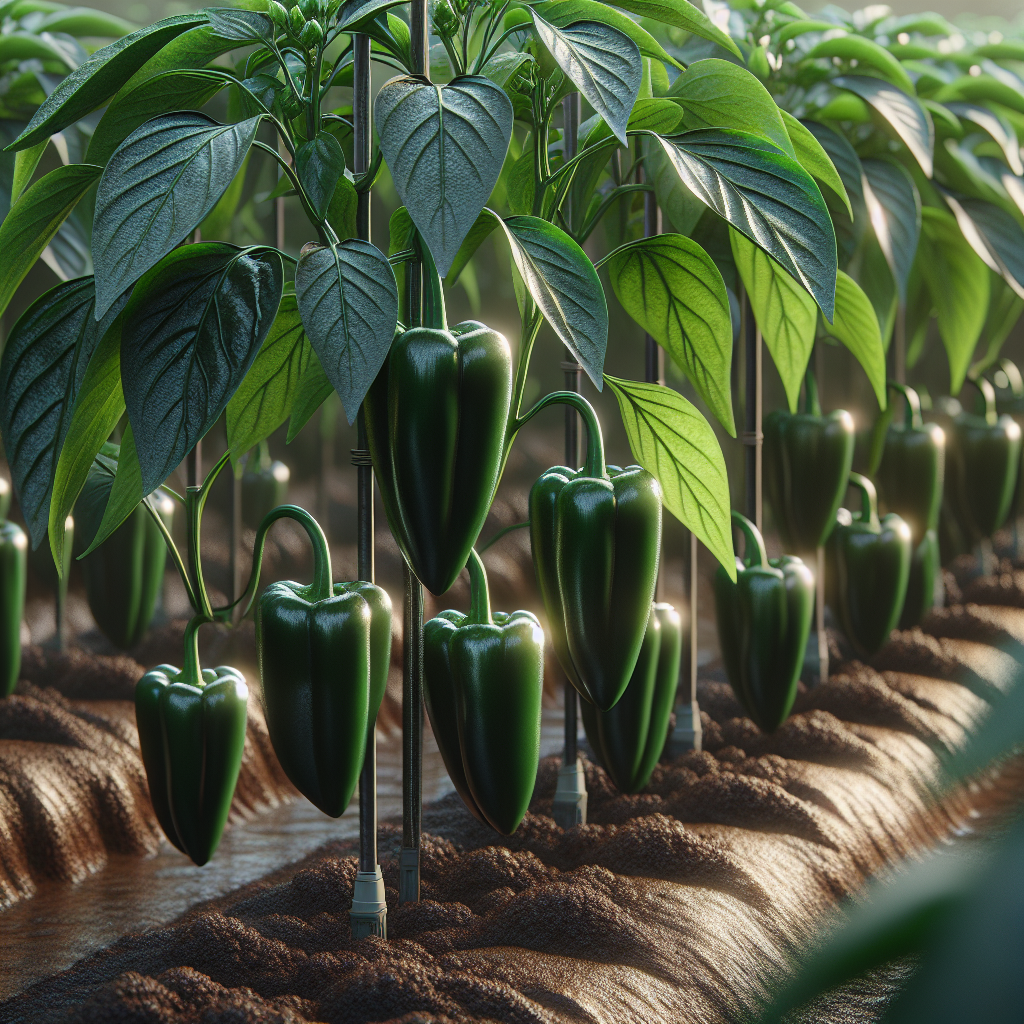
Introduction to Poblano Pepper
A classic Mexican chili with deep culinary and cultural importance, this pepper is typically harvested green when glossy and full-sized, though it can also be left to ripen to a dark red-brown before drying into ancho. It is prized not for extreme heat but for balanced flavor: mildly pungent, slightly sweet, and often more complex than standard bell types. In commercial and home production alike, poblano is valued for stuffing, roasting, drying, and fresh-market sales because fruits are broad-shouldered, thick-fleshed, and visually distinctive.
The name is associated with Puebla, Mexico, where the pepper has long been part of regional cuisine, especially in dishes such as chiles rellenos and mole. Botanically, it belongs to the same species as many sweet peppers and hot chilies, but its growth habit, fruit architecture, and flavor profile set it apart. Compared with many thin-walled hot peppers, poblano needs a slightly longer warm season to reach ideal size and wall thickness. Growers who understand its preference for steady warmth, moderate fertility, and uninterrupted moisture are rewarded with heavy flushes of premium fruit.
Heat level usually ranges around 1,000 to 2,000 Scoville Heat Units, though some fruits can be milder or slightly hotter depending on genetics and growing conditions. Stress from drought, excessive heat, or irregular irrigation can intensify pungency and reduce fruit quality. If you also grow other peppers, the broader cultural guidance in a Bell Pepper guide is useful for comparing nutrient and watering demands, but poblano generally benefits from a bit more patience before harvest and careful fruit support once production begins.
Botanical Profile of Poblano Pepper
This crop is a warm-season, frost-sensitive perennial by nature but grown as an annual in most temperate and subtropical production systems. Plants usually reach 60 to 90 cm tall, though in long seasons with excellent fertility and staking they may exceed 1 m. Habit is upright to semi-bushy, with branching that becomes increasingly open under heavy fruit load.
Leaves are smooth, ovate, and medium to dark green, with a moderately dense canopy that protects fruit from sunscald better than many open-canopied chili types. Flowers are typically white, star-shaped, and borne singly or occasionally in pairs at nodes. Successful fruit set is strongly influenced by temperature: daytime temperatures between 24 and 29b0C and night temperatures between 16 and 21b0C are near ideal. When days exceed roughly 32 to 35b0C for extended periods, pollen viability can drop, blossom abortion may increase, and fruit set can stall.
Fruits are characteristically broad at the shoulder, tapering gently to a blunt point, often described as heart-shaped or triangular. Typical mature green fruits measure 10 to 15 cm long and 5 to 8 cm wide, with thick walls and a slightly wrinkled or uneven surface depending on cultivar and growing conditions. Fresh-market poblanos are usually harvested dark green and glossy. If fully ripened, the fruits turn red to deep brownish-red and can be dried into ancho chili, which develops sweeter, raisin-like, smoky notes.
From transplant to first harvest, most strains require about 70 to 85 days under good conditions; from direct seeding, expect longer. Because the fruits are relatively large and fleshy, total season length matters. Cool summers often produce healthy plants with slow fruit bulking, while excessively hot nights can reduce fruit set. Pollination is generally self-fertile, but bee activity and light plant movement can improve uniformity of set.
Soil, pH, and Climate Requirements for Poblano Pepper
This crop performs best in loose, well-aerated, fertile soil with excellent drainage and moderate water-holding capacity. A sandy loam or loam enriched with stable compost is ideal. Heavy clay can work if deeply amended and formed into raised beds, but poorly drained soil is one of the fastest routes to stunting, root disease, and erratic growth. Root systems are not especially deep compared with larger fruiting crops, so the upper 20 to 30 cm of soil should be crumbly, biologically active, and free from compaction.
The preferred pH is 6.2 to 6.8. Plants can tolerate about 6.0 to 7.0, but nutrient efficiency declines outside the optimal band. At pH below 6.0, calcium and magnesium availability may become limiting, and the risk of blossom-end rot increases when combined with uneven soil moisture. At pH above 7.2, iron, manganese, and zinc availability can decrease, leading to interveinal chlorosis on young leaves. A professional soil test before planting is strongly recommended. If pH is low, agricultural lime should be incorporated several weeks to months before planting. If pH is high, elemental sulfur or acidifying organic amendments can help, though adjustments take time.
Climate matters as much as soil. Poblano thrives in warm, sunny conditions with a long frost-free season of at least 120 days for high-quality full production. Soil temperature should ideally be above 18b0C at transplanting. Below about 15b0C, root activity slows markedly, leaves may become purplish from phosphorus stress, and early growth can stall for weeks. Frost is lethal, and even chilling nights below 10b0C can cause setback, flower drop, and delayed harvest.
Full sun is essential: at least 8 hours of direct light, with 10 or more preferable in field conditions. In very hot inland climates, however, brief afternoon shade or 20 to 30% shade cloth during heat waves can preserve pollen viability and reduce sunscald. Relative humidity in the moderate range is ideal. Excess humidity with dense foliage increases bacterial and fungal pressure, while very arid conditions can trigger flower drop unless irrigation is carefully managed.
For soil-building strategies before planting, growers often benefit from the practical principles in Soil health tips, especially when preparing beds for heavy-feeding fruiting crops.
Step-by-Step Planting & Propagation
Start from seed indoors 8 to 10 weeks before the last expected frost. Use a sterile, fine-textured seed-starting mix rather than garden soil. Sow seeds 0.5 to 1 cm deep in cell trays or small modules. Germination is fastest at 27 to 30b0C; at these temperatures, seeds may emerge in 7 to 14 days. At 20 to 22b0C, germination becomes slower and less uniform. Bottom heat is extremely useful for peppers.
Once seedlings emerge, provide very bright light immediately to prevent stretching. Day temperatures around 22 to 26b0C and night temperatures around 18 to 20b0C produce compact, vigorous transplants. Water lightly but consistently: the medium should remain evenly moist, never saturated. A waterlogged seedling mix deprives roots of oxygen and encourages damping-off. Seedlings are ready for potting up when roots hold the plug together and the first true leaves are well developed.
Pot up into 7.5 to 10 cm pots if outdoor planting is still several weeks away. Use a fertile but well-drained potting mix. Begin light feeding with a dilute, balanced fertilizer once plants have 2 to 3 true leaves. Avoid overfeeding nitrogen at this stage, which can create soft, overly lush transplants that struggle after field setting.
Harden off for 7 to 10 days before transplanting by gradually exposing plants to outdoor light, wind, and temperature variation. Do not harden peppers by exposing them to cold nights below 12b0C; the process should toughen plants, not chill them.
Transplant only after all frost danger has passed and soils are reliably warm. Space plants 45 to 60 cm apart in rows 75 to 90 cm apart. In intensive raised-bed systems, two staggered rows per bed can work if airflow remains adequate. A typical target density is enough to create light canopy closure without trapping humidity. Plant at the same depth as the seedling grew in its pot; unlike tomatoes, peppers do not benefit much from deep stem burial.
Water transplants in thoroughly to settle soil around roots. Immediately apply mulch once the soil is warm: black plastic mulch can accelerate early growth in cool climates, while straw or leaf mulch helps moderate moisture and reduce soil splash in warmer regions. Direct seeding is possible only in long, warm seasons, but it is generally less reliable because emergence and early development are slow in cool soils.
Care & Maintenance regimes for Poblano Pepper
Consistent moisture is one of the defining factors in premium poblano production. Aim to keep soil evenly moist in the main root zone, roughly the top 15 to 25 cm, without allowing it to become muddy or stagnant. As a practical field benchmark, the soil should feel cool and lightly damp when squeezed, forming a weak ball that crumbles rather than smearing. During active flowering and fruit fill, most plantings need about 25 to 40 mm of water per week, but sandy soils and high heat may require more frequent irrigation.
The key is consistency. If the soil swings from dry to saturated, plants respond with blossom drop, misshapen fruit, tougher skin, variable heat, and sometimes blossom-end rot. Signs of underwatering include mid-afternoon wilt that persists into evening, dull or gray-green foliage, aborted blossoms, and fruits that stop enlarging. Signs of overwatering include persistent wilting despite wet soil, yellowing lower leaves, edema-like blistering, slowed growth, and a sour smell in poorly drained beds. Drip irrigation is superior to overhead watering because it maintains stable root-zone moisture and reduces foliar disease.
Nutrient management should favor steady, moderate feeding rather than heavy bursts. Before planting, incorporate mature compost plus a balanced organic or conventional fertilizer according to soil test results. A general target is moderate nitrogen with ample phosphorus, potassium, calcium, and magnesium. Too much nitrogen produces lush foliage at the expense of flowering and can make plants more attractive to Aphids. Once the first fruits set, a side-dressing slightly higher in potassium than nitrogen helps support wall thickness, color development, and overall fruit quality.
Calcium availability depends less on total soil calcium than on uniform water movement through the plant. If blossom-end rot appears, do not assume the soil lacks calcium before checking irrigation consistency, root health, salinity, and pH. Foliar calcium sprays may reduce symptom severity on new fruit in some situations, but they do not fix erratic watering or damaged roots.
Staking or caging is highly recommended. Poblano fruits are heavier than many chili types, and branches can split under load after rain or irrigation flushes. A single stake with soft ties, Florida weave, or compact cages all work. Pruning is usually minimal; remove only damaged, diseased, or soil-contact leaves, and avoid excessive canopy stripping that exposes fruit to sunscald.
Weed control should be proactive early in the season because peppers are poor competitors when young. Mulching reduces weed pressure and stabilizes moisture. Cultivate shallowly if needed, since roots near the surface are easily damaged.
Pests, Diseases & Organic Management
Aphids, Thrips, Flea beetles, Pepper weevils in some regions, Spider mites, and Hornworms are the main insect threats. Aphids cluster on tender growth and undersides of leaves, causing curling, sticky honeydew, and virus transmission risk. Thrips scar flowers and young fruit and are notorious vectors of Tomato spotted wilt virus. Spider mites thrive in hot, dusty conditions and cause stippling, bronzing, and fine webbing. Flea beetles produce characteristic shot-hole damage on seedlings and young transplants.
An organic management program begins with prevention: clean transplants, weed control around the field, reflective mulches where virus pressure is high, adequate spacing, and avoiding excess nitrogen. Insect exclusion netting can protect young plantings if installed before pest arrival and removed when overheating becomes a risk. Strong water sprays can suppress Aphids early, while insecticidal soap or neem-based products may help when coverage is thorough and applications are timed to avoid leaf burn. Beneficial insects such as lady beetles, lacewings, minute pirate bugs, and predatory mites are valuable in biologically active gardens and low-spray farms.
Common diseases include Bacterial spot, Anthracnose, Phytophthora root and crown rot, Powdery mildew in some climates, and several viruses such as Cucumber mosaic virus, Tobacco mosaic virus, and Tomato spotted wilt virus. Bacterial spot often appears as small water-soaked lesions that become dark and scabby on leaves and fruit. Anthracnose typically causes sunken lesions on ripening fruit. Phytophthora is especially destructive in waterlogged soils, where plants can collapse rapidly despite apparently adequate moisture.
Disease prevention is much more effective than cure. Use certified clean seed or reputable transplants, rotate away from solanaceous crops for at least 3 years when disease has been present, avoid working plants when foliage is wet, and keep irrigation off leaves where possible. Remove infected fruit and badly diseased plants promptly. Sanitize stakes, trays, and tools. If tobacco users handle plants, hands should be washed first to reduce mosaic virus risk.
Organic growers often rely on copper products for bacterial suppression and biofungicides containing Bacillus species or Trichoderma as preventive tools, but coverage and timing are everything, and these materials work best before disease becomes severe. The healthiest pepper fields are those with warm soil, balanced nutrition, rapid leaf drying, and disciplined rotation.
Harvesting, Curing & Optimal Storage
For fresh poblano use, harvest when fruits are full-sized, firm, dark green, and glossy, usually 10 to 15 cm long depending on cultivar. Do not wait for skin dullness if the goal is fresh market quality; dulling often signals advancing maturity and thicker skin with reduced shelf appeal. Cut fruits with pruners or a sharp knife, leaving a short stem attached. Pulling by hand can snap brittle branches or strip bark from fruiting nodes.
Frequent harvest encourages continued flowering and fruit set. In peak season, pick every 3 to 5 days. Oversized fruit left too long on the plant can suppress additional production because the plant shifts resources into seed maturation. If producing ancho, allow fruits to ripen fully on the plant until red to deep reddish-brown, then harvest before major weather damage, cracking, or rot develops.
Curing for drying requires warm, airy conditions and protection from direct rain or heavy dew. Fruits may be dried whole in arid climates, but in humid regions it is safer to split them to reduce mold risk. Drying temperatures around 50 to 57b0C in a dehydrator or drying room preserve color and reduce spoilage. Properly dried fruits should be leathery to brittle, with no cool, damp interior pockets.
Fresh storage is best at 7 to 10b0C with 90 to 95% relative humidity. Temperatures much below 7b0C can cause chilling injury, seen as pitting, water-soaked patches, and rapid decay after removal from storage. Under ideal conditions, fresh fruits often keep for 2 to 3 weeks, though best eating quality is usually within 7 to 10 days. Avoid washing before storage unless necessary; surface moisture accelerates decay. For roasted storage, peel and seed if desired, then refrigerate briefly or freeze for long-term use.
Companion Planting for Poblano Pepper
The most useful companions are those that either deter pests, attract beneficial insects, or occupy a different rooting and canopy niche without competing aggressively. Onion is a strong companion because its pungent foliage can help confuse some pest insects while taking up relatively little horizontal space. Garlic offers similar benefits and can be especially useful around bed edges where airflow remains good.
Thai Basil is valuable near pepper rows because it attracts pollinators and beneficial insects while tolerating similar warmth and irrigation patterns. Nasturtium can function as a trap or distraction plant for Aphids and also draws in predatory insects. These companions work best when arranged intentionally rather than crowded into the immediate root zone. Keep at least 20 to 30 cm of space around the pepper stem so companions do not trap humidity against the lower canopy.
Avoid pairing with aggressive heavy feeders that cast dense shade or with crops requiring very different irrigation patterns. Fennel is widely avoided near many vegetables due to allelopathic tendencies, and sprawling cucurbits can overrun peppers if not controlled. Good companion planting improves ecology around the crop, but it should never replace sound spacing, rotation, irrigation, and sanitation practices.