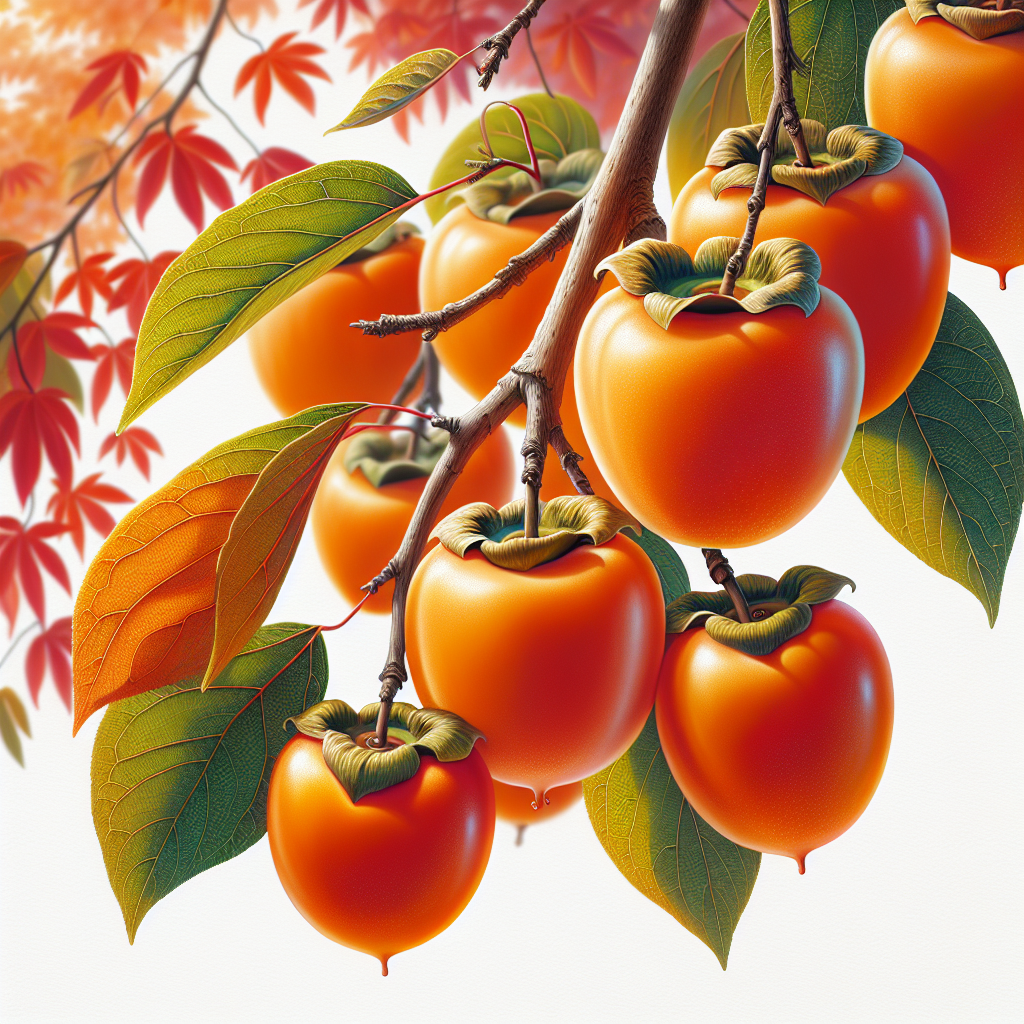
Introduction to Persimmon (Fuyu Jiro)
The Fuyu Jiro persimmon (Diospyros kaki 'Fuyu Jiro') stands out as one of the most popular non-astringent persimmon varieties worldwide, celebrated for its rich orange-red, squat, tomato-like fruits that deliver a crisp texture and honey-sweet flavor without the mouth-puckering tannins of astringent types. Originating from Japan, this cultivar has gained traction in the United States, particularly in California, where it thrives in Mediterranean climates, producing bountiful harvests from October to December. Unlike its astringent counterpart, Persimmon (Hachiya), Fuyu Jiro can be enjoyed fresh at any ripeness stage, making it a favorite for salads, salsas, and direct snacking.
Growers appreciate Fuyu Jiro for its self-fruitful nature, though cross-pollination with pollinator varieties like Gailey boosts yields. Mature trees reach 15-25 feet, offering shade and ornamental appeal with glossy green leaves turning brilliant red-orange in fall. This guide provides professional-grade advice for cultivating Fuyu Jiro, from site selection to post-harvest handling, ensuring high-quality fruit production. For small farms, integrating Fuyu Jiro diversifies income streams with low-maintenance, high-value fruit that stores well. Check out this Fall Companion Planting Guide: Boost Yields and Soil Health for Small Farms and Gardens for synergistic planting ideas.
Botanical Profile of Persimmon (Fuyu Jiro)
Fuyu Jiro belongs to the Ebenaceae family, a deciduous tree native to East Asia with a rounded canopy and attractive, leathery leaves. Botanically, it is a pollination-variant non-astringent (PVNA) type, meaning fruits are edible firm and seeds may or may not form depending on pollination. Trees exhibit alternate bearing but with proper care, yields stabilize at 100-300 pounds per mature tree annually.
Key characteristics include flattened, square-shouldered fruits weighing 7-10 ounces, with vibrant orange skin and dense, orange flesh rich in vitamins A and C, antioxidants, and tannins that diminish as fruit matures. The calyx remains attached, a distinctive feature. Root systems are deep and wide-spreading, demanding space—allow 20-25 feet between trees. Blooming in late spring, inconspicuous greenish flowers attract bees, leading to fruit set by early summer. Hardiness spans USDA zones 7-10, tolerating brief dips to 0°F once established. For deeper insights, explore the Persimmon (Fuyu) wiki page.
Soil, pH, and Climate Requirements for Persimmon (Fuyu Jiro)
Fuyu Jiro persimmons demand well-drained, loamy soils to prevent root rot, thriving in sandy loam or clay loam amended with organic matter. Avoid heavy clays or waterlogged sites; raised beds or mounds (12-18 inches high) are essential in poorly drained areas. Optimal pH ranges from 6.0-7.5—slightly acidic to neutral—test soil annually and amend with lime if below 6.0 or sulfur if above 7.5.
Climate-wise, Fuyu Jiro excels in 200-400 chill hours (below 45°F), full sun (8+ hours daily), and hot summers for sugar accumulation. It handles mild winters but protect young trees from frost with wraps or burlap. Ideal temperatures: 60-85°F daytime, not below 28°F during bloom. In humid regions, ensure airflow to curb fungal issues. Mulch with 4-6 inches of wood chips or compost to retain moisture, suppress weeds, and regulate soil temperature. Drought tolerance improves after year 3, but irrigate deeply (1-2 inches weekly) during fruit swell.
Step-by-Step Planting & Propagation
Propagation: Fuyu Jiro is typically grafted onto D. kaki or D. virginiana rootstocks for vigor and disease resistance—seed propagation is unreliable due to variability. Collect scions in winter, graft via whip-and-tongue or chip budding in spring. Root cuttings in perlite under mist for 4-6 weeks at 70°F.
Site Preparation: Select a sunny, wind-sheltered spot. Dig holes 2x wider than root ball, 12 inches deeper. Mix native soil 50/50 with compost; avoid fresh manure.
Planting Steps: 1. Plant bare-root or container trees in late winter/early spring (dormant season). 2. Position graft union 4-6 inches above soil. 3. Spread roots naturally, backfill without air pockets. 4. Water deeply, mulch out to drip line. 5. Stake if needed, but remove after year 1 to promote strong trunk.
Space dwarf rootstocks 12-15 feet apart, standards 20-25 feet. For container growing, use 20-30 gallon pots with citrus/palm mix, repot every 2-3 years. Young trees need 50-70% shade cloth first summer. Prune at planting to balance top growth.
Care & Maintenance regimes for Persimmon (Fuyu Jiro)
Watering: Deep, infrequent irrigation—1 inch/week first two years, then taper. Use drip emitters under mulch to target roots.
Fertilization: Apply balanced 10-10-10 in early spring (1 lb per year of tree age, max 10 lbs). Supplement with nitrogen post-harvest if leaves yellow. Foliar sprays of micronutrients (zinc, iron) in summer prevent deficiencies.
Pruning: Open-center or modified central leader system. In winter dormancy, remove deadwood, watersprouts, and crossing branches. Thin fruit clusters to 4-6 inches apart for larger fruits. Head young trees to 30-36 inches at planting.
Training: Espalier or cordon for small spaces. Support heavy crops with limb proppers.
Weed control via mulch; mow grass alleys. Monitor for alternate bearing—thin heavily in "on" years.
Pests, Diseases & Organic Management
Common pests include aphids, scale insects, and mealybugs—blast with water or apply neem oil/horticultural oil in evenings. Mealybugs cluster on branches; release ladybugs or use insecticidal soap. Birds and squirrels target fruit; use netting from color change.
Diseases: Anthracnose causes leaf spots/fruit rot—improve airflow, apply copper fungicide. Phytophthora root rot in wet soils—use resistant rootstocks, avoid overwatering. Powdery mildew controlled with sulfur sprays. For integrated pest management, see Why 90% of Small Farms Fail at Pest Management - And 8 Organic Fixes That Actually Work—adapt strategies like beneficial insects and row covers.
Organic regime: Beneficial nematodes for soil pests, Bacillus thuringiensis for caterpillars, kaolin clay barrier for beetles. Scout weekly; prune infected parts.
Harvesting, Curing & Optimal Storage
Harvest when fruits shift from green to orange (color break), firm but not hard—typically mid-October. Clip with 1-inch stem to avoid calyx tear. Yields peak at 10-15 years; pick every 3-5 days to stagger.
No curing needed for non-astringent Fuyu Jiro—eat immediately or store. Refrigerate at 32-40°F, 85-90% humidity for 2-4 months; ethylene-sensitive, store away from apples. Ripen at room temp to soften slightly. For market, box in single layers; yields 50-100 marketable fruits/tree.
Process into jams, dried slices, or puree—freeze extras. Post-harvest, fertilize and prune to stimulate next crop.
Companion Planting for Persimmon (Fuyu Jiro)
Fuyu Jiro pairs well with nitrogen-fixers like clover understory to enrich soil without competing roots. Plant marigold or yarrow at drip line edges to deter nematodes and attract pollinators. Avoid potato or nightshades due to shared pests.
Beneficials: Thyme and nasturtium repel aphids, enhance biodiversity. Legumes like peas in alleys fix nitrogen. In guilds: comfrey for mulch, daffodils for rodent deterrence.
Avoid: Walnuts (allelopathic), deep-rooted grasses. Space-aware companions: garlic or onion as underplantings suppress weeds, repel borers. Rotate annually for soil health. This setup boosts yields 20-30% via pest control and nutrient cycling.