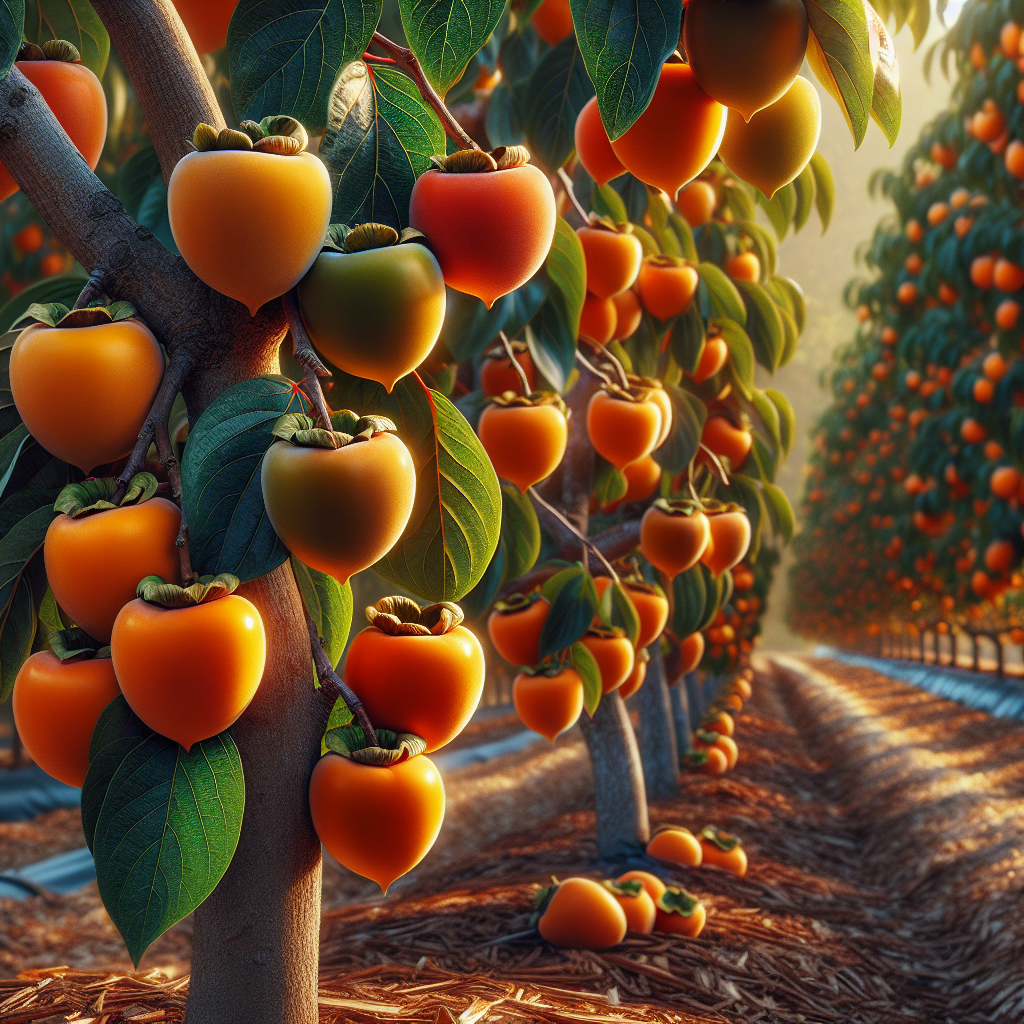
Introduction to Persimmon (Hachiya)
Astringent persimmons occupy a special place among late-season tree fruits, and 'Hachiya' is one of the most recognized cultivars in that group. Unlike non-astringent persimmons, this variety must be allowed to soften substantially before eating; if consumed too early, the high soluble tannin content causes an intense puckering sensation that makes the fruit nearly inedible. When properly ripened, however, the flesh transforms into a deep orange, jelly-like pulp with notes of apricot, date, brown sugar, and spice.
'Hachiya' originated within the long cultivation history of Japanese persimmons and became widely planted in Mediterranean and subtropical orchard regions because of its ornamental beauty, reliable bearing, and premium culinary quality. The tree is attractive throughout the year: glossy green leaves in spring and summer, orange-red autumn foliage, and striking orange fruit that often hangs after leaf drop. For growers, it offers both fresh-market and processing potential, especially for baking, drying, preserves, and pulp.
Commercially and in advanced home orchards, 'Hachiya' rewards patience rather than neglect. It is more forgiving than many stone fruits in regard to pruning complexity and disease pressure, but fruit quality is strongly affected by irrigation management, crop load, sun exposure, and harvest timing. Growers familiar with Persimmon (Fuyu) will recognize the shared species background, though the eating stage, texture, and handling requirements differ markedly.
Botanical Profile of Persimmon (Hachiya)
This cultivar belongs to the Ebenaceae family and the species Diospyros kaki, commonly called the Japanese or Asian persimmon. Trees are deciduous, medium-vigorous, and typically reach 15-25 feet (4.5-7.5 m) in height in managed plantings, though older specimens on vigorous rootstocks can exceed that if left unpruned. The natural canopy tends toward upright when young, broadening with age into a rounded to somewhat open crown.
The leaves are alternate, broadly elliptic, thick, and glossy, usually 4-7 inches long. Their substantial cuticle helps the species tolerate summer heat better than many thin-leaved temperate fruits. Flowers are usually borne on current season growth arising from one-year-old wood. Flowering occurs in spring after bud break, reducing frost vulnerability relative to very early-blooming fruits such as peach or apricot.
'Hachiya' fruit is large, elongated, and acorn- or heart-shaped, often 200-300 grams under good culture. The skin develops a bright orange to red-orange color at maturity. Flesh is highly astringent while firm because tannins remain in a soluble form. Full edible ripeness comes only after softening, when tannins polymerize and the mouth-drying sensation disappears.
Pollination behavior in Asian persimmons is somewhat variable by cultivar and orchard conditions. 'Hachiya' is commonly grown successfully as a single cultivar and can set fruit parthenocarpically, so a dedicated pollinizer is often unnecessary for home growers. However, pollination can influence seed development and in some cases fruit characteristics. Excess pollination in mixed orchards may lead to seeded fruit, which is not inherently negative but can alter market preference.
Root systems are relatively deep compared with shallow-rooted fruit crops, yet young trees establish slowly and dislike chronic waterlogging. The wood can be somewhat brittle under heavy crop loads, making branch angle training important in the first several years. Persimmons also exhibit a tendency toward alternate bearing if trees are allowed to overcrop one year and exhaust reserves.
Soil, pH, and Climate Requirements for Persimmon (Hachiya)
This tree performs best in deep, well-drained loam or sandy loam with moderate water-holding capacity. Ideal soil depth is at least 3 feet, allowing stable anchorage and access to subsoil moisture during dry periods. Although persimmons tolerate a range of soils better than many fruit trees, they are not well suited to heavy, compacted clay that stays saturated after rain or irrigation. In poorly drained ground, roots become oxygen-starved, feeder roots die back, and the tree responds with reduced shoot extension, pale foliage, premature leaf drop, and fruit shed.
A practical target soil pH is 6.0-7.0, though acceptable performance often occurs from about 5.8 to 7.5. At pH above 7.5, iron and manganese availability may decline, especially in calcareous soils, producing interveinal chlorosis on young leaves. If planting in alkaline ground, incorporate substantial organic matter before establishment and monitor leaf color closely. Foliar iron treatments may correct symptoms temporarily, but long-term performance depends on managing root-zone chemistry and drainage.
Climate preference is warm temperate to subtropical with a defined dormant season. 'Hachiya' generally performs well in USDA zones 7-10, though exact cold tolerance depends on rootstock, acclimation, and duration of freezing. Dormant wood can withstand moderate winter cold, but young trees are more vulnerable to sunscald and freeze injury. Spring frost is less threatening than for earlier-blooming crops, yet severe late frosts can still damage new shoots and flowers.
For fruit quality, the ideal site offers full sun, low frost-pocket risk, and enough summer warmth to develop sugars and color. A minimum of 6-8 hours of direct sunlight is necessary; 8-10 hours is preferable for consistent fruiting and stronger wood. In excessively shaded locations, trees become lanky, fruit set declines, and fruit coloration is poorer.
Rainfall patterns matter as much as total moisture. The species tolerates summer dry periods once established, but abrupt swings between drought and saturation can cause fruit drop, cracking, and erratic sizing. Soil should remain evenly moist but never swampy. In field terms, aim to keep the active root zone at roughly 60-80% of field capacity during the main fruit expansion period. If you squeeze a soil sample from 6-8 inches deep, it should feel cool and cohesive but not ooze water. Dust-dry, powdery soil at that depth indicates under-irrigation; a sour smell, sticky anaerobic texture, or standing water in planting basins suggests overwatering.
Wind exposure should also be considered. Moderate airflow reduces disease pressure, but strong winds can scar fruit, break laden limbs, and increase moisture stress. Windbreaks placed far enough away to avoid shading can be beneficial in exposed orchard sites. Broader soil management principles discussed in soil health strategies are especially useful for long-lived tree crops like persimmon.
Step-by-Step Planting & Propagation
Most growers should begin with a grafted nursery tree rather than attempting to raise named 'Hachiya' from seed. Seedlings do not come true to type, and fruit quality can vary dramatically. Commercial trees are usually grafted onto selected rootstocks that improve vigor, compatibility, and adaptation.
Choose a one-year or two-year grafted tree with a straight trunk, a visible healthy graft union, no bark wounds, and several well-spaced lateral branches if available. Bare-root planting is commonly done in late winter to early spring while trees are fully dormant; container-grown stock can also be planted in spring, avoiding periods of intense heat.
- Select the site carefully. Leave 15-20 feet between trees on moderate-vigor rootstocks, and more if minimal pruning is planned. Avoid low depressions where cold air settles or where rainwater pools.
- Prepare the soil several weeks ahead if possible. Remove perennial weeds in at least a 3-4 foot diameter circle. If the soil is compacted, loosen broadly rather than digging a narrow deep hole. Trees often stagnate when roots encounter a hard glazed planting-hole wall.
- Dig a hole only as deep as the root system and 2-3 times as wide. The finished planting depth should keep the graft union several inches above the final soil line.
- Inspect roots. Trim broken or girdling roots cleanly. Soak bare-root trees in water for 1-2 hours before planting, but not overnight.
- Plant with the root flare at or slightly above grade. Backfill with native soil unless the site is extremely poor; heavy amendment only inside the hole can discourage outward root exploration.
- Water deeply after planting to eliminate air pockets. Apply enough to wet the soil 12-18 inches deep.
- Mulch with 2-4 inches of wood chips or shredded bark over the root zone, keeping mulch 4-6 inches away from the trunk to prevent collar rot and rodent damage.
- Head the tree if necessary to balance top and root volume. For whip-like young trees, cut back to encourage scaffold development at the desired height.
Propagation by grafting is the professional standard. Common methods include whip-and-tongue grafting on dormant rootstock, cleft grafting, or budding in suitable climates. Hardwood cuttings are generally unreliable for maintaining commercial-quality trees, and seed propagation is mainly used to produce rootstocks.
If training from planting, establish 3-5 primary scaffolds with wide crotch angles of roughly 45-60 degrees. Narrow angles are structurally weak and more likely to split under heavy fruit loads later. Temporary limb spreaders or tying can greatly improve branch architecture in years one and two.
Care & Maintenance regimes for Persimmon (Hachiya)
The first three years determine long-term productivity. Young trees need regular irrigation because their root systems are limited and the species can establish more slowly than growers expect. During the first growing season, water deeply once or twice weekly depending on soil texture and weather. Sandy soils may require smaller, more frequent irrigations; loam soils generally benefit from deeper, less frequent watering. The goal is to moisten the root zone to 12-24 inches and then allow the upper inch or two to dry slightly before the next irrigation.
A useful moisture check is to probe the soil near the dripline. If the top 3 inches are dry but soil at 6 inches is still cool and lightly moist, irrigation timing is usually appropriate. If leaves droop by midday and remain limp into evening, fruitlets drop, or terminal shoots stop elongating during warm weather, the tree may be under moisture stress. By contrast, overwatered trees often show yellowing leaves, soft rank growth, poor leaf gloss, and in severe cases blackened feeder roots and sudden fruit shed.
Once established, mature trees typically need less frequent but still deliberate watering. In dry summer climates, a mature bearing tree often benefits from deep irrigation every 10-21 days depending on soil type, canopy size, and temperature. Avoid severe water deficit from flowering through final fruit swell. Consistency improves size, reduces premature drop, and supports return bloom.
Fertilization should be moderate. Excess nitrogen stimulates vegetative growth, delays fruit maturity, and can increase susceptibility to breakage and some pests. In fertile soils, young trees may need little or no fertilizer in the planting year beyond compost mulch. From year two onward, apply nitrogen conservatively in early spring if shoot growth is weak. As a rough benchmark, nonbearing young trees often perform well with the equivalent of 0.1-0.25 pounds of actual nitrogen per year of tree age, split if necessary, while mature trees are adjusted according to leaf analysis and vigor. Annual shoot extension of about 12-18 inches on bearing wood is usually sufficient; much more may indicate overfeeding.
Persimmons are commonly trained to a modified central leader or open vase, depending on orchard system and labor preference. Pruning is lighter than in peaches. Focus on removing dead wood, crossing limbs, weak pendant growth, watersprouts, and overly crowded interior shoots. Because fruit forms on current season growth from one-year-old shoots, overly aggressive pruning can reduce the crop. Winter pruning shapes structure; light summer pruning may be used to improve light penetration in dense canopies.
Fruit thinning is often overlooked but important for 'Hachiya'. Trees can set heavily, and overloaded branches produce smaller fruit, more limb damage, and increased alternate bearing. Thin shortly after natural fruit drop, leaving adequate spacing so fruit do not cluster tightly. Support or prop heavily laden limbs before autumn if branch angles are poor.
Weed control should extend at least to the dripline in young orchards. Turfgrass competing directly under the canopy reduces early growth substantially. Mulch, shallow cultivation, and organic sheet mulching are effective. Avoid repeated trunk injury from string trimmers.
Pests, Diseases & Organic Management
'Hachiya' is relatively resilient, but not trouble-free. The best organic management strategy is preventive: full sun, strong airflow, clean sanitation, and balanced nutrition. Stressed trees attract more problems than well-managed trees.
Common insect issues vary by region. Scale insects may colonize twigs and leaves, causing sticky honeydew and Sooty mold. Mealybugs can appear in sheltered canopies. Aphids sometimes infest tender spring growth, though they rarely cause major yield loss unless populations surge. In some areas, Stink bugs and Leaf-footed bugs are among the most serious fruit pests because they pierce developing fruit, causing dimpling, corky patches, premature drop, or internal damage.
Organic control begins with monitoring. Inspect the underside of leaves, young shoots, and fruit clusters every 7-14 days during active growth. Encourage beneficial insects by maintaining floral diversity nearby, especially with Yarrow and Clover, which provide habitat and nectar resources. Dormant horticultural oil can suppress overwintering scale and mite eggs when applied during full dormancy under appropriate temperatures. In-season insecticidal soap or neem-based products may help against soft-bodied pests, but coverage must be thorough and sprays should be timed to avoid pollinator activity.
Wildlife can be more damaging than insects. Birds often peck ripening fruit, and raccoons, opossums, and deer may feed heavily as sugar levels rise in autumn. Netting, trunk guards, fencing, and prompt harvest are often necessary in high-pressure areas.
Disease pressure is usually moderate compared with many orchard crops, but several problems deserve attention. Anthracnose can mark leaves and fruit, particularly in wet weather. Cercospora and other leaf spots may cause premature defoliation if the canopy stays dense and humid. Crown or root rots develop in chronically waterlogged soil. Botrytis and secondary fruit rots can affect damaged or overripe fruit in storage.
Sanitation is essential. Remove mummified fruit, rake and compost or dispose of heavily diseased leaves, and prune for light penetration. Never allow irrigation to keep the trunk base constantly wet. If fungal pressure is recurrent, organic copper products may be used preventively according to label directions, especially around leaf fall and early spring, but they work best as part of an integrated program rather than as a rescue treatment.
Physiological disorders are also common. Fruit drop can result from overcropping, irregular irrigation, excess nitrogen, poor pollination conditions, or sudden weather stress. Calyx separation, cracking, and sunburn are more likely when trees move abruptly from dry to wet conditions or when fruit are exposed after severe pruning.
Harvesting, Curing & Optimal Storage
Harvest timing is the decisive skill with 'Hachiya'. Fruit should be physiologically mature before picking, usually when full size has been reached and skin color has turned from greenish-orange to a uniform bright orange or orange-red. However, physiological maturity is not the same as eating ripeness. The fruit may be harvestable while still firm, but it will remain astringent until softened.
Use hand clippers to harvest, leaving the calyx attached and a short stem stub intact. Pulling fruit by hand can tear skin near the shoulder and shorten storage life. Handle carefully; even firm fruit bruise more easily than apples or pears. Harvest is often staggered over several pickings as fruit color develops.
For immediate fresh use, allow the fruit to soften at room temperature until it feels like a very ripe tomato or water balloon. At that point, soluble tannins have largely lost their astringency and the pulp is ready for spoon eating or baking. If faster deastringency is desired, keep fruit in a paper bag with a ripe banana or apple to increase ethylene exposure. Commercial curing methods may use controlled carbon dioxide or alcohol vapor, but for most growers simple ambient ripening is sufficient.
Storage strategy depends on ripeness stage. Mature but still firm fruit can often be held for a short period under cool conditions, roughly 32-40°F (0-4°C) with high relative humidity around 85-90%, though chilling sensitivity and quality loss vary with maturity. Once fully soft, storage life becomes short, often only a few days under refrigeration. Overripe fruit develop skin translucency, leakage, fermented aromas, or mold at cracks and should be processed immediately.
For processing, fully ripe pulp can be scooped, strained if desired, and frozen in measured portions. This is one of the best ways to preserve surplus 'Hachiya'. The cultivar is also excellent for drying once partially deastringed and peeled, producing a concentrated sweetness similar to dates. In traditional methods, whole peeled fruit are hung and massaged during drying to produce a dense, confection-like texture.
Yield depends on age, pruning, and environment, but mature trees under good management can be highly productive. Do not let fruit hang too long into repeated freeze-thaw cycles, as texture declines quickly after hard frost injury.
Companion Planting for Persimmon (Hachiya)
The most useful companion strategy for this tree is not crowding it with heavy-feeding annuals, but creating a biologically active orchard floor that supports pollinators, predatory insects, and stable soil structure. The root zone should remain low-competition during establishment, so keep companion plants outside the immediate trunk area for the first 1-2 years.
Low-growing nitrogen-fixing groundcovers such as Clover can be established in alleyways or at the outer dripline, where they reduce erosion, improve infiltration, and contribute organic matter through mowing and decomposition. Thyme works well in dry, sunny orchard margins because it attracts beneficial insects while staying relatively low and noncompetitive. Yarrow is especially valuable as an insectary plant, drawing hoverflies and parasitic wasps that help regulate Aphids and other soft-bodied pests. Nasturtium can serve as a seasonal trap and pollinator plant in mixed plantings, though it should not be allowed to smother young trunks.
Avoid planting vigorous grasses or thirsty vegetable crops directly under the canopy where they compete for summer moisture. Also avoid dense companion vegetation right against the trunk, as it increases humidity and rodent shelter. In professional orchards, the best system is often a clean mulched basin around the tree with managed flowering strips beyond that zone.
When properly designed, companion planting around persimmon is less about boosting yield through folklore and more about habitat engineering: reducing bare soil, improving infiltration, supporting beneficial insects, and lowering maintenance pressure over the life of the orchard.