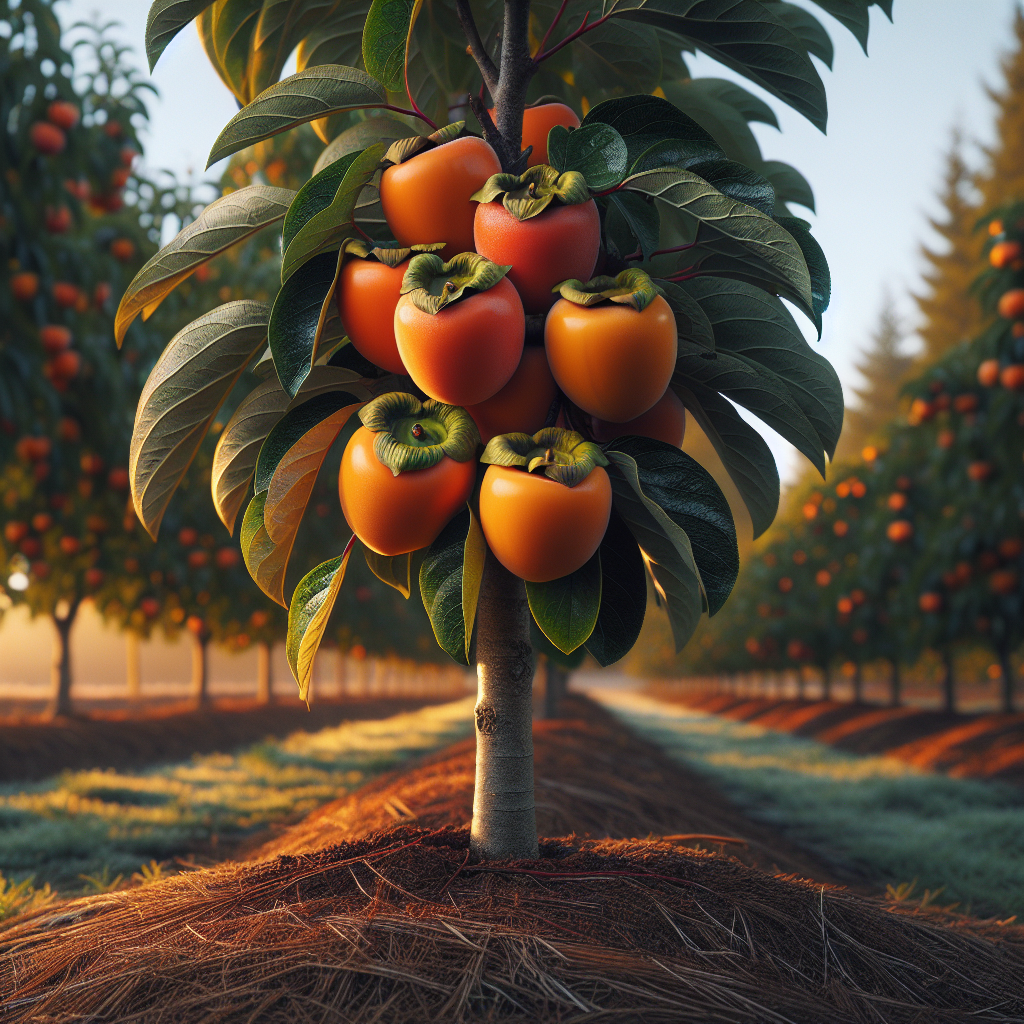
Introduction to Persimmon (Fuyu)
Originating from East Asia and widely refined in Japanese horticulture, Fuyu is one of the best-known non-astringent persimmon types in commercial and backyard production. Its fruit is typically squat, tomato-shaped, orange to deep orange at maturity, and notable because it can be eaten firm, unlike astringent cultivars that must soften fully before becoming palatable. That single characteristic has made it especially important in fresh-market production, where shelf life, transportability, and consumer convenience matter.
Fuyu trees are valued not only for fruit quality but also for ornamental merit. They have glossy summer foliage, often excellent autumn color, and dramatic fruit display after leaf drop. In the orchard, however, they should be treated as a serious fruit crop rather than a decorative tree. Yield consistency, fruit size, skin finish, and branch strength all depend on disciplined cultural practices.
In comparison with the elongated, soft-ripening Persimmon (Hachiya), Fuyu is better suited to growers who want a dual-use fruit: crisp when freshly colored, or softer and richer after additional ripening. Commercially, that flexibility allows multiple harvest windows. For diversified orchards, it can fit into a late-season marketing niche after many stone fruits are finished and before winter citrus peaks.
Historically, Asian persimmons spread from China into Korea and Japan, where cultivar selection became highly sophisticated. Fuyu emerged as a landmark pollination-constant non-astringent type. In practical terms, that means the fruit generally loses astringency on the tree as it matures, independent of seed formation, though local climate and crop load can still influence eating quality. For growers, Fuyu offers a blend of consumer-friendly flavor and manageable orchard performance, especially in warm temperate regions with dry autumn weather.
Botanical Profile of Persimmon (Fuyu)
Fuyu belongs to the Ebenaceae, the ebony family, and is botanically classified as Diospyros kaki. Trees are typically deciduous, medium-sized, and moderately vigorous, reaching roughly 12 to 20 feet tall in managed orchard systems, though older, unpruned trees can grow larger. The growth habit is naturally rounded to somewhat spreading, with brittle wood under heavy fruit load if not trained correctly.
Leaves are alternate, broad, leathery, and dark green, often with a slight sheen. The root system is relatively deep when established, but young trees can be slow to anchor and resent root disturbance. This is one reason container-grown trees should be handled gently at transplanting and why bare-root planting must be timed carefully.
Flowers are usually borne on current season growth arising from one-year-old wood. Depending on rootstock and clone source, many Fuyu plantings produce predominantly female flowers and can set fruit without pollination, though occasional male flowers may occur in some persimmon types. Parthenocarpic fruit set is common enough that a pollinizer is not generally required for home production. Still, seed presence can alter fruit shape, flesh color around the seed, and sometimes flavor complexity.
Fruit is technically a berry. Fuyu fruit is flattened to oblate, usually 150 to 250 grams under good management, with glossy orange skin and firm orange flesh. High-quality fruit should be sweet, mild, and low in tannic bite at harvest maturity. Fruiting occurs on relatively short laterals, and trees often overbear once mature, producing many small fruit unless thinning or good fertility balance is maintained.
A notable physiological trait is calyx persistence. The leafy calyx remains attached at harvest and serves as a useful visual indicator of fruit health. A fresh, green to olive calyx usually suggests less dehydration and better postharvest quality. If the calyx is shriveled or blackened before harvest, investigate water stress, disease, or delayed picking.
Rootstocks vary by region. D. kaki seedlings are used in some areas, while D. lotus and D. virginiana may be used where soil adaptation or cold tolerance is desired. Rootstock affects vigor, anchorage, calcareous soil tolerance, and compatibility, so commercial growers should source trees from reputable nurseries that specify rootstock identity.
Soil, pH, and Climate Requirements for Persimmon (Fuyu)
Fuyu performs best in deep, well-drained loam to sandy loam with moderate water-holding capacity. Ideal soil depth is at least 3 to 4 feet for unrestricted rooting. Heavy clay is not automatically disqualifying, but internal drainage must be improved because persimmons strongly dislike prolonged root-zone saturation. If water stands longer than 24 hours after a soaking rain, the site is marginal unless berms, drains, or raised rows are installed.
Optimal soil pH is about 6.0 to 7.0, with acceptable performance extending slightly outside that range if nutrient management is adjusted. At pH above 7.5, iron and manganese can become less available, and young leaves may show interveinal chlorosis. At pH below about 5.5, root growth can slow and nutrient imbalances become more likely. A pre-plant soil test is essential. If pH is too low, incorporate finely ground agricultural lime months ahead of planting. If too high, elemental sulfur may help, but correction in alkaline soils is slow, so rootstock choice and organic matter management become more important.
Organic matter around 3% to 5% is ideal for balancing moisture retention and aeration. Excessively rich soils with high nitrogen mineralization can push lush vegetative growth at the expense of fruiting and winter hardiness. The goal is steady, moderate growth, not overly vigorous watersprouts.
Climatically, Fuyu is best adapted to warm temperate and subtropical-margin conditions. It thrives where summers are warm, autumns are mild and relatively dry, and winters provide enough chill for normal dormancy without severe deep freezes. Mature trees can tolerate moderate cold, but young trees are more vulnerable to trunk injury and scaffold damage. Spring frost can damage emerging shoots and flowers, although persimmon generally blooms later than peaches and some other fruit trees, offering a degree of frost avoidance.
A practical target is full sun, at least 8 hours daily. Light drives sugar accumulation, orange coloration, and strong flower bud development for the following year. Shade reduces fruit sweetness and increases lanky growth. Good air movement also matters because still, humid canopies increase leaf spot pressure and prolong surface moisture on fruit.
Rainfall during harvest season is a major quality issue. Persistent autumn rain can cause skin cracking, surface blemishes, and softer fruit with reduced storage life. In wet regions, choose the sunniest, best-drained slope available. South- or southwest-facing sites are often best in cooler climates, while hot inland sites may benefit from slight afternoon moderation.
For broader orchard planning and fertility strategy, see soil health tips.
Step-by-Step Planting & Propagation
Choose a planting site before you choose the tree. Prioritize drainage, full sun, air movement, and enough space for a mature canopy. Standard spacing is commonly 15 to 20 feet between trees and 18 to 20 feet between rows, though high-density systems can go tighter if summer pruning and vigor control are consistent.
Plant dormant bare-root trees in late winter to early spring in temperate regions, before bud break. Container trees can be planted in spring or early autumn where winters are mild, but avoid extreme summer heat because fresh transplants lose water faster than their recovering roots can supply it.
Test the soil 3 to 6 months ahead. Correct pH and major nutrient imbalances before planting. Avoid adding high-nitrogen fertilizers into the planting hole.
Prepare the site, not just the hole. Remove perennial weeds in at least a 3-foot diameter circle. If drainage is marginal, create a raised planting mound 8 to 18 inches high and 3 to 5 feet wide.
Dig a broad hole. Make it 2 to 3 times wider than the root spread but no deeper than the original root depth. A deep hole encourages settling and crown burial, which can suffocate roots.
Set the tree correctly. Spread bare roots naturally. Keep the graft union 2 to 4 inches above the final soil line. On container trees, tease out circling roots only if they are severe; do not shred the root ball.
Backfill with native soil. Avoid creating a pot effect with overly amended backfill. Water thoroughly during backfilling to settle soil around roots and eliminate large air pockets.
Irrigate deeply after planting. Apply enough water to moisten the root zone 12 to 18 inches deep. For many soils this means 5 to 10 gallons immediately after planting, then repeated according to weather and drainage.
Mulch properly. Apply 2 to 4 inches of coarse organic mulch over the root zone, keeping it 4 to 6 inches away from the trunk. This conserves moisture, buffers soil temperature, and reduces weed competition.
Head the tree if needed. Whip trees are often headed back to 30 to 40 inches to force scaffold development. Feathered trees may need selective scaffold retention instead.
Propagation for true-to-type Fuyu is almost always by grafting or budding, not seed. Seedlings are genetically variable and may produce inferior or astringent fruit. Bench grafting, whip-and-tongue, cleft grafting, and T-budding onto compatible rootstocks are standard nursery practices. Hardwood cuttings are generally unreliable for commercial propagation.
If establishing an orchard, stake young trees only where wind is a serious issue. Over-staking can produce weak trunks. Use a flexible tie and remove supports once the tree is stable.
Care & Maintenance regimes for Persimmon (Fuyu)
Water management is one of the most important factors in Fuyu quality. Young trees need consistent moisture while roots establish. Mature trees are fairly drought tolerant, but fruit size, sugar accumulation, and next year’s flower bud formation all decline under severe moisture stress.
Aim for evenly moist, never waterlogged soil. In practical terms, the top 2 to 3 inches may dry slightly between irrigations, but soil at 6 to 12 inches should remain lightly moist during active growth. A simple field test is to squeeze soil from 6 inches deep. It should hold together loosely, not ooze water and not crumble into dust. During the first year, many growers irrigate once or twice weekly depending on soil type and heat. Sandy soils may need smaller, more frequent irrigations; loams may need a deep soak every 5 to 10 days. Mature orchard trees often perform well with deep irrigation every 10 to 14 days in dry weather, adjusted for evapotranspiration and crop load.
Signs of underwatering include dull leaves, marginal leaf scorch, premature fruit drop, reduced fruit size, and hard soil that pulls away from the basin edge. Signs of overwatering include persistent yellowing, soft weak shoot growth, leaf drop without wilting, sour-smelling soil, algae at the basin surface, and fruit splitting or bland flavor. Chronic saturation predisposes roots to Phytophthora and other decline problems.
Fertilization should be modest. Excess nitrogen is a common mistake and causes rampant shoot growth, delayed fruit maturity, and weaker fruiting wood. Young trees may receive a light spring application of a balanced fertilizer or composted manure, but only after growth begins. Mature trees often need just enough nitrogen to support 12 to 18 inches of annual terminal extension on non-bearing scaffolds and less on heavily cropping trees. If shoots exceed 24 inches broadly across the canopy, reduce nitrogen. If growth is under 6 inches and leaves are pale, investigate nutrition and root health.
A typical orchard program may include early spring nitrogen, with potassium added based on soil and leaf analysis. Calcium is important for fruit quality indirectly through overall tree health, though foliar calcium response in persimmon is less dramatic than in apples. Micronutrient sprays may be warranted in alkaline soils.
Pruning should focus on structure, light distribution, and crop load balance. Open center and modified central leader systems both work, but many growers favor a low, strong scaffold framework because fruit can be heavy and wood brittle. In the first 3 years, select 3 to 5 wide-angled scaffolds spaced vertically and radially. Remove narrow crotches early.
Once bearing begins, prune lightly but annually. Remove dead, crossing, shaded, and overly vigorous upright shoots. Thin congested fruiting wood to allow sunlight into the canopy. Heavy winter pruning can stimulate excessive vegetative regrowth, so balance dormant pruning with summer pinching if vigor is too high.
Fruit thinning is often beneficial. If clusters or adjacent fruits are too dense, remove extras when fruit are marble- to walnut-sized, keeping one fruit per shoot at close spacing or allowing more where shoots are strong and well lit. Thinning improves size, color, and branch safety. Branch breakage is a real risk in overloaded Fuyu trees.
Weed control should maintain a vegetation-free strip under the canopy, especially for the first 3 to 5 years. Grass competition can greatly reduce establishment. Mulch, shallow cultivation, and organic sheet mulches are effective, but avoid trunk contact and vole habitat buildup.
Sunburn and trunk injury can affect young trees. White tree guards or diluted white interior latex paint on the trunk can reduce southwest injury in hot-sun, cold-night climates.
Pests, Diseases & Organic Management
Fuyu is relatively resilient compared with some tree fruits, but it is not pest-free. The main strategy is prevention through sanitation, airflow, balanced fertility, and timely monitoring.
Scale insects may colonize twigs and branches, weakening trees and leading to sticky honeydew or sooty mold in mixed infestations. Dormant oil sprays, applied during true dormancy with temperatures safely above freezing, can suppress overwintering populations. Ensure full coverage of bark crevices.
Mealybugs and Aphids can appear on soft new growth, especially where nitrogen is excessive. Strong water sprays, release of beneficial insects, and avoidance of lush overfertilization help keep them under control.
Fruit flies and Stink bugs are serious in some regions. Stink bug feeding can distort fruit and create corky spots. Fine-mesh exclusion, orchard sanitation, and edge-habitat monitoring are useful non-chemical tools. Fallen fruit should be removed promptly because it can attract secondary pests and harbor disease inoculum.
Bird damage increases sharply as fruit colors. Netting is often the most reliable protection for small orchards. In larger plantings, combine visual deterrents with prompt harvest rather than relying on scare tactics alone.
Crown and root rots, especially Phytophthora, are the most dangerous problems in poorly drained sites. Symptoms include sparse canopy, small chlorotic leaves, branch dieback, and poor response to fertilization. Prevention is the only dependable organic strategy: excellent drainage, cautious irrigation, raised beds where necessary, and disease-free nursery stock.
Leaf spot diseases may cause spotting and premature defoliation in humid climates. Sanitation matters. Remove heavily infected fallen leaves, improve canopy airflow, and avoid overhead irrigation late in the day. Copper-based sprays may be used preventively in some organic programs, but always avoid unnecessary applications and follow local regulations.
Anthracnose and fruit rots can blemish fruit in wet weather. Pruning for light penetration, removing mummified fruit, and harvesting promptly once mature are key cultural controls.
Vertebrate pests should not be overlooked. Deer browse young shoots, rabbits can girdle trunks, and gophers or voles may damage roots. Physical barriers are often essential in the establishment phase.
Companion habitat can support beneficial insects. Flowering strips using Yarrow, Thyme, and Clover near but not directly against the trunk zone can improve pollinator and predator presence while also moderating erosion and weed pressure.
Harvesting, Curing & Optimal Storage
Fuyu should be harvested when the ground color has turned from greenish to orange and the fruit has reached near-full size, but while still firm if intended for storage or shipping. Unlike astringent persimmons, waiting for softness is not required for edibility. In fact, many consumers prefer the crisp stage.
Harvest by clipping fruit with pruners, leaving the calyx attached and a very short stem. Pulling by hand can tear the skin around the shoulder and reduce storage life. Handle gently; despite firm flesh, the skin bruises more easily than it appears.
Maturity indicators include full cultivar color, developed sweetness, and reduced background green around the calyx. Taste sampling matters because external color can develop ahead of full flavor in some climates. Fruit from overloaded trees may color before sugars rise adequately.
Fuyu does not require curing in the same way as onions or winter squash, but a short conditioning period at cool room temperature can improve eating quality if harvested slightly early. Avoid stacking fruit deeply during this period. Single-layer trays or shallow crates are preferable.
For storage, keep fruit cool and moderately humid. Ideal storage is around 32 to 40°F (0 to 4°C) with relative humidity near 85% to 90%. Too little humidity leads to shriveling; too much free moisture encourages decay. Firm fruit can keep for several weeks under good conditions, while softer fruit should be consumed quickly.
Do not store damaged, cracked, or overripe fruit with sound fruit. Sort carefully. Fruit intended for market should be graded for size, skin finish, color, and absence of shoulder cracks or pest injury.
If a softer texture is desired, allow fruit to ripen at room temperature for several days after harvest. Ethylene from apples or bananas can accelerate softening, but monitor closely because over-soft fruit becomes delicate and short-lived. For comparison in postharvest handling of late-season fruit crops, growers managing mixed orchards often adapt methods from Apple packing and humidity control systems.
Companion Planting for Persimmon (Fuyu)
Companion planting around a persimmon orchard should support soil health, beneficial insects, and weed suppression without creating excessive root competition directly at the trunk. The most effective design is usually zoned: a mulch ring around the tree base, then a managed understory or alley planting outside that ring.
Clover is one of the best understory companions. It suppresses weeds, helps protect soil from erosion, supports pollinators when flowering, and contributes nitrogen biologically over time. Keep it mowed or trimmed so it does not compete too aggressively with young trees, and maintain a vegetation-free band immediately around the trunk.
Thyme works well on drier, sunny orchard margins or berm edges. Its low habit reduces mowing burden, its flowers attract beneficial insects, and it tolerates leaner soils. It is especially useful where you want living groundcover without a tall canopy that traps humidity.
Yarrow is valuable in insectary strips because its umbels attract parasitic wasps, hoverflies, and other predators that help regulate soft-bodied pests. Place it near row edges or between orchard blocks rather than directly in the wetted irrigation zone of newly planted trees.
Nasturtium can be used seasonally in home orchards as a sacrificial companion and pollinator attractor, though in commercial plantings it is less commonly relied on as a core understory species. It is most useful where visual monitoring and hand management are feasible.
Avoid highly competitive perennial grasses close to young trees, and avoid companions that require frequent deep cultivation within the root zone. Persimmon roots dislike repeated disturbance. The best companion strategy is one that improves biological diversity while preserving tree dominance over water and nutrients.