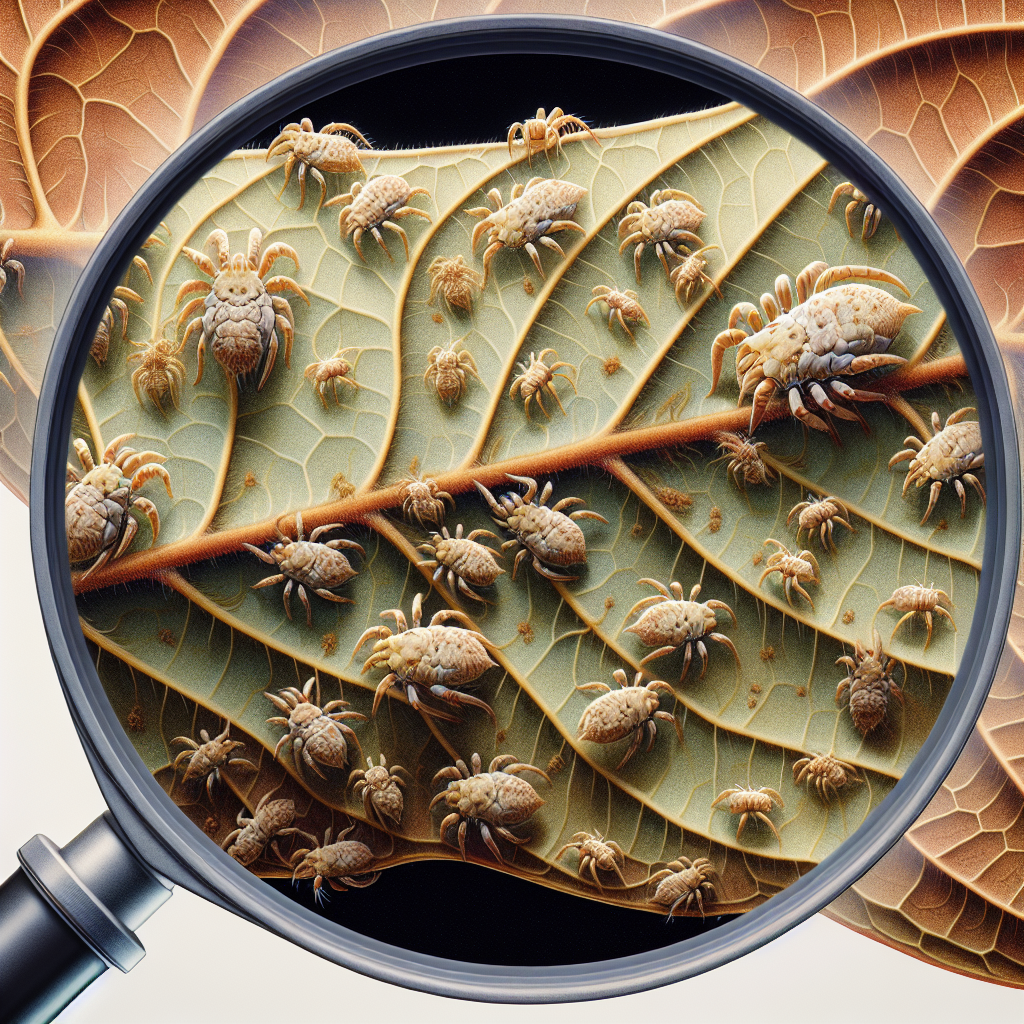
Introduction to Persea mite
The Persea mite, scientifically known as Oligonychus perseae, is a tiny eriophyid mite that poses a significant threat to avocado production worldwide, particularly in regions like California, Mexico, and parts of South America. First identified in California avocado orchards in 1990, this pest rapidly spread due to its high reproductive rate and ability to thrive in warm, dry conditions. Unlike more visible pests like aphids or spider mites, Persea mites are nearly invisible to the naked eye, measuring just 0.5 mm in length with a worm-like body and two pairs of legs.
These mites feed on the undersides of avocado leaves, extracting chlorophyll and causing characteristic bronzing that reduces photosynthesis. Heavy infestations can lead to premature leaf drop, weakening trees and slashing fruit yields by up to 70% in severe cases. Avocado growers must prioritize vigilant scouting and integrated pest management (IPM) strategies to combat this pest, as it develops resistance to some chemical controls. For small farms, early intervention with organic methods is crucial to avoid costly losses. Learn more about Spring Pest Patrol: Organic AI Strategies to Shield Your Crops from Common Invaders for proactive defense tips.
Understanding the Persea mite's biology is key to effective control. Females overwinter in protected leaf crevices, resuming activity in spring when temperatures rise above 60°F (15°C). A single female can produce hundreds of offspring, leading to explosive population growth during summer. This guide provides comprehensive diagnostics, lifecycle insights, and proven management plans tailored for avocado producers.
Identifying Symptoms & Damage
Persea mite damage is often mistaken for nutrient deficiencies or environmental stress, making accurate diagnosis essential. The primary symptom is bronzing or russeting on the upper leaf surface, appearing as reddish-brown patches that start near the leaf tip and midrib. Undersides show yellow stippling where mites have fed, often accompanied by fine webbing in advanced stages—though less webbing than spider mites.
Examine leaves with a 10x-20x hand lens: active infestations reveal pale, cigar-shaped mites crawling on veins. Damage progresses from older leaves outward; severe cases cause leaf curl, necrosis, and defoliation, exposing fruit to sunburn. Trees may exhibit twig dieback and reduced vigor, with yield losses correlating to 20-30% defoliation thresholds.
Differentiate from look-alikes: Phytophthora causes dark lesions with gummosis, while drought stress shows uniform yellowing without stippling. Tap infested leaves over white paper; mites appear as tiny moving specks. Monitor Hass Avocado trees closely, as they are highly susceptible. Early detection via weekly scouting prevents escalation—check 20 leaves per tree from multiple canopy levels.
Economic impact is profound: in California's $3 billion avocado industry, Persea mites cause millions in annual losses through reduced fruit size and quality. Defoliated trees produce smaller, thinner-skinned avocados prone to post-harvest disorders.
Lifecycle and Progression of Persea mite
Persea mites complete their lifecycle in 8-14 days under optimal conditions (75-85°F, low humidity), allowing 10-15 generations per year. Adults are 0.3-0.5 mm long, lemon-yellow to reddish-orange, with females larger and more abundant. Eggs are translucent, laid singly on leaf undersides along veins.
Lifecycle stages: Eggs hatch in 2-4 days into larvae (6-legged), progressing to protonymphs and deutonymphs (8-legged), then adults. All stages feed voraciously; nymphs cause most damage. Populations peak in late spring/early summer, declining in fall with cooler weather. Overwintering females enter diapause in leaf folds or bark crevices.
Progression: Light infestations (<5 mites/leaf) cause minor stippling; moderate (5-20 mites/leaf) lead to bronzing; heavy (>20 mites/leaf) trigger defoliation within weeks. Dispersal occurs via wind or on infested nursery stock. Predators like mites (e.g., Euseius tularensis) and six-spotted thrips provide natural control, but broad-spectrum sprays disrupt them.
Timing interventions to target eggs/nymphs maximizes efficacy. Track degree-days (base 55°F) for population forecasts: first generation peaks at 300-400 DD.
Environmental Triggers & Risk Factors
Persea mites flourish in hot, dry climates with temperatures 70-95°F and humidity below 50%. Dusty conditions from wind or poor irrigation exacerbate outbreaks by stressing trees and aiding mite dispersal. Over-fertilization with nitrogen promotes lush growth, ideal for mite feeding.
Risk factors include:
- Susceptible varieties: Hass Avocado and Fuerte Avocado are most vulnerable; Mexican seedlings resist better.
- Tree stress: Drought, poor drainage, or root issues from root rot weaken defenses.
- Proximity to infested groves: Wind spreads mites rapidly.
- Irrigation deficits: Low humidity favors mites over predators.
Avoid overhead watering, which boosts humidity and predators. Monitor during El Niño droughts or heatwaves. Young trees (<5 years) and interior canopies are hotspots.
Organic Control & Treatment Plans
Organic management emphasizes IPM: monitoring, cultural controls, and targeted treatments. Avoid synthetic miticides to preserve beneficials.
1. Monitoring: Scout weekly with hand lens; treat at 5-10 mites/leaf.
2. Cultural Controls:
- Increase irrigation to 100% ETc, maintaining soil moisture.
- Apply micronutrient sprays (zinc, manganese) to boost tree vigor.
- Prune dense canopies for better spray penetration.
3. Organic Treatments:
- Wettable sulfur: 5-10 lbs/acre, 70% formulation; apply when temps <90°F. Two applications 7-10 days apart.
- Neem oil: 1-2% solution; smothers eggs/nymphs.
- Insecticidal soap: Potassium salts at 2% weekly.
- Oils: Narrow-range horticultural oil at 1-2 gal/acre.
Biological Controls: Release predatory mites (e.g., Galendromus helveolus) at 1:10 pest:predator ratio. Conserve thrips and lacewings.
Treatment Plan:
- Early season: Preventive sulfur at bud break.
- Peak infestation: Soap + oil rotation, 7-day intervals.
- Post-treatment: Scout 3x/week; reapply if >5 mites/leaf.
Efficacy: Sulfur achieves 90% control; combine with irrigation for 95% reduction. Rotate modes of action to prevent resistance.
Preventing Persea mite in the Future
Prevention hinges on grove hygiene and resilience-building. Inspect nursery stock; quarantine new plantings. Plant resistant rootstocks like Dusa or VC 801.
Long-term Strategies:
- Irrigation optimization: Drip systems to avoid dust/wet foliage.
- Cover crops: Clover suppresses dust, supports predators.
- Nutrient balance: Avoid excess N; foliar Zn/Mn quarterly.
- Sanitation: Remove fallen leaves; shred debris.
- Monitoring tech: Sticky traps and degree-day models.
Annual plan: Pre-spring sulfur, mid-summer oils, fall cleanup. Build biodiversity with yarrow and nasturtium borders to attract predators. Resistant cultivars like GEM reduce risk by 50%.
Crops Most Affected by Persea mite
Persea mites primarily target avocado (Persea americana), with over 90% of damage on commercial cultivars. Hass Avocado suffers most due to thin leaves; Fuerte Avocado follows. Rare reports on guava (Psidium guajava) and other laurels, but avocados account for all economic impact. No significant effects on mango, citrus, or ornamentals. Focus protection on avocado groves; diversified farms interplant with non-hosts like tomato to disrupt cycles.