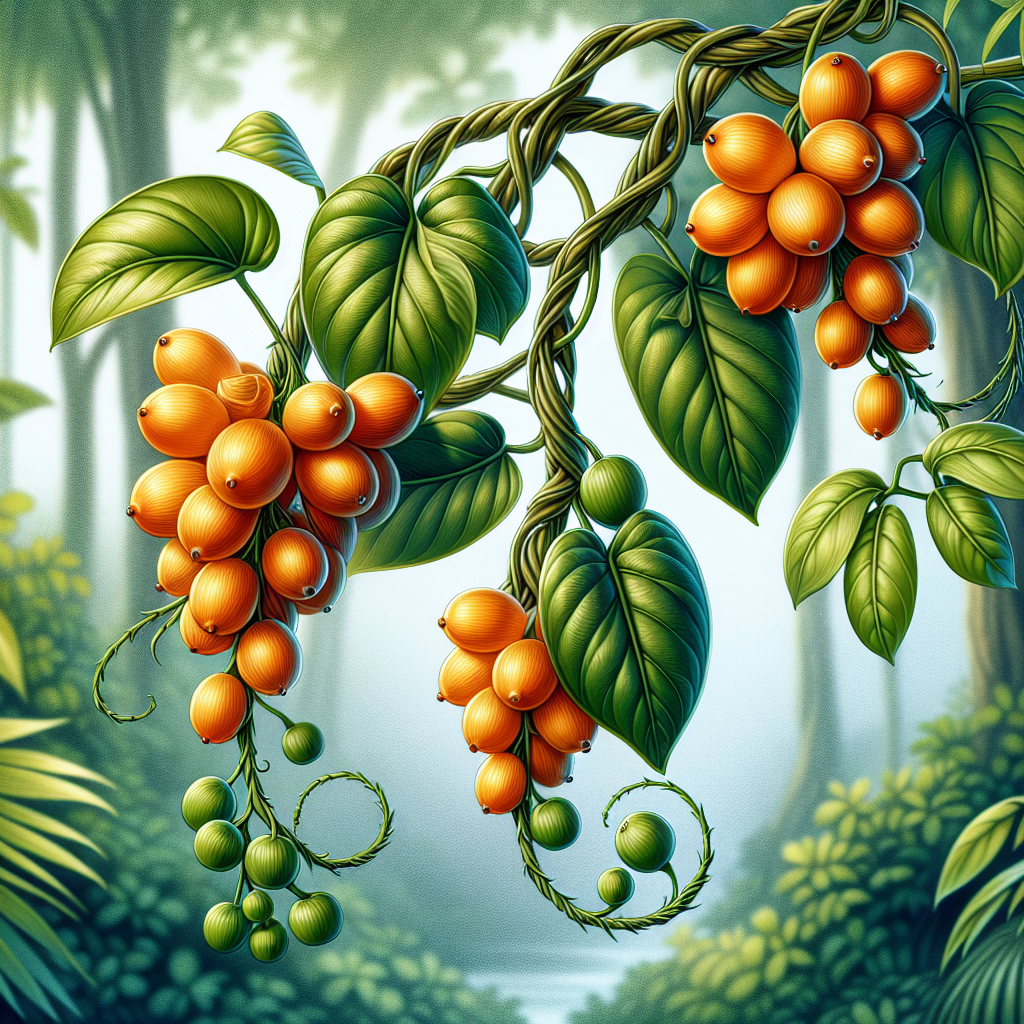
Introduction to Natal Orange (Strychnos madagascariensis)
Natal Orange, scientifically known as Strychnos madagascariensis, is a captivating tropical vine originating from the island of Madagascar and parts of mainland Africa. Often mistaken for a citrus due to its vibrant orange fruits, this member of the Loganiaceae family produces round, glossy berries that dangle enticingly from its twisting lianas, reaching lengths of up to 30 meters in the wild. Though the fruits contain potent alkaloids like strychnine and brucine—rendering them highly toxic and unsuitable for consumption—the plant holds immense value in sustainable agriculture, agroforestry, and ornamental landscaping.
In cultivation, Natal Orange thrives as a vigorous climber, providing excellent ground cover, erosion control on slopes, and habitat for pollinators and wildlife. Farmers and botanists appreciate its resilience to drought and poor soils, making it ideal for reclaiming degraded lands or integrating into orange orchards as a living trellis. This comprehensive guide draws from ethnobotanical knowledge, field trials in tropical zones, and modern horticultural research to equip growers with professional-grade techniques for propagation, maintenance, and management. Whether you're establishing a permaculture system, restoring biodiversity, or experimenting with exotic vines, mastering Natal Orange unlocks ecological and aesthetic rewards. Expect first fruits in 3-5 years from seed, with mature vines yielding hundreds of berries annually under optimal conditions.
Botanical Profile of Natal Orange (Strychnos madagascariensis)
Strychnos madagascariensis is an evergreen to semi-deciduous liana classified in the Strychnos genus, closely related to the infamous strychnine tree (Strychnos nux-vomica). It features smooth, grayish bark on rope-like stems that twist and branch profusely, supporting opposite, elliptical leaves (5-12 cm long) with prominent veins and a glossy green hue. Flowers emerge in loose axillary cymes during the wet season, presenting as small, white to cream-colored stars with a faint, sweet fragrance that attracts nocturnal pollinators like moths and bats.
The signature feature is its fruit: spherical berries 2-4 cm in diameter, turning from green to vivid orange at maturity, each containing 4-8 hard seeds embedded in a fleshy, bitter pulp. Alkaloid concentrations peak in unripe fruits, deterring herbivores, while birds disperse seeds effectively. Roots are extensive and fibrous, aiding soil stabilization. In its native range (USDA zones 10-12), it flowers year-round in equatorial climates but synchronizes with monsoons elsewhere. Growth rate is rapid—up to 2-3 meters per year once established—making it a dynamic addition to living fences or shade structures. Genetic diversity is high, with variants showing varying thorniness or fruit size; select thornless strains for easier handling. For deeper insights into Why Companion Planting Feels Like Guesswork for Small Farms - And How AI Makes It Foolproof, explore synergies with this vine.
Soil, pH, and Climate Requirements for Natal Orange (Strychnos madagascariensis)
Natal Orange demands tropical to subtropical conditions, flourishing in full sun to partial shade with temperatures consistently above 15°C (59°F). Ideal climates mimic its Madagascar habitat: hot, humid summers (25-35°C/77-95°F) and mild, dry winters without frost. It tolerates brief dips to 10°C but suffers leaf drop and dieback below 5°C. Annual rainfall of 1000-2000 mm is optimal, with well-defined wet/dry seasons promoting flowering; supplemental irrigation sustains growth in arid zones.
Soil preferences lean toward freely draining, sandy loams or lateritic soils with pH 5.5-7.5—slightly acidic to neutral. It excels in nutrient-poor substrates, scavenging phosphorus efficiently via mycorrhizal associations, but responds to organic amendments like composted manure (5-10 kg per planting hole). Avoid waterlogged clays to prevent root rot. Salinity tolerance is moderate (EC <4 dS/m), suiting coastal plantings. Mulch heavily with leaf litter or wood chips to retain moisture and suppress weeds. Test soil annually; maintain NPK balance with slow-release formulations (e.g., 10-20-20 at 50g/m² yearly). In marginal areas, pair with mango for microclimate moderation.
Step-by-Step Planting & Propagation
Propagation Methods
Seeds are the primary method, viable for 6-12 months if dried and stored cool. Scarify by nicking seed coat, soak in warm water 24 hours, then sow in 50:50 sand-peat mix at 25-30°C. Germination: 2-4 weeks, 60-80% rate. Transplant seedlings at 15-20 cm to 1L pots.
Cuttings (semi-hardwood, 15-20 cm) root in mist propagation under IBA (3000 ppm); success 40-60% in 4-6 weeks. Air-layering works on mature vines: girdle, apply rooting hormone, wrap in sphagnum—roots in 8-10 weeks.
Planting Guide
- Site Prep: Clear site, dig holes 50x50x50 cm, 3-5 m apart along trellises or trees. Amend with 20% compost, gypsum if sodic.
- Timing: Plant at wet season onset (e.g., Oct-Dec in Southern Hemisphere).
- Planting: Position root ball level, stake loosely, water deeply. Install wire/wood trellis for climbing.
- Initial Care: Shade 50% for 2 weeks, irrigate weekly until established (3 months). Prune tips to encourage bushiness.
Scale up: 1000 vines/ha for agroforestry yields 5-10 tons biomass/year. Monitor for aphids early.
Care & Maintenance regimes for Natal Orange (Strychnos madagascariensis)
Water young vines weekly (20-30L/plant), reducing to drought-tolerant maturity (every 2-4 weeks). Fertilize quarterly: N-rich in growth phase (20-10-10), P-K in fruiting (10-30-20). Prune annually post-harvest: remove deadwood, thin canopy for airflow, train to supports. This stimulates 20-30% more fruiting spurs.
Weed control: mulch 10 cm thick, slash around base. Earth up roots in windy sites. In polycultures, it suppresses grasses effectively. Monitor growth: 1-2 m/year target. For heat stress, see Why Summer Heatwaves Are Silently Killing Small Farm Yields - And 7 Organic Strategies to Fight Back—no, wait, use one blog only, already used companion. Adjust: foliar seaweed extracts boost resilience. Pest scouting biweekly; integrated regimes below.
Pests, Diseases & Organic Management
Common pests: caterpillars defoliate leaves—Bt kurstaki sprays (weekly). Mealybugs cluster on stems; neem oil + ladybugs. Leafhoppers vector phytoplasma—reflective mulches, pyrethrum.
Diseases: Powdery mildew in humid shade—improve ventilation, potassium bicarb. Leaf spot diseases (Alternaria)—copper oxychloride, remove debris. Root rot from overwatering—solarize soil, Trichoderma drenches.
Organic IPM: Companion with marigold for nematodes, release predatory wasps. Neem seed kernel extract (5%) deters 80% borers. Cultural: diverse understory reduces outbreaks by 50%. Scout with sticky traps; thresholds: 10% leaf damage triggers action.
Harvesting, Curing & Optimal Storage
Harvest orange-ripe fruits by hand or pole, avoiding skin tears (Jul-Oct peak). Yield: 5-20 kg/vine/year mature. For seed: extract pulp, wash, dry seeds 3-5 days at 30°C (viability 90%). Fruits store 2-4 weeks at 10-15°C, 85% RH; use for dyes or repellents.
Curing: Air-dry seeds in single layer, store in breathable bags at 15°C (<10% moisture). Long-term: silica gel pouches, 5+ years viability. Process biomass for mulch; alkaloids deter storage beetles. Safety: Wear gloves—toxic sap irritates skin.
Companion Planting for Natal Orange (Strychnos madagascariensis)
Pair with N-fixers like pigeon pea for soil enrichment, thyme for pest repulsion. Underplant with ginger or turmeric—shade tolerance synergizes. Avoid legumes sensitive to alkaloids. Benefits: Vines shelter cassava, boost biodiversity. Intercrop density: 2x2 m grid. Enhances yields 15-25% via microclimate and pest diversion.