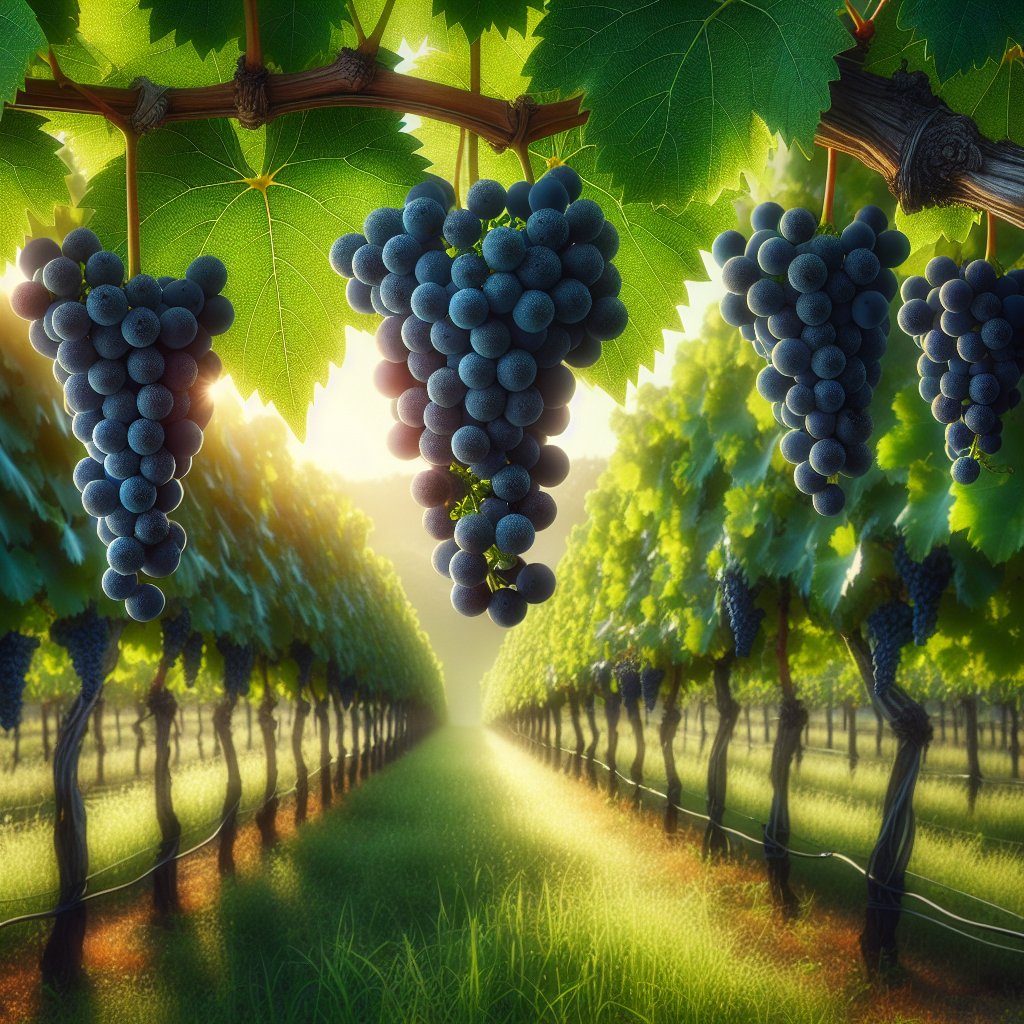
Introduction to Merlot Grapes
Originating in Bordeaux and historically associated with the Right Bank districts of Saint-Émilion and Pomerol, this classic black wine grape has become a global benchmark for red wine production. It is widely planted because it generally ripens earlier than Cabernet Sauvignon, can produce generous yields, and often develops plush texture, dark fruit character, and approachable tannin structure.
For growers, however, Merlot is not simply an “easy” grape. It is a cultivar that responds dramatically to terroir and management. On cool, fertile sites it may produce excessive canopy, delayed lignification, and wines with green bell-pepper notes. On shallow, drought-prone soils it can shut down too early, leading to shriveled berries and elevated sugar without full phenolic balance. The best results come from matching Merlot to moderate-vigor sites, regulating water carefully, and maintaining a canopy that protects fruit from heat spikes while preserving airflow.
Commercially, Merlot is often used both as a varietal wine and as a blending component, especially with Cabernet Sauvignon and Cabernet Franc. Growers interested in broader viticulture fundamentals may also compare its behavior with general grape cultivation. For soil-building strategies in perennial systems, a useful reference is this soil health guide.
Botanical Profile of Merlot Grapes
This cultivar belongs to the species Vitis vinifera, the Eurasian grapevine species responsible for most of the world’s fine wine production. Merlot is a deciduous woody perennial climber that grows as a liana in its wild form but is trained in vineyards onto trellis systems for productivity, fruit exposure control, and labor efficiency.
Key botanical and agronomic characteristics include:
- Growth habit: Vigorous to moderately vigorous depending on rootstock, soil fertility, and water availability.
- Budbreak: Typically early to medium-early, which can expose it to spring frost risk in colder valleys.
- Ripening period: Medium to early relative to many red vinifera cultivars, often before Cabernet Sauvignon.
- Cluster form: Medium-sized clusters, often moderately compact; compactness can increase rot pressure in humid seasons.
- Berry traits: Small to medium berries with dark blue-black skins, moderate skin tannin, and relatively juicy pulp.
- Leaf morphology: Medium to large leaves, often pentagonal with five lobes and a somewhat bullate surface.
- Wine profile relation to horticulture: Berry composition is highly influenced by crop load, potassium uptake, and canopy shading.
Merlot’s parentage is now understood to include Cabernet Franc and Magdeleine Noire des Charentes. This lineage helps explain some of its early-ripening tendency. The variety is also known for relatively fruitful basal buds, which makes spur pruning possible in many regions, though cane pruning may be preferred in frost-prone or low-vigor settings.
From a phenological standpoint, Merlot needs careful observation between fruit set and veraison. If vines carry too many clusters or too much shade, berries may remain large but chemically diluted, resulting in lower anthocyanin concentration and weaker tannin structure. By contrast, moderate water deficit after fruit set often improves berry skin-to-pulp ratio and color development.
Soil, pH, and Climate Requirements for Merlot Grapes
This variety performs best in temperate viticultural climates with warm days, cool nights, and a reliably dry period near harvest. It is less suited to very humid tropical conditions, where fungal pressure and poor dormancy can become chronic problems, and less ideal for very cold continental zones where winter injury and spring frost are frequent.
Optimal climate profile:
- Growing season mean temperatures roughly 16-20°C.
- Warm, sunny summers with 1,300-1,600 growing degree days (region-dependent).
- Limited rainfall near harvest to reduce botrytis and berry splitting.
- Good air drainage on slopes or benches to reduce frost risk.
Heat sensitivity and fruit style: Merlot benefits from warmth, but excessive heat above about 35°C during ripening can reduce acidity and push jammy flavors, especially when the canopy is too open and clusters receive harsh afternoon sun. In hot inland sites, east-facing rows or partial western shade can prevent berry sunburn and loss of aromatic complexity.
Cold sensitivity: Winter hardiness is moderate but not exceptional. Mature dormant wood may tolerate substantial cold, yet trunk injury becomes more likely below about -18 to -20°C depending on acclimation, rootstock, and duration of exposure. Early budbreak makes low-lying frost pockets particularly risky.
Soil texture and drainage: Merlot thrives in well-drained soils with moderate water-holding capacity. Ideal textures include:
- Gravelly loams for balanced vigor and concentration.
- Clay-loam over free-draining subsoil for sustained summer moisture.
- Silty loams if drainage is excellent and vigor is controlled.
Heavy clay can work if internal drainage is sound, but waterlogged spring soils delay root function and increase chlorosis, weak shoot growth, and disease susceptibility. Sandy soils are usable but often require frequent irrigation and organic matter management because drought stress can develop rapidly after fruit set.
Root zone requirements:
- Effective rooting depth: at least 75-100 cm preferred.
- Avoid hardpan, perched water tables, and salinity.
- Electrical conductivity should remain low to moderate; saline irrigation water can reduce vine vigor and berry quality over time.
pH target: The ideal soil pH is generally 6.0-7.0, with acceptable performance from about 5.8-7.5 depending on rootstock. Below pH 5.5, aluminum and manganese toxicity may become problematic, while phosphorus availability declines. Above pH 7.5, iron chlorosis is a common risk, especially on calcareous soils if sensitive rootstocks are used.
Nutrient balance: Merlot responds poorly to excessive nitrogen. Overfertilized vines often produce long internodes, dense lateral growth, delayed fruit maturation, and higher disease pressure. Target moderate vigor: shoots around 1.0-1.5 meters by veraison in balanced systems are often adequate, though this varies by trellis and training method.
Step-by-Step Planting & Propagation
New vineyards are almost always established with grafted nursery vines rather than seed, because seed propagation does not produce true-to-type Merlot. Choose certified disease-free planting material grafted onto a rootstock matched to site constraints such as lime tolerance, drought tolerance, nematode pressure, or vigor control.
1. Select the site carefully Choose a location with:
- Full sun, ideally 7-8+ hours daily.
- Gentle slope for cold air drainage.
- No standing water after heavy rain.
- Good access to irrigation and harvest logistics.
Avoid valley bottoms with recurrent frost and fields with a history of grapevine viruses, Crown gall, or root-knot Nematodes unless remediated.
2. Test soil before planting At least 6-12 months before planting, conduct:
- Standard pH and nutrient analysis.
- Organic matter test.
- Salinity test if irrigation water is questionable.
- Deep profile pits to inspect drainage and rooting restrictions.
Correct pH before planting if necessary. Incorporate phosphorus, potassium, gypsum, lime, or compost based on lab results, not guesswork.
3. Prepare the ground Subsoil compacted layers if present, but only when soil moisture is right to avoid smearing. Form rows aligned to maximize light interception while accounting for wind and slope. Install trellis end posts before planting if possible.
4. Choose spacing Typical spacing for Merlot:
- Between vines: 1.0-1.8 m
- Between rows: 2.2-3.0 m
Higher-density plantings can improve competition and fruit quality on vigorous soils, while wider spacing may be better in mechanized or drier systems.
5. Plant dormant grafted vines Plant in early spring after severe frost danger has eased but before vines break strongly. Keep roots moist before planting. Dig holes large enough to spread roots naturally downward and outward. Position the graft union 5-10 cm above final soil level to prevent scion rooting.
Backfill with native soil rather than highly amended potting mixes, which can create texture discontinuities. Water in thoroughly to settle soil around roots.
6. Install protection and irrigation Use grow tubes where rabbits, herbicide drift, or wind exposure are concerns. Drip irrigation is strongly preferred for Merlot because it allows precise moisture control and reduces canopy humidity.
7. Train in the establishment years Year 1: Select the strongest shoot and tie it to a stake to form the future trunk. Year 2: Establish trunk height and cordons or prepare for cane-pruned systems. Year 3: Allow a light crop only if vine diameter, root establishment, and canopy strength are adequate.
Propagation by cuttings Own-rooted hardwood cuttings are possible biologically but are not standard in professional vineyards due to Phylloxera risk and the advantages of rootstock matching. Use only in regions proven free of Phylloxera and after careful phytosanitary consideration.
Care & Maintenance regimes for Merlot Grapes
High-quality Merlot depends on annual precision rather than occasional intervention. The most important management domains are irrigation, pruning, canopy control, nutrient moderation, and crop regulation.
Irrigation management Young vines need frequent but not constant moisture. Mature vines prefer deep, measured irrigation cycles rather than daily shallow watering.
General targets:
- During establishment, maintain evenly moist soil in the upper 20-30 cm while roots expand.
- For mature vines, allow the top few centimeters to dry between irrigations, but avoid sustained wilting during bloom and fruit set.
- Moderate deficit after fruit set often improves quality, but severe stress reduces berry size too aggressively and can halt sugar accumulation.
As a practical field guide, soil in the active root zone should feel cool and slightly moist, not sticky and saturated. If you squeeze a loam sample from 20-30 cm depth, it should form a weak ball that breaks apart easily, not ooze water. In drip-irrigated vineyards, many growers aim to replenish a controlled fraction of evapotranspiration, increasing during canopy expansion and reducing somewhat from berry set to pre-harvest depending on quality goals.
Signs of underwatering:
- Basal leaves losing turgor by midafternoon repeatedly.
- Shortened shoot tips stopping growth too early in summer.
- Small, tough berries with rapid sugar rise but poor flavor development.
- Marginal leaf scorch on hot sites.
Signs of overwatering:
- Excessive lateral shoots and dense canopy.
- Pale leaves from poor root aeration.
- Large berries with diluted flavor.
- Higher incidence of sour rot, botrytis, or splitting.
- Persistent wet soil smell or algal growth around emitters.
Pruning Dormant pruning sets the crop potential for the coming season. Merlot is commonly trained on vertical shoot positioning (VSP) with spur pruning in moderate climates, though cane pruning may improve uniformity where basal bud fruitfulness is inconsistent.
Target balanced pruning weights and bud counts. Overcropping a weak vine is one of the fastest ways to reduce both current and next-season performance. Remove dead wood, weak canes, and crowded spur positions. Maintain renewal positions to avoid cordon congestion over time.
Canopy management Merlot tends to develop dense canopies on fertile soils. This can trap humidity and shade clusters, increasing methoxypyrazines, lowering anthocyanins, and worsening disease pressure.
Key practices:
- Shoot thinning early when shoots are 10-20 cm long.
- Position shoots vertically and evenly.
- Remove laterals selectively around the fruit zone.
- Conduct modest leaf removal on the morning-sun side after fruit set if disease pressure is high.
Avoid aggressive fruit exposure in hot climates, as berries can sunburn, turning brown or developing leathery patches. The ideal cluster zone is bright and airy, not fully exposed all day.
Nutrition Apply nutrients from petiole tests, leaf blade tests, and soil data. Merlot commonly benefits from balanced potassium and magnesium management, but excessive potassium can raise juice pH and reduce wine stability. Nitrogen should be conservative and timed to avoid stimulating excessive late-season vegetative growth.
Typical deficiency symptoms:
- Nitrogen deficiency: pale older leaves, reduced shoot growth.
- Magnesium deficiency: interveinal chlorosis on older leaves.
- Iron chlorosis: yellow young leaves with green veins, especially on high-pH soils.
- Potassium imbalance: marginal scorch or high juice pH with soft acid structure.
Crop load adjustment If fruit set is heavy, cluster thinning may be justified, particularly on young vines or in cool seasons. Aim for vine balance, not maximum tonnage. Merlot with excessive crop often ripens sugars before tannins and color are fully developed.
Pests, Diseases & Organic Management
Merlot is vulnerable to the full range of common grapevine pests and fungal diseases, especially where canopies are dense and rainfall or humidity is elevated.
Major fungal diseases
- Powdery mildew: Appears as gray-white fungal growth on leaves and berries. It thrives in warm, dry-to-moderately humid conditions and can scar berries, reduce photosynthesis, and impair ripening.
- Downy mildew: Causes yellow oil spots on leaves and white sporulation beneath. Favored by wet conditions and poor airflow.
- Botrytis bunch rot: Particularly important in compact-cluster years or rainy harvest periods. In Merlot, tight clusters can trap moisture and allow internal berry breakdown.
- Phomopsis and Anthracnose: More common where sanitation is poor and spring moisture persists.
Organic disease management principles
- Prune for airflow and remove infected wood.
- Keep fruit zone open enough to dry quickly after dew or rain.
- Avoid overhead irrigation.
- Apply sulfur preventively for Powdery mildew where allowed and temperatures permit.
- Use copper products judiciously for Downy mildew prevention in organic programs, while avoiding phytotoxicity and excessive soil accumulation.
- Time sprays preventively; once bunch rot is established inside compact clusters, rescue options are limited.
Insect and mite pests
- Grape berry moth
- Leafhoppers
- Mealybugs
- Spider mites
- Thrips in some regions
- Wasps and birds near harvest
Use monitoring traps, leaf scouting, and threshold-based action. Beneficial habitat strips can support parasitoids and predatory arthropods. Yarrow, Thyme, and Clover are often useful around vineyard margins or alley systems for attracting beneficial insects and improving ecological resilience.
Trunk and root problems
- Crown gall after freeze or mechanical injury
- Eutypa and other trunk diseases entering through pruning wounds
- Phylloxera in ungrafted vines
- Nematodes on susceptible sites
Sanitize pruning tools between diseased blocks, prune during dry weather if possible, and protect large wounds where trunk disease pressure is severe.
Bird and vertebrate damage Birds can remove substantial crop in the final 2-3 weeks before harvest. Netting is the most reliable solution. Deer browsing is especially damaging to young vines and can deform future trunks.
Harvesting, Curing & Optimal Storage
Wine grapes are not “cured” in the way onions or garlic are cured, but post-harvest handling still matters enormously. The goal is to harvest at the narrow window where sugars, acids, skins, seeds, and flavor compounds are aligned with the intended wine style.
Harvest timing Merlot is typically harvested when:
- Soluble solids are often around 23-25°Brix for many red wine goals, though target range varies by region and style.
- Titratable acidity remains adequate for freshness.
- pH is not excessively high.
- Seeds are turning brown rather than bright green.
- Skins taste less vegetal and more plummy, dark-fruited, or softly herbal depending on site.
Do not rely on Brix alone. Merlot can accumulate sugar before phenolic maturity, especially in hot years or on overcropped vines. Taste berries from multiple vineyard zones. Look for uniform color, resilient skins, and diminishing harsh seed bitterness.
How to harvest Harvest in the cool morning whenever possible. Use clean, shallow picking bins to reduce berry crushing. Remove visibly moldy, bird-damaged, sunburned, or underripe clusters during picking. Crushed berries in warm bins quickly oxidize and can initiate unwanted fermentation or microbial growth.
Field handling
- Keep harvested fruit shaded.
- Transport rapidly to processing.
- Avoid stacking bins too high if fruit is delicate.
- Process the same day whenever possible.
Short-term storage Freshly harvested wine grapes are best stored only briefly. Ideal holding conditions before crush are about 0-5°C with high relative humidity, but most small growers should avoid prolonged storage and instead process within hours. Longer holding increases the risk of rot, volatile acidity development, and loss of fresh fruit character.
Yield expectations Depending on region, training, vine age, and intended quality tier, yields may range from moderate to high. Premium wine production usually favors lower to moderate yields with balanced leaf area and berry composition rather than sheer tonnage.
Companion Planting for Merlot Grapes
In vineyards, companion planting is usually less about intercropping directly under the vine and more about designing understory and alley species that support beneficial insects, suppress erosion, improve trafficability, and moderate excessive vine vigor.
Best companion options for this cultivar:
- Clover: Useful as a living cover in row middles, especially white or low-growing types. It fixes nitrogen, supports pollinators and beneficial insects, and reduces erosion. However, vigorous stands can increase nitrogen supply too much on already fertile sites, so mow and manage carefully.
- Thyme: A low-growing aromatic herb well suited to border plantings or dry edges. It attracts beneficial insects, tolerates lean soils, and does not create heavy competition when kept outside the vine root zone.
- Yarrow: Excellent for insectary function, supporting hoverflies, parasitic Wasps, and predatory insects. It also fits well in biodiversity strips near vineyard blocks.
Companion planting strategy Use companions primarily in alleyways, headlands, or dedicated insectary strips rather than directly against trunks. Keep a vegetation-free strip immediately around young vines to reduce competition for water and nutrients. In mature dry-farmed vineyards, avoid aggressive cover crops under vines unless vigor is excessive and water availability is reliable.
What to avoid nearby Avoid tall, dense companion vegetation that traps humidity around clusters or competes strongly during bloom and berry set. Also avoid species that host problematic pests shared with grapevines or require irrigation patterns that keep the canopy humid.
In practical terms, the ideal companion system for Merlot is one that encourages biological diversity without pushing the vine toward excessive vigor or moisture stress. Managed correctly, living groundcovers and insectary borders can reduce erosion, improve soil structure, support beneficials, and make the vineyard more resilient over time.