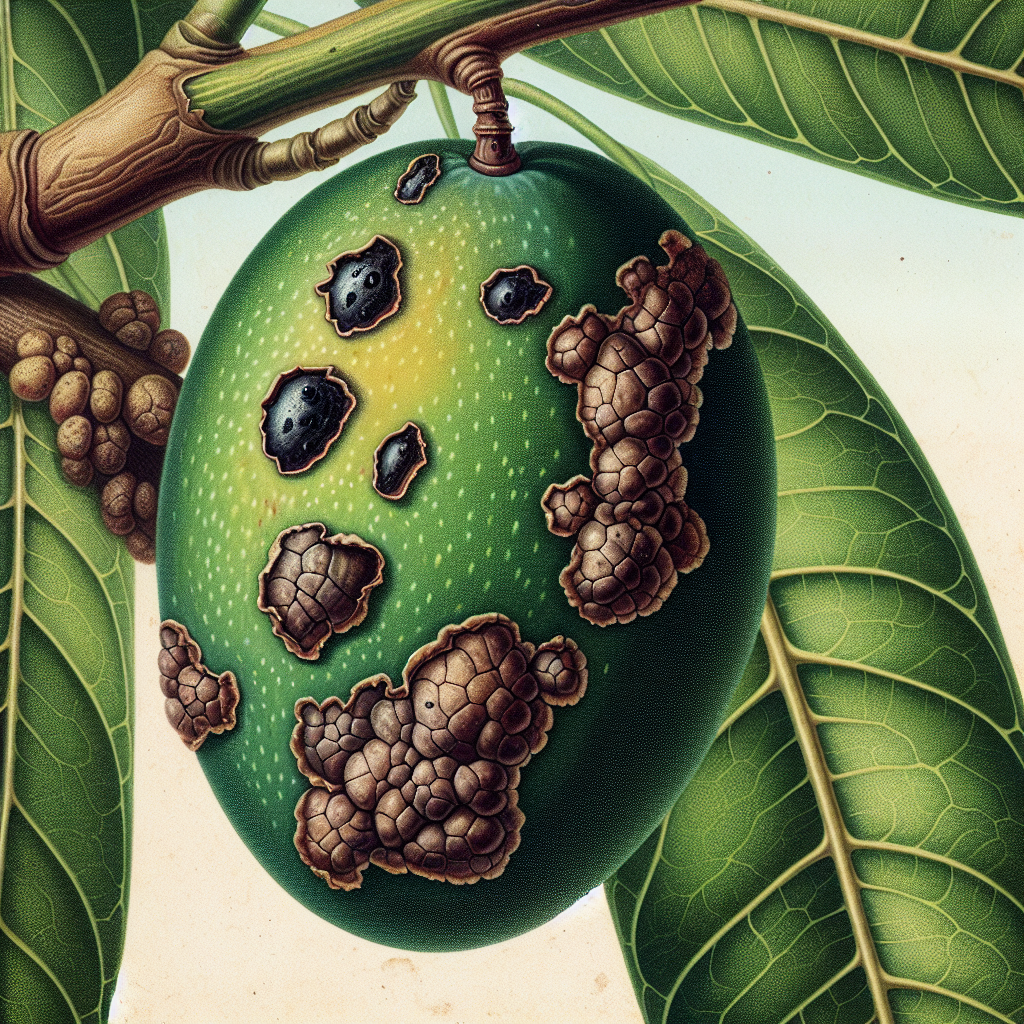
Introduction to Mango Scab
Mango scab is one of the most economically important fungal diseases impacting Mango cultivation worldwide, particularly in humid tropical and subtropical areas. Caused by the ascomycete fungus Elsinoë mangiferae, this pathogen targets tender tissues such as young leaves, panicles, and developing fruits, resulting in blemished produce that fetches lower market prices or becomes unmarketable. First identified in Florida in the early 20th century, mango scab has since spread to major production regions including India, Australia, Southeast Asia, and parts of Africa, where it can cause up to 50% yield reductions in susceptible varieties during favorable conditions.
The disease is especially problematic for commercial growers because it not only reduces fruit size and quality but also predisposes mangoes to secondary infections like anthracnose, exacerbating losses. Symptoms appear as dark, corky lesions that crack and distort plant parts, making early detection crucial. While chemical fungicides exist, organic management strategies are increasingly preferred for sustainable farming, aligning with global demands for residue-free produce. This guide provides comprehensive diagnostics, lifecycle insights, and practical organic control measures to help growers protect their crops effectively. For small farms, integrating these strategies with tools like AI-powered disease forecasting can optimize timing and reduce inputs—check out Why Misidentifying Plants Costs Small Farms Thousands - And How AI Camera Diagnosis Fixes It Fast for tech-enhanced tips.
Understanding mango scab's biology is key to prevention. The fungus survives in infected plant debris and produces spores that splash onto new growth during rainy periods. In high-density orchards, poor air circulation amplifies spread, underscoring the need for proactive canopy management. This definitive guide equips botanists, entomologists, agricultural experts, and farmers with science-backed protocols to diagnose, manage, and prevent outbreaks, ensuring robust mango yields year after year.
Identifying Symptoms & Damage
Accurate identification of mango scab is essential for timely intervention, as symptoms mimic other foliar diseases like Alternaria leaf spot. On leaves, initial signs appear 7-14 days after infection as small, irregular, olive-green spots on the underside of young leaves. These spots darken to black, become raised and corky, and may coalesce into larger lesions up to 1 cm in diameter. Severely affected leaves curl, twist, and drop prematurely, leading to defoliation and reduced photosynthesis.
Flower panicles show olive-black lesions on peduncles and rachises, causing flowers to blacken, shrivel, and abort. This results in poor fruit set, with yield losses of 20-80% in severe cases. On fruits, symptoms are most diagnostic: small, dark brown to black scab-like spots form around the lenticels, especially on young fruits under 6 cm. Lesions crack as fruit expands, creating fissures that invite pathogens like fruit rots. Mature fruits develop angular, necrotic areas with a reddish-brown halo, rendering them deformed, cracked, and susceptible to post-harvest decay.
Damage quantification reveals economic impacts: scab reduces fruit size by 30-50%, lowers grade standards, and increases cull rates. In young orchards, repeated defoliation weakens trees, delaying bearing age. Differentiate from anthracnose by scab's corky texture versus anthracnose's sunken, salmon-colored spores. Use a hand lens to spot fungal acervuli (spore masses) in cracks. Lab confirmation via microscopy reveals Elsinoë's characteristic 2-celled ascospores. Early scouting—weekly during wet seasons—prevents escalation.
Lifecycle and Progression of Mango Scab
Elsinoë mangiferae follows a polycyclic lifecycle, with multiple infection cycles per season driven by wet weather. Primary inoculum overwinters in fallen leaves, mummified fruits, and bark lesions as stromata—dormant fungal structures. In spring, during rains, these release conidia (asexual spores) that splash up to 1-2 meters via wind-driven rain.
Spores germinate on wet surfaces within 6-12 hours at 20-30°C (68-86°F), penetrating via stomata or wounds. Incubation lasts 1-3 weeks, producing new acervuli that release secondary conidia, perpetuating epidemics. Optimal infection occurs at 25°C with leaf wetness >12 hours; temperatures above 35°C inhibit sporulation. Sexual ascospores form in pseudothecia on old debris, ensuring long-term survival.
Progression peaks during flowering and fruit set (March-June in Northern Hemisphere), with 5-10 cycles possible. Disease severity builds exponentially: 10% initial incidence can reach 80% by harvest without control. Infected tissues dry and crack, shedding spores for 2-3 months. Understanding this cycle informs spray timing—target pre-bloom and post-rain events. Cultural removal of debris disrupts inoculum, breaking the cycle.
Environmental Triggers & Risk Factors
Mango scab thrives in warm (22-30°C), humid environments with frequent leaf wetness, common in monsoon climates. Rainfall >20 mm/week and relative humidity >85% trigger outbreaks; prolonged dry spells halt progression but don't eliminate inoculum. Poor air circulation in dense canopies retains moisture, amplifying risk—orchards with <5m tree spacing suffer 3x higher incidence.
Susceptible varieties like Tommy Atkins, Kent, and Keitt are highly vulnerable; resistant cultivars like Alphonso Mango show tolerance. Young flushes and panicles are most susceptible (<4 weeks old). Over-fertilization with nitrogen promotes succulent growth, ideal for infection. Soil pH >7.5 limits micronutrient uptake, stressing trees. Irrigation overhead increases splash dispersal; drip systems reduce risk by 40%.
Secondary factors include wounding by mango hoppers or hail, creating entry points. Monoculture orchards without windbreaks face higher spore loads. Climate change extends wet seasons, intensifying epidemics—projections indicate 20% more scab pressure by 2050 in Florida. Monitor with weather stations: act when rain >10mm forecasted.
Organic Control & Treatment Plans
Organic management integrates cultural, biological, and approved fungicides for sustainable control. Cultural Practices (Foundation): Prune for open canopies (30-50% light penetration), removing 20-30% deadwood annually. Rake and destroy fallen debris post-harvest to cut inoculum 70%. Time fertilizer for dry periods; avoid N excess. Use drip irrigation and mulching to minimize wetness.
Biological Controls: Apply Bacillus subtilis (Serenade) or Trichoderma harzianum at 5-10g/L every 14 days during high risk. These antagonize Elsinoë via competition and antibiosis, reducing incidence 40-60%. Introduce predatory mites if mites exacerbate wounds.
Organic Fungicides: Copper hydroxide (e.g., Kocide, 1-2kg/ha) or sulfur (Bonide, 5-10kg/ha) pre-bloom and at 10-14 day intervals—up to 6 applications. Neem oil (2-3%) with sticker disrupts spore germination. Baking soda (sodium bicarbonate, 5g/L + surfactant) raises pH, inhibiting growth; apply post-rain.
Treatment Protocol: Scout weekly; initiate at 5% panicle incidence. Spray schedule: 1) Dormant (copper), 2) Bud swell, 3) Full bloom, 4) Fruit set, 5) Pea-size fruit. Rotate modes of action. Efficacy: 80-95% with compliance. For outbreaks, strip-harvest and sanitize.
Preventing Mango Scab in the Future
Long-term prevention builds resilient orchards. Select resistant varieties like Nam Dok Mai or Irwin alongside Kulfi Mango. Site selection: well-drained, airy slopes >300m elevation reduce humidity. Establish windbreaks with guava or legumes.
Integrated Pest Management (IPM): Monitor with sticky traps for vectors; interplant marigold to deter hoppers. Annual sanitation removes 90% inoculum. Balanced nutrition—apply micronutrients (Zn, Mn) via foliar sprays counters stress. Grafting onto resistant rootstocks enhances vigor.
Forecasting: Use rain gauges and apps for spray windows. Cover crops like clover suppress splash. Post-harvest, hot water dip fruits (52°C, 15min) curbs latent infections. Quarantine new plantings. Educate workers on hygiene. With these, incidence drops <5%, boosting yields 25%.
Crops Most Affected by Mango Scab
Mango scab primarily afflicts Mangifera indica varieties, with over 100 cultivars susceptible. Commercial types like Tommy Atkins Mango, Kent Mango, and Keitt Mango suffer most due to export demands for blemish-free fruit. Alphonso Mango shows moderate resistance but still requires management.
Rarely, the pathogen crosses to related Anacardiaceae like cashew or pistachio, causing minor leaf spots. No significant impact on non-hosts like avocado or banana. In mixed orchards, proximity to infected mangoes risks spread via windblown spores. Focus protection on mango blocks.