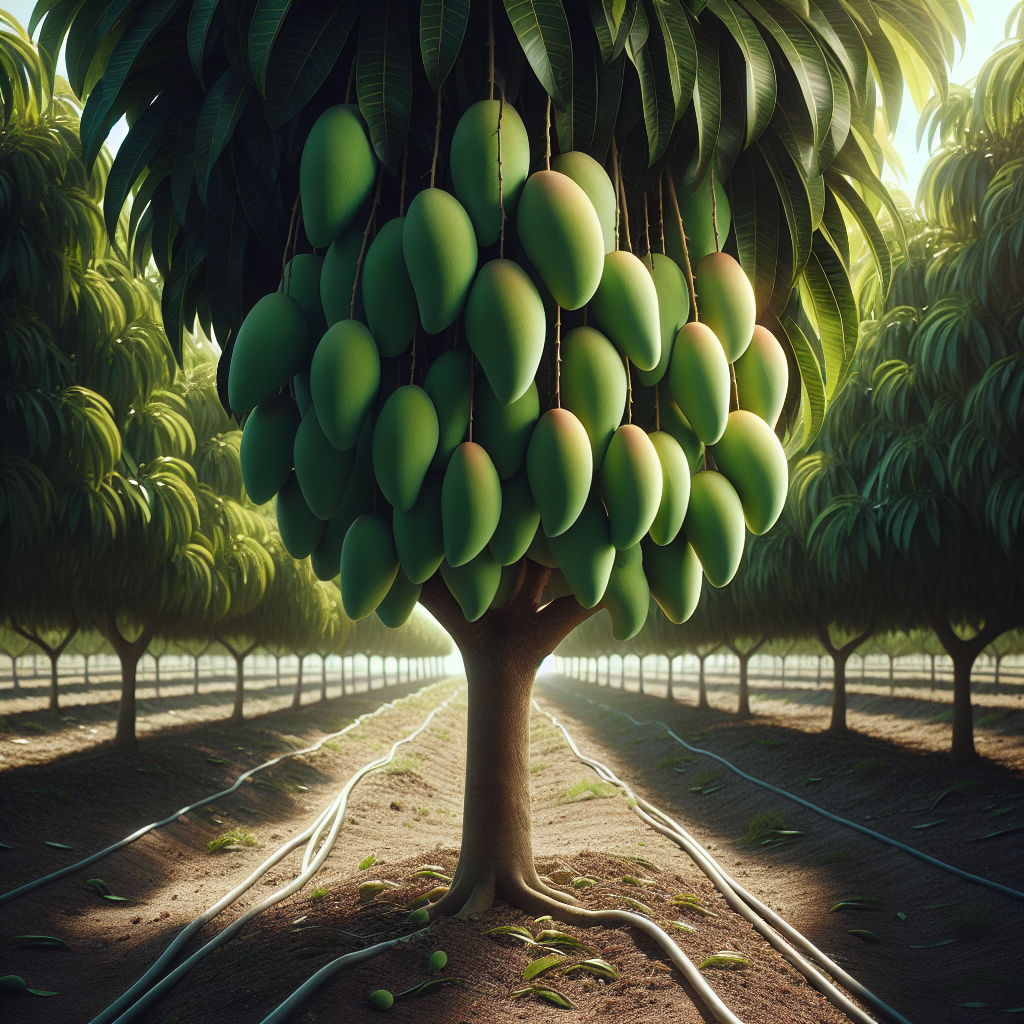
Introduction to Keitt Mango
Originating in Florida in the mid-20th century, this cultivar became one of the most important late-maturing mangoes in both backyard and commercial orchards. It is believed to have arisen from a seedling of the Indian-type 'Mulgoba' lineage, and it gained popularity because it fills a critical marketing gap after many early and mid-season mango varieties have finished. Fruit are typically large, oval to oblong, with flesh that is juicy, sweet, aromatic, and notably low in fiber compared with many older commercial cultivars.
What makes this variety especially useful is its production timing and fruit behavior. Mature fruit often remain mostly green even when physiologically ripe, sometimes developing only a faint yellow blush or light pink shoulder depending on sun exposure. That trait can confuse inexperienced growers, but professionals value it because the fruit can be harvested based on maturity indices rather than superficial color. Keitt also tends to have good shelf performance relative to softer dessert cultivars, which is one reason it remains important in export and local fresh markets.
In well-managed orchards, trees can be vigorous and productive, but they are not maintenance-free. Without structured pruning, the canopy becomes tall, dense, and difficult to harvest. Its performance is best where dry weather coincides with flowering and where soils drain quickly. In humid zones it can still produce well, but Anthracnose pressure increases and canopy ventilation becomes essential. For general mango culture comparisons, see the broader Mango guide.
Botanical Profile of Keitt Mango
This cultivar belongs to the family Anacardiaceae, the same family as cashew and pistachio. Like other mangoes, it is an evergreen tree with a dense, rounded canopy if unmanaged, though young trees often show upright, vigorous growth before branching out. Leaves are lanceolate, leathery, and emerge in reddish to bronze flushes before hardening to glossy dark green. These flush cycles are agronomically important because pests such as Thrips and scale insects often exploit tender new growth.
Panicles are terminal and many-flowered, carrying both male and hermaphroditic flowers. Fruit set is naturally low relative to bloom intensity, which is normal in mango. Keitt commonly produces large fruit ranging roughly from 450 grams to over 900 grams under good culture, with some exceptional fruit exceeding that. Flesh is deep yellow, nearly fiberless to low-fiber, with a rich sweet flavor balanced by mild acidity when harvested at proper maturity.
The seed is monoembryonic, so trees grown from seed will not come true to type. That is why commercial propagation is done by grafting onto seedling rootstocks. Juvenile seedling trees take much longer to bear and may produce fruit unlike the parent. Grafted trees, by contrast, generally begin meaningful production in 3 to 5 years under favorable conditions.
Botanically and horticulturally, one important characteristic is its late harvest season. Depending on region, fruit may mature from late summer into autumn, often after cultivars such as Kent Mango or Tommy Atkins in comparable climates. This extended ripening window makes it attractive for staggered orchard planning, labor management, and market timing.
Soil, pH, and Climate Requirements for Keitt Mango
Deep, well-drained soil is the single most important site factor. Ideal textures are sandy loam, loam, or gravelly loam with rapid internal drainage and at least 1.2 to 1.5 meters of exploitable rooting depth. Heavy clay is not automatically disqualifying, but only if drainage is engineered with raised berms, subsurface drainage, and careful irrigation control. Mango roots need oxygen; prolonged saturation sharply increases the risk of root decline, nutrient imbalance, and disease.
The preferred soil pH is about 5.5 to 7.5, with the optimum band often around 6.0 to 6.8 for nutrient availability. At pH above 7.8, iron, zinc, and manganese deficiencies become common, especially in calcareous soils. Symptoms include interveinal chlorosis on young leaves, reduced flush vigor, and small fruit. At pH below 5.2, aluminum and manganese toxicity may impair root growth and reduce microbial balance. Before planting, a complete soil test should include pH, electrical conductivity, organic matter, phosphorus, potassium, calcium, magnesium, sodium, and micronutrients.
Climate should be tropical to warm subtropical with a pronounced dry spell or at least lower humidity during flower induction and bloom. Annual temperature optima are generally 24-30°C, though established trees tolerate hotter conditions if soil moisture is adequate. Vegetative growth slows below about 15°C, and cold injury becomes increasingly likely below 4°C. Flowers and tiny fruitlets are highly vulnerable to chilling and frost; even brief exposure near 0°C can cause major crop loss.
Rainfall of 750-2500 mm can support production, but distribution matters more than the annual total. Excess rain during bloom washes pollen, promotes Anthracnose, and reduces fruit set. Conversely, moderate water stress before flowering can encourage reproductive development in mature trees. During fruit expansion, however, severe drought leads to undersized fruit, fruit drop, and internal quality issues.
Wind protection is useful, especially in cyclone-prone or exposed coastal sites. Strong winds shred leaves, scar fruit, and break fruiting branches. Shelterbelts should be placed far enough away to avoid excessive shade or root competition.
Step-by-Step Planting & Propagation
Use only grafted nursery trees from reputable sources. A high-quality planting tree should have a straight graft union, no bark cracking, no circling roots, healthy green leaves, and at least 2-4 well-spaced scaffold candidates. Avoid overly tall, soft nursery plants because they establish poorly and are more likely to snap in wind.
Choose the site carefully. Full sun is essential. Select a position with at least 8 hours of direct light and excellent air movement. Keep trees away from frost pockets, low depressions, and sites with standing water after rain.
Prepare the ground in advance. Clear perennial weeds in a radius of at least 1-1.5 meters. If soil is compacted, rip or subsoil before the rainy season. In marginal drainage conditions, build raised mounds or berms 30-60 cm high and 1.5-2 m wide.
Space correctly. Home growers often underestimate final canopy size. Standard orchard spacing ranges from about 7 x 7 m to 10 x 10 m depending on vigor, pruning system, and machinery. High-density systems are possible, but only with disciplined annual canopy control.
Plant shallow rather than deep. Dig a hole only as deep as the root ball but 2-3 times as wide. The top of the root ball should sit level with, or slightly above, surrounding soil. Planting too deep is a common cause of decline.
Handle the root ball gently. Remove the container carefully. If roots are circling heavily, tease them outward lightly or make 3-4 shallow vertical cuts to redirect them. Do not break apart the root ball excessively.
Backfill with native soil. Avoid filling the hole with highly amended potting mix, which can create a perched water table or discourage roots from moving outward. Compost may be incorporated lightly across the wider planting zone, not concentrated only in the hole.
Water immediately and settle the soil. Apply enough water to wet the full root ball and surrounding soil profile. For a typical 15-25 liter nursery tree, 10-20 liters right after planting is usually adequate, depending on soil texture.
Mulch properly. Apply 5-10 cm of coarse organic mulch over the root zone, but keep it 15-20 cm away from the trunk to prevent collar rot and rodent damage.
Stake only if necessary. In windy locations, use a flexible tie and remove support once the trunk can stand independently.
Propagation is almost always by veneer grafting, cleft grafting, or side grafting onto vigorous mango seedling rootstocks. Seed propagation is useful mainly for rootstock production. Scions should come from healthy, true-to-type, non-flushing mother trees with mature buds. Grafting success improves when temperatures are warm, humidity is moderate, and scion wood is neither overly soft nor fully woody and dormant.
Care & Maintenance regimes for Keitt Mango
Irrigation should be adjusted by tree age, soil type, and phenological stage rather than applied on a fixed calendar. Newly planted trees need frequent but not constant moisture. The goal is evenly moist, aerated soil in the upper 20-40 cm, not soggy ground. In sandy soil, young trees may need water 2-3 times per week during hot dry weather; in loam, once or twice weekly may suffice. A practical target is to allow the top 3-5 cm of soil to dry slightly between irrigations while deeper soil remains faintly moist.
Signs of under-watering include drooping young leaves during the morning, marginal leaf scorch, weak flushes, excessive fruit drop, and stunted fruit enlargement. Signs of overwatering include persistent leaf yellowing, a sour smell in the root zone, algae or moss growth near emitters, lack of new flush, blackened feeder roots, and fruit that splits or drops after saturated periods. Mature trees tolerate short dry spells better than waterlogging.
For bearing trees, irrigation is typically reduced before flowering to avoid excessive vegetative flush. Once fruit are set and enlarging, provide deeper, less frequent irrigation that wets the active root zone to roughly 45-90 cm depth depending on tree size and soil. Avoid extreme swings between drought and saturation because that increases fruit drop and can reduce soluble solids.
Nutrition should be based on leaf and soil analysis, but a general pattern is helpful. Young trees need modest, regular nitrogen to build canopy structure. Split applications every 6-8 weeks during active growth are better than large doses. Mature bearing trees need a more balanced program emphasizing potassium for fruit sizing and quality, with enough nitrogen to support post-harvest flushing but not so much that vegetative growth suppresses flowering. Calcium, magnesium, zinc, boron, iron, and manganese are commonly limiting in alkaline soils.
Organic matter additions are beneficial, but avoid piling manure against the trunk or applying fresh, high-salt amendments. Foliar micronutrient sprays can be effective before bloom and during active flush, especially for zinc and boron where deficiencies are documented. Excess nitrogen late in the season often causes rank growth that is more disease-prone and less likely to flower well.
Pruning is essential. After establishment, train 3-4 primary scaffold branches beginning 60-100 cm above ground. Remove narrow crotches, crossing limbs, and vigorous upright water shoots. For production trees, post-harvest tipping of terminal shoots helps maintain a manageable canopy and stimulates branching. The best commercial canopies are low, open, and pickable, usually held at 3-4.5 m where possible. Dense interior shade reduces flowering wood and increases disease pressure.
Weed management should prioritize a weed-free ring around the trunk, especially in the first 2-3 years. Grasses compete aggressively for nitrogen and water. Maintain mulch, shallow hand weeding, or carefully managed cover crops between rows. A living alley can work well, but avoid dense vegetation directly under the canopy unless irrigation and fertility are adjusted accordingly. For broader orchard floor strategies, see soil health tips.
Fruit thinning is rarely practiced on a large scale, but in young trees it is often wise to remove heavy early crops so the structure develops before the tree is burdened. Bagging fruit can reduce fruit fly stings, wind scarring, and some surface blemishes in small orchards.
Pests, Diseases & Organic Management
Anthracnose is one of the most important diseases, especially in humid climates. It affects panicles, flowers, young fruit, leaves, and postharvest fruit surfaces. Symptoms include black lesions on blossoms, blossom blight, fruit spotting, and premature fruit drop. Organic control depends heavily on pruning for airflow, sanitation, dry-site selection, and timely copper-based protectant sprays during vulnerable bloom periods where permitted.
Powdery mildew can be severe in dry conditions with cool nights and humid mornings. It appears as a whitish powder on panicles, flowers, and small fruit, leading to flower abortion and poor set. Sulfur sprays may help prevent outbreaks, but they must be used with caution in hot weather to avoid phytotoxicity.
Bacterial black spot may occur in some regions, especially where wind-driven rain and wounds are common. Fruit and leaves develop dark angular lesions, and severe infections reduce packout quality. Windbreaks, sanitation, careful pruning, and avoiding overhead irrigation help reduce spread.
Mango hoppers, Thrips, Scales, Mealybugs, and Fruit flies are major insect concerns depending on region. Hoppers and Thrips damage flowers and new flush. Scale and Mealybugs excrete honeydew that fosters sooty mold, reducing photosynthesis and downgrading fruit. Fruit flies sting developing fruit, causing internal breakdown and drop.
Organic management is most effective when layered:
- Keep the canopy open so sprays and air can penetrate.
- Remove mummified fruit and diseased twigs promptly.
- Encourage beneficial insects by maintaining flowering borders outside the immediate trunk zone.
- Use sticky monitoring traps or pheromone/lure traps where appropriate.
- Bag individual fruit in small plantings once they are marble to egg sized.
- Use horticultural oils for Scales and Mealybugs during non-bloom periods, ensuring complete coverage and avoiding heat stress conditions.
- Apply kaolin clay where permitted to reduce sunburn and some insect pressure.
- Collect and destroy fallen infested fruit quickly to break fruit fly life cycles.
Nutritional balance also affects pest pressure. Soft, nitrogen-rich flushes attract sap-feeding pests. Over-irrigated, heavily fertilized trees are often more susceptible than moderately grown, well-pruned trees.
Harvesting, Curing & Optimal Storage
Harvest maturity should be judged by fruit shoulders filling out, beak reduction, full fruit size, a slight lightening of skin tone from dark green to green-yellow, and internal flesh color beginning to deepen near the seed. Calendar timing helps, but local experience with dry matter and specific orchard conditions is more reliable. Keitt is famous for being deceptive: fruit can be mature while still quite green.
For premium quality, harvest with clippers rather than pulling fruit. Leave a short stem of 0.5-1 cm at picking, then de-sap carefully by inverting fruit stem-end down on racks or paper so latex drains away from the skin. Mango sap can cause severe skin burn and cosmetic damage, especially if fruit are stacked immediately after harvest.
Handle fruit gently. Even minor impact bruises may not show immediately but later appear as internal breakdown or uneven softening. Harvest in the cool part of the morning when field heat is lower. Do not wash dirty fruit aggressively before sap drainage is complete.
Curing in practice means allowing sap flow to cease and fruit surfaces to dry in shade with good airflow. Some growers condition fruit at moderate room temperature for 12-24 hours before grading and packing. Fruit intended for local ripening can then be held at about 20-24°C to develop flavor and soften evenly.
For longer storage, mature-green fruit are generally held around 10-13°C with 85-90% relative humidity, though exact thresholds depend on maturity stage. Temperatures that are too low can induce chilling injury, expressed as uneven ripening, grayish flesh, poor aroma, pitting, and increased decay. Fully ripe fruit store only briefly and are best used within several days.
Properly harvested Keitt often has good shelf life compared with more delicate dessert mangoes. That makes it suitable for local markets, shipping, and staggered sales. However, overmature fruit soften rapidly and lose shipping quality, while immature fruit may color poorly and develop bland flavor. Dry matter testing, Brix assessment after ripening, and simple orchard harvest records are valuable for refining harvest timing year by year.
Companion Planting for Keitt Mango
Companion planting around orchard trees should support pollinators, improve soil cover, reduce erosion, and moderate weed competition without robbing young trees of water. The best companions are shallow-rooted, low-growing, and easy to manage. In mature orchards, the objective is usually functional biodiversity rather than crowding the root zone.
Clover is among the best companions because it acts as a living groundcover, helps suppress weeds, supports beneficial insects when in bloom, and contributes biologically fixed nitrogen if managed well. Keep it mowed low and do not let dense cover creep against the trunk in wet climates.
Peanuts can work in tropical and subtropical systems as a low-growing legume that protects soil from erosion and provides additional biological activity in the rhizosphere. It is especially useful in wider row middles or along orchard edges rather than directly against newly planted trunks.
Thai Basil is useful near orchard margins, kitchen-garden style plantings, or diversified smallholdings because its flowers attract pollinators and predatory insects. Place it where it receives sun without competing directly with the tree's central root zone.
Sunflower can also function at orchard borders as an insectary and biomass plant, but it should be kept far enough from young trees to avoid shading and nutrient competition. In all cases, maintain a clean mulch ring directly around young trunks and keep companion species outside that critical establishment zone.
Poor companions include tall, thirsty annuals planted too close to the trunk, aggressive vines, or crops requiring constant cultivation that disturbs mango roots. The most successful systems combine a protected root collar zone, a managed mulch band, and a low-competition living understory farther out from the drip line.