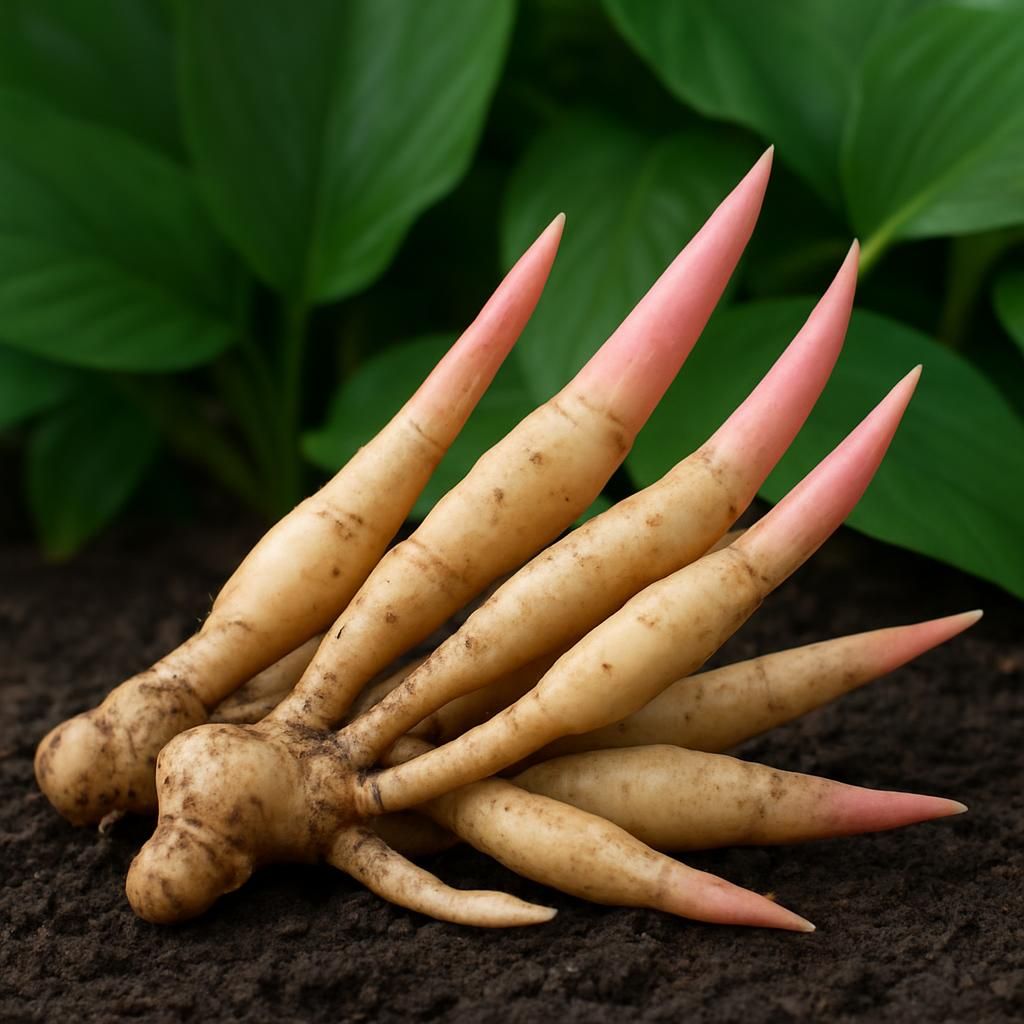
Introduction to Krachai (Boesenbergia rotunda)
Krachai (Boesenbergia rotunda) is a perennial herbaceous plant belonging to the ginger family (Zingiberaceae). Native to Southeast Asia, particularly Thailand, Indonesia, and Malaysia, it is cultivated primarily for its slender, finger-shaped rhizomes that possess a distinctive citrus-pine aroma. These rhizomes are essential in Thai, Indonesian, and Malaysian cooking, where they are used fresh in curries, soups, and stir-fries. Beyond culinary uses, krachai has a long history in traditional medicine for treating digestive issues, inflammation, and microbial infections.
Commercial and small-scale growers value krachai for its relatively fast growth cycle compared to other rhizomatous spices such as Ginger and Turmeric. The plant thrives in warm, humid tropical and subtropical climates and can be grown successfully in raised beds, containers, or open-field systems with proper irrigation and shade management. With increasing global demand for authentic Asian ingredients, krachai presents an excellent opportunity for diversified tropical farming operations.
Botanical Profile of Krachai (Boesenbergia rotunda)
Boesenbergia rotunda is a rhizomatous perennial that grows 30–80 cm tall. It produces pseudostems formed by overlapping leaf sheaths and lanceolate leaves 15–40 cm long. The plant develops a cluster of slender, branched rhizomes that resemble fingers, hence the common name “fingerroot.” These rhizomes are pale yellow to cream-colored with a pinkish tinge at the tips when young. Small, tubular yellow flowers with pinkish-purple markings emerge from the base during the rainy season.
The rhizomes contain essential oils rich in camphor, borneol, and pinene, responsible for the characteristic aroma. Krachai spreads via underground rhizomes and can form dense clumps if not harvested regularly. Unlike ginger, the rhizomes remain relatively thin and do not form large, fleshy structures, making spacing and harvesting techniques critical for commercial production.
Soil, pH, and Climate Requirements for Krachai (Boesenbergia rotunda)
Krachai performs best in well-drained, fertile loamy soils rich in organic matter. Heavy clay soils should be amended with compost, rice hulls, or coarse sand to improve drainage and prevent rhizome rot. The ideal soil pH range is slightly acidic to neutral.
| Parameter | Ideal Range | Notes |
|---|---|---|
| Soil Type | Sandy loam to loam | High organic matter content essential |
| Soil pH | 5.5 – 6.8 | Avoid alkaline soils |
| Temperature (Day) | 25 – 32 °C | Optimal growth temperature |
| Temperature (Night) | 18 – 24 °C | Protect from frost |
| Annual Rainfall | 1500 – 2500 mm | Even distribution preferred |
| Relative Humidity | 70 – 90 % | High humidity supports leaf health |
| Light Requirement | 30 – 50 % shade | Partial shade prevents leaf scorch |
| Elevation | 0 – 800 m | Thrives in lowland tropical areas |
Consistent moisture without waterlogging is critical. In regions with distinct dry seasons, supplemental irrigation or mulching is necessary to maintain soil moisture.
Step-by-Step Planting & Propagation
Krachai is primarily propagated vegetatively using healthy rhizome sections. Select disease-free mother plants and cut rhizomes into 5–8 cm pieces, each containing at least one active bud. Allow cut surfaces to dry for 24 hours before planting to reduce rot risk.
- Prepare raised beds or containers with a 15–20 cm layer of well-decomposed compost mixed into the top 30 cm of soil.
- Plant rhizome pieces horizontally at a depth of 5–8 cm with buds facing upward.
- Maintain 20–25 cm spacing between plants and 30–40 cm between rows.
- Water thoroughly after planting and apply a 5 cm layer of organic mulch (rice straw, coconut coir, or dried leaves).
- Provide 30–50 % shade using shade nets during the first 4–6 weeks until new shoots emerge.
Rhizomes typically sprout within 10–21 days under optimal temperature and moisture conditions. Once established, gradually reduce shade to full filtered light.
Care & Maintenance regimes for Krachai (Boesenbergia rotunda)
Regular irrigation, balanced nutrition, and timely weeding are essential for high-quality rhizome production. The following table outlines recommended schedules for water, fertilizer, and pruning throughout the crop cycle.
| Growth Stage | Watering Frequency | Fertilizer Application | Pruning / Maintenance |
|---|---|---|---|
| Establishment (0–6 weeks) | Keep soil consistently moist (every 2–3 days) | 5-10-10 NPK at 2 kg/100 m² after 3 weeks | Remove yellow or damaged leaves |
| Vegetative (6–16 weeks) | 2–3 times per week | Apply compost tea or 10-10-10 every 4 weeks | Weed regularly; mulch top-up |
| Rhizome Bulking (16–24 weeks) | 1–2 times per week | Potassium-rich fertilizer (0-0-20) at 1.5 kg/100 m² | Remove flower stalks to direct energy to rhizomes |
| Pre-harvest (24–28 weeks) | Reduce watering 2 weeks before harvest | Stop nitrogen applications | Final weeding and leaf cleanup |
Monitor soil moisture using a tensiometer or finger test. Overwatering during the bulking stage can cause rhizome splitting and fungal infection.
Pests, Diseases & Organic Management
Krachai is susceptible to several pests and diseases common to the ginger family. Major threats include Aphids, Spider mites, and Root-knot nematodes. Fungal issues such as Rhizoctonia and Pythium can cause rhizome and root rot, especially in poorly drained soils.
Organic management strategies include:
- Introducing beneficial insects (ladybugs, lacewings) for aphid and mite control.
- Applying neem oil or insecticidal soap at 7–10 day intervals during outbreaks.
- Using solarization and crop rotation with non-host plants to reduce nematode populations.
- Incorporating well-decomposed compost and biochar to suppress soil-borne pathogens.
- Maintaining proper spacing and drainage to minimize fungal pressure.
Regular scouting and early intervention are key to preventing economic losses.
Harvesting, Curing & Optimal Storage
Krachai reaches harvest maturity 6–8 months after planting when rhizomes have developed characteristic finger-like branches and the leaves begin to yellow. Harvest by carefully loosening the soil around clumps with a digging fork and lifting entire plants. Shake off excess soil and separate rhizomes from the mother plant.
For fresh market sales, wash rhizomes gently and air-dry in shade for 2–3 hours. For longer storage, cure rhizomes at 25–28 °C with 80–85 % humidity for 3–5 days, then store in perforated plastic bags at 10–12 °C. Properly cured rhizomes maintain quality for 4–6 weeks. Avoid refrigeration below 8 °C to prevent chilling injury.
Companion Planting for Krachai (Boesenbergia rotunda)
Krachai benefits from strategic companion planting that improves soil health, deters pests, and maximizes land use. Suitable companions include Thai Basil, Garlic, and Turmeric. These plants help repel aphids and spider mites while improving biodiversity.
Avoid planting near Potato or Tomato due to shared susceptibility to certain soil-borne pathogens. Intercropping with leguminous cover crops such as Clover between rows can fix nitrogen and reduce weed pressure. For additional guidance on organic companion strategies, see Summer Companion Planting: 10 Organic Pairings to Boost Small Farm Resilience.