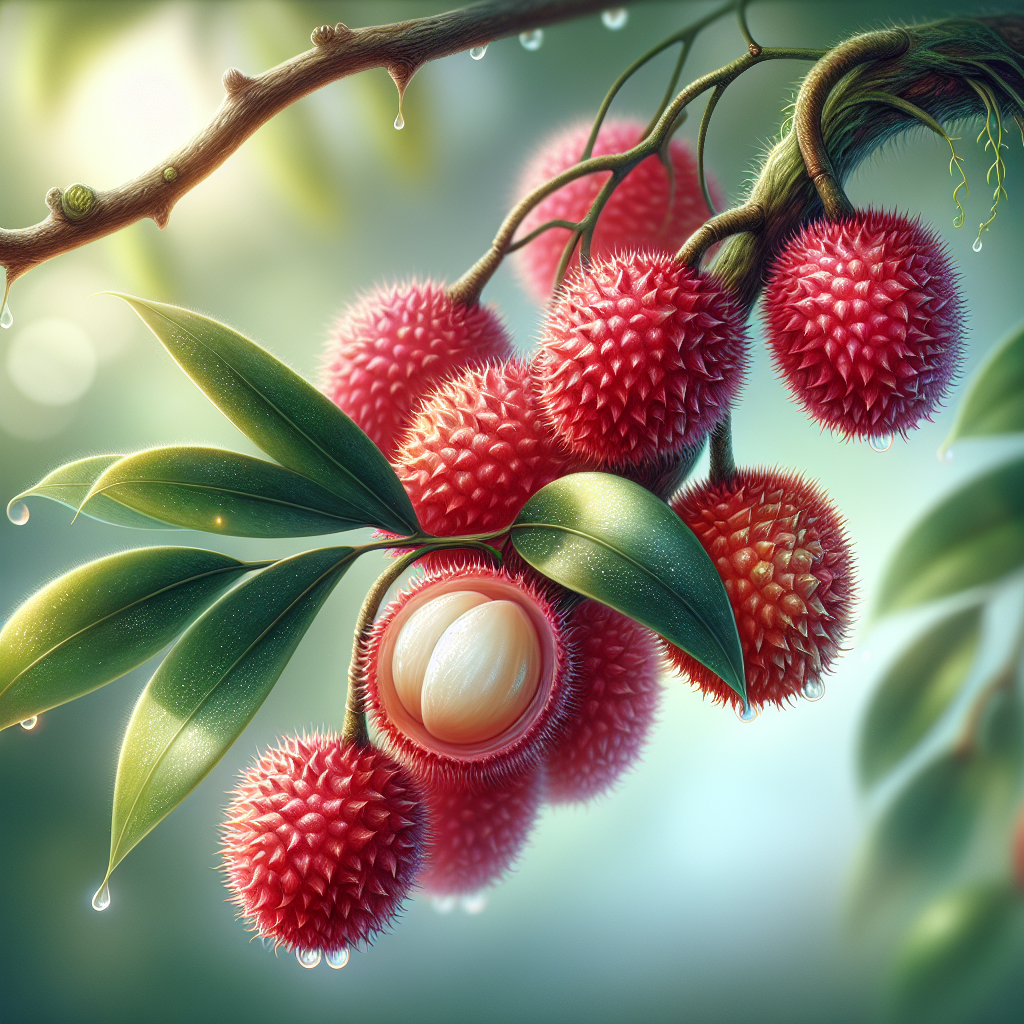
Introduction to Korlan (Nephelium hypoleucum)
Korlan (Nephelium hypoleucum), also known as red rambutan or pulasan in some regions, is an underappreciated gem among tropical fruits. This evergreen tree belongs to the Sapindaceae family, sharing kinship with the more famous rambutan and lychee. Native to the rainforests of Peninsular Malaysia, Thailand, and parts of Indonesia, Korlan has gained niche popularity for its striking appearance and delectable fruit. The tree produces pendulous clusters of ellipsoid fruits, 4-7 cm long, covered in soft, red spines that are less hairy than rambutan's. Inside, translucent white arils surround a single seed, offering a sweet-tart flavor with hints of grape and citrus—far superior in eating quality to its wild relatives.
Commercially, Korlan remains rare outside Southeast Asia, commanding premium prices in international markets due to limited supply. Yields can reach 50-100 kg per mature tree annually, with fruits ripening 12-15 weeks after bloom. For small-scale tropical farmers, Korlan offers diversification potential alongside staples like mango or durian. Its resilience to humid conditions and moderate size (10-20 m tall) make it suitable for backyard orchards or intercropping. However, successful cultivation demands precise attention to climate, soil drainage, and pest management. This deep-dive guide equips growers with professional strategies for propagation, care, and harvest. For more on optimizing tropical polycultures, check this insightful Fall Companion Planting Guide.
Botanical Profile of Korlan (Nephelium hypoleucum)
Korlan is a dioecious evergreen tree, meaning male and female flowers occur on separate plants, necessitating cross-pollination for fruit set. Mature specimens reach 15-25 meters in height with a straight bole up to 50 cm in diameter, though cultivated varieties are often pruned to 8-12 m for easier harvesting. The compound leaves are pinnate, 20-50 cm long, with 6-12 pairs of glossy, leathery leaflets (10-25 cm x 3-7 cm) that are dark green above and pale beneath—hence the species epithet 'hypoleucum' (slightly white below).
Flowers are small (3-5 mm), apetalous, and borne on branched panicles up to 30 cm long. Male inflorescences are more robust, while female ones are slimmer. Pollination relies on bees, flies, and other insects, with peak blooming in the dry season (March-May in native habitats). Fruits mature 100-120 days later, turning from green to bright red or orange-red, with 1-3 cm long flexible spines. Each fruit weighs 20-50 g, with 60-70% edible aril. The seed is ellipsoidal, 2-3 cm long, with a sarcotesta that can be roasted and eaten. Korlan trees exhibit cauliflory, producing fruit directly on older branches and trunks, a trait shared with cacao and coconut. Root systems are shallow and spreading, making them sensitive to waterlogging but excellent for erosion control in humid tropics.
Growth is rapid in youth (1-2 m/year), slowing after 5-7 years. Trees bear fruit at 5-7 years from seed, 3-4 years from grafting. Lifespan exceeds 50 years, with peak production from 15-30 years. Nutritionally, Korlan arils provide 18-20° Brix sugars, vitamin C (40-50 mg/100g), and antioxidants, positioning it as a superfruit candidate.
Soil, pH, and Climate Requirements for Korlan (Nephelium hypoleucum)
Korlan demands well-drained, fertile soils rich in organic matter—sandy loams or clay loams with 2-5% humus are ideal. Avoid heavy clays or compacted soils prone to waterlogging, as roots rot quickly in anaerobic conditions. Optimal pH is 5.5-6.5, slightly acidic; test and amend with dolomite lime if below 5.0 or sulfur if above 7.0. Incorporate 10-20 kg compost per planting hole, plus 200-300 g rock phosphate for phosphorus-loving roots.
Climate-wise, Korlan is a lowland tropical specialist: USDA zones 10b-12, with average temperatures 24-30°C (75-86°F). It tolerates brief dips to 10°C but suffers above 38°C without irrigation. Annual rainfall of 2000-3000 mm, evenly distributed, is perfect; supplement with drip irrigation during dry spells (<100 mm/month). High humidity (70-90%) aids flowering, but 2-3 dry months trigger bloom. Wind protection is crucial—plant in sheltered valleys or use windbreaks like banana hedges. Full sun (6-8 hours/day) promotes vigorous growth, though 30% shade benefits young trees. Elevations up to 800 m are tolerable, but yields drop above 500 m. Mulch heavily (10-15 cm organic matter) to retain moisture and suppress weeds.
Step-by-Step Planting & Propagation
Propagation favors grafting over seeds for uniformity and disease resistance. Seed propagation: Collect ripe fruits, extract seeds, and sow immediately in 50% sand:50% compost beds. Germination occurs in 10-20 days at 28-32°C. Transplant seedlings at 30-40 cm tall to 20 L pots. Viability lasts 2-3 weeks refrigerated.
Grafting (preferred): Use cleft or veneer grafting on rambutan or longan rootstocks in the rainy season. Success rates: 80-90%. Air-layering (marcotting) yields 70% take on 2-3 year branches—wound, apply rooting hormone, wrap in moist sphagnum, roots form in 6-8 weeks.
Planting: Site prep: Dig 60x60x60 cm holes, fill with topsoil + 20 kg FYM + 500 g wood ash. Space 8-10 m apart (100-150 trees/ha). Plant grafted saplings 20-30 cm deep, stake, and mulch. Best time: start of wet season. Irrigate weekly until established (6 months). Prune to single leader at 1 m height.
Care & Maintenance regimes for Korlan (Nephelium hypoleucum)
Irrigation: Deep water young trees weekly (50-100 L/tree); mature trees need 2000-3000 L/month during fruiting. Use drip systems to target roots.
Fertilization: Annual regime: Year 1-3: 200 g NPK 15-15-15 + 100 g urea/tree, split 3x. Mature: 2-3 kg complete fertilizer + 1 kg urea + 2 kg MOP/tree/year, plus foliar micronutrients (Zn, B, Mn). Apply post-harvest and pre-bloom.
Pruning: Annually remove deadwood, watersprouts, and crowded branches. Open center for light penetration; tip-prune after harvest to stimulate next bloom.
Weed control: Mulch + shallow cultivation; avoid root disturbance.
Pests, Diseases & Organic Management
Pests: Fruit-piercing moths (top threat)—use light traps and protein baits. Mealybugs and scale insects controlled with neem oil (2%) or introduce Cryptolaemus beetles. Shoot borers: remove infested tips. Birds deterred with netting.
Diseases: Anthracnose (Colletotrichum spp.): copper fungicide sprays pre-monsoon. Phytophthora root rot: improve drainage, apply Trichoderma. For integrated strategies, see Why 90% of Small Farms Fail at Pest Management—adapt these for tropical orchards.
Organic IPM: Beneficials like ladybugs, predatory mites; sanitation; reflective mulches.
Harvesting, Curing & Optimal Storage
Harvest when 80% fruits red, spines flexible (July-Oct). Clip clusters with secateurs; yield 30-80 fruits/cluster. Handle gently to avoid spine damage. Field-curing: 2-3 days shade to build sugars.
Postharvest: Cool to 13-15°C, 85-90% RH. Shelf life: 2-3 weeks at 15°C; 4-6 weeks controlled atmosphere. For export, hydrocool and pack in ventilated cartons. Arils freeze well at -18°C for 6-12 months.
Companion Planting for Korlan (Nephelium hypoleucum)
Intercrop young orchards with legumes (pigeon pea) for nitrogen fixation, or shade-tolerant ginger. Avoid competitive shallow-rooted crops. Mature: understory pineapple or turmeric suppresses weeds. Repellents: marigold vs nematodes; thyme deters moths. Windbreaks: guava or bamboo.