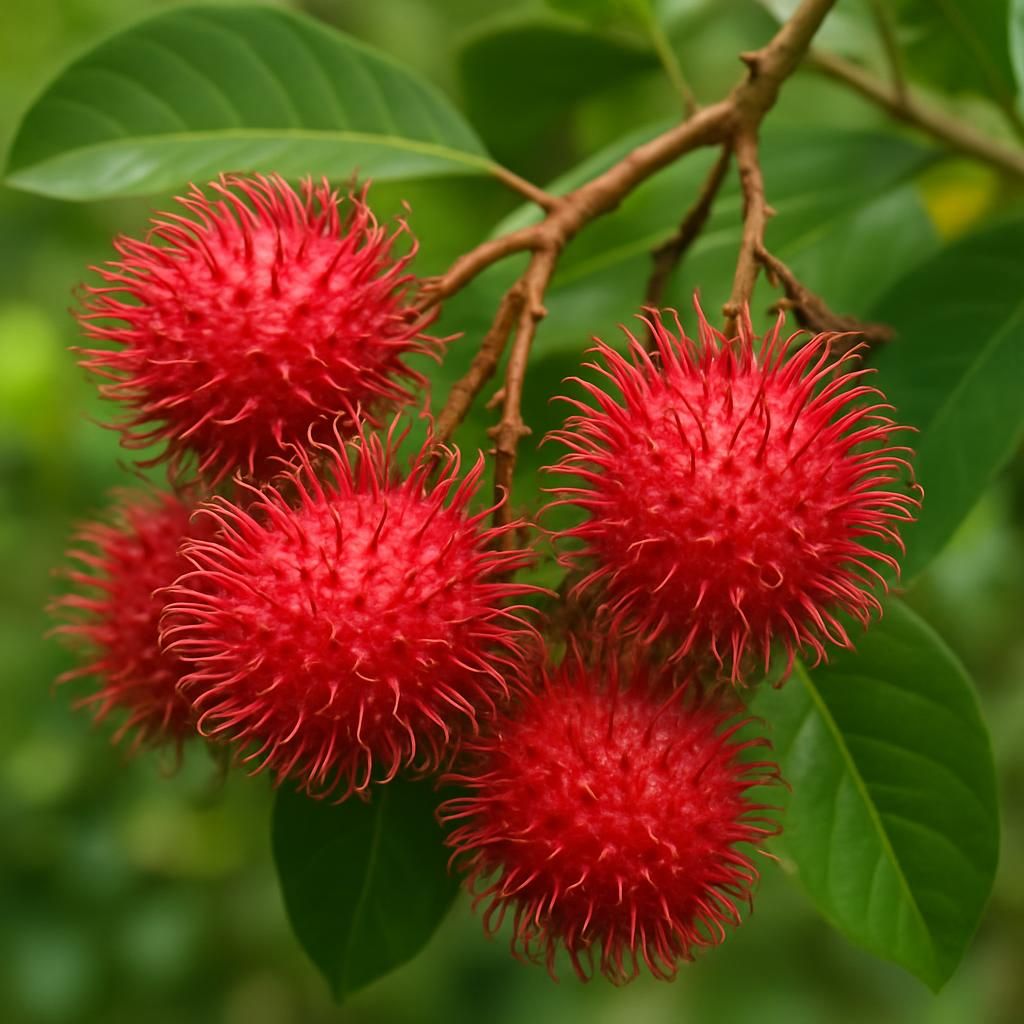
Introduction to Rambutan
Rambutan (Nephelium lappaceum) is a medium-to-large tropical tree in the Sapindaceae family, closely related to Lychee and longan. The name derives from the Malay word for "hairy," referring to the soft, pliable spines covering the fruit. Trees can reach 15–25 m in height with a dense, spreading canopy when left unpruned. The fruit itself is an oval drupe 3–6 cm long with translucent white, sweet-sour flesh surrounding a single seed. Rambutan is grown commercially across Thailand, Malaysia, Indonesia, the Philippines, and increasingly in parts of Central America and Australia. Its high water content (around 80 %) and delicate skin make post-harvest handling critical.
Botanical Profile of Rambutan
The species is a diploid (2n = 22) evergreen with alternate, pinnate leaves 15–45 cm long. Young leaves are reddish and mature to a glossy dark green. Small, apetalous flowers appear in axillary or terminal panicles; most cultivars are andromonoecious, bearing both male and hermaphrodite flowers on the same tree. Cross-pollination by insects, especially bees and flies, improves fruit set. Fruit development takes 100–120 days after anthesis. The aril is attached to the seed and varies from sweet to slightly acidic depending on cultivar. Popular commercial varieties include Rongrien, Binjai, and Jitlee. Trees begin bearing 3–5 years after planting from grafted stock and can remain productive for 25–30 years with proper management.
Soil, pH, and Climate Requirements for Rambutan
Rambutan thrives in deep, well-drained sandy loam to clay loam soils rich in organic matter. The root system is shallow and fibrous, making good drainage essential to prevent Phytophthora root rot. The crop prefers a pH range of 4.5–6.5 and will not tolerate salinity above 2 dS/m. Annual rainfall of 2000–3000 mm distributed throughout the year is ideal, although supplemental irrigation is required during dry spells. Temperatures between 22 °C and 30 °C support optimal growth; trees suffer damage below 10 °C and above 38 °C. High relative humidity (70–90 %) reduces fruit cracking and improves pollinator activity.
| Parameter | Ideal Range | Notes |
|---|---|---|
| Soil Type | Sandy loam to clay loam | Deep profile (>1 m) with good drainage |
| Soil pH | 4.5–6.5 | Avoid alkaline soils; lime only if <4.0 |
| Temperature | 22–30 °C | Protect from frost; shade young trees |
| Annual Rainfall | 2000–3000 mm | Even distribution preferred |
| Relative Humidity | 70–90 % | Critical during flowering and fruit set |
| Elevation | 0–600 m | Lower yields above 800 m |
Step-by-Step Planting & Propagation
Rambutan is almost always propagated by grafting or air-layering to ensure true-to-type plants and earlier bearing. Seed propagation is used only for rootstocks. Select healthy, disease-free scion wood from high-yielding mother trees. Rootstocks are raised from fresh seeds sown in polybags; seedlings reach grafting size (pencil thickness) in 6–8 months. Use the cleft or side-wedge graft during the rainy season when cambial activity is high. Maintain 70 % shade for the first 4 weeks after grafting and gradually harden off. Field planting should occur at the start of the rainy season. Dig pits 60 × 60 × 60 cm and incorporate 10–15 kg well-rotted manure plus 100 g rock phosphate. Space trees 8–10 m apart in a square or hexagonal pattern. Mulch immediately after planting and install temporary shade structures for the first dry season.
Care & Maintenance regimes for Rambutan
Young trees require regular watering (20–30 L per tree twice weekly) until established. Mature orchards need 50–70 mm of water per week during flowering and fruit development. Fertilizer schedules should be split into 4–6 applications annually, emphasizing nitrogen in the vegetative phase and potassium during fruiting. Pruning is limited to removal of dead wood and water sprouts; heavy heading cuts reduce next season’s crop. Inter-row cover crops such as Pueraria phaseoloides help suppress weeds and improve soil nitrogen.
| Growth Stage | Watering Schedule | Fertilizer (per tree/year) | Pruning Schedule |
|---|---|---|---|
| Year 1–2 | 20–30 L twice weekly | 200 g NPK 15-15-15 split 4× | Formative: remove lower branches |
| Year 3–5 | 40–50 L weekly during dry periods | 500 g NPK 15-15-15 + 200 g K₂SO₄ split 4× | Light: dead wood & water sprouts |
| Mature (Year 6+) | 70–100 L weekly or drip irrigation | 1.5–2 kg NPK 12-12-17-2 + 300 g MgSO₄ split 6× | Annual: sanitation only |
| Post-harvest | Reduce to 30–40 L weekly | 300 g NPK 15-15-15 + micronutrients | Remove broken limbs after harvest |
Pests, Diseases & Organic Management
Major insect pests include fruit flies, mealybugs, and thrips. Fruit flies can be managed with protein-bait sprays and sanitation. Mealybugs and scale insects are controlled by releasing Cryptolaemus montrouzieri and applying horticultural oils. The most serious disease is Phytophthora root and collar rot, prevented by improving drainage and using resistant rootstocks. Anthracnose (Colletotrichum gloeosporioides) causes fruit spotting; copper-based sprays and removal of infected debris are effective. Regular monitoring and removal of fallen fruit reduce inoculum. Neem oil and Bacillus thuringiensis provide organic options for lepidopteran larvae.
Harvesting, Curing & Optimal Storage
Rambutan fruits are harvested at full color when the spines are still flexible. Pick by hand or with secateurs, leaving a short stem to reduce latex bleeding. Yield ranges from 20–50 kg per tree at full maturity. Sort immediately to remove damaged or overripe fruit. Pre-cool to 10–12 °C within 4 hours of harvest to slow respiration. Store at 10–12 °C and 90–95 % RH for up to 14 days; temperatures below 8 °C cause chilling injury. Modified-atmosphere packaging with 5–8 % O₂ extends shelf life to 21 days for export. Avoid stacking more than three layers deep to prevent bruising.
Companion Planting for Rambutan
Interplanting with leguminous cover crops such as pigeon pea and Gliricidia sepium improves soil fertility and provides partial shade for young trees. Banana and coconut are traditional companions that create a multi-layered canopy and moderate microclimate humidity. Flowering herbs such as Thai basil attract pollinators and beneficial insects. Avoid planting solanaceous crops nearby, as they may share Phytophthora susceptibility. Maintain a 2 m weed-free strip around trunks to reduce competition and rodent habitat.