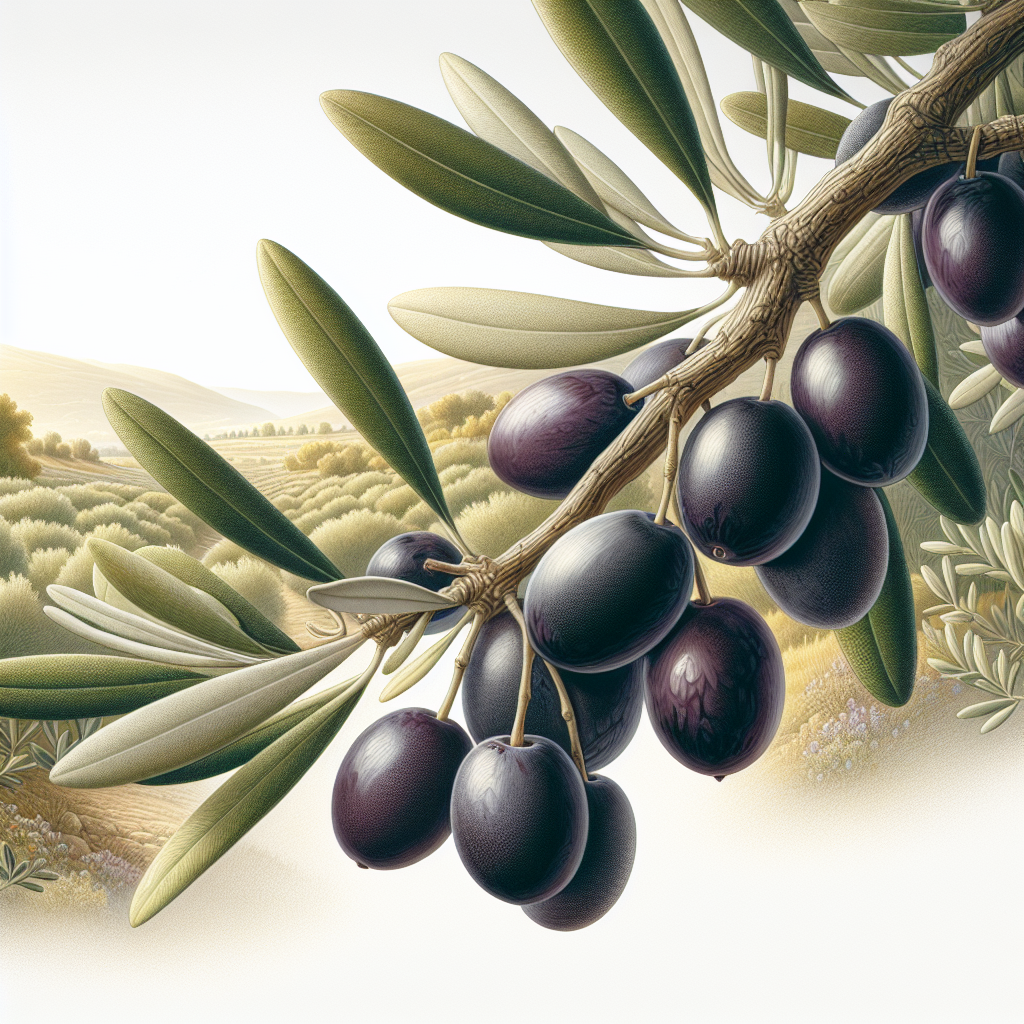
Introduction to Kalamata Olive
The Kalamata olive (Olea europaea 'Kalamata') stands as one of the world's most iconic table olives, originating from the Messinia region of Greece. Renowned for its distinctive almond-shaped fruit, deep purple-black hue, and robust, fruity flavor with notes of wine and figs, Kalamata olives are a staple in Mediterranean cuisine. These olives are primarily harvested for brining or curing, commanding premium prices in global markets due to their PDO (Protected Designation of Origin) status when authentically produced.
Growing Kalamata olives requires patience, as trees take 3-5 years to bear fruit and reach full productivity at 10-15 years. Mature trees can produce 50-100 kg of olives annually under optimal conditions, making them a worthwhile long-term investment for small farms, homesteads, or commercial operations. Success hinges on replicating the tree's native Mediterranean environment: hot, dry summers; mild, wet winters; and excellent drainage. This guide provides professional-grade advice for cultivating high-quality Kalamata olives, from site selection to post-harvest processing. For broader context on olive cultivation, see the Olive (crop) page.
Key benefits include drought tolerance once established, evergreen aesthetics for windbreaks or hedges, and versatility for oil production if table fruit is surplus. Challenges involve frost sensitivity in young trees and specific curing needs to achieve the signature meaty texture. With proper management, Kalamata olives yield not just profit but a taste of ancient Greek heritage in your own backyard.
Botanical Profile of Kalamata Olive
Kalamata olive trees belong to the Oleaceae family, classified as Olea europaea subsp. europaea, with 'Kalamata' as a dual-purpose cultivar (table and limited oil). These are self-incompatible trees, requiring cross-pollination from varieties like Arbequina or Castelvetrano Olive for reliable fruit set. Trees grow to 6-10 meters tall with a gnarled trunk, silvery-green lanceolate leaves (5-10 cm long), and small creamy-white flowers in axillary panicles during spring.
Fruit develops from June to November, maturing to 2-3 cm long, asymmetrical drupes with a pointed apex and firm, meaty mesocarp surrounding a single pit. Oil content is moderate at 20-25%, lower than oil varieties but sufficient for home pressing. Root systems are extensive and shallow, aiding drought resistance but demanding deep, aerated soils to prevent waterlogging.
Phenology includes vegetative growth in spring, flowering in May-June (depending on latitude), fruit set in early summer, veraison (color change) in September, and harvest readiness by late fall. Trees are long-lived, exceeding 100 years with proper care, and alternate bearing is common—high crop one year, low the next—mitigated by pruning and nutrition. Adaptability extends to USDA zones 8-11, with container culture possible in cooler climates using dwarf rootstocks.
Soil, pH, and Climate Requirements for Kalamata Olive
Kalamata olives demand well-drained, rocky or sandy loam soils to mimic their Greek hillside origins; heavy clays lead to Phytophthora root rot. Optimal pH is 6.0-8.0, tolerating slight alkalinity but suffering in acidic conditions below 5.5. Soil tests should guide amendments: incorporate gypsum for sodic soils or lime for low pH.
Climate-wise, 400-600 chill hours (below 7°C) promote uniform flowering, with summer temperatures of 25-35°C ideal for fruit fill. Annual rainfall of 500-800 mm, concentrated in winter, suffices; supplemental drip irrigation during dry spells boosts yields by 20-30%. Avoid frost pockets—young trees tolerate -7°C briefly, mature ones -12°C. High humidity fosters fungal issues like peacock spot, so opt for sloped, windy sites.
Microclimate matters: south-facing slopes maximize heat units. In marginal areas, use frost fans or overhead sprinklers. Soil preparation involves deep ripping (60 cm) to shatter compaction, followed by organic matter like composted manure at 5-10 kg/m² for microbial activity. Mulch with gravel or woodchips conserves moisture and suppresses weeds. For small farms, Soil Health Mastery: 5 Proven Strategies for Small Farms to Build Fertile Ground Without Breaking the Bank offers practical tips adaptable to olives.
Step-by-Step Planting & Propagation
Propagation: Kalamata is typically propagated by hardwood cuttings (10-15 cm, semi-ripe in summer) or grafting onto rootstocks like wild olive (O. europaea var. sylvestris) for vigor. Suckers from mature trees root readily in perlite under mist. Seed propagation is unreliable due to heterozygosity.
Site Prep: Select full-sun sites with 6-7 m spacing (high-density: 4x6 m). Dig holes 60x60x60 cm, backfill with native soil amended 20% compost. Plant in late winter/early spring post-frost.
Planting Steps: 1. Soak bare-root trees overnight. 2. Trim roots, prune top to balance. 3. Position graft union 10 cm above soil. 4. Stake firmly. 5. Water deeply (50 L/tree), mulch 10 cm thick. 6. Apply copper fungicide to prevent collar rot.
Initial irrigation: weekly for first year, tapering to biweekly. Fertilize at planting with 100 g NPK 10-10-10. For container starts, use 20-50 L pots with sandy mix, overwinter indoors in cold zones.
Care & Maintenance regimes for Kalamata Olive
Pruning: Annual winter pruning maintains open canopy for light penetration: remove deadwood, watersprouts, and inward growth. Alternate bearing control involves 'on' year light pruning and 'off' year heavier cuts. Tools: sterilized secateurs.
Irrigation: Drip systems deliver 20-40 L/week/tree in summer; deficit irrigation (50% ETc) enhances fruit quality. Monitor soil moisture at 30 cm depth.
Fertilization: Soil/leaf analysis guides: N 50-100 kg/ha yearly, P/K based on deficiency. Foliar micronutrients (Zn, B, Fe) in spring. Organic options: compost tea, fish emulsion.
Weed Control: Mulch + mow alleys; pre-emergents like flazasulfuron for groves. Hand-pull under canopy.
Winter Protection: Wrap trunks in young trees; hill soil mounds for grafts.
Pests, Diseases & Organic Management
Pests: Primary threats include olive fruit fly (bait sprays with spinosad), black scale (hort oil), and mealybugs (soap sprays). Monitor with traps; release lacewings.
Diseases: Olive knot (Pseudomonas) via copper sprays; peacock spot (Cycloconium) with lime sulfur. Verticillium wilt rare in resistant rootstocks. Promote airflow via pruning.
Organic Strategies: Neem oil for scales, kaolin clay for fruit fly, compost extracts for soil pathogens. Beneficials: birds for flies, predatory beetles for scales. Avoid overhead watering. See Spring Pest Patrol: Organic AI Strategies to Shield Your Crops from Common Invaders for integrated plans.
Harvesting, Curing & Optimal Storage
Harvest late October-November at 18-22% oil for table olives: hand-pick or shake onto nets to avoid bruising. Yield: 20-50 kg/tree at maturity.
Curing: 1. Slit lengthwise. 2. Brine in 8-10% salt + vinegar (pH 3.5). 3. Ferment 6-12 months at 18-20°C, skimming scum. 4. Stage brine to 7% salt. Alternatives: dry-salt or water-cure.
Storage: Refrigerated brined olives last 6-12 months; oil-submerged indefinitely. Process promptly to prevent souring.
Companion Planting for Kalamata Olive
Kalamata olives pair well with nitrogen-fixers like clover for soil fertility, thyme or rosemary for pest repulsion, and marigold against nematodes. Underplant with garlic to deter aphids. Avoid potato or water-hungry crops competing for resources. Yarrow attracts pollinators. Learn more in Why Companion Planting Feels Like Guesswork for Small Farms - And How AI Makes It Foolproof.