Introduction to Peacock spot
Peacock spot, scientifically known as Stagonospora nodorum blotch (SNB) or Septoria nodorum blotch, is one of the most economically important foliar diseases impacting cereal crops worldwide. Caused by the necrotrophic fungus Stagonospora nodorum (formerly Septoria nodorum), this disease manifests as distinctive leaf spots that resemble the eye patterns on a peacock's feathers—hence the name. First identified in the early 20th century, peacock spot has become a persistent challenge for wheat growers, particularly in temperate regions with high rainfall.
The pathogen infects all above-ground plant parts, starting with lower leaves and progressing upward, potentially causing 10-50% yield reductions in severe epidemics. In addition to direct tissue damage, S. nodorum produces toxins like SnToxA that exacerbate necrosis and reduce grain quality through shriveled kernels and low test weights. This guide provides professional-grade diagnostic criteria, lifecycle insights, and integrated management strategies tailored for commercial and small-scale farmers. Understanding peacock spot is crucial for wheat producers, as it often co-occurs with other leaf spot diseases like Septoria leaf spot, complicating field diagnosis.
Global incidence is highest in Europe, North America, and Australia, where winter wheat varieties are particularly susceptible. Recent studies indicate rising prevalence due to climate shifts favoring prolonged leaf wetness. Early detection and proactive management can preserve yields and maintain profitability, making this disease a focal point for precision agriculture.
Identifying Symptoms & Damage
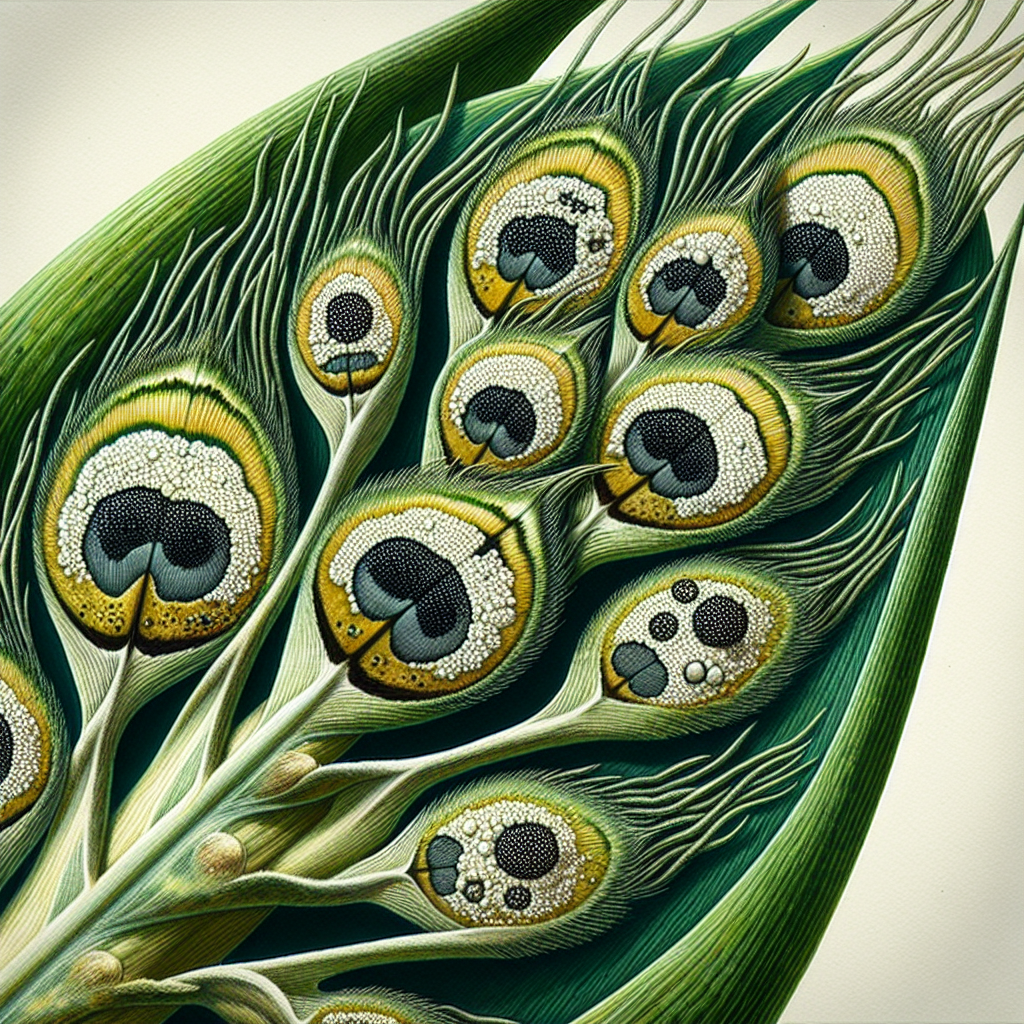
Peacock spot symptoms appear 10-14 days after infection, initially as small, water-soaked lesions on lower leaves. These evolve into oval to elliptical spots (3-10 mm long) with a grayish-white center, dark brown to black borders, and a characteristic yellow halo—mimicking peacock eye feathers. Mature spots often feature tiny black pycnidia (fruiting bodies) embedded in the center, visible under magnification as dark specks exuding orange spore masses in wet conditions.
Leaf infection starts at the leaf tip and margins, progressing basipetally. Severe cases lead to blighting of entire leaves, with up to 50% leaf area necrosis by tillering stage. On stems, dark brown lesions with black pycnidia form, weakening culms and increasing lodging risk. Glume blotch, the most yield-damaging phase, appears at heading as tan to light brown blotches on glumes and awns, often with black pycnidia. Pinkish spore ooze confirms active infection during rain.
Damage quantification correlates with disease severity: 20% leaf area affected at flag leaf emergence can cut yields by 10-15%; glume infection exceeding 30% reduces grain weight by 20-40% and downgrades quality. Secondary effects include reduced photosynthesis, poor grain fill, and increased susceptibility to powdery mildew. Differentiate from tan spot (smaller, yellow-centered spots without pycnidia) or Septoria tritici blotch (larger, rectangular lesions with abundant pycnidia). Field diagnosis: scrape spots to reveal pycnidia; lab confirmation via PCR detects S. nodorum DNA.
Yield impacts are compounded in continuous wheat systems, where residue harbors inoculum. Scout weekly from tillering, using the Wheat Disease Severity Scale: 1-5% mild, >20% severe requiring intervention.
Lifecycle and Progression of Peacock spot
S. nodorum is a polycyclic pathogen with multiple infection cycles per season. Primary inoculum overwinters as pycnidia on infected crop residue, seeds, and volunteer plants. Spring rains ( >8 hours leaf wetness at 10-25°C) release pycnidiospores, which splash-disperse up to 1-2 meters to lower leaves.
Germination occurs within 6-12 hours on wet foliage, with appressoria forming to penetrate via stomata or wounds. Incubation lasts 7-21 days, depending on temperature (optimum 20°C) and humidity. Symptoms emerge as chlorotic flecks expanding to necrotic spots. New pycnidia mature in 14-21 days, producing conidia for secondary spread via rain splash and wind-driven rain.
Three to five cycles occur from autumn to harvest, peaking at flag leaf stage. Sexual stage (pseudothecia) forms on residue post-harvest, producing ascospores for long-distance airborne dispersal. Seed transmission rates reach 20-50% in heavily infected crops. Toxin production (SnToxA, SnTox1) sensitizes tissues, accelerating spread in susceptible varieties.
Progression: Autumn infections on seedlings → tillering leaf spots → stem/glume phases at booting. Epidemics build when residue >30% surface cover and rainfall >500 mm/season. For detailed management timing, check our Soil Health Mastery blog post, which discusses residue management.
Environmental Triggers & Risk Factors
Peacock spot epidemics require prolonged leaf wetness (8-48 hours), temperatures 5-25°C (optimum 15-20°C), and susceptible hosts. High humidity (>85%) and frequent rain (>20 mm/week) drive splash dispersal. Cool, wet springs favor early buildup; warm, dry summers limit late-season spread.
Key risk factors: continuous cereals (>2 years), high residue retention (>30%), narrow rotations lacking brassicas or barley. Excessive nitrogen (>150 kg/ha) promotes lush foliage ideal for infection. Susceptible varieties (e.g., older winter wheats) amplify risk; volunteer plants bridge seasons. Poor airflow from dense canopies (>400 plants/m²) extends wetness periods.
Soil factors: neutral pH (6.5-7.5), high organic matter retain moisture. Climate change extends risk windows with wetter autumns. Integrated Pest Management (IPM) thresholds: initiate scouting if >10% lower leaves infected at tillering.
Organic Control & Treatment Plans
Organic management emphasizes cultural, biological, and resistant varieties, avoiding synthetic fungicides. Cultural Practices: Rotate with non-hosts like peas or onions (2-3 years minimum); destroy volunteers; bury residue via tillage (10-15 cm depth). Promote airflow with 20-25 cm row spacing, avoid excess N.
Resistant Varieties: Select SNB-tolerant wheats (e.g., varieties with low SnToxA sensitivity); check regional trials for ratings <5 on 1-9 scale.
Biological Controls: Apply Clonostachys rosea or Trichoderma spp. (1-2x at tillering) to suppress residue inoculum. Compost teas with Bacillus subtilis reduce conidia germination by 40-60%.
Organic Fungicides: Copper oxychloride (pre-tillering, 2-3 kg/ha) or sulfur-based products (flag leaf, 5 kg/ha); potassium bicarbonate for early suppression. Timing: first application at 10% severity on leaf 3, repeat 14-21 days.
Monitoring: Use weather-based models (e.g., wetness hours >40) for sprays. Integrate with companion planting like clover for diversity. Expect 20-40% control; combine for >70% efficacy.
Preventing Peacock spot in the Future
Long-term prevention builds resilient systems. Crop Rotation: 3-4 year cycles with corn, legumes, or brassicas reduce inoculum by 80%. Residue Management: Minimum tillage with residue incorporation; cover crops like rye suppress splash.
Variety Selection: Plant resistant hybrids (e.g., <3 rating); diversify fields with blends. Fertility Balance: Soil test-guided N (120-140 kg/ha split); K/Mg amendments harden tissues.
Sanitation: Clean equipment/seeds; deep plow stubble. Scouting & Forecasting: Weekly checks; apps track wetness/risk indices. IPM Integration: Threshold-based action; beneficials like predatory mites control vectors.
Future-proof with cover cropping: plant oats post-harvest to outcompete volunteers. Monitor for resistance erosion; rotate modes of action.
Crops Most Affected by Peacock spot
Primarily wheat (Triticum aestivum), especially winter types, with losses up to 50% in wet seasons. Barley (Hordeum vulgare) suffers net blotch-like symptoms, 10-30% yield hits. Minor hosts: rye (rye), triticale (triticale), and wild grasses. Durum wheat highly susceptible to glume blotch.
Rarely impacts oats or maize. Global hotspots: UK, France, US Great Plains, Australia. Susceptibility varies: soft white wheats > hard red springs.