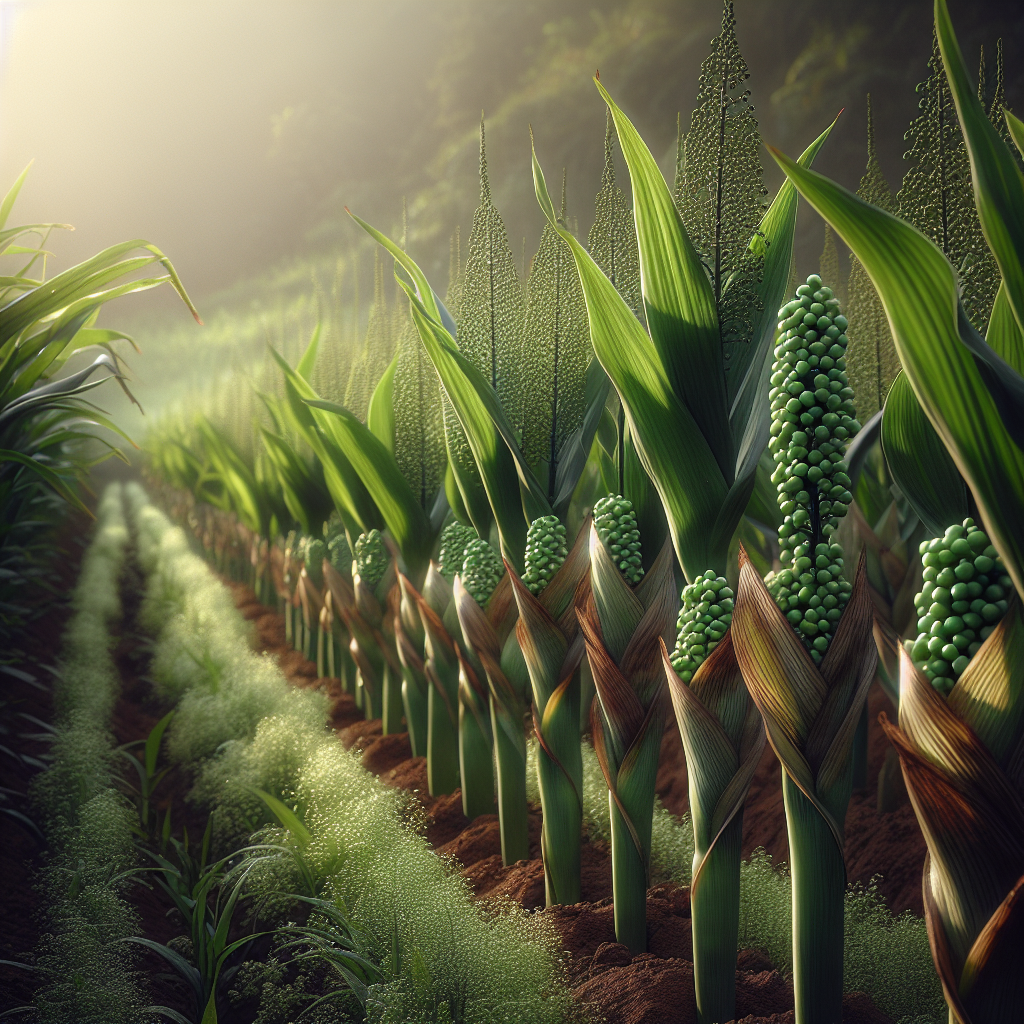
Introduction to Job's Tears
An ancient cereal of Southeast and East Asia, this species has been cultivated for centuries as a food grain, forage plant, medicinal crop, and source of naturally hard, glossy beads used in jewelry and religious craftwork. In English it is commonly called Job's Tears because the shiny, teardrop-like involucres surrounding the seed resemble droplets. In different production systems, growers may raise it either for soft-shelled edible grain types or for hard-shelled ornamental forms, and understanding which type you have is essential because harvest, processing, and market value differ significantly.
Agronomically, it is a robust C4 grass with a long warm growing season, moderate to high moisture demand, and a strong response to fertile soils. It performs best where summers are hot, rainfall is dependable, and frost is absent for at least 120 to 150 days. Farmers familiar with corn will recognize some similarities in canopy development and nutrient demand, but Job's Tears is generally more tolerant of intermittent wet feet and often better suited to humid lowland conditions than many small grains.
This crop is especially valuable in diversified systems because it can serve multiple purposes at once: grain production, erosion control, animal fodder from vegetative biomass, and ecological diversification in mixed fields. In many traditional farms it is planted along moist margins, paddy edges, or lower slopes where drainage is imperfect but not permanently flooded.
Botanical Profile of Job's Tears
This species belongs to the Poaceae family and is taxonomically placed in the genus Coix. The plant is a tall, tufted annual or short-lived perennial grass depending on climate and management. Most cultivated grain forms are grown as annuals. Plants commonly reach 1 to 2 meters in height, though vigorous types in fertile tropical soils can exceed that.
The stems are cane-like, jointed, and branching from the base or lower nodes. Leaves are long, arching, and broad compared with many millet species, often 2 to 5 centimeters wide and 30 to 60 centimeters long. The root system is fibrous and relatively extensive, allowing decent recovery after short dry spells, but maximum yield still depends on consistent soil moisture.
Its flowering biology is unusual and one of the crop's defining features. The female spikelet is enclosed in a hardened, bead-like involucre that varies in color from ivory and gray to brown, purple, or nearly black. The male flowers emerge from the terminal opening. In edible forms, the shell is usually thinner and easier to mill. In bead forms, it is extremely hard, glossy, and durable.
Several botanical forms and landraces exist. Coix lacryma-jobi var. ma-yuen is often associated with edible cultivated forms selected for larger grain and thinner shells. Wild or ornamental types tend to have smaller, harder structures and lower direct food value. This distinction matters because some growers unknowingly plant ornamental bead types and later discover that dehulling is impractical for food use.
Growth proceeds through seedling establishment, tillering, stem elongation, flowering, grain fill, and dry-down. Grain maturation is not always perfectly uniform across tillers, so commercial growers often harvest in stages or wait for the majority of heads and involucres to mature while accepting some variation.
Soil, pH, and Climate Requirements for Job's Tears
This crop thrives in deep, fertile, moisture-retentive but aerated soils. Ideal textures are silt loam, clay loam, or fertile alluvial loam with good organic matter. It tolerates heavier ground better than many cereals, provided water does not remain stagnant long enough to exclude oxygen from the root zone. Light sandy soils can work, but only if irrigation and fertility are managed carefully because rapid drying and nutrient leaching sharply reduce tillering and grain fill.
The preferred soil pH is approximately 5.5 to 7.0, with an optimum near 6.0 to 6.8. It can tolerate mildly acidic conditions better than strongly alkaline soils. Below pH 5.2, aluminum toxicity and phosphorus fixation may limit vigor; above pH 7.5, micronutrient lock-up, especially zinc and iron, may show as interveinal chlorosis on younger leaves.
For climate, Job's Tears is best suited to tropical, subtropical, and warm temperate regions with a long frost-free season. Optimal temperature for active growth is about 22 to 32°C. Germination is strongest when soil temperatures are at least 18 to 20°C. Growth slows below 15°C, and even light frost can severely damage or kill plants.
Moisture is one of the most important management factors. The crop performs best with evenly moist soil from establishment through grain filling. A practical target is to maintain soil moisture near 60 to 80% of field capacity through vegetative growth, increasing toward the upper end during panicle initiation and early grain fill. In field terms, soil at 10 to 15 centimeters deep should feel cool and slightly adhesive when squeezed, forming a weak ball that breaks apart with light pressure. If it becomes powdery at that depth, the crop is entering stress. If the soil stays greasy, smells sour, or leaves remain pale and drooping despite wet ground, roots may be oxygen-starved.
Rainfall of 900 to 1500 mm over the season is favorable, though high yields are possible under irrigation. The plant tolerates temporary waterlogging better than drought, but chronic saturation still reduces root health, promotes fungal disease, and weakens stand uniformity. Raised beds or shallow drainage furrows are helpful in monsoonal climates where intense storms cause ponding.
If you are improving field structure before sowing, principles used in broader regenerative cereal systems apply well; see soil health strategies for ideas on organic matter building and infiltration.
Step-by-Step Planting & Propagation
Propagation is almost always by seed. Select seed from a known edible strain if grain is your target. Reject lots containing many undersized, malformed, or extremely hard bead-like kernels unless ornamentals are the goal.
Prepare the field 2 to 4 weeks before sowing. Incorporate well-finished compost or aged manure at roughly 10 to 20 tons per hectare, depending on baseline fertility. Create a fine but not powdery seedbed. Excessively fluffy soil causes uneven seed depth and erratic emergence.
Time sowing after frost danger has passed and soil temperatures are reliably warm. In monsoon climates, sow at the onset of dependable rains but avoid the first extreme downpours if crusting or washout is likely.
Pre-soak seed for 8 to 24 hours in clean water to speed germination, especially in drier seed lots or cooler marginal conditions. Do not soak so long that fermentation begins.
Sow seed 2 to 4 centimeters deep. In lighter soil, plant closer to 4 centimeters; in heavier or wetter soil, 2 to 3 centimeters is safer.
Space rows 50 to 75 centimeters apart for hand-weeded or intercropped systems, or 30 to 45 centimeters in more intensively managed grain blocks. Within rows, thin or plant to 15 to 30 centimeters between plants. Wider spacing encourages tillering and easier airflow; denser spacing can improve weed suppression but increases disease pressure in humid climates.
For broadcast seeding, increase seed rate because emergence and spacing uniformity will be lower. Precision drilling is preferable for grain production.
Keep the topsoil consistently moist until emergence, which usually occurs in 7 to 21 days depending on temperature and shell hardness.
Transplanting is possible but less common. If started in modules, sow one seed per cell and transplant when seedlings have 3 to 4 true leaves, taking care not to disturb the root ball. Direct seeding usually outperforms transplants except in very short-season regions.
In smallholder mixed systems, farmers often place Job's Tears on moist field edges or in strips alternating with legumes. This can reduce weed competition, diversify harvest windows, and moderate risk.
Care & Maintenance regimes for Job's Tears
Early establishment is the most critical phase. Seedlings grow steadily once warm weather arrives, but they are poor competitors with aggressive weeds for the first 4 to 6 weeks. Keep the field clean with shallow hoeing, wheel hoe cultivation, stale seedbed techniques, or mulch between wider rows. Avoid deep cultivation that severs shallow feeder roots.
Nutrient demand is moderate to high, especially for nitrogen and potassium. A balanced fertility approach works best. As a general program for medium-fertility soils, apply the equivalent of 60 to 120 kg/ha nitrogen, 30 to 60 kg/ha phosphorus, and 30 to 80 kg/ha potassium, adjusting to soil test results and yield targets. In organic systems, split nitrogen sources such as composted poultry manure, feather meal, or fermented plant-based inputs so that roughly one-third is available at planting, one-third at early tillering, and one-third just before stem elongation. Too much early nitrogen produces lush foliage at the expense of grain set and increases lodging risk.
Watch the leaves for nutrient clues. Pale green older leaves and weak tillering often indicate nitrogen shortage. Marginal scorching or weak stalks can point to potassium deficiency. Purpling of young plants in cool soils may indicate temporary phosphorus limitation.
Irrigation should be adjusted by stage. During germination and emergence, maintain uniformly moist surface soil without crusting. During vegetative growth, irrigate when the upper 5 to 8 centimeters begin to dry but before plants roll leaves or lose midday turgor. During flowering and early grain fill, never allow severe moisture stress: even 5 to 7 days of dryness in hot weather can reduce grain set and kernel weight. A useful benchmark is 25 to 40 mm of water per week under moderate conditions and 40 to 50 mm in hotter, windy periods, accounting for rainfall and soil type.
Signs of underwatering include folded leaves in the morning, bluish-gray foliage, slowed stem extension, poor tillering, and small involucres. Signs of overwatering include persistent wilting despite wet soil, yellowing from the lower canopy upward, sour-smelling soil, blackened roots, and increased fungal lesions on leaves or sheaths.
Mulching with straw or chopped grass between rows helps stabilize moisture, reduce splash-borne disease, and suppress weeds. Keep mulch a few centimeters away from the stem bases to avoid collar rot in humid conditions.
Lodging can occur in fertile soils, especially with excess nitrogen and dense stands. If plants become top-heavy, reduce late nitrogen, avoid over-irrigation, and maintain adequate potassium and silica-rich organic matter where available.
Pests, Diseases & Organic Management
Job's Tears is generally resilient, but it is not pest-free. Common threats vary by region and include Stem borers, Armyworms, Grasshoppers, Aphids, and Birds at grain maturity. In humid production zones, Leaf blights, Rusts, Sheath rots, and Root rots are the most relevant disease categories.
Stem borers cause dead hearts in younger plants or tunneling in maturing stems. Look for pinholes, frass, or central whorls that pull out easily. Remove and destroy heavily infested stems early. Encourage predator diversity by maintaining flowering border plants and avoiding broad-spectrum sprays.
Armyworms and caterpillars skeletonize or chew leaves rapidly. Scout at dusk and early morning. Hand-picking works in small plots; Bacillus thuringiensis is effective against young larvae when applied thoroughly.
Aphids may cluster on tender growth and sometimes vector viral problems. Strong water sprays, conservation of lady beetles and lacewings, and carefully applied insecticidal soap can suppress outbreaks.
Bird pressure can be severe as grains mature. Netting, reflective tape, field rotation, and synchronized block planting reduce localized losses better than scare devices alone.
For disease management, prevention matters more than cure. Use clean seed, rotate out of grasses for at least 2 years when disease pressure has been high, and avoid planting in low spots where humidity lingers. Space plants for airflow and irrigate early in the day so foliage dries quickly.
Leaf blight symptoms include elongated tan or brown lesions that may merge under wet conditions. Remove heavily infected debris after harvest. Organic copper products can slow spread in severe cases, but they should be used judiciously and only as part of a broader sanitation and airflow strategy.
Root and crown issues usually begin with saturated soil. Uproot a symptomatic plant and inspect roots: healthy roots are pale and firm, while diseased roots are brown, water-soaked, or sloughing. Improve drainage immediately rather than simply reducing irrigation frequency without correcting infiltration.
Weed management is also part of pest management. Dense grass weeds harbor insect populations and compete strongly for nitrogen. Two timely weedings before canopy closure often determine whether the crop remains vigorous enough to outgrow later pressure.
Harvesting, Curing & Optimal Storage
Harvest timing depends on end use. For edible grain, wait until most involucres or seed structures have matured and turned firm, with plants beginning to yellow and dry. Moisture content at harvest is often still too high for safe storage, so post-harvest drying is essential. For bead use, wait until shells are fully hardened and glossy.
Unlike some cereals, ripening may be uneven among tillers. In small plots, selective picking of mature heads or repeated cuttings can improve quality. In field-scale systems, harvest when about 80 to 90% of the crop is mature and accept some mixed maturity, then sort during processing.
Cut whole stalks and bundle them, or strip mature clusters by hand. Dry the harvested material under cover with strong ventilation until grain moisture falls to about 12% or lower for storage. If drying conditions are humid, use raised racks, mesh trays, or forced-air systems. Grain that seems dry externally may still contain dangerous internal moisture, so do not rush bagging.
Threshing can be done by beating dried heads, trampling on clean tarps, or using small mechanical threshers. Edible types must then be dehulled or milled. This is one reason cultivar choice matters so much: hard-shelled ornamental forms are difficult and uneconomical to process as food grain.
For storage, use clean, dry containers in a cool, low-humidity space. Ideal storage conditions are below 15°C and below 60% relative humidity when possible. In warmer climates, sealed food-grade containers with desiccant packs or dry botanical repellents can help. Inspect monthly for condensation, off-odors, mold, insect frass, or heating. Any musty smell indicates moisture problems and grain should be re-dried immediately.
Properly dried grain can store for many months, often 8 to 12 months or longer under good conditions. Seed reserved for planting should come from the healthiest, most productive plants and be stored especially carefully because viability declines rapidly under heat and humidity.
Companion Planting for Job's Tears
This crop works best with companions that either improve soil fertility, attract beneficial insects, or occupy a different canopy niche without aggressively shading young plants. Legumes are particularly useful because Job's Tears responds strongly to available nitrogen but should not be overforced with lush synthetic fertility.
Clover can be used as a low understory or off-season living cover in wider row systems. It helps reduce erosion, supports pollinators when allowed to flower, and can contribute biologically fixed nitrogen over time. In wetter climates, manage it carefully so it does not create excessive humidity at the crop base.
Soybeans are a practical intercrop or rotational companion where spacing allows. They occupy a complementary mid-layer, diversify farm output, and leave useful nitrogen residues if residues are returned to the soil. Keep spacing generous enough that neither crop suppresses the other during early establishment.
Sunflower can act as a beneficial insect attractor and visual wind filter on field margins. It also helps distribute pollinator and predator activity across the block, though it should remain on borders rather than mixed densely into the stand because of competition for light and moisture.
Thai Basil is especially useful in garden-scale production. Its flowers attract pollinators and predatory insects, and its strong aroma can make mixed plantings more diverse ecologically. Place it on bed edges or row ends rather than inside dense grain rows.
Avoid pairing Job's Tears too tightly with other heavy-feeding tall grasses, since competition for nitrogen, root space, and light can sharply reduce yield. Where intercropping is desired, use strip arrangements rather than intimate mixing, and ensure each strip remains accessible for weeding and harvest.