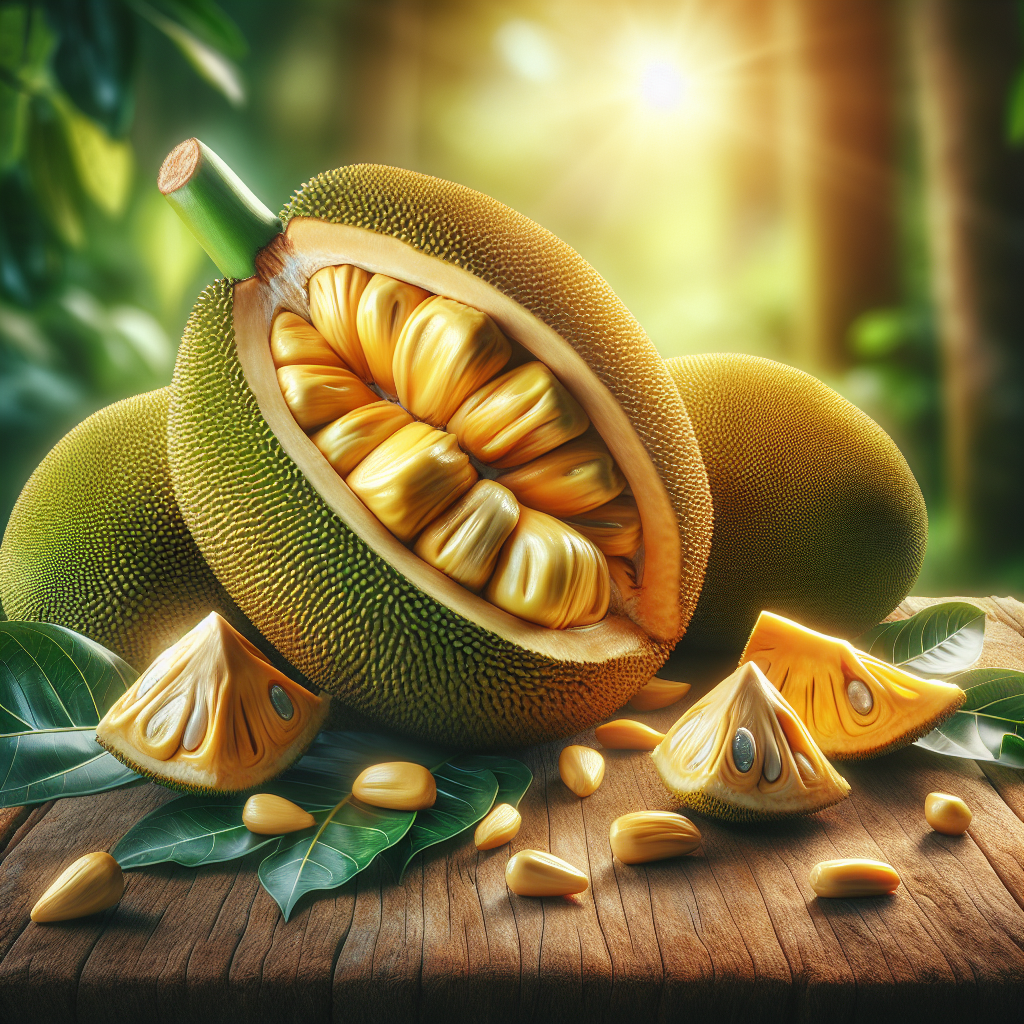
Introduction to Jackfruit (J-31)
Jackfruit (J-31), a superior cultivar of Artocarpus heterophyllus, stands out as one of the largest tree-borne fruits, capable of producing fruits weighing 30-50 kg or more. Native to the rainforests of South and Southeast Asia, this variety has been selectively bred for enhanced fruit size, sweetness, and disease resistance, making it ideal for commercial and homestead cultivation in tropical and subtropical regions. J-31 trees are vigorous growers, reaching 15-20 meters in height, with deeply lobed leaves and a distinctive milky latex. The fruit's thick, spiny rind encases hundreds of large, yellow bulbs rich in carbohydrates, vitamins A and C, and potassium, positioning it as a sustainable meat substitute in vegan diets and a staple in tropical agriculture.
Economically, Jackfruit (J-31) offers multiple revenue streams: fresh fruit sales, processed jackchips, flour for gluten-free baking, and even timber from mature trees. With proper management, a single tree can yield 100-200 kg annually after 5-7 years, providing long-term returns for small farms. This comprehensive guide draws on botanical expertise to deliver actionable strategies for maximizing yields while minimizing inputs. Whether you're scaling up production or starting a backyard orchard, mastering J-31 cultivation ensures resilience against climate variability and market demands. For insights into similar tropical giants, explore Durian (crop).
Botanical Profile of Jackfruit (J-31)
Jackfruit (J-31) belongs to the Moraceae family, closely related to breadfruit and mulberry. As a monoecious evergreen, it produces separate male and female flowers on the same tree, with female flowers developing into syncarps—the compound fruit structure. The J-31 cultivar features larger bulbs (5-10 cm) with a honey-like flavor, ripening in 90-120 days. Leaves are glossy, 15-25 cm long, with juvenile leaves deeply lobed and adult leaves elliptic. Roots are extensive, with a taproot system extending 2-3 meters deep, demanding ample space—minimum 10x10 meters per tree.
Flowering occurs year-round in equatorial zones but peaks with monsoon onset. Pollination is primarily by wind and insects like bees. Seeds are recalcitrant, losing viability within weeks, necessitating fresh propagation. J-31 exhibits protogyny, where female flowers mature first, reducing self-pollination issues. Growth is rapid in the first 3 years (1-2 m/year), slowing thereafter. Nutrient demands peak during fruit swell, requiring high potassium for bulb development. This profile underscores J-31's adaptability to intercropping in young orchards, enhancing early farm profitability.
Soil, pH, and Climate Requirements for Jackfruit (J-31)
Jackfruit (J-31) thrives in deep, well-drained loamy soils rich in organic matter, with pH 6.0-7.5. Avoid waterlogged clays prone to Phytophthora (disease); amend heavy soils with 30-50% compost and raised beds. Optimal texture: 40% sand, 30% silt, 30% clay. Conduct soil tests targeting 200-300 ppm K, 100-150 ppm P, and 150-200 ppm N. Incorporate gypsum for sodic soils and lime for acidic profiles below pH 6.0.
Climatically, J-31 demands frost-free tropics: 24-32°C daytime, minima above 15°C. Annual rainfall 1500-2500 mm, evenly distributed; supplement with drip irrigation (20-40 L/tree/day) in dry spells exceeding 2 weeks. Humidity >60% supports fruit set; mulch conserves moisture and suppresses weeds. Windbreaks of Gliricidia (crop) protect young trees. Elevation up to 1000 m suits upland farms, but chilling below 10°C halts growth. For heatwave resilience, see Why Summer Heatwaves Are Silently Killing Small Farm Yields - And 7 Organic Strategies to Fight Back. Salinity tolerance is low (EC <2 dS/m); leach with quality water.
Step-by-Step Planting & Propagation
Propagation: Favor air-layering or grafting for J-31 uniformity over seeds. Select 2-3 year scions from high-yield mother trees. For air-layering: girdle 5 cm wide, apply 5000 ppm IBA rooting hormone, wrap in moist sphagnum moss and polythene; roots form in 6-8 weeks. Graft onto rootstock like local robustus varieties using cleft or veneer methods (80% success). Seed propagation: Sow fresh seeds 2-3 cm deep in 50% sand:50% compost; germinate in 10-14 days at 28-32°C.
Site Preparation: Clear land, plow 60 cm deep, incorporate 20 kg FYM + 500g SSP per pit. Dig 1x1x1 m pits, space 10-12 m apart (83-100 trees/ha).
Planting: Transplant 1-2 year seedlings (60-90 cm) at monsoon onset. Position graft union 20 cm above soil. Stake, mulch 10 cm thick with paddy straw. Initial fertilizer: 500g NPK 10-20-20/tree at planting.
Young Tree Care: Irrigate weekly (50 L/tree), prune watersprouts. Intercrop with Thai Basil (crop) or legumes for soil cover.
Care & Maintenance regimes for Jackfruit (J-31)
Irrigation: Drip schedule: 40-60 L/day during fruiting; deficit irrigate pre-monsoon to trigger flowering. Mulch retains 30% more moisture.
Fertilization: Year 1-3: 1-2 kg NPK 10-30-20/tree annually, split 3x. Mature: 5-10 kg N, 3-5 kg P, 10-15 kg K/tree/year + 50 kg FYM. Foliar: 2% urea + 1% KNO3 biweekly during swell.
Pruning: Annually post-harvest: remove deadwood, watersprouts, inward branches. Maintain open center for light penetration. Tip prune to promote laterals.
Weed Control: Mulch + manual; pre-emergent glyphosate sparingly.
Training: Single trunk to 4-5 m, then scaffold 4-6 primaries.
Monitor via regular scouting; adjust based on leaf analysis.
Pests, Diseases & Organic Management
Pests: Mealybugs (pest) cluster on shoots—neem oil 2% + 0.5% soap weekly. Fruit flies (pest) attack ripening: cue-lure traps + protein baits. Beetles (pest) bore shoots—remove manually, entomopathogenic fungi. Aphids (pest)—ladybugs + garlic-chili spray.
Diseases: Rhizoctonia (disease) causes root rot—improve drainage, Trichoderma drench. Anthracnose (disease)—copper oxychloride + sanitation. Powdery mildew (disease)—sulfur sprays. Avoid overhead watering.
Organic IPM: Yellow sticky traps, neem cake soil amendment, Marigold (crop) borders. For broader strategies, check Why 90% of Small Farms Fail at Pest Management - And 8 Organic Fixes That Actually Work.
Harvesting, Curing & Optimal Storage
Harvest at 90-120 days post-anthesis when milk exudes yellow, spines soften, rind yellows 75%. Use pole pruners or ladders; cut stalk 5-10 cm. Yield: 50-150 fruits/tree.
Curing: Ripen at 25-30°C, 85% RH; ethylene 100 ppm accelerates. Shelf life 7-10 days.
Storage: Mature green: 13-15°C, 85-90% RH (4-6 weeks). Ripe: 12°C (2-3 weeks). Process into chips (60°C drying) or frozen pulp (-18°C, 12 months).
Post-harvest: Sort, clean, wax for markets.
Companion Planting for Jackfruit (J-31)
Young J-31 orchards benefit from shade-tolerant undercrops. Nitrogen-fixers: Pigeon pea (crop), Clover (crop)—boost soil N 20-30%. Repellents: Rosemary (crop), Nasturtium (crop) deter mites (pest). Groundcovers: Sweet Potato (crop) suppress weeds.
Avoid allelopathic Walnut (crop). Interplant Banana (crop) for wind protection, microclimate moderation. Mature trees: minimal understory to avoid competition. Benefits: 15-25% yield boost, biodiversity. See Why Companion Planting Feels Like Guesswork for Small Farms - And How AI Makes It Foolproof.