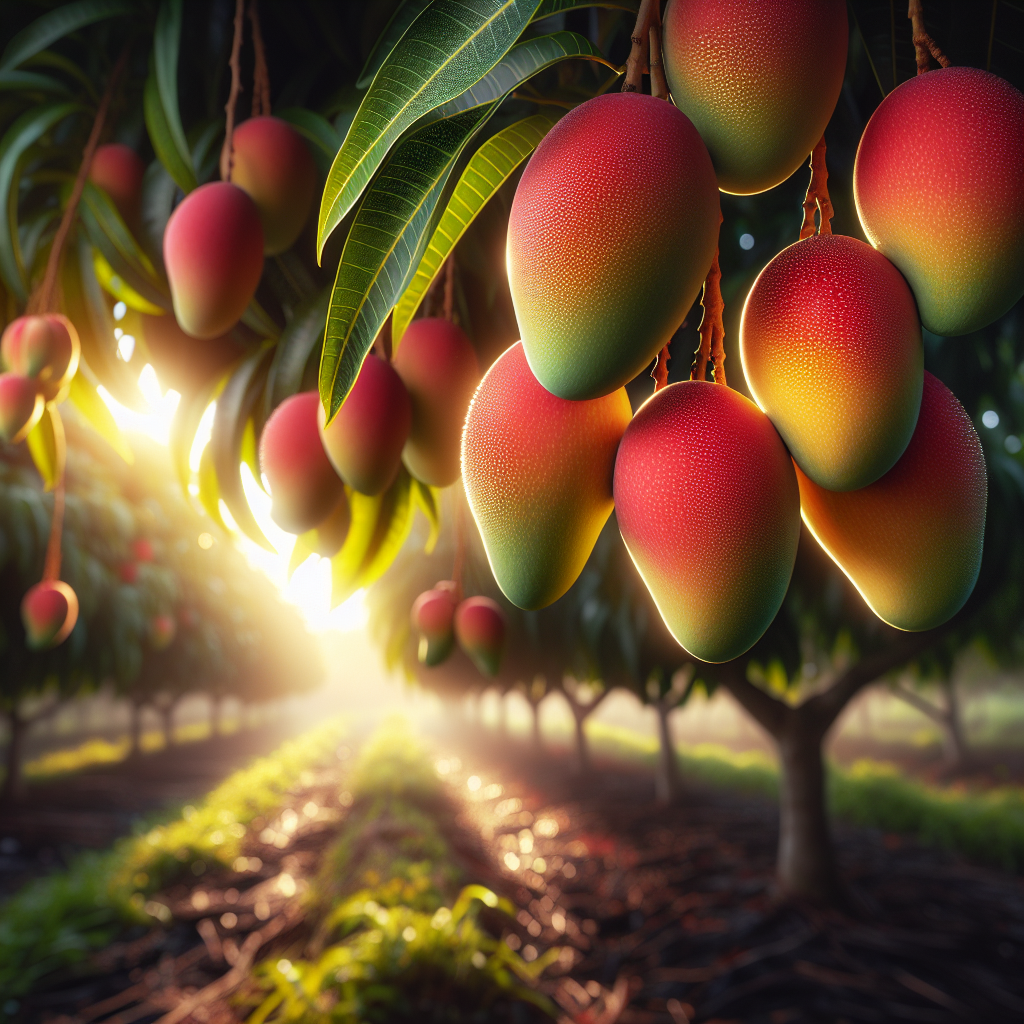
Introduction to Irwin Mango
Developed in Florida and later widely embraced in East Asia, especially Japan and Taiwan, this cultivar has earned a reputation for combining ornamental appeal with high eating quality. The fruit is typically medium-sized, oval to oblong, and develops a vivid red to crimson blush over yellow-orange ground color when grown under high light. Flesh is deep orange, aromatic, sweet, and notably low in fiber, making it especially desirable for fresh eating and premium gift markets.
What distinguishes this variety in commercial and advanced home production is its balance of traits: a comparatively compact growth habit, attractive fruit finish, good productivity under warm conditions, and a harvest window that can be managed with pruning and nutrition. Like other selections of Mango, it is an evergreen tropical fruit tree, but Irwin is especially sensitive to overwatering, poor air circulation, and excessive nitrogen during floral initiation. Growers who understand its phenology—flush growth, rest period, flowering, fruit set, fruit fill, and postharvest recovery—consistently obtain better yields and sweeter fruit.
Irwin is often favored where growers want a tree that can be kept at a practical height of 2.5-4.5 m with annual pruning, rather than allowing the 8 m or taller canopies common in unmanaged seedling mangoes. That makes it suitable for high-density orchards, protected courtyards in frost-free regions, and intensive backyard culture.
Botanical Profile of Irwin Mango
This cultivar belongs to the Anacardiaceae family, the same botanical family as cashew and pistachio. It is a grafted cultivar of Mangifera indica, and as with nearly all premium mangoes, clonal propagation is essential because seedlings will not produce fruit true to type.
Tree habit is moderately vigorous but less sprawling than many older commercial cultivars. The canopy is typically rounded and dense, with flushes of coppery-red new leaves that mature to glossy dark green. Leaves are lanceolate, leathery, and generally 15-30 cm long, with prominent midribs and a drooping habit on young shoots. Internode length is moderate, which helps the tree respond well to formative pruning.
Inflorescences are terminal panicles that may reach 15-35 cm long, carrying hundreds to thousands of small flowers. As in most mango cultivars, the majority are male, with a smaller proportion of perfect flowers capable of setting fruit. Pollination is largely insect-mediated, especially by flies, bees, and other small flower visitors. Fruit set can be naturally low relative to bloom volume, so a heavy bloom does not guarantee a heavy crop.
Fruit characteristics are a major reason Irwin is planted. Mature fruit commonly weigh about 300-500 g, though size varies with crop load and thinning. Shape is generally ovate-oblong with a modest beak. Skin color develops best in full sun and low canopy crowding, often turning a brilliant red that can cover much of the fruit surface. The flesh is smooth, nearly fiberless to very low fiber, and richly sweet with a mild acidity that keeps flavor from becoming flat. The seed is monoembryonic, meaning seedlings are genetically variable and unsuitable for preserving cultivar identity.
In terms of bearing behavior, Irwin can be productive but may show fluctuations if pruning, irrigation, and nutrient timing are poorly managed. It flowers better after a period of relatively cool, dry weather or a mild stress-induced rest phase. Excessive vegetative flush at the wrong time often suppresses flowering.
Soil, pH, and Climate Requirements for Irwin Mango
Excellent drainage is non-negotiable. The root system of this cultivar, like mango in general, performs best in deep, aerated soils where oxygen remains available after rainfall or irrigation. Ideal soils are sandy loams, gravelly loams, volcanic loams, or well-structured loams with rapid internal drainage. Heavy clay can be used only if planted on raised mounds or berms and never in depressions where water stands.
Target soil pH is 5.5-7.0, with the practical sweet spot around 6.0-6.5. Below pH 5.2, aluminum and manganese issues may arise and phosphorus becomes less available. Above pH 7.5, iron, zinc, and manganese deficiencies become common, expressed as interveinal chlorosis on young leaves, reduced flush vigor, and poor fruit finish. In alkaline soils, foliar micronutrient programs are usually more reliable than soil application.
The rooting zone should stay moist but never saturated. A useful benchmark is to maintain soil moisture at roughly 60-80% of field capacity during active vegetative growth and early fruit development, then avoid excessive irrigation near maturity to protect flavor concentration and reduce fruit splitting risk. If you squeeze a handful of root-zone soil, it should feel cool and slightly cohesive, not muddy or water-oozing. Chronic overwatering shows up as dull green leaves, limp new flush, blackened feeder roots, sour-smelling soil, and sometimes sudden leaf drop despite wet ground.
Climate requirements are best described as tropical to warm subtropical. Optimum temperature for active growth is about 24-32°C. Vegetative growth slows below 18°C, and floral induction is often encouraged by cooler but non-freezing nights in the range of 10-18°C, depending on tree age and regional conditions. Young trees are highly vulnerable below 2°C, while established trees may survive a very brief light frost with damage. Commercially, this cultivar should be considered unsuitable for any site with recurring frost.
Rainfall should ideally be seasonal rather than constant. A dry period before flowering helps synchronize bloom and limit Anthracnose pressure. High humidity and rainfall during bloom increase flower blight and poor fruit set. Wind protection is important because strong winds scar fruit, shred panicles, and increase water stress.
Full sun is essential. At least 8 hours of direct sun daily is recommended for strong bloom, good red coloration, and high soluble solids in fruit. Shading reduces floral intensity and encourages lanky, disease-prone canopies.
For broader orchard floor and fertility ideas, see soil health strategies.
Step-by-Step Planting & Propagation
Use grafted nursery trees from reputable sources. Choose plants with a clearly visible graft union, healthy green bark, no circling roots, and balanced branching. Avoid oversized container trees that are root-bound, as they establish more slowly than younger, vigorous stock.
Select the site carefully. Choose a frost-free, sunny location with excellent air drainage and no standing water after rain. Allow at least 5-7 m spacing for a standard orchard layout, or 3.5-5 m if you intend to keep trees intensively pruned.
Prepare the planting area rather than an overly amended hole. If soil drainage is imperfect, create a mound or berm 30-60 cm high and 1.5-2 m wide. In wet climates, this step dramatically improves survival.
Test soil before planting. Correct pH in advance if needed. Incorporate only modest organic matter if soil is extremely poor; do not create a rich pocket surrounded by hostile subsoil, which can trap roots.
Plant at the correct height. Set the tree so the root ball sits slightly above final soil grade, typically 2-5 cm proud. Never bury the graft union. Backfill firmly but gently to eliminate large air gaps.
Water in thoroughly once. Apply enough water to settle soil around the root ball, then let the upper few centimeters of soil begin drying before watering again.
Mulch widely but keep it off the trunk. Use 5-10 cm of coarse organic mulch in a ring extending 60-120 cm from the trunk, leaving a 10-15 cm bare collar. Mulch moderates soil temperature, suppresses weeds, and supports microbial activity.
Stake only if wind exposure demands it. Ties must be soft and loose enough to avoid bark abrasion.
Propagation is almost always by grafting. Veneer grafting, cleft grafting, and epicotyl grafting are common methods depending on nursery system. Rootstocks are usually seedling mangoes selected for vigor and adaptation. Since Irwin is monoembryonic, seed propagation does not preserve fruit quality or tree habit. Air-layering is not standard for commercial mango due to poor root system performance.
Container growing is possible in very warm climates or under protected culture. Use a large, free-draining container of at least 75-150 liters for long-term performance, with a coarse substrate containing bark, pumice, sand, or perlite. Root confinement helps size control, but irrigation and feeding must be more precise.
Care & Maintenance regimes for Irwin Mango
Irrigation should be stage-specific. Newly planted trees need frequent but light establishment watering. In warm weather, this may mean 10-20 liters every 2-3 days for the first 2 weeks, then every 3-5 days for the next 4-8 weeks depending on soil texture. Sandy soils need smaller, more frequent applications; loams need deeper, less frequent watering.
Once established, irrigate deeply enough to wet the root zone to about 30-60 cm, then allow partial drying before the next cycle. Mature trees in active growth may need watering every 5-10 days in sandy soils and every 10-14 days in heavier loams, adjusted for rainfall and evapotranspiration. During floral induction and bloom, slightly reduced irrigation often helps limit unnecessary vegetative flushing, but severe drought will reduce fruit set and can cause panicle desiccation. During fruit enlargement, moisture should be steady; major wet-dry swings contribute to fruit drop, internal stress, and inconsistent size.
Fertilization should be conservative with nitrogen, especially on bearing trees. In the first 2-3 years, aim to build a balanced canopy with small, split applications. A practical program is 3-4 feedings annually using a balanced fertilizer plus micronutrients, with total actual nitrogen rising gradually from roughly 50-100 g per tree in year one to 200-400 g by year three, depending on vigor and soil fertility. Excess nitrogen causes soft, rank growth, delayed flowering, higher disease pressure, and poorer fruit color.
For bearing trees, emphasize potassium and adequate calcium, magnesium, zinc, manganese, boron, and iron. A typical annual ratio might shift toward something like 1:0.5:1.5 or 1:0.5:2 for N:P:K depending on soil tests. Apply most nitrogen after harvest and during postharvest recovery, not immediately before expected bloom. Foliar sprays of boron and zinc before flowering can improve flower quality where deficiencies exist, but rates must be cautious to avoid burn.
Pruning is central to Irwin management. After planting, tip vigorous shoots to encourage 3-4 well-spaced scaffold branches. In years 1-3, shape a low, broad framework rather than allowing a single dominant leader to climb. After harvest, remove dead wood, crossing branches, crowded interior shoots, and excessively upright water sprouts. Keep canopy height within reach for spraying and harvest. A practical target is 2.5-4 m in intensive systems.
Mango flowers on terminal growth, so indiscriminate winter pruning can remove next season's crop. The best time for structural pruning is usually immediately after harvest, allowing enough time for mature post-pruning flushes to harden before floral induction. Ideally, the final vegetative flush should mature at least 3-4 months before expected flowering.
Fruit thinning is not always required, but if panicles set heavily, selective thinning can improve fruit size, reduce limb breakage, and support more uniform ripening. Remove malformed, damaged, or clustered fruit early.
Weed control should prioritize a clean, mulched root zone without trunk contact. Mechanical cultivation close to the trunk is risky because mango has many shallow feeder roots. Avoid turf competition in the first 2-3 years.
In areas with strong sun and sparse canopies, exposed limbs may suffer sunburn. Whitewashing trunk and major limbs with diluted interior-grade white latex paint can reduce damage.
Pests, Diseases & Organic Management
Anthracnose is often the most important disease, especially in humid climates. It affects flowers, young fruit, leaves, and ripening fruit, causing black lesions, blossom blight, and postharvest decay. Good airflow, prompt postharvest pruning, and avoiding overhead irrigation are foundational. Organic programs often rely on copper-based sprays timed before and during bloom, with careful attention to label restrictions and local regulations.
Powdery mildew can damage panicles, flowers, and young fruit under dry days with humid nights. Symptoms include white powdery growth, flower abortion, and fruitlet drop. Sulfur sprays can help in organic systems, but avoid sulfur during very high heat and never combine it closely with oil sprays.
Bacterial black spot, where present, causes angular black lesions on leaves and fruit and can lead to cracking. Windbreaks, sanitation, and copper are key tools. Avoid excessive nitrogen and rough overhead irrigation that spreads inoculum.
Fruit flies are a major direct pest in many mango-growing regions. Fallen fruit sanitation is critical: collect and destroy dropped fruit at least 2-3 times weekly during the season. Protein bait traps, attract-and-kill systems, fine exclusion bags on premium fruit, and orchard hygiene are highly effective components of an organic strategy.
Scale insects, Mealybugs, and Aphids feed on sap and produce honeydew, leading to sooty mold. Horticultural oils and insecticidal soaps can suppress them when applied thoroughly to problem zones, but coverage must avoid bloom periods when pollinators are active. Encouraging beneficial insects with Thai Basil, flowering borders, and reduced broad-spectrum insecticide use improves biological control.
Mango seed weevil and Leaf-feeding caterpillars are regional concerns. Monitor regularly, especially during fruit set and early fruit development. Hand removal, trapping, and localized biocontrol-based treatments are preferable to repeated broad interventions.
Root diseases become severe where drainage is poor. Trees may show weak flush, sparse foliage, dieback, and eventual collapse. Prevention is far more effective than cure: plant high, irrigate carefully, and maintain oxygen in the root zone.
Organic management works best as an integrated program: resistant site selection, sanitation, pruning for airflow, balanced fertility, mulching without waterlogging, pest monitoring, and timely biological or low-residue inputs. Trees pushed with excess nitrogen and constant moisture almost always suffer more pest and disease pressure.
Harvesting, Curing & Optimal Storage
Harvest timing strongly affects flavor. Irwin should be picked at mature-green to early color-break stage for shipping, or nearer full color for local direct markets. Mature fruit usually show fuller shoulders near the stem end, background color transition from dark green toward lighter green or yellowish tones, and a slight waxy bloom loss. A few representative fruit can be tested for dry matter and soluble solids if precision is needed.
Do not rely on external red color alone, because sun exposure can intensify blush before internal maturity is complete. Fruit harvested too early may soften unevenly, remain flat in flavor, and develop internal translucency or poor aroma.
Use clippers rather than pulling fruit. Leave a short stem piece initially to reduce sap burn, then trim after latex flow slows. Mango sap can blacken skin and reduce marketability, so harvested fruit should be placed stem-end down on racks or absorbent material for de-sapping.
Field heat removal matters in hot regions. Move harvested fruit quickly into shade and then into a well-ventilated packing area. Wash only if your system supports sanitary drying; otherwise, unnecessary wetting can worsen postharvest disease.
A short curing or conditioning period at warm room temperature helps fruit complete ripening evenly. For local sales, 20-25°C is often suitable. For storage, mature-green fruit are best held around 10-13°C with relative humidity near 85-90%. Below about 10°C, chilling injury becomes likely, expressed as uneven ripening, grayish flesh, surface pitting, or poor flavor development. Fully ripe fruit are shorter-lived and should be marketed quickly.
Never stack fruit too deeply during ripening. Compression bruising and latex staining greatly reduce premium pack quality. Individual wrapping or partition trays help preserve the attractive finish for which this cultivar is known.
Companion Planting for Irwin Mango
Companion planting around a mango tree should support pollination, beneficial insect activity, weed suppression, and soil protection without causing dense shade, root competition, or chronic humidity around the trunk. Low-growing, non-invasive companions are best, especially in the first years while canopy shape is being established.
Thyme is useful as a living groundcover in dry, sunny margins. It attracts pollinators, suppresses some weeds, and tolerates the lean, well-drained conditions mango prefers. Keep it outside the immediate trunk collar so airflow remains open.
Clover can function as a nitrogen-contributing understory in wider orchard alleys, especially where mowing is practical. It also supports beneficial insects. However, in very humid climates or tight plantings, manage it carefully so it does not create excess moisture retention around the root zone.
Nasturtium helps draw pollinators and beneficial insects while acting as a visual indicator plant for Aphids in diversified systems. It performs best where irrigation is not excessive and should be kept as a low ring or patch, not a smothering mat.
Garlic is often used along orchard edges as a compact, non-competitive companion with strong aroma and efficient use of shallow surface space during cooler seasons. It does not replace pest management, but it fits well in mixed small-farm plantings.
Avoid aggressive grasses, tall annuals that shade the canopy skirt, or heavy feeders planted directly inside the main root zone. In commercial orchards, the best companion system is often a managed alley cover crop plus a mulched, vegetation-free strip beneath the canopy drip line.