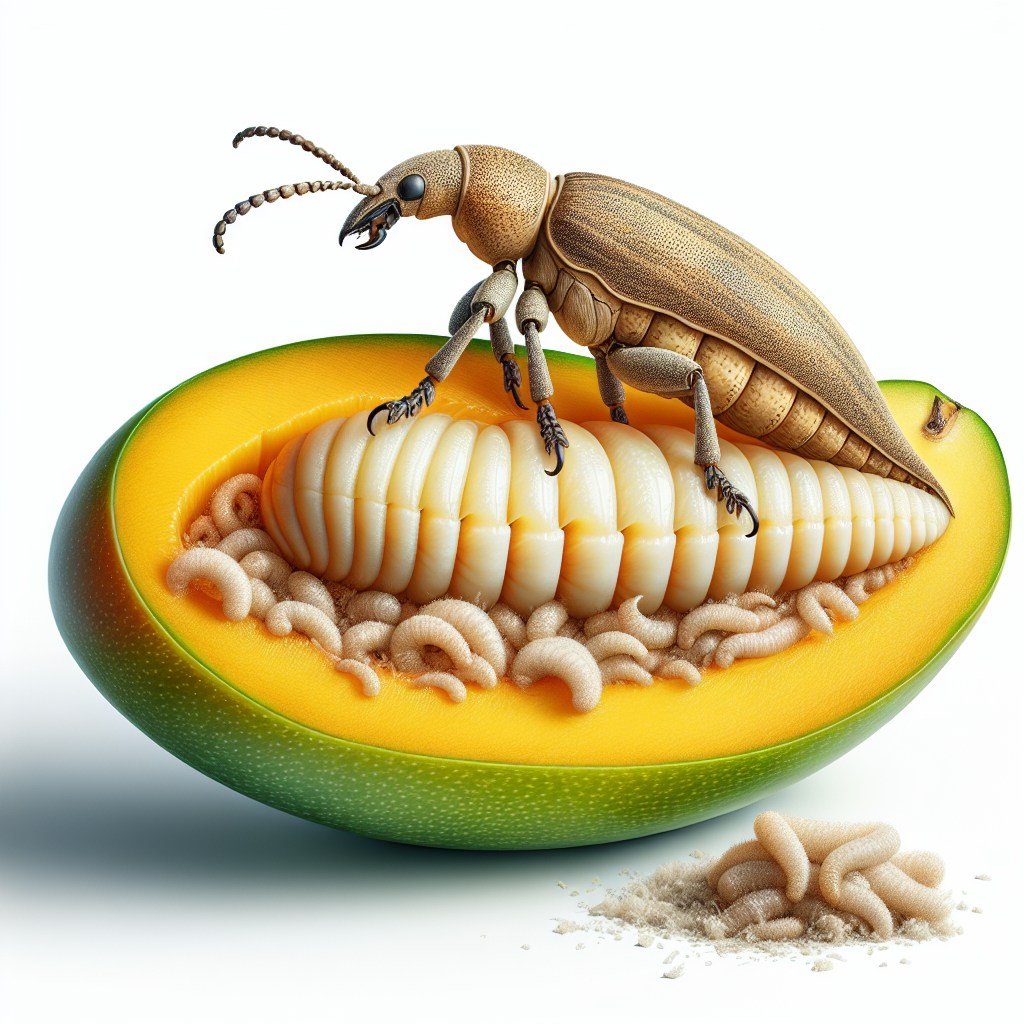
Introduction to Mango seed weevil
The mango seed weevil, scientifically known as Sternochetus mangiferae, stands as one of the most notorious pests threatening mango production worldwide. Native to Southeast Asia, this small beetle has spread to major mango-growing regions including Africa, Australia, the Pacific Islands, and parts of the Americas. Adult weevils measure 8-10 mm in length, featuring a distinctive elongated snout and a mottled brown body that provides excellent camouflage on mango tree bark and fruits.
This pest's insidious nature lies in its hidden development inside mango seeds, often going undetected until harvest. Infestations can lead to 20-50% losses in severe cases, particularly impacting export markets where quarantine regulations demand weevil-free fruits. As a professional botanist and agricultural expert, understanding this pest's biology is crucial for growers aiming to protect their yields. Learn more about the primary host Mango (crop) and its cultivation challenges.
Mango seed weevils thrive in warm, humid tropical climates, completing multiple generations per season. Females lay eggs directly into developing fruits through a small puncture, and larvae tunnel into the seed, feeding on the cotyledon. This internal feeding disrupts seed viability and introduces pathways for secondary pathogens, compounding damage. Early detection and integrated pest management (IPM) are key to minimizing economic impacts, especially for small-scale farmers in endemic areas.
Identifying Symptoms & Damage
Spotting mango seed weevil infestations requires keen observation, as much of the damage occurs internally. The first visible sign is the egg-laying puncture: a tiny, dark dot (0.5-1 mm) on the fruit skin, often near the stalk end. This mark may exude a drop of gum-like exudate, distinguishing it from other pests like fruit flies.
As larvae develop inside the seed (typically 4-6 weeks post-oviposition), fruits may show premature ripening or internal discoloration. Cut open infested fruits to reveal creamy-white grubs (up to 12 mm long) within the seed, frass (insect waste), and a hollowed-out cotyledon. Advanced damage leads to seed abortion, fruit drop, or shriveled, blackened seeds at harvest.
Post-harvest inspection is critical: shake mature fruits over white paper to detect emerging adults or exit holes (1-2 mm). Infested seeds often split open, releasing powdery frass and revealing pupal cases. Yield losses manifest as reduced marketable fruit (up to 30% in unmanaged orchards) and quarantine rejections. Differentiate from Seed Weevils in other crops by the specific mango fruit association and snout morphology.
Secondary symptoms include fruit cracking from larval pressure or entry of fungi like anthracnose. Monitor trees weekly from fruit set (pea-sized stage) using a 10x hand lens for punctures. Threshold: 5% infested fruits triggers action. Document patterns to refine scouting protocols.
Lifecycle and Progression of Mango seed weevil
Understanding the mango seed weevil's lifecycle—spanning 6-8 weeks—is essential for timed interventions. Adults emerge from infested fruits post-harvest, seeking shelter in tree bark crevices or leaf litter. They enter diapause (dormancy) during dry seasons, resuming activity with monsoon rains.
Oviposition phase: Mated females (lifespan 6-12 months) lay 20-40 eggs singly into fruits 20-60 days after petal fall. Eggs hatch in 3-5 days into legless larvae that bore directly into the seed.
Larval stage (3 instars, 20-30 days): Larvae feed voraciously on seed contents, producing galleries filled with frass. Fully grown larvae (12 mm) pupate within the seed.
Pupal and adult emergence: Pupation lasts 7-14 days; new adults chew exit holes and drop to soil. There are 1-3 generations per year, synced with fruiting cycles. Check Alphonso Mango varieties for varietal susceptibility insights.
Progression peaks during fruit maturation (90-120 days post-bloom). Overwintering adults climb trees at flowering, explaining why canopy hygiene is vital.
Environmental Triggers & Risk Factors
Mango seed weevils flourish in temperatures of 25-32°C (77-90°F) and relative humidity >70%, typical of tropical wet seasons. High rainfall (>1000 mm annually) triggers adult emergence from diapause, synchronizing with fruit set.
Key risk factors:
- Monoculture orchards: Lack of diversity favors buildup; interplant with Thai Basil to disrupt cycles.
- Poor sanitation: Fallen infested fruits serve as reservoirs.
- Early-maturing varieties: Like Tommy Atkins Mango, allowing multiple generations.
- Irrigated dry seasons: Artificial humidity extends activity.
Soil type influences pupation success; sandy loams retain weevils near surface. Proximity to wild hosts (e.g., guava) heightens infestation risk. Climate change may expand ranges into subtropical zones. Monitor weather data for predictive modeling.
Organic Control & Treatment Plans
Organic management emphasizes IPM, avoiding broad-spectrum synthetics. Start with cultural controls:
- Sanitation: Collect and destroy dropped fruits weekly; bury >50 cm deep or hot-compost at 60°C.
- Pruning: Remove bark shelters and old inflorescences post-harvest.
Biological controls:
- Release parasitoids like Quadrastichus mangiferae (up to 50% larval mortality).
- Encourage predators: ants, birds, and spiders (note: generalist).
Organic treatments:
- Neem oil (2-5 ml/L): Spray at pea-stage fruit (3x, 10-day intervals); azadirachtin deters oviposition (80% reduction).
- Kaolin clay: Barriers coat fruits, reducing punctures by 70%.
- Trap crops: Plant susceptible early varieties as borders.
- Pheromone traps: Delta traps with aggregation lures (1/10 trees) for monitoring/mass-trapping.
Treatment plan:
- Scout weekly; act at 2% punctures.
- Apply neem + kaolin at fruit set, repeat at marble stage.
- Post-harvest: flood fields or solarize soil.
For severe cases, Bacillus thuringiensis (Bt) targets larvae if exposed. Track efficacy with fruit dissections. Read Spring Pest Patrol: Organic AI Strategies to Shield Your Crops from Common Invaders for tech-enhanced monitoring.
Preventing Mango seed weevil in the Future
Long-term prevention builds resilient systems:
- Resistant varieties: Plant late-maturing cultivars like Keitt Mango with thick skins.
- Orchard design: Wide spacing (10x10m), windbreaks to reduce humidity.
- Quarantine: Inspect nursery stock; hot-water treat seeds (48°C, 15 min).
- Soil management: Cover crops suppress pupae; rotate with non-hosts.
- Monitoring tech: Sticky traps + AI apps for early detection.
Annual calendar:
- Pre-flowering: Prune, trap adults.
- Fruit set: Barrier sprays.
- Harvest: Total sanitation.
- Off-season: Soil treatments.
Certification programs (e.g., GlobalGAP) enforce protocols, boosting market access.
Crops Most Affected by Mango seed weevil
Primarily Mangifera indica (Mango), with 100+ cultivars impacted. Susceptible: Alphonso, Kesar, Tommy Atkins. Less: Nam Dok Mai due to small seeds.
Secondary hosts (rare): Guava (Psidium guajava), papaya, wild mango relatives. No economic damage elsewhere, but bridges infestations. Focus IPM on commercial mango blocks.