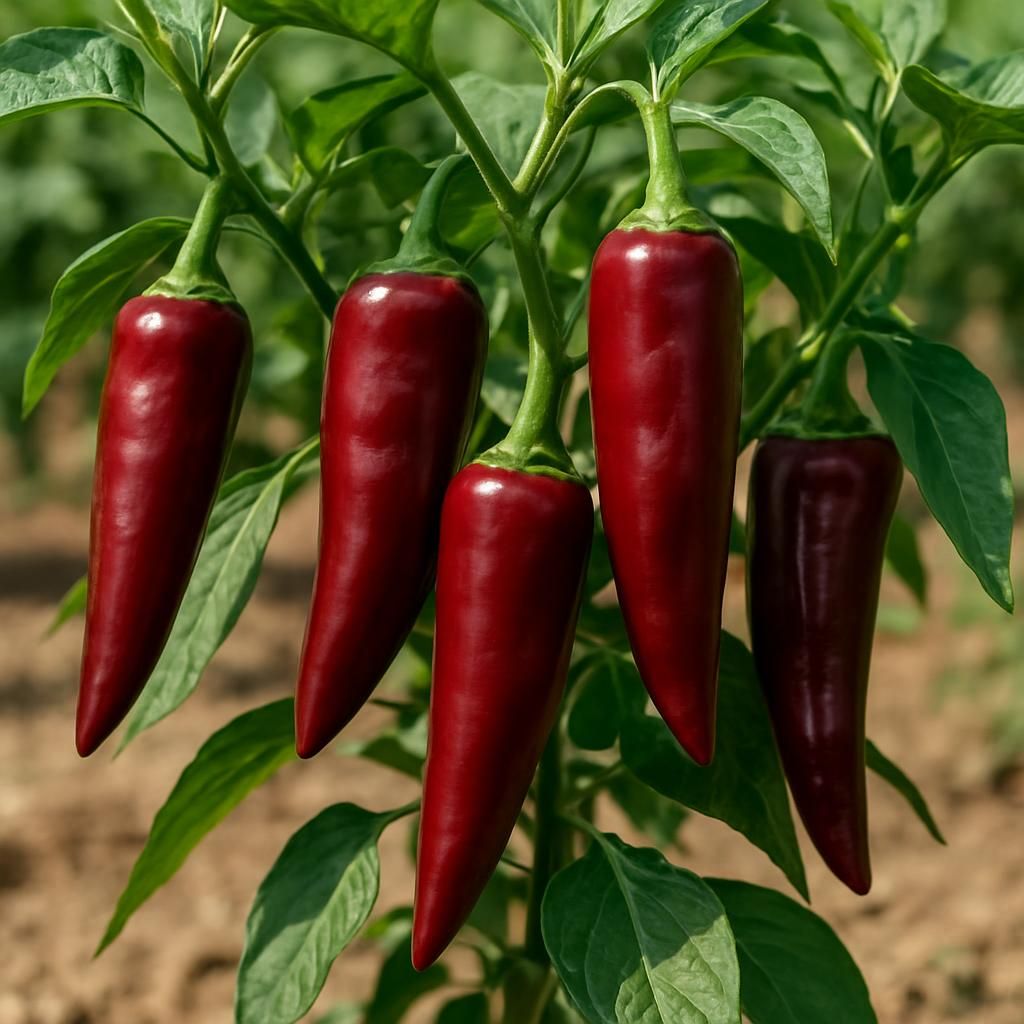
Introduction to Guntur Sannam Chili
Guntur Sannam Chili (Capsicum annuum 'Guntur Sannam') originates from the Guntur district of Andhra Pradesh, India, where it has been cultivated for generations. It is renowned for its vibrant red hue, moderate-to-high heat (Scoville heat units typically ranging from 35,000–50,000), and excellent drying qualities that make it a staple in both domestic and export markets. Farmers value it for its relatively short duration, high yield potential, and strong demand in the global spice trade.
Botanical Profile of Guntur Sannam Chili
Guntur Sannam is an annual herbaceous plant belonging to the Solanaceae family. It produces upright bushes reaching 60–90 cm in height with a semi-spreading habit. The plant bears small, slender, tapering fruits measuring 5–7 cm long and 1–1.2 cm wide at the shoulder. Fruits turn from green to deep glossy red at maturity. The cultivar is moderately branching with medium-sized leaves and produces single or paired flowers at each node.
Soil, pH, and Climate Requirements for Guntur Sannam Chili (MUST INCLUDE A MARKDOWN TABLE OF IDEAL CONDITIONS)
Guntur Sannam Chili thrives in well-drained sandy loam to clay loam soils rich in organic matter. The crop performs best in tropical and subtropical climates with temperatures between 20–35 °C and requires 600–800 mm of well-distributed rainfall or irrigation.
| Parameter | Ideal Range | Notes |
|---|---|---|
| Soil Type | Sandy loam to clay loam | Avoid waterlogging; raised beds recommended |
| Soil pH | 6.0–7.0 | Slightly acidic to neutral |
| Temperature | 20–35 °C (day); 15–20 °C (night) | Optimum fruit set at 25–30 °C |
| Rainfall | 600–800 mm | Critical during flowering and fruiting |
| Altitude | Up to 1,000 m | Performs well in plains and low hills |
Step-by-Step Planting & Propagation
- Select certified, disease-free seeds of Guntur Sannam Chili. Soak seeds in water for 12 hours before sowing to improve germination.
- Prepare nursery beds 1 m wide with well-decomposed farmyard manure at 5–6 kg/m². Sow seeds in lines 10 cm apart at 0.5–1 cm depth during October–November in southern India.
- Maintain nursery moisture and provide partial shade. Seedlings are ready for transplanting in 35–45 days when they attain 10–15 cm height with 4–6 true leaves.
- Transplant seedlings in the main field at 45 × 45 cm spacing on raised beds or ridges during December–January after the last frost risk has passed.
- Water immediately after transplanting and provide light shade for the first 3–5 days to reduce transplant shock.
Care & Maintenance regimes for Guntur Sannam Chili (MUST INCLUDE A MARKDOWN TABLE OF WATER, FERTILIZER, AND PRUNING SCHEDULES)
Consistent moisture, balanced nutrition, and timely pruning are essential for maximizing yield and fruit quality.
| Stage | Watering Schedule | Fertilizer Application | Pruning & Training |
|---|---|---|---|
| Seedling (0–30 days) | Light irrigation every 2–3 days | 10 t FYM + basal NPK 40:60:40 kg/ha | Remove lower leaves at transplanting |
| Vegetative (30–60 days) | Irrigation every 4–5 days | Top-dress 20 kg N at 30 DAT | Pinch terminal bud at 30–35 DAT |
| Flowering (60–90 days) | Irrigation every 5–7 days | 20 kg N + 20 kg K₂O at 60 DAT | Remove diseased or damaged branches |
| Fruiting (90+ days) | Irrigation every 6–8 days | Foliar 1% KNO₃ spray at 75 and 90 DAT | Light pruning of non-bearing shoots |
Pests, Diseases & Organic Management
Major pests include Aphids, Thrips, Spider mites, and fruit borers. Common diseases are Anthracnose, Bacterial wilt, and Chili leaf curl disease. Adopt integrated management: use yellow sticky traps for sucking pests, spray neem oil (5 ml/L) every 10–12 days, and apply Trichoderma viride at 2.5 kg/ha mixed with 50 kg FYM for soil-borne pathogens. Rogue out virus-infected plants promptly.
Harvesting, Curing & Optimal Storage
Harvest fruits at full red ripe stage, 90–110 days after transplanting. Pick in the early morning to reduce moisture loss. Sun-dry fruits on clean tarpaulins for 6–8 days until moisture content reaches 8–10%. Store dried chilies in clean jute bags or airtight containers in a cool, dry place away from direct sunlight. For longer storage, vacuum-pack or use silica gel desiccants.
Companion Planting for Guntur Sannam Chili
Plant Marigold and Basil around chili beds to repel nematodes and aphids. Intercrop with Onion or Garlic to reduce thrips incidence. Avoid planting near Eggplant or Tomato to minimize shared disease pressure. Leguminous cover crops such as Cowpea improve soil nitrogen and suppress weeds between rows.