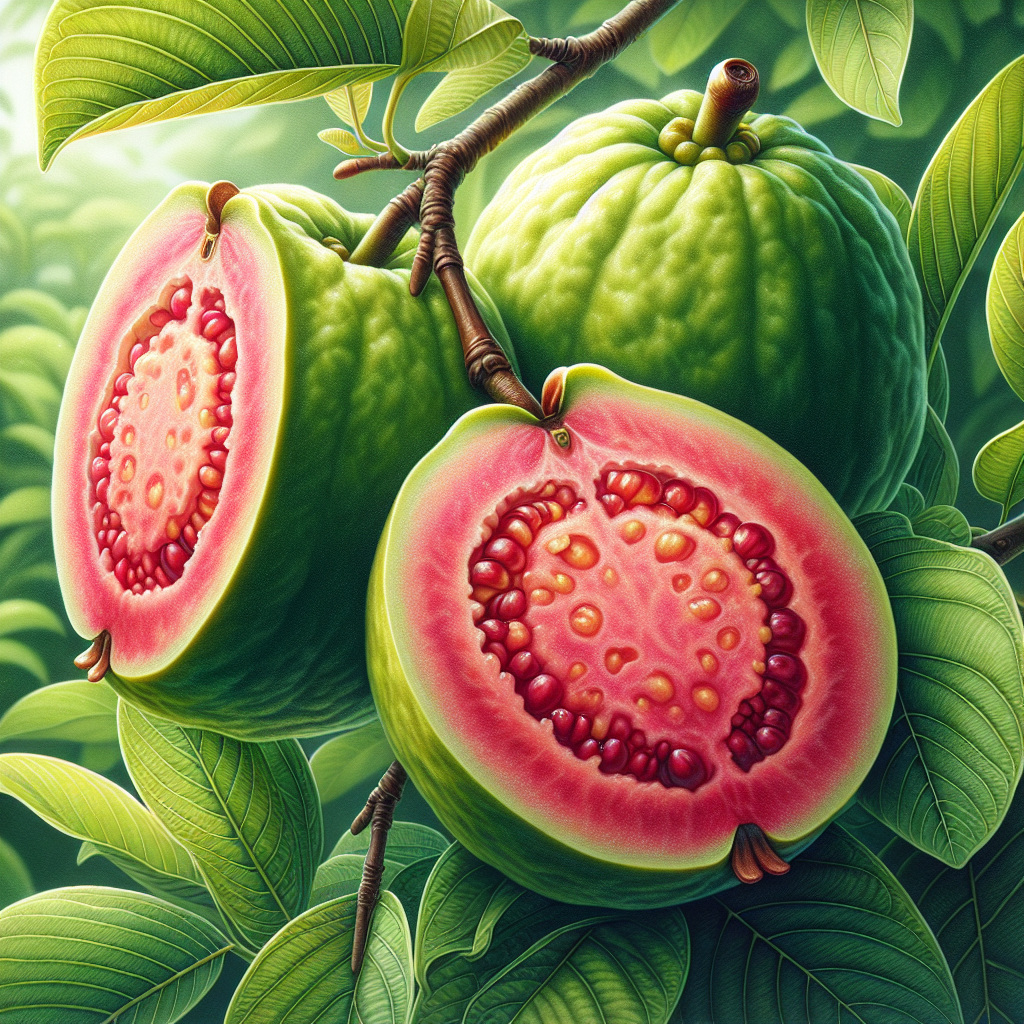
Introduction to Guava (Ruby Supreme)
Guava (Ruby Supreme), scientifically known as Psidium guajava 'Ruby Supreme', stands out as one of the most sought-after guava cultivars for both commercial orchards and home gardens. Originating from advanced breeding programs in subtropical regions like Florida and Australia, this variety is celebrated for its striking ruby-red to deep pink flesh, exceptional sweetness (Brix levels often exceeding 14°), and minimal seed content. Unlike common guavas, Ruby Supreme produces large, pear-shaped fruits weighing 200-400 grams each, with a thin, edible skin that ripens to a glossy green-yellow hue.
This cultivar thrives in warm climates but has impressive cold tolerance down to 28°F (-2°C) for short periods, making it suitable for USDA zones 9-11 and even protected cultivation in zone 8. Growers appreciate its vigorous growth, early fruiting (as young as 2 years from graft), and heavy cropping—up to 100-150 pounds per mature tree annually. Nutritionally, Ruby Supreme guavas are packed with vitamin C (over 200mg per 100g), antioxidants, and dietary fiber, positioning them as a high-value crop for fresh markets, juices, and processed products. For more on general guava cultivation, see the Guava (crop) page.
Successful cultivation hinges on understanding its specific needs: well-drained soils, full sun, and consistent moisture without waterlogging. This deep-dive guide equips professional growers with evidence-based practices to achieve optimal yields, combat pests organically, and maximize post-harvest quality. Whether scaling up for export or diversifying a small farm, Ruby Supreme offers profitability through its premium pricing and year-round production potential in frost-free areas.
Botanical Profile of Guava (Ruby Supreme)
Ruby Supreme belongs to the Myrtaceae family and is a selection from the Apple Guava group (Psidium guajava). It exhibits a semi-dwarf to medium tree habit, reaching 10-15 feet tall and 8-12 feet wide at maturity, with a dense, bushy canopy of glossy, oval leaves (4-6 inches long) that remain evergreen in ideal conditions. The tree's bark is smooth and mottled gray-brown, peeling in patches as it ages.
Flowers are white, 1-inch wide, with five petals and numerous stamens, borne solitary or in clusters on current season's growth. Blooming occurs year-round in tropics but peaks in spring and fall in subtropics, leading to fruit set 3-4 months later. Fruits are pyriform (pear-shaped), 3-4 inches long, with creamy-white to ruby-pink flesh surrounding a central seed cavity containing few, small seeds. Flavor profile: sweet-tart with floral notes, far superior to seedy white-fleshed varieties.
Root system is shallow and fibrous, extending 2-3 times the canopy width, making it sensitive to root disturbance. Ruby Supreme is self-fertile but benefits from cross-pollination with other guavas like Apple Guava (crop) for enhanced set. Growth rate is rapid in youth (2-3 feet/year), slowing after fruiting age. Hardiness: tolerates brief freezes better than tropical fruits like mango, but protect trunks with wraps in marginal areas.
Soil, pH, and Climate Requirements for Guava (Ruby Supreme)
Ruby Supreme guavas demand well-drained, fertile soils to prevent root rot, thriving in sandy loams, volcanic soils, or amended clay loams. Avoid heavy clays or waterlogged sites; ideal texture allows roots to penetrate deeply while retaining moisture. Organic matter content of 3-5% boosts fertility—incorporate composted manure or green manures pre-planting.
Optimal pH is 5.5-7.0, slightly acidic to neutral; test soil annually and adjust with lime (for pH <5.5) or sulfur (for pH >7.5). Micronutrients like zinc, iron, and manganese are critical—deficiencies show as yellowing leaves (chlorosis); apply chelated formulations if needed.
Climatically, Ruby Supreme excels in USDA zones 9b-11, requiring 20-30 inches annual rainfall or equivalent irrigation. Full sun (8+ hours/day) is essential for fruit color and sugar development. Temperatures: optimum 68-86°F (20-30°C); growth stalls below 50°F (10°C), damage below 28°F (-2°C). High humidity (60-80%) favors growth but increases disease risk—ensure good airflow. Wind protection is vital for young trees; use hedges like gliricidia. In marginal areas, employ frost blankets or micro-sprinklers. For heatwave strategies, check this blog post.
Step-by-Step Planting & Propagation
Propagation: Grafting onto disease-resistant rootstocks (e.g., Taiwan or Allahabad Safeda) is preferred for uniformity and vigor; cleft or veneer grafts succeed at 80-90% rates in spring. Air-layering (marcotting) yields rooted plants in 6-8 weeks—wound branches, apply rooting hormone, wrap in moist sphagnum. Seeds are viable but result in variable offspring; stratify in sand for 30 days if used.
Site Preparation: Select elevated sites with slope >2% for drainage. Dig holes 3x wider than root ball, 2 feet deep; amend with 40% compost, 10-10-10 fertilizer (1 lb/hole). Space trees 12-15 feet apart (15x15 for dwarfs); high-density: 10x10 feet with pruning.
Planting Steps: 1. Plant in early spring post-frost, bare-root or containerized. 2. Position graft union 4-6 inches above soil. 3. Backfill, tamp firmly, stake if windy. 4. Water deeply (20-30 gal/tree), mulch 4-6 inches deep (organic, kept 6 inches from trunk). 5. Apply copper fungicide to trunk for protection.
Young trees need weekly irrigation establishing roots; transition to deep, infrequent watering. Expect first fruits in 2-3 years.
Care & Maintenance regimes for Guava (Ruby Supreme)
Irrigation: Drip systems deliver 1-2 inches/week, increasing to 3 inches during fruit swell. Mulch conserves moisture; deficit irrigation post-harvest enhances next bloom.
Fertilization: Annual regime: 1 lb 10-10-10 NPK per year of age (max 10 lbs mature tree), split 3 applications (Feb, May, Aug). Foliar sprays: 2% urea + micronutrients monthly during growth. Avoid excess N to prevent vegetative overgrowth.
Pruning: Annual post-harvest: remove deadwood, water sprouts, thin canopy for light penetration (20-30% removal). Train to central leader or open vase; dwarf trees need minimal heading.
Weed Control: Mulch + shallow cultivation; cover crops like clover suppress grasses.
Monitor for nutrient deficiencies: pale leaves = N; interveinal chlorosis = Fe/Zn.
Pests, Diseases & Organic Management
Pests: Common invaders include aphids, mealybugs, fruit flies, and scale insects. Organic controls: neem oil (0.5% weekly), insecticidal soap, beneficials like ladybugs. Trap fruit flies with protein baits; wrap fruits in paper bags.
Diseases: Watch for anthracnose (fruit rot), root rot from Phytophthora, and powdery mildew. Prevent with copper sprays (pre-bloom), improve drainage, avoid overhead watering. For anthracnose, apply biofungicides like Bacillus subtilis. Ruby Supreme shows resistance but scout weekly.
Integrated management: diverse plantings, sanitation, reflective mulches. Learn more organic fixes here. Rotate with legumes to break nematode cycles.
Harvesting, Curing & Optimal Storage
Harvest when fruits yellow at base, firm but yielding to thumb pressure (120-140 days from bloom). Clip with shears, leaving 1-inch stem. Yields peak at 5-7 years; multiple picks every 7-10 days.
Curing: ripen at 68-77°F (20-25°C), 85-90% RH for 3-5 days. Avoid chilling injury (<50°F).
Storage: Fresh: 45-50°F (7-10°C), 85-95% RH, 2-3 weeks. Processed: puree flash-frozen or dried. Market as premium for its color and taste.
Companion Planting for Guava (Ruby Supreme)
Ruby Supreme pairs well with nitrogen-fixers like pigeon pea for soil enrichment and marigold for nematode suppression. Underplant with thai basil to deter flies. Avoid nightshades like tomato due to shared pests. Nasturtium traps aphids; yarrow attracts pollinators. Space companions 3-5 feet from trunk to prevent root competition. Benefits: improved pest control, microclimate moderation, and biodiversity. For more, see Why Companion Planting Feels Like Guesswork for Small Farms - And How AI Makes It Foolproof.