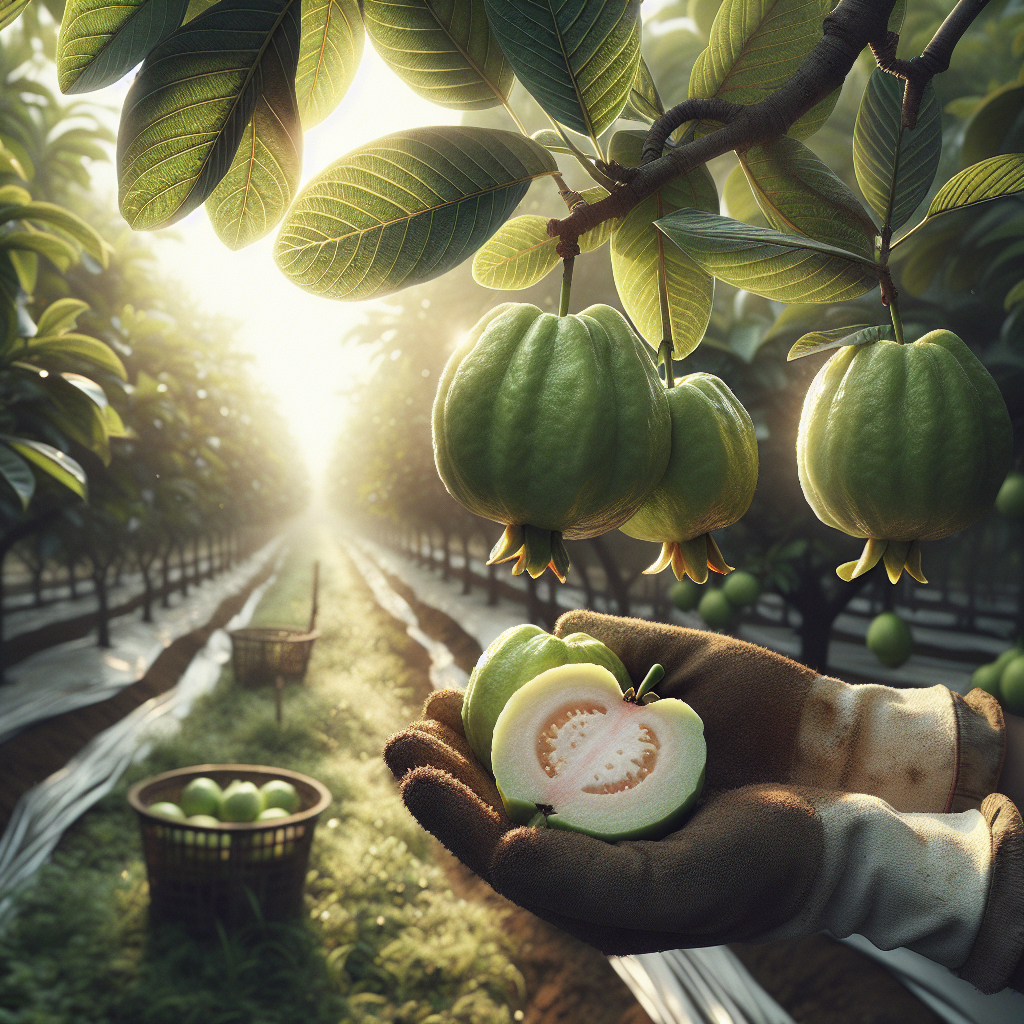
Introduction to Apple Guava
A classic form of common guava, this fruit is often called “apple guava” because of its rounded shape, crisp-to-tender flesh, and balanced sweet-acid flavor that can resemble a tropical cross between pear, strawberry, and mild apple notes. It belongs to the myrtle family, Myrtaceae, and has been cultivated for centuries across tropical America before spreading through Asia, Africa, and the Pacific. Today it is one of the most adaptable fruit trees in warm climates, thriving from humid lowlands to drier subtropical regions with irrigation.
Commercially and in backyard production, apple guava is valued for more than taste. The tree bears relatively early, can fruit once or several times a year depending on climate, tolerates a broad range of soils, and responds well to pruning for manageable height. Fruits may have white, cream, pink, or salmon flesh depending on selection, though the market often recognizes “apple guava” as the larger, round-fruited type with smooth green to yellow skin and firm flesh suitable for fresh eating, juice, preserves, and processing.
Nutritionally, the fruit is exceptionally rich in vitamin C, dietary fiber, and antioxidant compounds. Agronomically, it is a resilient crop but not a neglect-tolerant one if premium fruit quality is the goal. High-quality production depends on controlling canopy density, avoiding waterlogging, balancing nitrogen with potassium, and protecting fruit from fly damage. If you already grow tropical fruit, its orchard behavior is somewhat easier than Mango in small-scale systems, especially where annual pruning and hand harvest are practical.
For broader orchard planning and soil-building ideas, see this practical piece on soil health.
Botanical Profile of Apple Guava
This species is typically a small evergreen tree or large shrub, commonly maintained at 2.5-4 m in managed orchards, though unpruned trees can exceed 6-8 m. The bark is characteristically smooth and flakes in thin patches, revealing mottled greenish, copper, or tan surfaces beneath. Young shoots are somewhat quadrangular, and opposite leaves are leathery, aromatic when crushed, and prominently veined.
Flowering occurs on current season’s growth, an important botanical fact that directly informs pruning strategy. White flowers, usually solitary or in small clusters, are bisexual and contain numerous stamens. Because fruit sets on new shoots arising from mature wood, growers can prune after harvest or during a resting period to stimulate a new flush that will bear the next crop. This is one reason guava responds so well to training compared with many other fruit trees.
The fruit is botanically a berry. Exterior color ranges from light green to yellow at maturity. Flesh texture varies by cultivar from crisp and granular to soft and melting. Seed count also varies widely; improved selections may have relatively fewer or softer seeds, whereas seedling trees often produce harder, more numerous seeds. Fruit shape in apple guava is commonly round to slightly oval, distinguishing it from more pear-shaped guava types in some regions.
Roots are generally shallow to moderately deep, with a dense feeding-root zone concentrated in the upper 30-60 cm of soil. This makes the crop responsive to mulching, drip irrigation, and surface-applied organic matter, but also vulnerable to drought stress, trunk injury from cultivation, and competition from aggressive grasses. The species is largely self-fertile, though cross-pollination by bees can improve fruit set and sometimes fruit size.
Soil, pH, and Climate Requirements for Apple Guava
This crop performs best in deep, well-drained loam to sandy loam with good organic matter and moderate water-holding capacity. Although guava is known for tolerating poorer soils better than many fruit trees, commercial-grade fruit quality declines sharply in compacted, chronically wet, saline, or highly alkaline sites. Ideal soil pH is 5.5-7.0, though trees can survive from about 4.5 to 8.2. Production is most consistent when pH stays between 6.0 and 6.8 because micronutrients such as iron, zinc, and manganese remain more available.
Drainage is critical. Apple guava tolerates short dry spells far better than persistent root-zone saturation. In heavy clay, standing water around the trunk for more than 24-48 hours after irrigation or rain significantly raises the risk of root decline, poor flushing, and fruit drop. In poorly drained sites, plant on raised mounds 30-50 cm high and at least 1-1.5 m wide. If soil forms a sticky ribbon and remains slick several days after rainfall, drainage improvement is mandatory before planting.
Climate preference is tropical to warm subtropical. Optimal mean temperatures are 23-28°C, but the tree can grow across a wider range. Vegetative growth slows below 15°C. Young trees may be damaged around 0 to -2°C, while mature trees can sometimes survive brief light frosts with defoliation and shoot injury. Flowering and fruit quality are best where there is strong sunlight, warm days, and either moderate humidity with air movement or a mild dry season. Excessively humid, stagnant conditions tend to worsen Anthracnose, Algal leaf spot, and fruit rots.
Annual rainfall of 1000-2000 mm is suitable if drainage is good, but the crop also succeeds in drier regions under irrigation. Water stress during early fruit development reduces size and may cause hard, undersized fruit. Conversely, sudden heavy irrigation after drought can split fruit or dilute flavor. Wind exposure should be moderated: guava is sturdier than some tropical fruit trees, but repeated hot dry winds scorch young leaves and reduce pollinator activity.
For orchard spacing, use 4 x 4 m to 6 x 6 m depending on vigor, pruning intensity, and mechanization. High-density systems can be established at 3 x 3 m if disciplined pruning is practiced every year. In home gardens, leave enough room for light penetration and harvesting from all sides.
Step-by-Step Planting & Propagation
Start with disease-free, true-to-type planting material. Seedling guavas are common and vigorous, but they vary in fruit size, flavor, flesh color, seediness, and bearing habit. For consistent apple guava production, use air-layered, grafted, or budded plants from a reputable nursery. Vegetatively propagated trees fruit earlier, often in 1-3 years, while seedlings may take longer and show wider quality variation.
- Site selection: Choose a full-sun location with at least 8 hours of direct light daily. Avoid frost pockets, low-lying wet areas, and places where turf grass will grow right up to the trunk.
- Soil testing: Test pH, electrical conductivity, and major nutrients before planting. Correct strongly acidic soils with agricultural lime several months ahead, or incorporate elemental sulfur in overly alkaline soils where practical.
- Ground preparation: Clear perennial weeds thoroughly. Incorporate well-finished compost into the future root zone, but do not create a rich “pot” inside poor subsoil; roots must transition into surrounding ground.
- Digging the hole: Make the hole 2-3 times as wide as the root ball but no deeper than the root ball height. Planting too deep is a frequent cause of slow establishment.
- Planting position: Set the root flare slightly above final soil level, especially in heavier soils. Backfill with native soil rather than a heavily amended mix.
- Water-in: Irrigate immediately to settle soil and eliminate air pockets.
- Mulch: Apply 5-10 cm of organic mulch over a broad circle, keeping it 10-15 cm away from the trunk to prevent collar rot.
- Initial heading: If the young tree is tall and whippy, head it lightly at 60-80 cm to encourage low scaffold formation.
Propagation by air layering is widely used because it preserves cultivar identity and produces a fruiting plant quickly. Select a healthy semi-hardwood shoot about pencil thickness, girdle a 2-3 cm ring of bark, apply moist rooting medium, and wrap securely. Roots often develop in 4-8 weeks under warm conditions. Grafting onto seedling rootstocks can improve uniformity and anchorage in commercial orchards.
Best planting season is early spring in subtropical areas after frost risk passes, or post-monsoon/early rainy season in tropical climates where excess waterlogging is not a problem. Avoid planting into cold soil or during peak heat unless irrigation is reliable.
Care & Maintenance regimes for Apple Guava
Irrigation should be deliberate rather than merely frequent. During establishment, keep the root zone evenly moist but never saturated. A good target is moist soil in the top 15-20 cm, with slight drying beginning near the surface before the next irrigation. In sandy soils this may mean watering 2-3 times weekly for new trees in hot weather; in loam, once or twice may suffice. Mature trees generally benefit from deep irrigation that wets soil to 30-45 cm, followed by partial drying. Constant shallow watering encourages surface rooting and instability.
Signs of under-watering include dull, slightly folded young leaves, reduced shoot extension, fruit drop, and small, hard fruit. Signs of overwatering include yellowing lower leaves, soft rank shoot growth, sour-smelling soil, algae at the base, and persistent wetness 24 hours after irrigation. Guava roots require oxygen; if a trowel inserted 10-15 cm deep reveals sticky, airless mud repeatedly, reduce irrigation frequency and improve drainage.
Nutrient management depends on age and cropping load. Young trees need moderate nitrogen for framework development, but excessive nitrogen delays sturdy wood formation and can increase pest susceptibility. A practical program is to split fertilizer into 3-4 applications per year in warm regions. Emphasize nitrogen during early canopy building, then shift toward balanced nutrition with adequate potassium and calcium as cropping begins. Potassium is especially important for fruit size, sweetness, skin strength, and tolerance to moisture fluctuations.
Organic growers often use composted manure, vermicompost, fish hydrolysate, oilseed meals, sulfate of potash, wood ash in moderation where appropriate, and foliar micronutrients if deficiencies appear. Zinc and iron deficiencies are common in alkaline soils; symptoms include interveinal chlorosis on young leaves and reduced leaf size. Foliar correction works faster than soil application in high-pH conditions.
Pruning is the defining management practice for high-quality apple guava. Because fruit forms on new shoots, prune to stimulate manageable, well-lit flushes. Establish 3-5 scaffold limbs from low on the trunk. Remove crossing branches, inward-growing shoots, suckers from the base, and weak twiggy growth in the interior. After harvest, lightly head back fruiting shoots and thin crowded wood. Severe pruning can rejuvenate old trees, but it may delay harvest temporarily and should be timed with climate and market windows.
Canopy goals are simple: sunlight should penetrate the outer 30-60 cm of the canopy, air should move freely, and fruit should hang where it can be picked without breaking limbs. Maintain most trees at 2.5-3.5 m for ease of bagging, spraying, and harvest. Unpruned trees become tall, dense, and less productive internally.
Mulching improves productivity markedly. Maintain a mulch ring out to at least the dripline on young trees if possible. This moderates soil temperature, feeds microbial life, reduces weed competition, and helps maintain steady moisture. Keep trunks exposed to air.
Weed control matters because the shallow feeder roots compete poorly with dense grass. Maintain a vegetation-free strip at least 60-100 cm around young trees. Mechanical cultivation should be shallow to avoid root damage.
Fruit thinning may be worthwhile on heavily bearing trees. Removing crowded or misshapen fruits shortly after set improves final size, reduces branch breakage, and can lower disease pressure by improving air movement around remaining fruit.
Pests, Diseases & Organic Management
Fruit flies are often the most economically important pest. Adult flies lay eggs beneath the skin, and larvae tunnel through ripening fruit, causing internal breakdown and secondary rot. The best organic strategy is integrated: sanitation, early harvest at mature-green to color-break stage where suitable, protein or bait traps, mass trapping, and fruit bagging. Collect and destroy fallen fruit at least twice weekly during the season. Leaving infested fruit on the ground guarantees carryover.
Birds, bats, and squirrels may also attack ripening fruit. Netting is often more reliable than scare tactics. In high-value orchards, individual fruit bagging with paper or breathable sleeves can simultaneously reduce fly damage, sunburn, and superficial blemishes.
Scale insects, Mealybugs, Aphids, and Whiteflies can colonize shoots and leaf undersides, especially where canopies are dense or nitrogen is excessive. These pests excrete honeydew, encouraging sooty mold that reduces photosynthesis and downgrades fruit appearance. Prune for airflow, control ants that protect sap feeders, and apply horticultural oils or insecticidal soaps with thorough coverage during cooler parts of the day.
Tea mosquito bug and other sucking insects may scar young fruits in some regions. Monitoring during flowering and early fruit set is essential. Neem-based products can help when used preventively and in rotation, but avoid spraying open flowers during peak pollinator activity.
Common diseases include Anthracnose, Fruit canker, Algal leaf spot, Wilt complexes, and Root rots in poorly drained ground. Anthracnose often appears as dark, sunken lesions on leaves, shoots, and fruit, especially in warm wet weather. Organic control relies on sanitation, pruning, wider spacing, avoiding overhead irrigation late in the day, and approved copper or biological fungicides as preventive measures.
Wilt and decline problems are frequently associated with root stress rather than a single pathogen. Trees planted too deep, irrigated too often, or grown in compacted soils may show leaf yellowing, dieback, reduced flushes, and eventual collapse. Prevention is far more effective than cure: raised beds, careful watering, clean nursery stock, and no trunk injury.
Nematodes can weaken trees in sandy soils, causing stunting and nutrient deficiency symptoms despite adequate fertilization. Organic suppression options include heavy organic matter inputs, solarization before planting in small plots, marigold rotations before orchard establishment, and maintaining biologically active soil.
Harvesting, Curing & Optimal Storage
Maturity is judged by a combination of skin color, aroma, size, and slight softening depending on market purpose. For local fresh markets, fruits are often picked when they turn from deep green to light green or yellow-green and emit a noticeable fragrance. For shipping or short storage, harvest at mature-green stage when the fruit is full-sized and seeds inside are developed but the flesh is still firm.
Do not rely on softness alone. Overripe apple guava bruises easily and develops internal breakdown rapidly, especially in warm conditions. Harvest by hand with a short stem attached or clip fruit to avoid skin tearing. Handle gently; even minor abrasions can become infection sites.
Unlike curing crops such as onions or sweet potatoes, guava does not undergo a long curing process. Instead, postharvest handling focuses on pre-cooling, sorting, and careful packing. Move harvested fruit out of sun immediately. Wash only if necessary and ensure surfaces dry quickly. Separate damaged, fly-stung, cracked, or diseased fruit from sound fruit.
At room temperature, ripe fruit may keep only 2-5 days depending on cultivar and harvest stage. At 8-10°C with high relative humidity around 85-90%, storage life can extend roughly 2-3 weeks for firm fruit, though chilling injury may occur if temperatures are too low for too long. Symptoms of chilling injury include skin pitting, failure to ripen properly, and increased decay after removal from storage.
For processing, fruit can be pulped, frozen, made into nectar, jam, jelly, leather, or paste. White-fleshed types often excel in fresh eating and juice, while pink-fleshed selections may be favored for color and aroma in processing.
Companion Planting for Apple Guava
In mixed orchards and agroecological plantings, companion species should support pollinators, reduce weed pressure, improve soil cover, or help with pest balance without competing aggressively for water. Low-growing, manageable companions are preferred over vigorous vines or tall annuals that shade the root zone and complicate harvest.
Thai Basil is useful near orchard margins and in young plantings because its flowers attract pollinators and beneficial insects while its compact habit avoids major competition. Clover works well as a living mulch between rows where traffic is moderate; it helps reduce erosion, feeds soil biology, and contributes biologically fixed nitrogen, though it should not be allowed to crowd the trunk area. Yarrow is valued for attracting predatory wasps, hoverflies, and other beneficial insects. Nasturtium can function as a trap and biodiversity plant in smaller systems while also covering bare soil.
Keep companion plants 30-60 cm away from the trunk on young trees, and irrigate with the tree’s needs in mind rather than the companions’. In humid climates, avoid dense understory growth directly beneath the canopy because it can slow drying and increase disease pressure. Companion planting should support orchard hygiene, not compromise it.