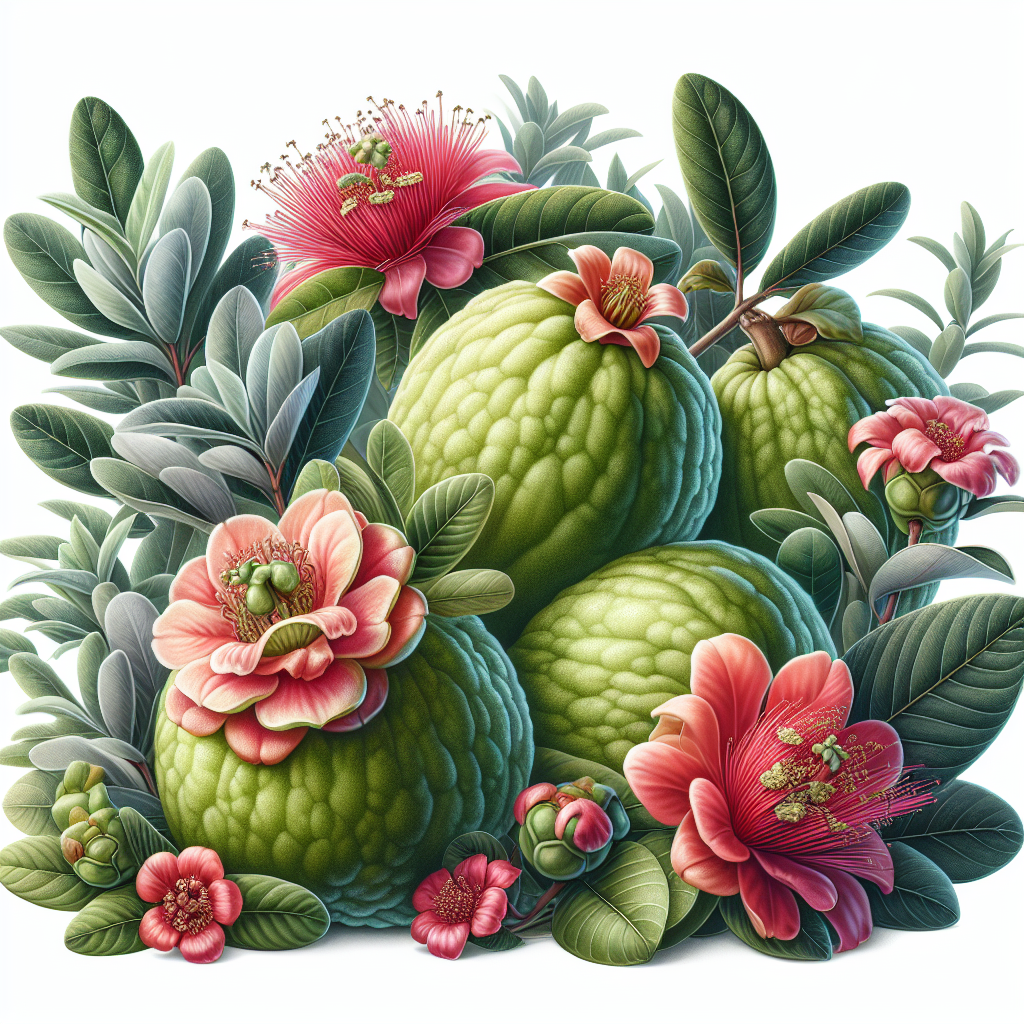
Introduction to Guava (Pineapple Guava - Mammoth)
Guava (Pineapple Guava - Mammoth), scientifically known as Acca sellowiana 'Mammoth', stands out as a premier cultivar in the feijoa family, renowned for its massive fruit size and exceptional adaptability. Native to the highlands of southern Brazil, Uruguay, Paraguay, and Argentina, this variety has gained global popularity for its unique flavor profile—a intoxicating blend of pineapple, guava, and strawberry that makes it a gourmet favorite. 'Mammoth' fruits can reach up to 4-5 inches in length, weighing 4-6 ounces each, far surpassing standard feijoas, and are packed with vitamin C, antioxidants, and dietary fiber.
This evergreen shrub or small tree grows 12-20 feet tall with attractive silver-green foliage and striking crimson flowers that double as edible decorations. It's particularly valued by small-scale growers for its drought tolerance once established, wind resistance, and ability to fruit heavily without cross-pollination—self-fertile traits that simplify cultivation. In permaculture systems, Apple Guava (crop) complements 'Mammoth' for diverse guava harvests, while its cold hardiness down to 10°F (-12°C) extends its range beyond traditional subtropical zones. Whether you're establishing a backyard orchard or scaling for market sales, Pineapple Guava 'Mammoth' offers reliable yields of 50-100 pounds per mature plant annually, with fruits ripening fall to winter for off-season income. For deeper insights into Why Companion Planting Feels Like Guesswork for Small Farms - And How AI Makes It Foolproof, explore synergistic pairings later in this guide.
Botanical Profile of Guava (Pineapple Guava - Mammoth)
Acca sellowiana 'Mammoth' belongs to the Myrtaceae family, distinguishing it from true guavas (Psidium spp.) while sharing aromatic appeal. This cultivar was selected for its superior fruit size and productivity, originating from New Zealand breeding programs in the mid-20th century. The plant features dense, oval leaves (2-3 inches long) with silvery undersides that provide year-round privacy screening and shade tolerance.
Edible crimson anthers emerge in spring, attracting pollinators like bees, though hand-pollination boosts yields in low-bee areas. Fruits develop from these flowers, maturing 4-6 months later with thick, greenish-brown skin protecting jelly-like, seed-filled pulp. Nutritionally, each 100g serving delivers 55 calories, 8g sugar, 55mg vitamin C (over 100% DV), and potassium for immune and heart health. 'Mammoth' is diploid and self-fruitful, producing hermaphroditic flowers, but planting multiples enhances pollination. Botanically vigorous, it resists most subtropical pests better than tropical guavas, with wood that coppices well for hedges. Growth habit is upright-spreading, ideal for espalier or container culture in pots up to 25 gallons.
Soil, pH, and Climate Requirements for Guava (Pineapple Guava - Mammoth)
Pineapple Guava 'Mammoth' excels in well-drained, loamy soils but adapts to sands, clays, and even heavy soils with amendments. Optimal pH ranges 6.0-7.5, slightly acidic to neutral; test soil and amend with lime if below 6.0 or sulfur if above 8.0. Incorporate 20-30% organic matter like composted pine bark or aged manure to improve drainage and fertility, targeting 2-4% organic content.
Climate-wise, it's hardy in USDA zones 8-11, tolerating brief dips to 10°F and summer highs over 100°F. It thrives in 20-40 inches annual rainfall but endures drought for months. Full sun (6-8 hours daily) promotes fruiting, though partial shade (4 hours) suffices in hot deserts. Coastal areas love its salt spray tolerance, while inland growers mulch heavily for moisture retention. Avoid prolonged freezes; protect young plants with frost cloth. In marginal zones 7b, plant against south-facing walls for microclimate warmth. Soil salinity tolerance up to 4 dS/m makes it viable near brackish water. For heatwave resilience, see Why Summer Heatwaves Are Silently Killing Small Farm Yields - And 7 Organic Strategies to Fight Back—key for 'Mammoth' in warming climates.
Step-by-Step Planting & Propagation
Propagation: 'Mammoth' roots easily from semi-hardwood cuttings (4-6 inches, June-August). Dip basal ends in 0.2% IBA rooting hormone, plant in 1:1:1 perlite-peat-sand under intermittent mist at 70-80°F. Roots form in 6-8 weeks; success rate 80-90%. Seeds germinate in 2-4 weeks at 75°F but yield variable offspring—stratify at 40°F for 30 days first. Air-layering mature branches in summer yields clones in 2 months.
Planting: Select 2-3-year nursery stock (18-24 inches tall). Plant in early spring or fall, spacing 10-15 feet apart for trees, 6-8 feet for hedges. Dig holes 2x root ball width, 1 foot deep; mix in 4-6 quarts compost and 1 lb dolomite lime. Set graft union 2 inches above soil; water deeply to settle. Mulch 3-4 inches thick (not touching trunk) with wood chips. For containers, use 20-gallon pots with gravel base.
Initial Care: Water weekly first year (1-2 inches), then biweekly. Stake if windy. Prune at planting to balance top growth. Expect first fruits year 2-3.
Care & Maintenance regimes for Guava (Pineapple Guava - Mammoth)
Watering: Deep, infrequent irrigation: 1-2 inches weekly young plants, monthly mature. Drip systems ideal; deficit irrigation late summer enhances flavor. Monitor for yellowing (overwater) or wilting (drought).
Fertilization: Spring application of balanced 10-10-10 (1 lb per year age, max 5 lb) or citrus/guava formula high in NPK and micronutrients (Zn, Fe, Mn). Foliar spray chelated iron monthly if chlorotic. Organic options: compost tea, fish emulsion 4x/year.
Pruning: Annual late winter: remove dead/crossing branches, thin canopy for light penetration. Head back vigorous shoots to promote fruiting spurs. Hedge trim post-harvest. Mature plants yield more with open-center form.
Weed & Mulch: Maintain 3-foot weed-free zone; mulch replenishes yearly. Windbreaks for young plants in exposed sites.
Pests, Diseases & Organic Management
'Mammoth' boasts strong resistance, but vigilance is key. Common pests: Aphids (pest), Scale insects (pest), Mealybugs (pest)—blast with water, apply neem oil (2% weekly) or insecticidal soap. Fruit flies (pest) attack ripening fruit; use protein bait traps or kaolin clay barrier. Birds love flowers/fruits—net mature plants.
Diseases: Root rot (disease) from overwatering (Phytophthora (disease)); ensure drainage, use phosphonate drenches. Powdery mildew (disease) in humid areas—potassium bicarbonate spray. Anthracnose (disease) rare; prune for airflow, copper fungicide preventively. Organic IPM: encourage lacewings/ladybugs, yellow sticky traps, sanitation. For broader strategies, Why 90% of Small Farms Fail at Pest Management - And 8 Organic Fixes That Actually Work details scalable solutions.
Harvesting, Curing & Optimal Storage
Harvest when fruits drop naturally or shake easily from tree (October-December in northern hemisphere). Skin remains green; test by thumb pressure—slightly soft at blossom end. Yields peak year 5-10; pick daily to avoid waste. Handle gently; fruits bruise easily.
No curing needed; eat fresh or ripen indoors 3-7 days at 60-70°F. Refrigerate at 32-41°F (90-95% humidity) up to 4 weeks; freeze pulp scooped from halves. Process into jelly, ice cream, smoothies—scoop edible flesh, discard core. Market as premium due to size/flavor; store unripe at 55°F for 2 months shipping.
Companion Planting for Guava (Pineapple Guava - Mammoth)
'Mammoth' pairs excellently with nitrogen-fixers like Clover (crop) or pigeon pea for soil enrichment, and pest-repellents like Nasturtium (crop) or marigolds to deter nematodes. Underplant with low-growers: strawberries (Strawberry (crop)), herbs (Thyme (crop)). Avoid heavy feeders like brassicas competing for water. Pair with Lemon (crop) for citrus-guava polyculture; yarrow (Yarrow (crop)) attracts beneficials. Space-aware guilds boost biodiversity, suppress weeds, and enhance microclimate. Read Fall Companion Planting Guide: Boost Yields and Soil Health for Small Farms and Gardens for seasonal tips.