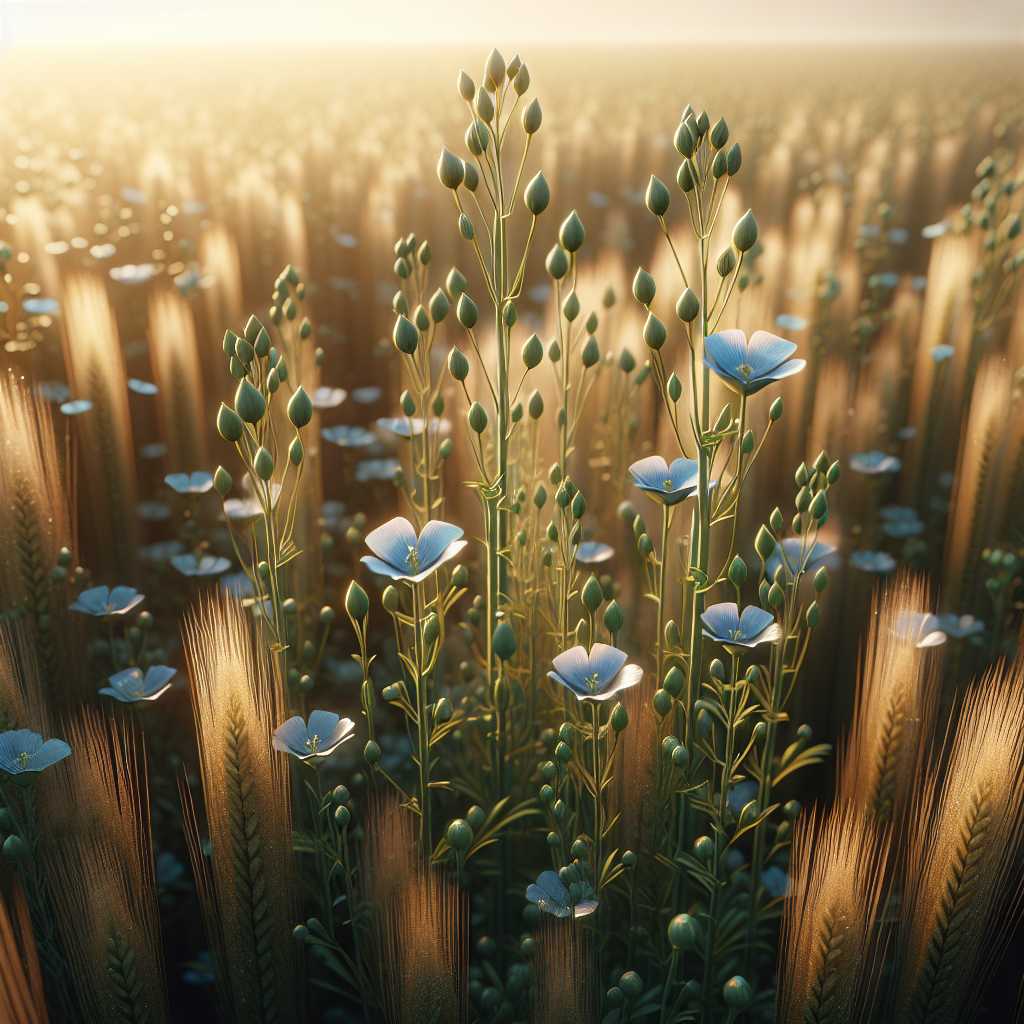
Introduction to Golden Flax
Golden flax is a golden- or amber-seeded type of Linum usitatissimum, the same species cultivated for millennia as one of humanity's oldest oilseed and fiber crops. Archaeological evidence places flax among the earliest domesticated plants in the Fertile Crescent, valued both for linen fiber and for seed rich in alpha-linolenic acid, protein, mucilage, and lignans. The golden-seeded forms are especially favored in food markets where a lighter-colored meal or oil is preferred, though agronomically they behave much like brown-seeded flax.
This crop is best understood as a cool-season, short-duration annual with a delicate early growth habit and a surprisingly resilient finish if weather stays dry near maturity. Compared with coarser grains, flax seedlings are less competitive with weeds, less tolerant of cRusted soil, and more sensitive to waterlogging. However, when seedbed preparation, sowing depth, and fertility are handled correctly, it can be a highly efficient crop with modest nutrient demand and good fit in cereal, pulse, and oilseed rotations. For broader species-level context, see Flax. A useful background read on rotation and soil-building principles is this soil health article.
Golden flax is usually grown for seed rather than textile fiber. Seed-oriented stands are somewhat more branched than fiber flax, and management aims to maximize uniform flowering, capsule set, and even dry-down. The crop's commercial value rises sharply when seed is clean, bright, sound, and low in moisture, so postharvest discipline matters as much as field management.
Botanical Profile of Golden Flax
This species belongs to the family Linaceae. It is an erect annual with a slender taproot and many fine lateral roots concentrated in the upper soil profile, which explains why it dislikes compaction and saturated topsoil yet also responds strongly to timely moisture during establishment. Plants typically range from 45 to 90 cm tall in seed production systems, depending on variety, fertility, stand density, and moisture.
Leaves are narrow, lanceolate, and alternately arranged on smooth, round stems. Flowers are usually sky blue in most flax, though petal color may vary slightly among lines; blooms are short-lived, often opening in the morning and dropping by afternoon under warm conditions. Each fertilized flower produces a rounded capsule containing multiple flat, glossy seeds. In golden flax, the seed coat is yellow to light amber rather than medium to dark brown. That color difference does not mean the plant is weaker; it is simply a seed trait selected for end use and market preference.
Growth stages are useful for management decisions:
- Emergence: cotyledons unfold at the soil surface; seedlings are fragile and vulnerable to cRusting and flea beetle feeding.
- Early vegetative: stem elongation begins; shallow roots expand rapidly in the top 15-30 cm of soil.
- Budding to flowering: nutrient uptake peaks, and moisture stress at this point can reduce capsule number.
- Capsule fill: seed accumulates oil and dry matter; severe heat or drought can reduce seed size.
- Ripening: stems yellow, capsules turn tan-gold, and seed rattles within dry bolls.
Golden flax differs somewhat from fiber flax in ideal stand architecture. For seed production, moderate spacing that allows limited branching is acceptable and often desirable, whereas fiber flax is sown densely to produce long, unbranched stems. Most growers targeting seed want a final stand dense enough to suppress late weeds but not so dense that lodging and disease become major risks.
Soil, pH, and Climate Requirements for Golden Flax
Golden flax performs best in fertile but not overly rich loam, silt loam, or clay loam with excellent drainage and a fine, firm seedbed. Sandy soils can work if moisture is dependable, but the crop may suffer from uneven emergence and drought stress during flowering. Heavy clay can produce good yields if structured well, yet poorly drained clay is one of the quickest ways to lose a stand through root stress, cRusting, or seedling disease.
The ideal soil pH is generally 6.0 to 7.5, with a practical sweet spot around 6.3 to 7.2. Below pH 5.8, nutrient imbalances and weaker root function become more likely; above pH 7.8, micronutrient availability, especially zinc, manganese, or iron, may decline depending on soil chemistry. Flax is not a heavy feeder compared with maize or brassicas, but it is sensitive to mismanaged fertility. Excess nitrogen pushes lush growth, delays maturity, increases lodging, and can worsen disease pressure. A balanced fertility program is more important than a high-input one.
Climate matters enormously. Golden flax is fundamentally a temperate, cool-season crop. It germinates in cool soils and tolerates light spring frost once emerged, but persistent hard freezes on small seedlings can thin the stand. Ideal establishment occurs with soil temperatures around 8-15°C. Vegetative growth is strongest under mild conditions, roughly 15-21°C, and seed fill is best when days are warm but not scorching. Temperatures consistently above 30°C during flowering and early seed fill may reduce capsule retention and oil quality.
Rainfall needs are moderate. A seasonal total of about 300-500 mm, well distributed, is often sufficient in dryland systems with moisture-conserving soils. The most critical moisture window is from germination through early flowering. During this period, the top 5 cm of soil should remain evenly moist but never saturated. In practical terms, soil squeezed from the seeding zone should feel cool and cohesive, not muddy, and should break apart with gentle pressure rather than smear. After flowering, the crop benefits from reducing rainfall intensity; wet weather near maturity promotes delayed ripening, seed staining, and harvest problems.
Avoid fields with standing water after rain, hardpan within the top 20-30 cm, or severe salinity. Flax is not highly salt tolerant. Electrical conductivity above roughly 4 dS/m begins to pose meaningful risk, especially at emergence.
Step-by-Step Planting & Propagation
Golden flax is propagated by seed and is almost always direct sown. Transplanting is not recommended because the crop establishes a delicate root system early and does not recover well from root disturbance.
Choose the right field. Select a clean field with low weed pressure and good surface drainage. Avoid planting after another flax crop for at least 3-4 years to reduce residue-borne diseases. Good preceding crops include cereals or pulses, especially Chickpeas when disease history and herbicide carryover are carefully reviewed.
Prepare a firm, level seedbed. Seed is small, so cloddy ground causes erratic depth placement. The goal is a seedbed where a boot heel leaves a shallow print, not a deep sink. Excessively fluffy soil dries too quickly and can bury seed too deep after rain.
Test soil before planting. Base fertilizer on soil analysis. Many successful seed flax crops use modest nitrogen, often around 30-70 kg/ha total available N depending on residual fertility, yield target, and rainfall outlook. Phosphorus should be adequate for root establishment; potassium is important where tests are low. Sulfur may be beneficial on sandy or low-organic-matter soils.
Time sowing early. Plant as soon as the field can be worked in spring and soil conditions are suitable. Earlier sowing generally improves yield by allowing flowering and fill before summer heat. In very cold climates, wait until the topsoil is workable and not waterlogged.
Set precise seeding depth. Sow 1.3-2.5 cm deep in most soils. In heavy or cRust-prone soils, stay closer to 1.3-1.9 cm. In lighter soils with drying risk, 2.0-2.5 cm may be safer. Depth inconsistency is a major cause of uneven maturity.
Use appropriate seed rate. For seed production, a common target is about 700-1,000 viable seeds per square meter, often translating to roughly 35-55 kg/ha depending on seed size and germination. Lower rates may encourage branching and uneven ripening; excessively high rates can increase lodging and humidity within the canopy.
Row spacing. Narrow rows, typically 15-20 cm, help the crop canopy close sooner and suppress weeds. Wider rows can work for low-input or intercropping systems but usually sacrifice weed competitiveness.
Roll if needed. A light roller after sowing can improve seed-to-soil contact and level stones before harvest, especially where direct combining is planned. Do not roll sticky soil.
Monitor emergence. Seedlings should emerge uniformly in 7-14 days depending on temperature. If surface cRust forms after heavy rain, emergence may stall. A patchy stand often traces back to cRusting, deep sowing, or saturated furrows.
Evaluate stand early. Count plants after emergence. A healthy, even stand is worth more than a thick but irregular one. Uneven stands flower and mature over too long a window, complicating harvest timing.
Care & Maintenance regimes for Golden Flax
Management of golden flax is about consistency rather than intensity. The crop seldom rewards dramatic corrective action; it rewards prevention.
Water management: In rainfed systems, conserve soil moisture with reduced tillage and residue management before planting. In irrigated production, the aim is to keep the root zone moderately moist through establishment and flowering, then allow gradual drying as seed reaches maturity. As a guide, maintain about 60-80% of field capacity in the upper 30 cm from seeding to early flowering. Below roughly 50% field capacity during flowering, plants may abort buds or set fewer capsules. Above field capacity for more than 24-48 hours, root oxygen drops and seedlings may yellow or stall. Visible overwatering symptoms include bluish-green foliage followed by pale lower leaves, sluggish growth despite moist soil, and in severe cases lodging or patchy root rot. Underwatering is seen first as reduced vigor, shorter plants, fewer branches in thin stands, and premature yellowing before full capsule fill.
Fertility management: Nitrogen should be conservative. If the crop receives too much available N, stems elongate excessively, lodging risk rises, and maturity becomes uneven. In moderate-yield environments, split applications are less common than in cereals because the season is short, but topdressing early may be justified if heavy rain leaches N and the crop is visibly pale before budding. Phosphorus is especially useful where soil tests are low, improving early root growth and vigor. Potassium supports stem strength and water regulation. Excess chloride salts should be avoided in sensitive soils.
Weed control: Golden flax is a poor early competitor. Fields must be clean at sowing. Use rotation, stale seedbed techniques, and dense uniform stands to suppress weeds. Mechanical weeding is difficult once plants are 8-10 cm tall because stems are brittle and shallow-rooted. Weed escapes are especially harmful because harvestable seed is hard to clean from similarly sized weed seeds.
Lodging prevention: Overfertilization, dense lush stands, wind, and storms near maturity all increase lodging. Lodged flax is slower to dry and more prone to disease and staining. Good potassium status, moderate nitrogen, and early sowing reduce risk.
Growth observation: A well-managed crop transitions from bright green vegetative growth to a more glaucous blue-green canopy, then to a uniform yellowing of stems and capsules. If the field remains patchy green late in the season, investigate uneven emergence, nitrogen variability, compacted zones, or disease hotspots.
Pests, Diseases & Organic Management
Golden flax has fewer catastrophic pest problems than some vegetable crops, but because seedlings are delicate and harvest quality standards are high, even moderate pressure can be costly.
Insect pests:
- Flea beetles may feed on cotyledons and first true leaves, producing shot-hole injury. Severe feeding can destroy emergence in hot, dry weather. Fast emergence is the best defense.
- Aphids occasionally colonize stems and flower structures, especially during warm, dry periods. Heavy infestations can reduce vigor and transmit viruses.
- Cutworms or Grasshoppers may injure seedlings locally.
- Thrips sometimes scar tissues under dry stress conditions.
Organic management begins with field hygiene, early planting, and preserving beneficial insects. Border vegetation that supports predators can help, as can companion insectary strips with Yarrow or Clover nearby rather than mixed densely within the flax stand. Avoid excess nitrogen, which can make the canopy more attractive to sap-feeding insects.
Diseases:
- Damping-off affects seeds and seedlings in cold, wet soils.
- Pasmo, a common fungal disease, causes brown lesions and banding on stems and leaves; severe infection weakens stems and reduces seed fill.
- Rust may appear as orange pustules on foliage and stems in humid weather.
- Wilt diseases can cause yellowing, browning, and collapse, particularly where flax is grown too frequently in rotation.
- Alternaria and other seed-associated fungi can stain seed and lower marketability.
Organic disease prevention relies heavily on rotation and microclimate management. Keep at least 3, ideally 4 years, between flax crops on the same field. Use clean seed with strong germination. Avoid poorly drained ground and excess nitrogen. Encourage fast canopy drying by not oversowing or overirrigating. If irrigation is necessary, water early in the day so foliage dries quickly.
Scout weekly from emergence through capsule fill. Check low spots first, then compacted headlands, then denser zones. Remove and inspect whole plants if symptoms appear. Distinguish nutrient stress from disease by looking at roots and stem lesions rather than leaf color alone.
Harvesting, Curing & Optimal Storage
Harvest timing is one of the most important determinants of golden flax quality. For seed production, the crop is generally ready when the majority of bolls are golden brown, stems are yellowing to tan, and seeds inside the lower and middle capsules are fully developed, glossy, and free from a soft, doughy interior. Mature seed rattles in dry capsules. Seed moisture at combining is often targeted around 10% or slightly higher if drying capacity is available.
Harvest too early and the seed is immature, with lower oil accumulation, green color, and poor storability. Harvest too late and shattering, weathering, tangled stems, and seed bleaching become more likely. Golden flax can be direct combined if the stand is even and weeds are well controlled. In uneven crops, swathing may help synchronize dry-down, though it introduces weather exposure risk.
Combine settings need care because flax straw can be stringy and seed is small. Keep cylinder or rotor action gentle enough to avoid cracking seed but aggressive enough to thresh capsules cleanly. Adjust sieves to remove light trash without blowing out seed. Because seed is smooth and can flow readily, ensure bins, augers, and seals are tight.
After harvest, clean seed promptly. Even small amounts of green plant material or weed seed increase heating risk. For safe storage, dry seed to about 8% moisture for short- to medium-term holding, and 7% or lower for longer storage in warm conditions. Seed going into oil pressing or food markets should also be protected from rancidity, so keep storage cool, dark, and dry. Temperatures below 15°C are preferable when possible. If seed smells painty, bitter, or stale, oxidation has begun.
Aerate bins after filling to equalize temperature. Monitor every 1-2 weeks initially for hot spots, cRusting, condensation, or moisture migration. Golden flax's high oil content makes poor storage especially unforgiving. Store only sound, clean seed free from insect contamination.
If saving seed for planting, select lots from healthy, uniform fields, dry gently, and avoid mechanical damage. Seed vigor declines faster in warm, humid storage than many growers expect.
Companion Planting for Golden Flax
In production agriculture, companion planting with flax is less about close intermingling and more about intelligent adjacency, border design, and rotational compatibility. Because golden flax seedlings are not aggressive competitors, the best companions are plants that support pollinators and beneficial insects nearby without shading the crop or tangling harvest.
Yarrow is especially useful on margins because its umbels attract parasitic wasps, hoverflies, and predatory insects that help suppress Aphids and small caterpillar pests. Clover works well in adjacent strips or as an understorey after flax establishment in carefully managed low-competition systems, contributing pollinator support and long-term soil structure improvement. Thyme can be used on borders in small-scale diversified farms where aromatic flowering herbs are intended to increase beneficial insect activity. Lentils fit well as a rotational companion rather than an in-row companion, reducing disease buildup associated with repeated oilseed or cereal monoculture and helping balance nutrient use.
Avoid pairing golden flax directly with tall, shading crops such as corn or vigorous sprawling plants. Also avoid dense mixed sowings with species harvested at very different times, because flax stems wrap around machinery and uneven maturity complicates threshing. On small farms, the most successful approach is usually a clean flax block bordered by insectary species rather than a true polyculture.
Where biodiversity strips are included, keep them narrow enough that airflow across the flax remains good. This matters because prolonged humidity around stem bases can increase fungal issues. Place flowering companions on the windward or perimeter edges, not within the main combine path. In garden-scale plantings, use companion plants to attract beneficials and mark field edges, but preserve at least modest open spacing around the flax so the crop remains upright and dries evenly near harvest.