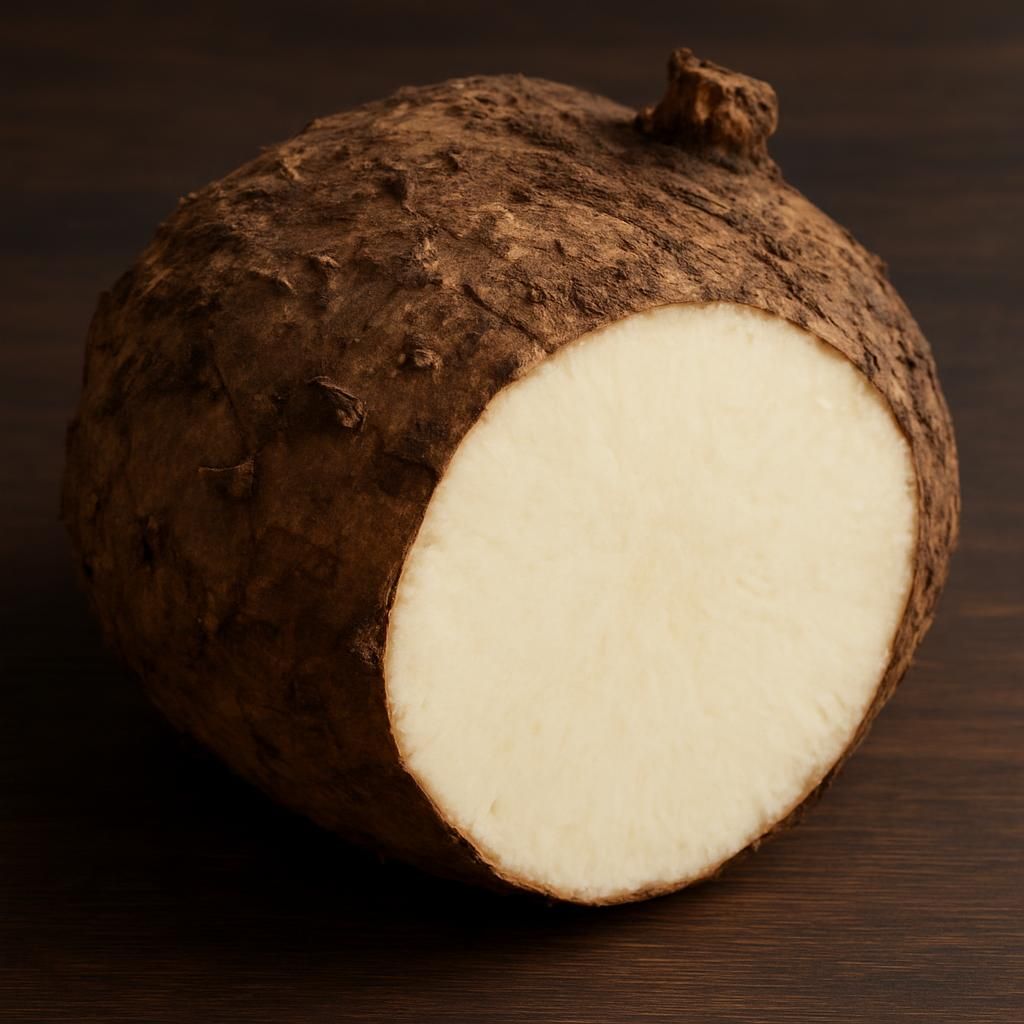
Introduction to Elephant Foot Yam (Suran)
Elephant Foot Yam (Suran), scientifically known as Amorphophallus paeoniifolius, is a staple tuber crop across tropical Asia and parts of Africa. The plant produces massive underground corms that serve as a rich source of carbohydrates, dietary fiber, and minerals. Its resilience to drought and ability to grow in marginal soils make it an important food-security crop for smallholder farmers.
Commercial cultivation has expanded because the corms fetch premium prices in urban markets and are used in processed snacks and flours. The crop cycle typically lasts 7–9 months, after which the corms enter dormancy. Because the plant is propagated vegetatively from corm pieces, seed cost is low and multiplication rates are high.
Botanical Profile of Elephant Foot Yam (Suran)
The plant belongs to the Araceae family and features a single, highly dissected leaf that emerges from the corm apex. The leaf canopy can reach 1.5–2 m in height, providing substantial photosynthetic surface. The inflorescence is a spadix surrounded by a purple spathe and emits a strong odor to attract pollinators.
The corm is globose to depressed-globose, weighing 2–15 kg at maturity. Internally, it is white to cream with occasional pinkish vascular bundles. The corm surface is covered by a thin, corky periderm that protects against moisture loss during storage.
Soil, pH, and Climate Requirements for Elephant Foot Yam (Suran)
Elephant Foot Yam thrives in well-drained sandy loam to clay loam soils with good organic matter. Heavy clay soils that remain waterlogged cause corm rot, while very sandy soils require frequent irrigation and mulching.
| Parameter | Ideal Range | Notes |
|---|---|---|
| Soil Type | Sandy loam to clay loam | Good drainage essential |
| Soil pH | 5.5–7.0 | Slightly acidic to neutral |
| Temperature | 25–35 °C | Optimal growth; frost kills foliage |
| Rainfall | 1000–1500 mm | Evenly distributed; supplement in dry spells |
| Altitude | 0–1200 m | Best yields below 800 m |
| Organic Matter | 2–3 % | Improves moisture retention and fertility |
Step-by-Step Planting & Propagation
- Select healthy, disease-free corms weighing 500–800 g.
- Cut into 150–200 g pieces, each with at least one bud.
- Dust cut surfaces with wood ash or Turmeric powder to prevent fungal entry.
- Prepare raised beds 30 cm high and 1 m wide; incorporate 10–15 t/ha well-rotted FYM.
- Plant pieces 10–12 cm deep at 60 cm × 60 cm spacing in February–March in subtropical regions.
- Mulch immediately with 10 cm of dry leaves or straw to conserve moisture.
Care & Maintenance regimes for Elephant Foot Yam (Suran)
Timely irrigation, balanced nutrition, and weed control are critical for commercial yields. The crop responds well to integrated nutrient management combining organic and limited inorganic inputs.
| Growth Stage | Water Schedule | Fertilizer Schedule | Pruning/Weeding Schedule |
|---|---|---|---|
| Planting–30 DAP | Light irrigation every 4–5 days | 10 t/ha FYM + 40 kg N basal | Hand weeding at 20 DAP |
| 30–90 DAP | Irrigation every 7–10 days | 20 kg P₂O₅ + 30 kg K₂O at 45 DAP | Mulch top-up + weeding at 45 and 75 DAP |
| 90–180 DAP | Irrigation every 10–12 days | 20 kg N top-dress at 90 DAP | Remove senescing leaves only |
| 180 DAP–Harvest | Reduce irrigation 3 weeks before harvest | No further fertilizer | Cease weeding; allow natural senescence |
Pests, Diseases & Organic Management
Major pests include Aphids, Mealybugs, and Scale insects. These sap-sucking insects can be controlled with neem oil (3 ml/L) sprays at 15-day intervals. Root-knot nematodes cause galls; solarization and application of 2 t/ha neem cake effectively suppress populations.
Diseases such as Collar rot (Sclerotium rolfsii) and Leaf spot diseases are managed by improving drainage, crop rotation with Rice, and spraying copper-based fungicides or Trichoderma viride (5 g/L). Rogue and destroy infected plants immediately.
Harvesting, Curing & Optimal Storage
Corms are ready when leaves turn yellow and dry (7–9 months after planting). Dig carefully to avoid cuts; cure in shade for 3–4 days. Store in well-ventilated rooms at 12–15 °C and 85–90 % RH; corms remain sound for 4–6 months. Periodic inspection removes sprouted or rotted corms.
Companion Planting for Elephant Foot Yam (Suran)
Intercropping with Ginger or Turmeric provides additional income and suppresses weeds. Leguminous cover crops such as Cowpea or Mung Bean fix nitrogen and improve soil structure. Avoid planting near Tomato or Potato because of shared nematode and fungal pathogens. Marigold borders repel nematodes and enhance biodiversity.
For more on building resilient small-farm systems, see The Truth About Weather Patterns and Small Farm Resilience.