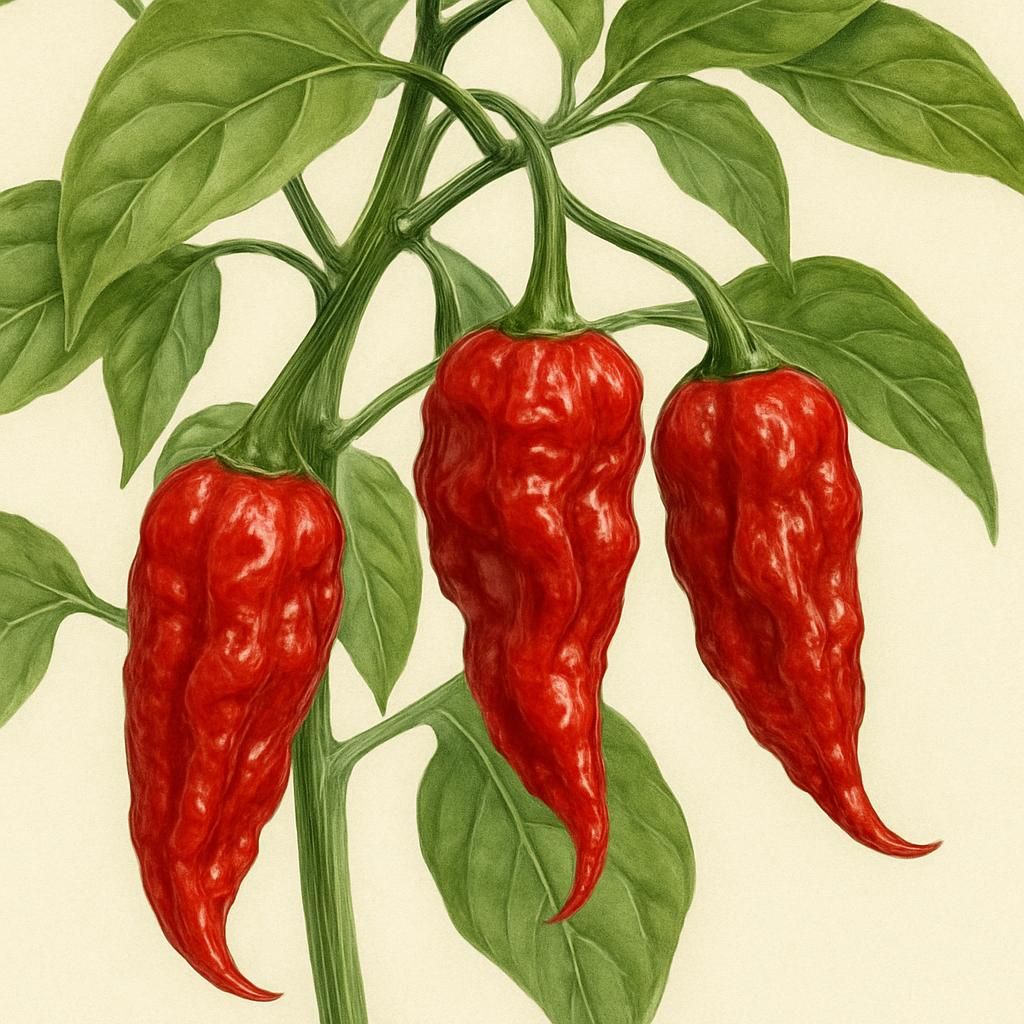
Introduction to Devil's Tongue Red
Devil's Tongue Red is a rare, super-hot chili pepper that combines visual drama with extreme heat levels often exceeding 300,000 Scoville Heat Units. Its long, tapered pods resemble a devil's tongue, ripen from green to a glossy scarlet, and carry a distinctive tropical-fruit aroma that makes them valuable for specialty hot sauces, powders, and culinary extracts. Commercial growers and serious home gardeners alike seek this variety for its high market price and visual appeal in fresh and dried form.
The cultivar belongs to the species Capsicum chinense, the same group that includes the Ghost Pepper and Habanero Pepper. It requires a long, warm growing season and consistent attention to fertility and moisture to reach full flavor and heat potential. With proper management, a single well-grown plant can produce 40–60 marketable pods over a 10–12 week harvest window.
Botanical Profile of Devil's Tongue Red
Devil's Tongue Red exhibits classic C. chinense morphology: compact, multi-branched bushes reaching 60–90 cm in height with dark-green, ovate leaves. Flowers are small, creamy-white with greenish anthers and appear continuously once night temperatures remain above 18 °C. The fruit is 7–10 cm long, deeply wrinkled, and ends in a sharp, curved tip. Internal placental tissue produces high concentrations of capsaicinoids, giving the pepper its signature heat and complex citrus-pine aroma.
Because the variety is photoperiod-insensitive, it flowers and sets fruit under a wide range of day lengths, making it suitable for both equatorial and temperate greenhouse production. Genetic studies place it within the same clade as other Caribbean chinense types, yet its elongated shape and thinner walls differentiate it from rounder habanero relatives.
Soil, pH, and Climate Requirements for Devil's Tongue Red (MUST INCLUDE A MARKDOWN TABLE OF IDEAL CONDITIONS)
Successful cultivation begins with well-drained, biologically active soil rich in organic matter. The crop performs best in sandy-loam to loam textures that allow rapid root penetration while retaining adequate moisture. Heavy clay soils should be amended with aged compost and coarse perlite or rice hulls to improve aeration and reduce risk of root rot.
| Parameter | Ideal Range | Notes |
|---|---|---|
| Soil Texture | Sandy loam to loam | Avoid compacted or waterlogged soils |
| Soil pH | 6.2 – 6.8 | Slightly acidic; lime only if below 5.8 |
| Organic Matter | 4 – 6 % | Maintain with annual compost applications |
| Day Temperature | 24 – 32 °C | Optimal fruit set above 21 °C nights |
| Night Temperature | 18 – 22 °C | Below 15 °C slows growth and causes blossom drop |
| Growing Season Length | 110 – 130 frost-free days | Start indoors 8–10 weeks before last frost |
| USDA Hardiness Zones | 9–11 (annual elsewhere) | Protect or grow under cover in cooler zones |
Step-by-Step Planting & Propagation
- Start seeds indoors 8–10 weeks before the last expected frost. Sow 5 mm deep in sterile seed-starting mix at 26–28 °C bottom heat. Germination occurs in 7–14 days.
- Transplant seedlings into 10 cm pots once the first true leaves appear. Maintain 24 °C day / 18 °C night temperatures and provide 14–16 hours of supplemental light.
- Harden off plants for 7–10 days when outdoor night temperatures stabilize above 15 °C. Gradually increase sun exposure and reduce watering frequency.
- Prepare planting beds by incorporating 5–7 cm of well-aged compost and a balanced organic fertilizer (NPK 4-4-4 or similar). Install drip irrigation lines spaced 30 cm apart.
- Space plants 45–60 cm apart in rows 75–90 cm wide. This density maximizes airflow while allowing mechanical cultivation between rows.
- Mulch immediately after transplanting with 5–7 cm of straw or shredded hardwood to suppress weeds and stabilize soil temperature.
Care & Maintenance regimes for Devil's Tongue Red (MUST INCLUDE A MARKDOWN TABLE OF WATER, FERTILIZER, AND PRUNING SCHEDULES)
Consistent moisture and measured fertility are critical for both yield and capsaicin concentration. Over-fertilization, especially with nitrogen, produces lush foliage at the expense of fruit quality.
| Growth Stage | Irrigation Frequency | Fertilizer (Organic) | Pruning Action |
|---|---|---|---|
| Transplant to 30 cm | Keep soil evenly moist (every 2–3 days) | 4-4-4 at 200 g/m², side-dress at week 3 | Remove lower leaves touching soil |
| Flowering | Deep watering 2× weekly | Switch to 2-5-8 at first bloom | Pinch growing tips at 30 cm to encourage branching |
| Fruit Set | Maintain 2.5 cm/week total | 2-5-8 every 3 weeks until first harvest | Remove suckers below first fork |
| Peak Harvest | Reduce to 1.5 cm/week | Stop nitrogen; apply 0-0-8 potassium | Light selective pruning for airflow |
| Post-Harvest | Withhold irrigation | Light compost tea to support regrowth | Cut back 30 % of canopy if overwintering |
Pests, Diseases & Organic Management
Devil's Tongue Red is susceptible to the same suite of pests and pathogens that affect other Capsicum species. Primary threats include aphids, thrips, spider mites, and whiteflies. Fungal issues such as powdery mildew and phytophthora become problematic under high humidity or poor drainage.
Implement an integrated pest management (IPM) program that begins with weekly scouting. Use yellow sticky traps to monitor flying insects and release beneficials such as Encarsia formosa for whiteflies and Phytoseiulus persimilis for spider mites. Neem oil and insecticidal soaps provide contact control without residue concerns. For soil-borne diseases, rotate away from solanaceous crops for at least three years and solarize beds during fallow periods.
Harvesting, Curing & Optimal Storage
Harvest pods at full color change for maximum heat and flavor. Use clean pruners to cut stems 1 cm above the calyx, avoiding bruising. Fresh market peppers should be cooled to 10–12 °C within two hours of harvest and held at 90–95 % relative humidity.
For drying, arrange pods in single layers on screens in a forced-air dehydrator at 35–40 °C until brittle (usually 8–12 hours). Store whole dried pods in airtight glass jars away from light. Properly dried and stored peppers retain pungency for 18–24 months. For long-term seed saving, isolate plants by 150 m or use insect netting to prevent cross-pollination with other chinense varieties.
Companion Planting for Devil's Tongue Red
Strategic companions improve pollination, deter pests, and enhance soil biology. Basil and Thai Basil planted at row ends attract pollinators and mask the scent of pepper plants from aphids. Marigold and nasturtium provide living mulch that suppresses weeds while their root exudates inhibit nematodes. Avoid planting near fennel or dill, which can attract unwanted insects.
Under greenhouse conditions, interplant with Cucumber on the north side of the row to provide light afternoon shade during peak summer heat. After final harvest, sow a cover crop of clover or hairy vetch to rebuild soil nitrogen and organic matter for the following season.
For further reading on harvest timing strategies that maximize small-farm revenue, see The Overlooked Art of Seasonal Harvest Timing for Small Farm Profit.