Ghost Pepper Growing Guide
Introduction to Ghost Pepper
Ghost Pepper, also known as bhut jolokia, is a legendary chile pepper cultivar most closely associated with Northeast India, especially Assam, Nagaland, and surrounding regions where hot, humid weather supports its long season and vigorous growth. It rose to global prominence after being recognized among the hottest peppers in the world, but beyond the heat, Ghost Pepper is valued for its distinct flavor profile: smoky, fruity, slightly floral, and deeply pungent. That aroma is important for growers and cooks alike, because mature fruits are not simply “hot”; they have a complex character that makes them especially suitable for hot sauces, dehydrated powders, infused oils, and spicy preserves.
From a production standpoint, Ghost Pepper is not a beginner’s pepper in the same way jalapeños or many cayenne types are. It germinates more slowly, develops more deliberately, and typically needs a longer frost-free season. It also reacts strongly to temperature swings, nutrient imbalance, and erratic watering. Plants can become highly productive once established, but they reward precision: warm root zones, evenly moist but aerated soil, moderate nitrogen, and sufficient potassium and calcium during flowering and fruiting.
Ghost Pepper is usually treated as an annual in temperate climates, though botanically it is a tender perennial and can survive for multiple years in frost-free or protected environments. In tropical and subtropical systems, mature plants can become shrub-like, yielding multiple flushes of fruit. If you already grow hot peppers, you may also want to compare cultural habits with other culinary companions such as Thai Basil, which often shares similar warmth-loving garden conditions.
Botanical Profile & Scientific Classification of Ghost Pepper
Ghost Pepper belongs to the Solanaceae family, the same family as tomato, eggplant, and potato. Its accepted scientific classification is typically given as:
- Kingdom: Plantae
- Clade: Angiosperms
- Clade: Eudicots
- Clade: Asterids
- Order: Solanales
- Family: Solanaceae
- Genus: Capsicum
- Species: Capsicum chinense
Although many growers associate the species name chinense with Chinese origin, that is a historical naming quirk. Like other domesticated peppers, Ghost Pepper traces its deeper ancestry to the Americas, but this specific cultivar became culturally and agriculturally significant in India. Bhut jolokia is often described as an interspecific or complex landrace-derived type with traits associated with Capsicum chinense and sometimes Capsicum frutescens in older discussions, but for practical cultivation it is treated as a Capsicum chinense super-hot pepper.
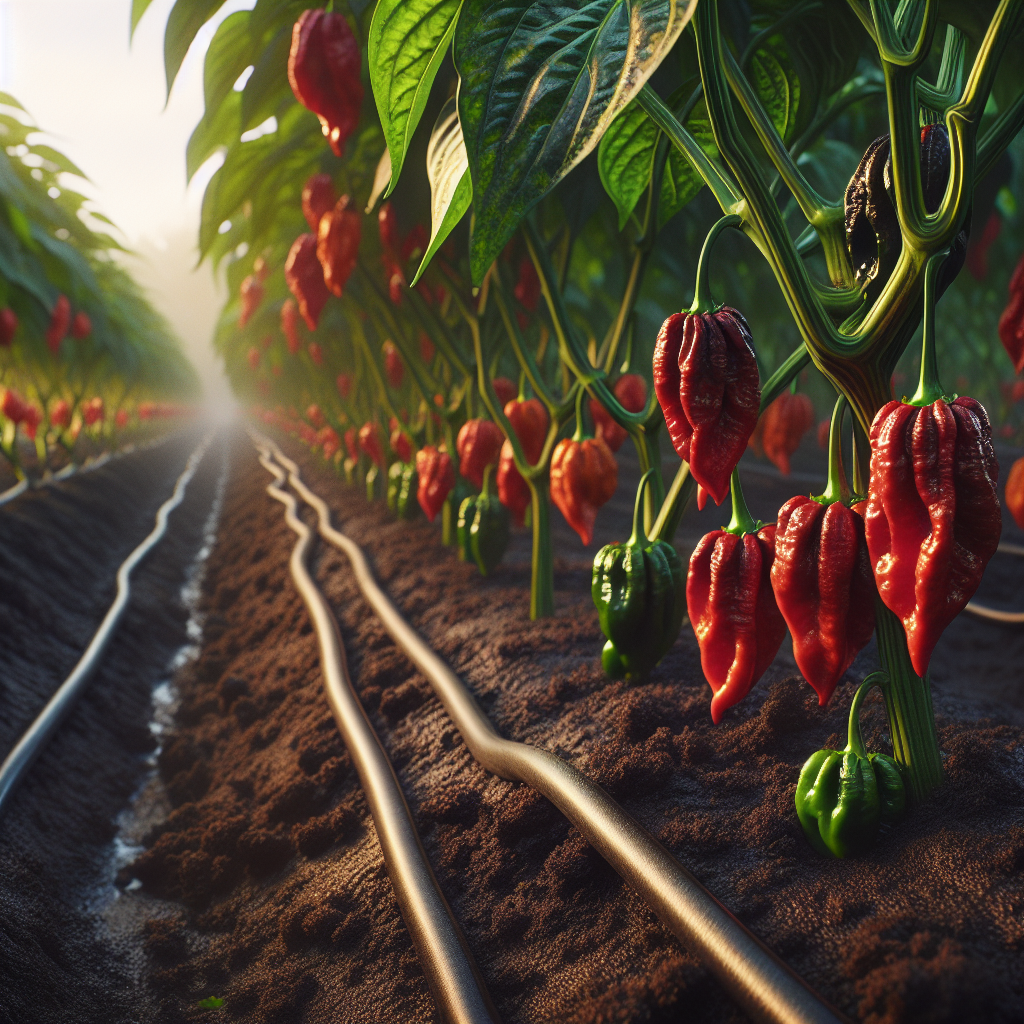
Ghost Pepper plants typically reach 60-120 cm tall in open-field conditions, though protected cultivation and long seasons can produce taller plants. Leaves are medium green, somewhat soft-textured, and broader than many annuum peppers. Flowers are generally small, pale, and nodding. Fruits are elongated, wrinkled, and tapering, often 5-8 cm long, maturing from green to orange-red or red depending on the strain. Some selections produce chocolate, peach, yellow, or other color variants, but the classic Ghost Pepper is red at maturity.
A defining physiological feature of Ghost Pepper is its high capsaicinoid content. These compounds are produced primarily in the placental tissues inside the fruit, not in the seeds themselves, though seeds become coated with capsaicin-containing tissues. Environmental stress, genetics, maturity stage, and nutrient balance can influence pungency. Full ripeness generally corresponds to maximum flavor and heat.
Ideal Soil, pH, and Climate Requirements for Ghost Pepper
Ghost Pepper performs best in fertile, well-drained, biologically active soil with high organic matter and a pH between 6.0 and 6.8. It can tolerate slightly broader conditions, roughly 5.8 to 7.0, but nutrient uptake becomes less efficient as pH drifts outside that range. At low pH, calcium and magnesium availability may decline; at higher pH, iron, manganese, and phosphorus can become less accessible, leading to chlorosis, stunting, or reduced flowering.
For field production, aim for a loamy or sandy loam soil that drains freely while still holding consistent moisture. Heavy clay can be used if improved with compost, leaf mold, or well-finished organic matter, but poorly drained soil is one of the fastest ways to stunt Ghost Pepper. Saturated root zones reduce oxygen availability, slow root respiration, and can trigger root rot or edema-like stress symptoms. Raised beds are highly recommended where rainfall is intense or subsoil drainage is poor.
Ideal soil texture and condition for Ghost Pepper:
- Organic matter: 3-5% or higher is beneficial
- Drainage: water should infiltrate readily, with no standing puddles after irrigation
- Root depth: at least 25-35 cm of loose, workable soil for strong establishment
- Moisture target: consistently moist, never muddy or bone dry
A practical soil moisture benchmark is to keep the root zone at about 60-80% of field capacity during active growth and fruiting. In plain terms, the soil should feel cool and slightly damp 5-8 cm below the surface. If a squeezed handful forms a weak ball that crumbles with a light tap, that is near ideal. If it drips or smears, it is too wet. If it feels dusty and will not hold shape at all, it is too dry.
Climate is critical for Ghost Pepper. This crop prefers:
- Day temperatures: 24-32°C
- Night temperatures: 18-24°C
- Germination temperature: 27-32°C
- Relative humidity: moderate to high, especially during establishment
- Frost-free period: ideally 120-150+ days
Growth slows dramatically below 16°C, and plants may abort flowers or stall entirely when nights remain cool for extended periods. Conversely, extreme heat above 35°C can also reduce fruit set, especially if combined with drought or low humidity. In hot regions, light afternoon shade can protect flowers and reduce sunscald.
Wind exposure matters more than many growers realize. Ghost Pepper branches can become brittle under heavy fruit load, so a site protected from persistent strong wind improves pollination retention and reduces stem breakage. If you are building a broader resilient soil program, see soil health tips.
Step-by-Step Planting & Propagation of Ghost Pepper
1. Seed selection
Choose fresh, viable seed from a reputable source. Ghost Pepper seed viability declines with age and poor storage. Use seed less than 2-3 years old whenever possible.
2. Pre-sowing preparation
Ghost Pepper seeds benefit from warmth more than almost any other common step. Some growers soak seeds for 8-24 hours in room-temperature water or weak chamomile tea to soften the seed coat, though this is optional. Avoid prolonged soaking that deprives seeds of oxygen.
3. Sowing Ghost Pepper seeds indoors
Start seeds 8-12 weeks before the last expected frost in temperate climates. Use a sterile, fine-textured seed-starting mix rather than heavy potting soil. Sow seeds 0.5-1 cm deep in trays or cell packs.
Maintain:
- Soil temperature: 28-30°C ideally
- Air temperature: 24-29°C
- Humidity: moderate, with good airflow to prevent damping-off
- Light after emergence: 14-16 hours daily under strong grow lights or in a bright greenhouse
Ghost Pepper germination commonly takes 14-30 days, and sometimes longer. Do not discard trays too quickly; this cultivar is notorious for uneven emergence.
4. Seedling care
Once seedlings emerge, provide intense light and slightly cooler air, around 21-26°C, while still keeping the root zone warm. Overly cool, wet conditions at this stage cause purpling, stunting, and disease susceptibility. Water only when the surface begins to dry slightly. Seedlings should remain turgid but never sit in saturated cells.
5. Potting up Ghost Pepper seedlings
When seedlings have 2-3 true leaves, transplant them into larger pots, usually 7-10 cm containers, then later into 1-2 liter pots if weather is still too cool for field planting. Burying stems slightly deeper than the original line is acceptable, but do not bury too deeply into cold media.
6. Hardening off
Harden plants for 7-10 days before transplanting. Start with a few hours of filtered outdoor exposure, gradually increasing sunlight and wind. Never transplant directly from a warm indoor environment into full sun and cold nights.
7. Transplanting Ghost Pepper outdoors
Transplant only when soil temperatures are consistently above 18°C and night temperatures reliably exceed 13-15°C. Space plants:
- In-row: 45-60 cm
- Between rows: 75-100 cm
Set transplants at the same depth as in their pots or slightly deeper. Water in thoroughly and mulch after the soil has warmed.
8. Direct sowing
Direct sowing is generally not recommended for Ghost Pepper except in very warm tropical or subtropical climates with a long season, because early growth is slow and weed competition can overwhelm young plants.
Care & Maintenance for Ghost Pepper
Watering Ghost Pepper precisely
Ghost Pepper needs consistent moisture, especially from transplanting through fruit fill. Inconsistent watering causes blossom drop, small fruit, corky growth, and physiological stress. A good target is 2.5-4 cm of water per week, adjusted for soil type, temperature, plant size, and rainfall. Sandy soils may require smaller, more frequent irrigation; heavier loams may need deeper, less frequent watering.
Best practice is to irrigate deeply when the top 3-5 cm begins to dry, but before wilting occurs. Drip irrigation is ideal because it keeps foliage dry and stabilizes root-zone moisture.
Signs Ghost Pepper needs water:
- Leaves lose firmness in midday and do not fully recover by evening
- Soil at 5-8 cm depth feels dry and warm
- Flower drop increases during hot weather
- Fruit remains smaller than expected
Signs of overwatering in Ghost Pepper:
- Constantly wet soil with sour smell
- Lower leaves yellowing uniformly
- Leaves drooping despite wet soil
- Slow growth, pale foliage, or root browning
- Increased fungus gnat activity in containers
Avoid shallow daily sprinkling. That encourages weak surface rooting and greater drought sensitivity.
Fertilizing Ghost Pepper
Ghost Pepper is a moderate feeder with a clear shift in nutrient demand over time. Excess nitrogen early can be useful for establishment, but too much after vegetative growth leads to lush foliage, delayed flowering, and reduced pungency concentration in some cases.
A practical fertility program:
- Before planting: incorporate mature compost plus a balanced base fertilizer
- Early vegetative stage: use a balanced fertilizer such as 5-5-5 or 10-10-10 at moderate rates
- Pre-flowering through fruiting: shift toward lower nitrogen and higher potassium, such as 5-10-10 or similar
- Calcium and magnesium: maintain adequate supply, especially in containers or acidic soils
Organic options include compost, vermicompost, fish hydrolysate, kelp meal, bone meal, sulfate of potash, and gypsum depending on soil test results. The best approach is always soil-test driven. Foliar feeding can help correct minor deficiencies quickly, but it should not replace root-zone fertility management.
Nutrient deficiency clues in Ghost Pepper:
- Nitrogen deficiency: pale older leaves, slow growth
- Phosphorus deficiency: dark, dull foliage and stunted roots, especially in cold soils
- Potassium deficiency: marginal leaf scorch, weak fruit development
- Calcium deficiency: blossom-end rot or distorted new growth
- Magnesium deficiency: interveinal yellowing on older leaves
Pruning and support for Ghost Pepper
Ghost Pepper does not require heavy pruning, but strategic management improves airflow and fruit quality. Remove damaged, diseased, or soil-touching leaves. In dense canopies, lightly open the plant center to improve air movement, particularly in humid regions where fungal issues are common.
Some growers pinch the first flower or early crown buds to encourage stronger branching before fruit set. This can improve total season yield in long-season climates. Staking or caging is strongly recommended because mature plants carrying many pods can split at branch forks.
Mulching Ghost Pepper
Apply organic mulch 5-8 cm thick once soil is warm. Straw, shredded leaves, or weed-free grass hay help conserve moisture, suppress weeds, and buffer root temperatures. Keep mulch a few centimeters away from the stem base to reduce crown rot risk.
Pests, Diseases & Organic Management Strategies for Ghost Pepper
Ghost Pepper is vulnerable to many of the same pests and pathogens as other peppers, but because it is slower-growing, early damage can have outsized effects.
Common pests on Ghost Pepper
Aphids cluster on new growth and undersides of leaves, sucking sap and spreading viruses. Look for curled leaves, sticky honeydew, and ant activity.
Spider mites thrive in hot, dry conditions, causing stippling, bronzing, and fine webbing.
Thrips scar leaves and flowers and can vector viruses.
Whiteflies weaken plants and increase sooty mold via honeydew production.
Cutworms may sever young transplants at the soil line.
Pepper weevils and fruit-boring caterpillars can damage buds and pods in some regions.
Organic control strategies:
- Use insect netting during early establishment where pest pressure is high
- Encourage beneficial insects with flowering borders
- Inspect twice weekly, especially undersides of leaves and flower clusters
- Use insecticidal soap for aphids and whiteflies
- Use horticultural oil or neem cautiously, applying at cooler times to avoid leaf burn
- Use strong water sprays to knock down aphids on established plants
- Maintain weed control to reduce alternate hosts
- Release beneficials such as lady beetles or predatory mites where practical
Common diseases of Ghost Pepper
Damping-off affects seedlings in cool, wet, poorly ventilated conditions.
Phytophthora root and crown rot is one of the most serious threats in poorly drained soils. Symptoms include sudden wilt, dark stem lesions near the soil line, and plant collapse.
Bacterial leaf spot causes water-soaked spots that turn brown and may affect fruit.
Anthracnose produces sunken lesions on ripening fruit.
Powdery mildew and other foliar fungi may appear in protected culture or humid climates.
Viruses such as cucumber mosaic virus, tobacco mosaic virus, and pepper mottle virus can stunt plants and distort foliage or fruit. These are often spread by insect vectors or contaminated handling.
Organic disease prevention for Ghost Pepper:
- Start with clean seed and sterile seedling media
- Rotate away from Solanaceae crops for 3-4 years where disease pressure exists
- Avoid overhead irrigation late in the day
- Space plants for airflow and prune lightly if canopy is too dense
- Mulch to prevent soil splash onto leaves and fruit
- Remove infected fruit and severely diseased plants immediately
- Sanitize stakes, tools, and greenhouse surfaces
- Use copper-based organic sprays only as a preventive measure where permitted and needed, not as a cure-all
The most important disease management principle for Ghost Pepper is moisture control: moist soil, dry foliage, and excellent drainage.
Harvesting, Curing & Optimal Storage of Ghost Pepper
Ghost Pepper fruits are usually ready 100-150 days from transplant depending on climate, strain, and management. Harvest at full mature color for peak flavor, aroma, and heat. Most plants produce green immature pods first, then transition through orange tones into full red.
How to harvest Ghost Pepper safely
Always wear gloves. For large harvests, consider eye protection and avoid touching your face. Use scissors or pruners rather than pulling pods by hand, which can snap brittle branches.
Harvest indicators:
- Full final color has developed
- Pod walls are glossy to slightly dull depending on maturity stage
- Fruit has reached expected size and wrinkling
- Aroma is stronger and more characteristic
Frequent picking encourages continued production. Remove damaged or diseased pods promptly.
Curing and drying Ghost Pepper
For powder production or long storage, dry pods immediately after harvest. Wash only if necessary, then dry thoroughly on the surface before processing.
Drying methods:
- Dehydrator at 50-57°C until pods are brittle
- Solar drying only in very dry climates with insect protection
- Low-temperature oven drying with strong ventilation
Do not dry in humid, stagnant conditions, as mold can develop internally. Whole pods may be slit to speed dehydration. When fully dry, stems snap cleanly and pod walls shatter rather than bend.
Fresh storage of Ghost Pepper
Fresh Ghost Pepper stores best at 7-10°C with 85-90% relative humidity for short-term holding. In household terms, refrigerate unwashed pods in a breathable bag or paper-lined container. They typically keep 1-2 weeks if sound and dry.
Long-term storage of Ghost Pepper
For maximum shelf life:
- Store fully dried pods in airtight jars away from light and heat
- Vacuum seal for best color and aroma retention
- Grind into powder only in a well-ventilated area and with respiratory caution
- Freeze fresh chopped peppers in sealed bags for convenient culinary use
Because capsaicin and volatile aroma compounds degrade gradually, cool, dark storage is preferable to warm pantry storage.
Companion Planting & Intercropping with Ghost Pepper
Ghost Pepper benefits from companion plants that help with pest balance, pollinator attraction, and efficient space use without creating excessive shade or root competition.
Good companions for Ghost Pepper include:
- Basil types, which may help attract pollinators and make efficient use of bed space
- Alliums such as garlic or onions, which can help diversify pest ecology
- Marigolds, often used to attract beneficial insects and add root-zone biodiversity
- Low-growing lettuce or shallow greens early in the season before pepper canopy closes
- Cilantro, dill, and flowering umbellifers nearby to support parasitic wasps and hoverflies
Intercropping principles for Ghost Pepper:
- Keep taller crops to the north or west side in northern hemisphere gardens so peppers still receive 8+ hours of sun
- Avoid aggressive feeders packed too tightly near root zones
- Use quick-maturing intercrops only while Ghost Pepper is small
- Preserve airflow; dense mixed plantings can trap humidity and increase disease
Avoid planting Ghost Pepper immediately adjacent to other large Solanaceae crops if disease pressure is already high, since tomatoes, eggplants, and other peppers can share pests and pathogens. Also avoid deep shade from maize, okra, or trellised vines unless your climate is extremely hot and afternoon protection is intentional.
In market gardens and diversified farms, a practical layout is a double row of Ghost Pepper on drip irrigation with insectary strips or herbs at bed edges. This preserves access for harvest, supports beneficial insects, and maintains the warm, open microclimate Ghost Pepper prefers.
Ghost Pepper is a rewarding crop for growers who enjoy precision and patience. With warm conditions, steady feeding, careful irrigation, and vigilant pest control, plants can deliver abundant yields of intensely aromatic super-hot pods that command attention in both the field and the kitchen.