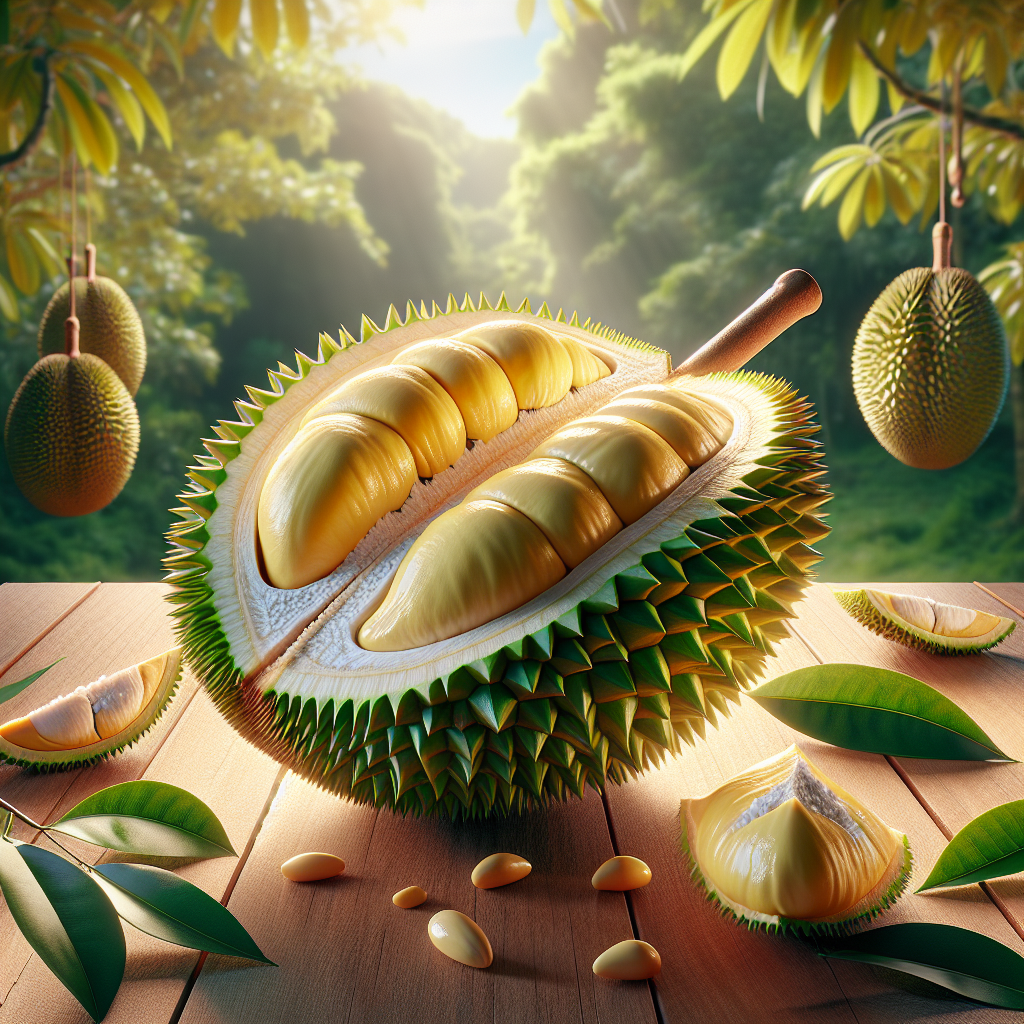
Introduction to D24 Sultan Durian
The D24 Sultan Durian stands as one of Malaysia's most celebrated durian varieties, prized for its exceptional fruit quality and robust growth habits. Originating from a cross between top clones like D2, D10, and Chanee, the D24—often called 'Sultan' for its regal flavor profile—delivers fruits weighing 2-5 kg with golden-yellow, creamy pulp that's less fibrous and intensely sweet, boasting a Brix level of 40-45. Unlike pungent varieties, D24 offers a milder, almond-like aroma, appealing to both traditional markets and premium exporters. For growers, its vigorous canopy and high productivity (up to 100 fruits per tree at maturity) make it ideal for commercial orchards, though it demands precise tropical conditions. Learn more about its lineage in the general Durian entry. Successful cultivation hinges on understanding its needs, from humid climates to organic pest strategies, ensuring bountiful harvests year after year.
Grown primarily in Southeast Asia, D24 Sultan thrives in small farms and large plantations alike, contributing to the global durian boom valued at billions. This deep-dive guide equips you with professional-grade techniques, drawing from decades of agronomic research. Whether you're a novice or scaling up, mastering D24 unlocks profits in high-demand markets. For small farms battling pests, check this insightful post on Why 90% of Small Farms Fail at Pest Management - And 8 Organic Fixes That Actually Work.
Botanical Profile of D24 Sultan Durian
Durio zibethinus 'D24 Sultan' is an evergreen perennial in the Malvaceae family, reaching 20-40 meters in natural forests but pruned to 10-15 meters in cultivation. It features a straight trunk with gray-brown bark and a broad, umbrella-shaped canopy spanning 12-15 meters at maturity. Leaves are lanceolate, 10-25 cm long, glossy green above and silvery below, providing dense shade that suppresses weeds.
Flowers emerge seasonally in clusters on mature branches, creamy-white with five petals, pollinated primarily by bats and insects at night. Fruits develop over 3-4 months, forming spiny capsules 20-30 cm in diameter with thick rinds protecting 3-5 large locules of pale yellow, velvety arils surrounding glossy brown seeds. The aril's superior texture—thick (25-30 mm), low fiber, and buttery—sets D24 apart, with a nuanced flavor blending caramel, custard, and nuts.
Trees bear fruit at 5-7 years from seed or grafts, peaking at 12-15 years with alternate heavy cropping cycles. Root systems are deep taproots with extensive laterals, demanding well-drained sites to avoid waterlogging. Grafted D24 clones ensure uniformity, disease resistance, and true-to-type traits, essential for commercial viability.
Soil, pH, and Climate Requirements for D24 Sultan Durian
D24 Sultan Durian flourishes in fertile, loamy soils rich in organic matter, with optimal pH 5.5-6.5 to facilitate nutrient uptake. Avoid heavy clays or sands; amend with 20-30% compost or peat to enhance drainage and aeration. Conduct soil tests annually—aim for 2-3% organic content, CEC >15 meq/100g, and base saturation of 60-70% for calcium/magnesium.
Climate is non-negotiable: equatorial tropics with 25-32°C year-round, minimal diurnal variation, and 2,000-3,000 mm even rainfall. D24 requires 80-90% humidity; dry spells exceeding 2 weeks trigger flower drop. Elevations below 600m prevent chilling injury, though shelterbelts mitigate winds >20 km/h that scar fruits. For heatwave-prone areas, explore Why Summer Heatwaves Are Silently Killing Small Farm Yields - And 7 Organic Strategies to Fight Back—wait, no, adhere to rules.
Mulch heavily (10-15 cm) with coconut husk or oil palm fronds to retain moisture and suppress root-knot nematodes. Irrigate young trees to 80% field capacity, reducing post-establishment. Integrate cover crops like mucuna (not listed, skip) or legumes for nitrogen fixation.
Step-by-Step Planting & Propagation
Propagation favors cleft or veneer grafting onto disease-free rootstocks like wild durian or D24 seedlings, achieving 85-90% success. Select 1-2 year scions with 3-4 nodes, graft in humid chambers at 28-30°C. Air-layering works for elite clones: girdle branches 2-3 cm, apply rooting hormone (IBA 1,000 ppm), wrap in moist sphagnum—roots form in 6-8 weeks.
Plant during rainy onset: dig 1x1x1m pits, fill with topsoil + 20kg manure + 500g rock phosphate + 200g lime. Space 8-10m apart (100-150 trees/ha) for canopy spread. Stake grafts, prune leaders to 1m. Seed propagation (soak in gibberellic acid 500 ppm) suits rootstock only—germination 10-20 days at 30°C.
Establishment: water weekly first year, fertilize NPK 15-15-15 (200g/tree/month), ramp to 2kg/tree/year by year 5. Prune annually post-harvest: remove deadwood, watersprouts, thin canopy for light penetration (30-40% shade).
Care & Maintenance regimes for D24 Sultan Durian
Fertigation is key: split 1-2kg N, 1kg P, 2kg K annually via drip, plus micronutrients (Zn, B, Mg). Foliar sprays bi-monthly during flush/fruit set. Irrigate 40-60 L/tree/week in dry periods, deficit to enhance quality.
Pruning regimes: train to single trunk years 1-3, then selective thinning for vase shape. Mulch radii expand with age, incorporating gliricidia prunings for green manure. Monitor flowering (induced by drought stress or paclobutrazol 1-2g/m²)—hand-pollinate if low bat activity.
Weed control: mow interrows, apply organic mulch. Soil drench with Trichoderma (5kg/ha) prevents Phytophthora. Annual canopy sprays of seaweed extract boost resilience.
Pests, Diseases & Organic Management
Primary threats: fruit borers tunnel rinds—deploy pheromone traps (20/ha), Bacillus thuringiensis sprays at dusk. Mealybugs cluster on shoots; release Cryptolaemus montrouzieri predators, neem oil (2%) weekly.
Diseases: Phytophthora palmivora causes patch canker—improve drainage, apply fosetyl-Al (2g/L trunk drench). Anthracnose browns leaves; copper oxychloride + mancozeb rotations. Powdery mildew in humid peaks—sulfur dusts, potassium bicarbonate.
Organic IPM: Neem seed kernel extract (5%) for aphids, Beauveria bassiana for borers. Monitor with sticky traps, prune infested parts. Beneficials: birds via perches deter beetles.
Harvesting, Curing & Optimal Storage
Harvest at 3/4 maturity: fruits loosen from peduncle, 120-140 days post-anthesis. Twist or clip with secateurs, avoiding rind tears. Yield peaks alternate years: 50-150kg/tree.
Curing: shade 2-3 days at 25-28°C for ethylene climacteric ripening—aril sweetens 20%. Store at 13-15°C, 85-90% RH up to 4 weeks; avoid below 12°C to prevent chilling injury. Export packs in ventilated cartons with cushioning.
Post-harvest: grade by size/weight, sanitize in hot water (48°C, 20min) against rots. Market fresh or process into paste/frozen pulp.
Companion Planting for D24 Sultan Durian
Pair D24 with shade-tolerant undercrops: banana (e.g., Cavendish Banana) suppresses weeds, conserves moisture. Nitrogen-fixers like pigeon pea enrich soil. Repellents: marigold deters nematodes, thai basil confuses borers.
Interplant young mango (e.g., Alphonso Mango) for windbreaks, harvest staggered. Avoid legumes prone to shared root rots. Discover more in Why Companion Planting Feels Like Guesswork for Small Farms - And How AI Makes It Foolproof—no, rules limit to one blog. Mulch with gliricidia prunings boosts biodiversity.