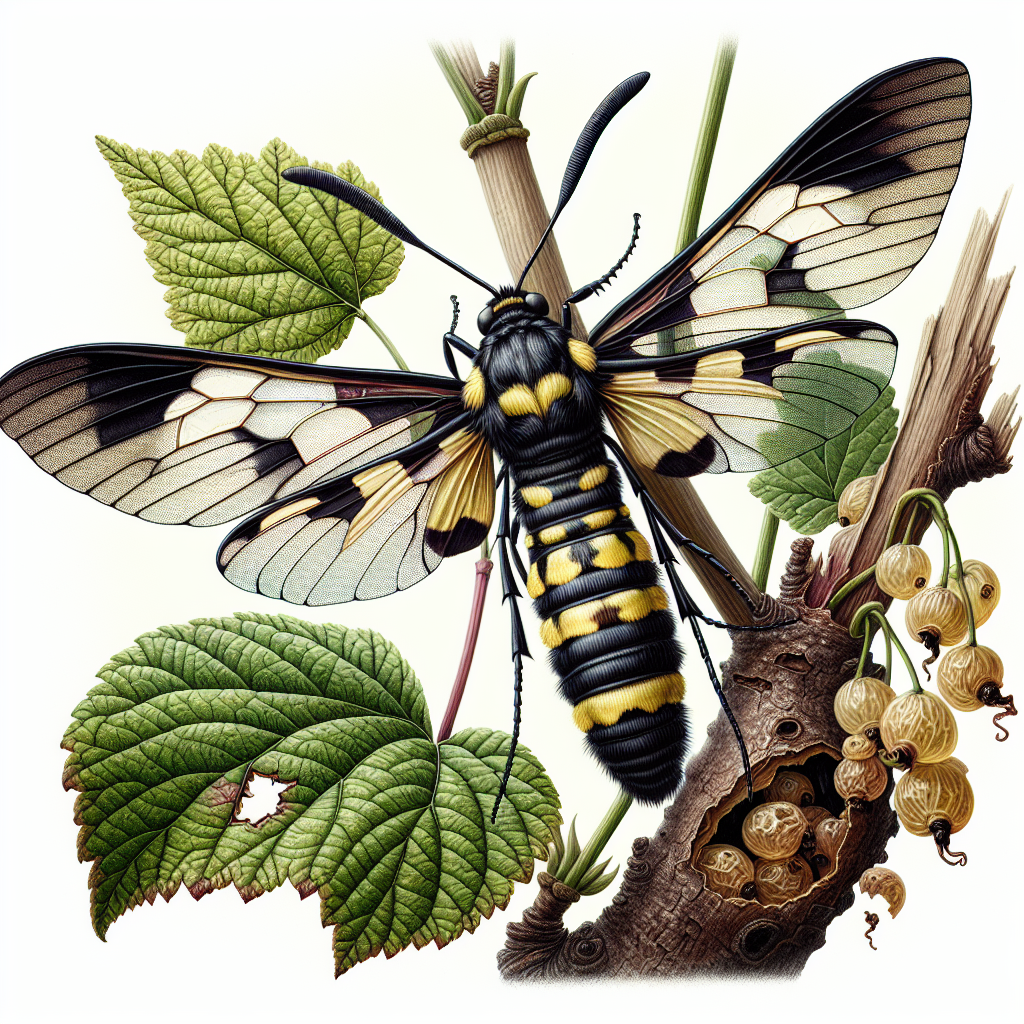
Introduction to Currant clearwing borer
The currant clearwing borer, scientifically known as Synanthedon tipuliformis, is a notorious pest targeting currant crops in temperate regions worldwide. Belonging to the family Sesiidae (clearwing moths), this insect mimics wasps in appearance, aiding its evasion from predators while laying eggs on vulnerable host plants. Adult moths emerge in early summer, with females depositing eggs on the bark of young canes and stems of currants, particularly red currant and black currant. The resulting larvae tunnel into the plant tissue, disrupting nutrient flow and often leading to cane death. This pest poses a serious threat to commercial berry farms and home gardens alike, potentially reducing yields by up to 50% in untreated infestations.
First identified in Europe in the 19th century, the currant clearwing borer has spread to North America and parts of Asia through international trade of planting material. Its impact is most severe in humid, temperate climates where currants thrive, such as the Pacific Northwest, Midwest U.S., and parts of the UK. Unlike surface-feeding pests like aphids or currant sawfly, the borer's internal feeding makes it challenging to detect until significant damage occurs. Growers must adopt vigilant scouting and proactive management to safeguard their harvests. This definitive guide equips agricultural professionals, small farm operators, and hobbyists with expert strategies for diagnosis, control, and prevention, drawing from entomological research and field-tested practices. For small farms battling timing issues with pests, check out Why Timing Kills Small Farm Profits - And How AI Task Scheduling Saves Your Harvests.
Identifying Symptoms & Damage
Accurate identification of currant clearwing borer damage is crucial for timely intervention. The most telltale sign is the presence of wilting or yellowing leaves on individual canes, often starting at the tips and progressing downward. This wilting occurs due to larval tunneling that girdles the vascular tissue, blocking water and nutrient transport. Affected canes may show a characteristic "sawdust-like" frass (insect waste) extruding from small entry holes, typically 1-2 mm in diameter, located 6-18 inches above the soil line on one-year-old wood.
Upon closer inspection, split the cane longitudinally to reveal creamy-white larvae, up to 1/2 inch long, with a brown head, feeding within the pith. Adult emergence holes are larger (3-5 mm) and often accompanied by pupal cases protruding from the bark. Severe infestations lead to cane dieback, where entire stems turn black and brittle, snapping easily. In heavy attacks, bushes appear sparse with reduced fruit clusters, and gummosis (oozing sap) may occur around entry points, sometimes confused with cane dieback diseases.
Differentiate from similar pests: unlike borers in other crops, currant clearwing targets only Ribes species, sparing nearby raspberry or gooseberry. Secondary symptoms include sooty mold from sap leakage attracting ants or sooty mold. Early-season scouting in June-July, using a hand lens, reveals eggs as tiny white clusters under bark flaps. Document damage with photos for precise diagnosis, and monitor for imported currant worm, a defoliator that causes leaf skeletonization rather than stem boring.
Lifecycle and Progression of Currant clearwing borer
Understanding the lifecycle of Synanthedon tipuliformis is key to disrupting its progression. This univoltine (one generation per year) pest overwinters as mature larvae within infested canes, just below the bark. Pupation occurs in late spring (May-June), with adults emerging 2-4 weeks later during warm spells above 70°F (21°C). Males, with yellow bands on a black abdomen and clear hindwings, hover in a "darting" flight pattern around host plants in midday sun, mimicking wasps.
Females live 7-10 days, ovipositing 20-50 eggs singly or in small groups on smooth bark of current-season growth. Eggs hatch in 10-14 days, and neonate larvae bore into the cane, feeding on pith and cambium for 10-11 months. Full larval development spans 300-400 degree days (base 50°F). Pupae are mahogany-colored, 15-20 mm long. Peak flight coincides with currant bloom to fruit set, making pheromone traps effective for monitoring.
Progression varies by climate: in cooler regions, emergence delays to July; in warmer areas, earlier peaks. Overwinter survival exceeds 80% in protected canes. Lifecycle completion takes 12 months, with 90% mortality from natural enemies like birds or parasitic wasps if exposed. Track progression using degree-day models starting January 1, targeting 500-600 DD for adult flight.
Environmental Triggers & Risk Factors
Currant clearwing borer thrives in specific conditions that growers can mitigate. Primary triggers include warm, humid springs (average >60°F in May), promoting early pupation and egg hatch. Stressed plants from drought, poor drainage, or nutrient deficiencies are highly susceptible, as weakened bark cracks provide ideal oviposition sites. Overcrowded plantings (>4 ft spacing) create humid microclimates favoring larval survival.
Risk factors encompass new plantings from infested stock, lack of rotation, and proximity to wild Ribes. Soil pH above 7.0 or compacted soils exacerbate root stress, indirectly boosting borer incidence. High nitrogen fertilization in late summer encourages succulent growth targeted by egg-laying females. Climate change extends flight periods, increasing overlap with crop phenology. Weedy borders harboring alternate hosts like wild currants amplify invasions. Assess site risk via historical infestation maps and soil tests.
Organic Control & Treatment Plans
Organic management of currant clearwing borer emphasizes integrated pest management (IPM) without synthetics. Cultural Controls: Prune and destroy infested canes in late winter (February-March), removing 6-12 inches below visible damage. Burn or solarize debris to kill overwintering larvae. Maintain 5-6 ft spacing for air circulation; mulch to retain moisture but avoid trunk contact.
Biological Controls: Encourage natural enemies like Bracon hebetor wasps and woodpeckers via bird boxes. Release commercial Trichogramma wasps at 100,000/acre during egg-laying (500 DD). Apply Bacillus thuringiensis (Bt) var. kurstaki to young larvae if exposed.
Mechanical/Physical: Wrap trunks with burlap or spirally wound paper in April to trap emerging adults. Use yellow sticky traps (10/acre) baited with clearwing pheromones for monitoring and mass-trapping. Probe canes with wire for larvae detection.
Organic Sprays: Apply neem oil (0.5-1%) or spinosad (OMRI-listed) at petal fall and 10-day intervals, targeting crawlers. Kaolin clay (Surround WP) creates a physical barrier on bark. Treatment plan: Scout weekly from bloom; treat if 5% canes show frass. Rotate modes to prevent resistance. Expect 70-85% control with consistent IPM.
Preventing Currant clearwing borer in the Future
Long-term prevention hinges on exclusion and resistance. Source certified, pest-free stock from reputable nurseries. Plant resistant varieties like 'Red Lake' currant or intercropped with thyme, a borer repellent. Destroy wild Ribes within 1/2 mile. Annual late-winter sanitation removes 90% overwintering sites.
Monitor with pheromone traps (1-2/acre) starting May; remove if >2 moths/trap/week. Apply dormant oil sprays (2-3% horticultural oil) in early spring to smother eggs. Promote biodiversity with flowering hedges attracting parasitic wasps. Rotate crops every 4-5 years, avoiding Ribes succession. Soil solarization in off-season kills pupae. Track via farm logs; resistant rootstocks reduce girth vulnerability. Combined strategies yield <2% infestation.
Crops Most Affected by Currant clearwing borer
Currant clearwing borer primarily targets Ribes genus: red currant, black currant, white currant, and European gooseberries. Red Lake and Consort cultivars suffer highest damage due to thin bark. Occasionally attacks gooseberry (Pixwell). Spares blueberries, raspberries despite proximity. Commercial yields drop 30-60% in peak years; home gardens see total cane loss. Focus protection on 2-5 year bushes.