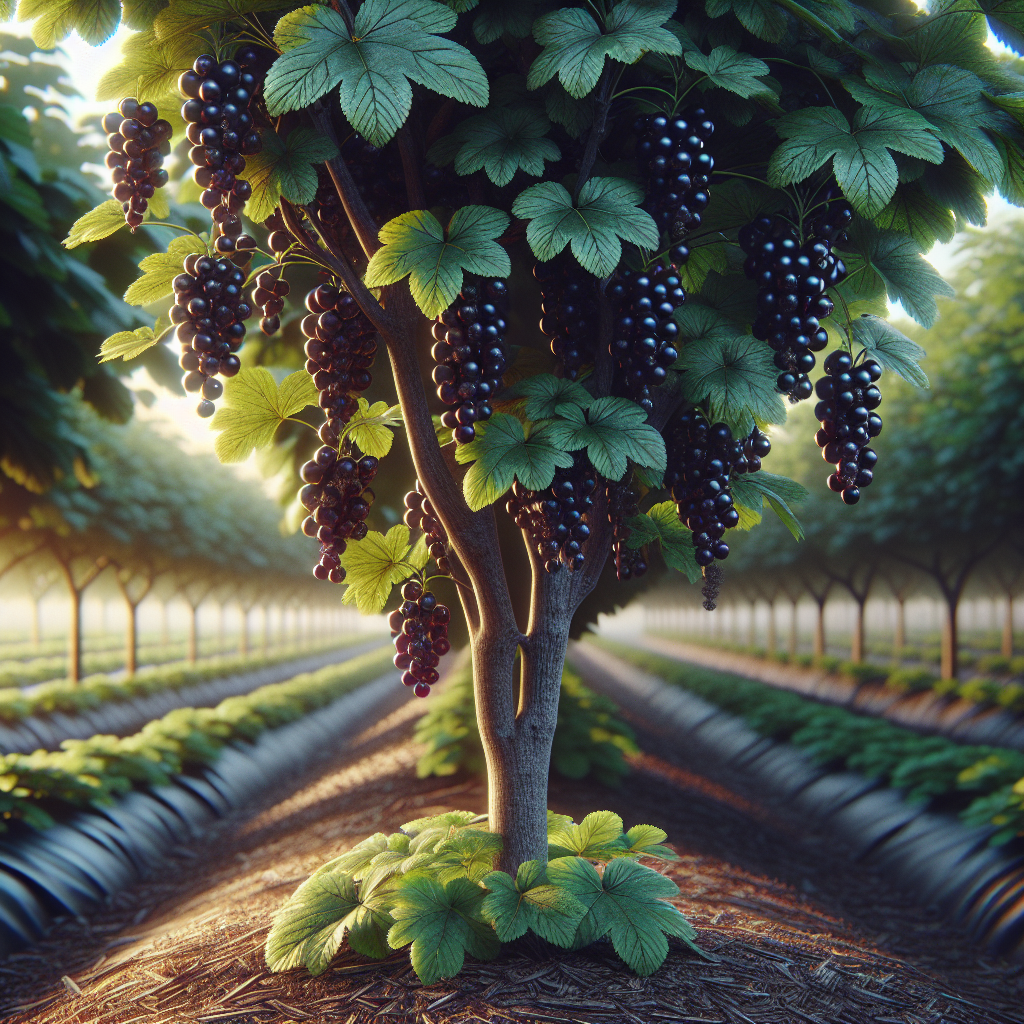
Introduction to Black Currant
A classic berry crop of northern and eastern Europe, this deciduous shrub has long been valued for fruit, juice, preserves, medicinal use, and even liqueur production. Its berries are notable for exceptionally high vitamin C content, deep purple-black pigmentation from anthocyanins, and a powerful resinous aroma that distinguishes it from sweeter, milder berries. In commercial and home production alike, success depends less on pampering and more on matching the plant to its preferred ecology: cool winters, moist fertile ground, and regular cane renewal.
Black currant is especially suited to growers in regions where summers are not excessively hot and dry. It fruits on relatively young wood and responds well to annual pruning, making it more manageable than many tree fruits. Although often grouped with red and white currants, it differs in flavor, growth habit, and pruning strategy. If you already grow other cane and berry crops, compare site management principles with Blueberry, but note that black currant tolerates heavier soils and a higher pH than blueberries.
Historically, black currants were heavily cultivated in Britain, Scandinavia, Russia, Poland, Germany, and the Baltic region. In North America, plantings were once restricted in many areas because some Ribes species can serve as alternate hosts for White pine blister rust. Modern regulations vary by region, and many improved cultivars show good resistance, but local compliance should always be checked before planting.
Botanical Profile of Black Currant
This species belongs to the family Grossulariaceae and is botanically classified as Ribes nigrum. It is a deciduous, multi-stemmed shrub that typically reaches 1.2-1.8 m tall and wide, though vigorous cultivars may exceed that under ideal fertility and moisture. Growth arises from the crown as new basal shoots, often called canes or stems, which form the framework for future cropping.
Leaves are palmately lobed, soft-textured, and aromatic when crushed due to glandular compounds. Flowers appear in spring on pendulous racemes, usually 5-10 mm across, greenish to pinkish, and are largely self-fertile in many modern cultivars, though cross-pollination can still improve fruit set and berry size in some cases. Fruit forms in strings, with each berry generally 8-15 mm in diameter depending on cultivar and crop load.
The most productive wood is usually one-year-old and two-year-old stems, with declining productivity on older wood. This biological trait drives the standard pruning system: continually remove the oldest canes to stimulate replacement from the base. Unlike some berries that crop on long-lived spurs, black currant demands renewal for both yield and fruit quality.
Roots are relatively shallow and fibrous, concentrated in the upper 20-40 cm of soil. That means the plant responds quickly to surface drying, compaction, and mulch quality. It also means cultivation around the crown should be shallow to avoid root injury. Because buds break early in spring, black currant can be vulnerable to late frost at flowering, particularly in low pockets where cold air settles.
Cultivar selection matters greatly. Some cultivars are bred for fresh eating, others for machine harvest, processing, disease resistance, or compact habit. Common professional traits to evaluate include resistance to Powdery mildew, Leaf spot, White pine blister rust, spring frost tolerance, fruit firmness, evenness of ripening, and suitability for hand versus mechanical harvest. In cooler regions, late-flowering cultivars can avoid frost injury; in warmer temperate regions, heat tolerance and resistance to premature leaf drop become more important.
Soil, pH, and Climate Requirements for Black Currant
The ideal soil is deep, fertile, moisture-retentive, and well-drained, with high organic matter and good crumb structure. Loams and clay loams are often excellent if drainage is adequate. Unlike blueberries, black currants do not require strongly acidic soil. Best performance is usually achieved at pH 6.0-6.8, though they can tolerate roughly 5.5-7.0 if nutrition is balanced and drainage is sound. Below pH 5.5, calcium and magnesium availability may become limiting; above pH 7.0, micronutrient tie-up and chlorosis may appear, especially on calcareous soils.
Before planting, aim for at least 3-5% organic matter in mineral soils. If soil is sandy, incorporate well-finished compost to improve water-holding capacity. If soil is heavy clay, the priority is structural improvement and drainage rather than simply adding organic matter to the planting hole. Never create a small amended pocket surrounded by dense clay, as it can behave like a bathtub and hold excess water around roots.
Drainage is critical despite the crop's love of moisture. Roots need oxygen. Waterlogged conditions for even a few days in warm weather can trigger root stress, leaf yellowing, weak shoot growth, and predisposition to Phytophthora or other Root rots. A useful field test is to dig a 30-40 cm hole, fill it with water, and observe drainage. If water remains after 24 hours, drainage is marginal and raised beds or drainage intervention are advisable.
Consistent soil moisture is one of the biggest determinants of berry size and yield. The root zone should remain evenly moist, roughly equivalent to 60-80% of field capacity through active growth and fruit fill. Practically, soil at 10-15 cm depth should feel cool and slightly damp, forming a weak ball when squeezed in the hand but not releasing free water. If it is powdery, pale, and loose, the plant is already under moisture stress. If it smells sour, smears, or stays slick and shiny, it is too wet.
In climates with 600-900 mm annual rainfall well distributed through spring and early summer, irrigation needs may be modest after establishment. In drier regions, expect to supply 25-40 mm of water per week during flowering, fruit set, and berry expansion, increasing slightly in hot windy weather on lighter soils. Drought stress during these stages causes small berries, uneven ripening, poor return bud formation, and early leaf senescence.
Climatically, black currant prefers cool temperate zones with full winter dormancy. It is highly cold hardy in winter, often tolerating severe frost once dormant, but flower trusses and newly opened blooms can be injured by spring freezes. It performs best where summer daytime temperatures stay mostly below 29°C. Extended heat above 32°C can reduce photosynthesis, scorch foliage, soften fruit, and suppress cane development. In warmer temperate zones, afternoon shade and wind protection can significantly improve resilience.
Full sun is best in cool climates, where it maximizes sugar development and disease suppression. In regions with hot summers, light afternoon shade can reduce heat stress without seriously compromising yield. Good air movement is important, but avoid exposed hilltops where desiccating wind strips soil moisture and damages emerging shoots.
Step-by-Step Planting & Propagation
Begin with certified disease-free plants from reputable nurseries. One- or two-year-old dormant bare-root stock is often the best choice for field establishment because it is economical, roots quickly, and adapts well when planted during dormancy.
For site preparation, eliminate perennial weeds at least one season before planting. Black currant competes poorly with grasses and deep-rooted weeds because of its shallow root system. Correct pH based on a soil test, incorporate phosphorus and potassium if needed before planting, and apply mature compost or well-rotted manure several months ahead if organic matter is low.
Plant during late autumn after leaf fall or in very early spring before bud break, depending on local winter severity and soil workability. In colder regions, spring planting avoids winter heaving; in milder climates, autumn planting allows earlier root establishment.
Space plants 1.2-1.8 m apart within the row and 2.4-3 m between rows for hand-managed systems. More vigorous cultivars and mechanized systems may require wider spacing. Tight spacing can increase early yield per area, but it also raises humidity within the canopy and complicates harvest and disease control.
When planting bare-root bushes:
- Soak roots in clean water for 1-2 hours before planting if they appear dry.
- Dig a hole wide enough to spread roots naturally without bending.
- Set the plant 5-8 cm deeper than it grew in the nursery. This deeper planting encourages multiple basal shoots from below soil level, which is highly desirable for long-term cane renewal.
- Backfill with native soil, firm gently, and water thoroughly to settle the root zone.
- Cut all shoots back after planting, leaving 2-4 buds above ground. This seems drastic, but it promotes strong basal cane production and better framework development.
Mulch immediately with 5-8 cm of weed-free straw, shredded bark, leaf mold, or composted wood chips, keeping material a few centimeters away from direct contact with the crown. Mulch moderates soil temperature, reduces moisture loss, suppresses weeds, and protects the shallow feeder roots.
Propagation is straightforward. Hardwood cuttings are the most common method. In late autumn to winter, take pencil-thick, healthy one-year shoots about 20-25 cm long. Make the basal cut just below a bud and the top cut above a bud. Insert cuttings vertically into a nursery bed or propagation medium so that only the top 1-2 buds remain above the surface. Keep evenly moist through the rooting period. By the next dormant season, many will have formed sufficient root systems for transplanting.
Layering also works well: bend a low flexible shoot to the ground, wound or lightly notch the underside where it touches soil, pin it in place, and cover that section with soil while leaving the tip exposed. After rooting, sever the new plant from the parent during dormancy.
Care & Maintenance regimes for Black Currant
During the first two seasons, the priority is framework development, root establishment, and weed exclusion. Do not allow weeds or turf to grow into the crown zone. Maintain a vegetation-free strip at least 60-90 cm wide. Competition during establishment can halve shoot growth and significantly delay full production.
Irrigation should be regular and measured. Newly planted bushes generally need enough water to moisten the top 25-30 cm of soil. On medium soils, this often means deep watering once or twice weekly rather than light daily sprinkling. By the third year, mature bushes still benefit from deep, infrequent irrigation, especially from bloom through harvest. Drip irrigation is ideal because it maintains steady root-zone moisture without wetting foliage. A practical target is to irrigate when the upper 5-8 cm begins to dry but before the 15 cm depth becomes dry.
Signs of underwatering include dull, slightly folded leaves; reduced shoot extension; berries remaining small and hard; and premature leaf yellowing in mid to late summer. Signs of overwatering include limp foliage despite wet soil, yellow lower leaves, blackened fine roots, sour-smelling soil, and weak pale regrowth. Chronic saturation often looks deceptively like nutrient deficiency because stressed roots cannot absorb nutrients properly.
Nutrition should be guided by soil and leaf analysis where possible. Black currants respond well to moderate nitrogen, but excess nitrogen can cause lush, soft growth that is more disease-prone and less winter-hardy. As a broad annual guideline for mature plants, apply nitrogen in early spring as buds begin to swell, using composted manure, blood meal, feather meal, or another appropriate source depending on the production system. Split applications may be useful on sandy soils. Avoid heavy late-summer nitrogen, which stimulates tender growth vulnerable to frost.
Potassium is important for fruit quality, cane strength, and winter hardiness. Deficiency may show as marginal leaf scorch on older leaves and reduced berry quality. Calcium and magnesium are usually adequate in well-balanced soils but should be monitored where pH is low or where repeated high-potassium amendments have been used.
Pruning is the single most important annual task after moisture management. The ideal mature bush often contains 8-12 strong canes of mixed ages, with a bias toward young wood. In the first year after planting cutback, allow several vigorous new canes to develop. In years two and three, keep the best new basal shoots and remove weak, crowded, low, or inward-growing stems. Once bushes are mature, remove about one-third of the oldest canes each dormant season, cutting them at ground level. Older canes are usually darker, rougher, and less productive. Retain strong one-, two-, and some three-year-old canes.
Summer pruning is usually minimal, but diseased, broken, or ground-dragging shoots can be removed anytime. Keep the center open enough for air circulation and spray penetration if treatments are used.
A productive planting remains commercially useful for many years, but yields often peak when pruning is consistent and crown vigor is maintained. Neglected bushes quickly become congested, shade their own fruiting wood, and carry smaller berries.
For broader fertility strategy, the principles in soil health tips also apply well to berry rows, especially regarding organic matter maintenance and reduced compaction.
Pests, Diseases & Organic Management
The most serious problems vary by region, but integrated prevention is far more effective than reactive spraying. Start with resistant cultivars, certified stock, clean pruning, open spacing, and a mulch-based weed program.
Aphids may colonize young shoots and underside of leaves, causing curling and sticky honeydew. Monitor early in spring. Encourage beneficial insects, avoid excess nitrogen, and use insecticidal soap only when colonies are actively exposed and beneficial impact can be minimized.
Currant clearwing borer is a serious pest in some areas. Larvae tunnel in stems, causing sudden wilt, dieback, hollow canes, and poor vigor. Remove and destroy infested canes below the damage as soon as symptoms appear. Maintaining plant vigor and sanitation is essential, but pheromone monitoring can also help detect adult activity in professional systems.
Spider mites become more problematic in hot, dry weather. Look for stippled leaves, bronzing, and fine webbing. Mites often flare where dust and drought are common. Maintain even moisture, reduce dust, and conserve predatory mites.
Birds can strip a planting rapidly as berries color. Netting is often the only dependable control for small and medium plantings.
American gooseberry mildew and Powdery mildew can affect leaves, shoots, and fruit, especially in humid still air and on nitrogen-rich soft growth. Symptoms include white powdery growth, distorted shoot tips, russeted fruit, and reduced vigor. Control begins with resistant cultivars, open pruning, and avoiding overhead irrigation. Sulfur or bicarbonate-based organic fungicides may help prevent spread when applied early and according to label restrictions.
Leaf spot and Anthracnose can cause speckling, blotching, and premature defoliation. Repeated early defoliation weakens next year's crop by reducing carbohydrate storage. Rake and remove heavily infected fallen leaves, maintain airflow, and avoid splash dispersal where possible. Organic copper products can be used preventively in some systems, but repeated use should be cautious because of copper accumulation in soil.
Botrytis may infect blossoms or fruit under prolonged wet conditions, especially in dense canopies. Good sanitation and canopy openness are the primary controls.
White pine blister rust is a major regulatory concern in some regions because Ribes can host one stage of the pathogen. Where restrictions exist, consult local extension or plant health authorities before planting. Resistant cultivars are strongly recommended wherever the disease is relevant.
Root rots are usually site-induced rather than contagious field epidemics. If plants remain stunted in wet spots, correct drainage first; replacing plants without solving the cause rarely succeeds.
Harvesting, Curing & Optimal Storage
Fruit typically ripens in early to mid-summer, depending on cultivar and climate. Berries are usually harvested when fully colored, aromatic, and uniformly black with good juice development. Unlike some fruits, black currants gain much of their characteristic flavor only at full maturity. Under-ripe fruit is sharply acidic and lacks depth.
For fresh-market or home use, harvest whole strigs or individual berries by hand when the majority of the cluster is fully ripe. For processing, fruit may be harvested slightly more uniformly once an entire bush reaches target maturity. Pick during cool morning hours after dew has dried but before afternoon heat softens fruit.
Handle gently. Although black currants are firmer than many soft berries, they can still bruise and leak if overfilled or repeatedly transferred. Use shallow containers and move fruit promptly into shade. Do not wash before storage unless fruit will be used immediately.
There is no curing phase in the manner used for onions or sweet potatoes. Instead, the postharvest objective is rapid cooling. Pre-cool as quickly as possible to 0-2°C with high relative humidity, around 90-95%. At these temperatures, fruit may store for about 1-2 weeks depending on cultivar, maturity, and field conditions at harvest. Warmer storage causes swift loss of aroma, shriveling, and mold development.
For longer preservation, freezing is excellent because the intense flavor survives well. Destemming before freezing improves convenience. Fruit intended for juice, jam, syrup, or fermentation can also be processed immediately after harvest for best color and aroma retention.
A mature, well-managed bush can yield several kilograms of fruit annually, though output varies widely by cultivar, age, pruning system, frost exposure, and pollination conditions. Low yield with good vegetative growth often points to spring frost, poor pruning age balance, or moisture stress during fruit set.
Companion Planting for Black Currant
The best companions around berry shrubs are those that improve pollinator presence, suppress weeds, protect shallow roots, or attract beneficial insects without competing aggressively for water and nutrients. Low-growing, non-invasive species are preferable to tall, heavy feeders.
Thyme is one of the most useful companions because it forms a restrained aromatic groundcover near row edges, helps reduce open soil, attracts small pollinators when flowering, and generally does not compete heavily if kept away from the crown. Yarrow is valuable nearby rather than directly under the bush; it attracts predatory insects and pollinators and can contribute to overall biodiversity in mixed plantings. Clover, used carefully in alleyways rather than tight against the stems, can function as a living mulch and nitrogen-contributing cover, though it must be managed so it does not create excessive competition in dry periods. Garlic can also be planted at row ends or in nearby beds where its upright habit and strong aroma fit diversified garden systems.
Avoid pairing black currants with vigorous perennial grasses, sprawling brambles placed too close, or thirsty annual vegetables that demand repeated cultivation in the root zone. The crop's shallow roots dislike disturbance, and dense competition near the crown almost always reduces cane renewal.
In professional systems, companion planting should be viewed as part of a strip-management strategy rather than as a random polyculture. Keep a clean or mulched crown zone, place flowering companions at row margins, and ensure irrigation reaches the currant root zone first. When done thoughtfully, companions enhance ecological stability without sacrificing berry yield or harvest access.