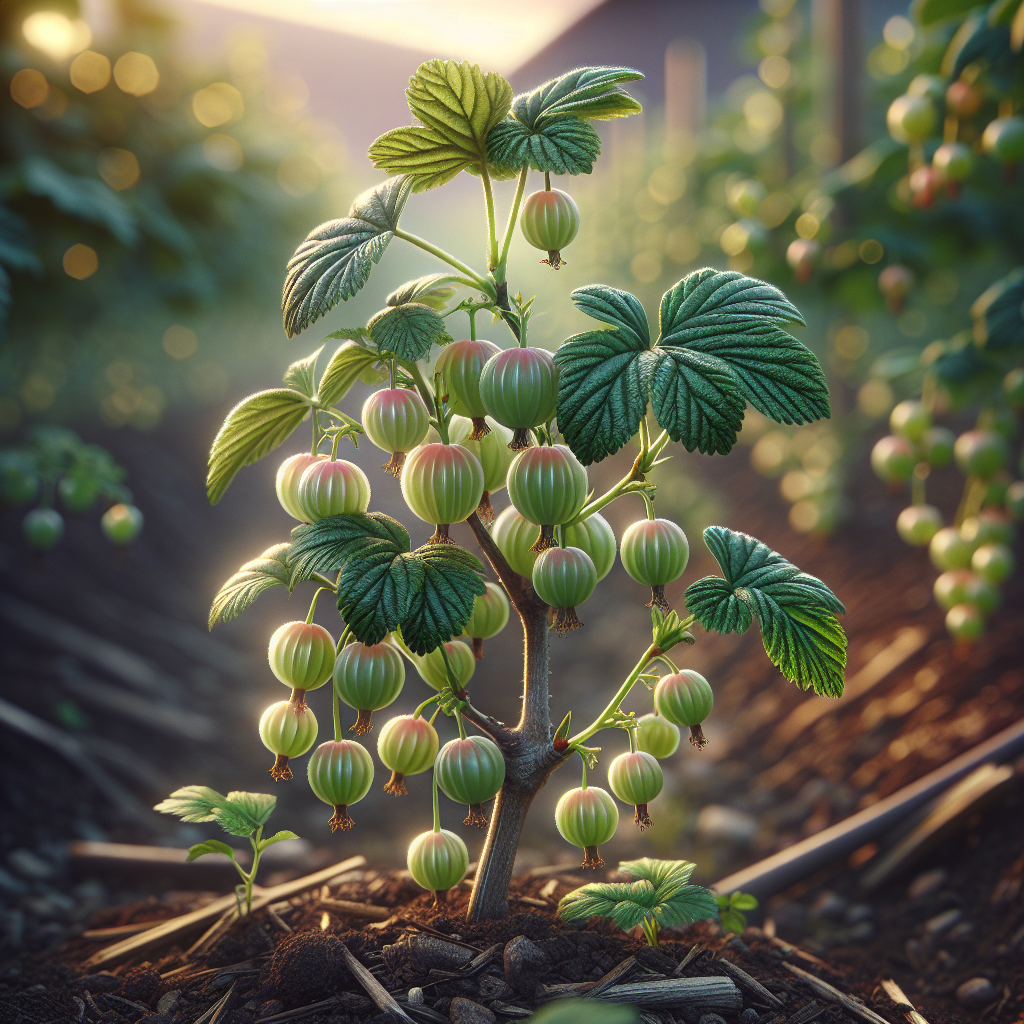
Introduction to Gooseberry (Pixwell)
An old, dependable cultivar, Pixwell earned its name from a practical trait growers still appreciate: the berries detach relatively easily and tend to hang where they can be picked without forcing hands deep into the thorny interior. That matters because gooseberries are highly rewarding but often underplanted due to their reputation for prickles, dense growth, and exacting harvest. Pixwell softens those difficulties while retaining the classic virtues of gooseberries: excellent cold tolerance, long-lived productivity, and fruit that bridges the flavor gap between tart currants and sweet dessert berries.
This cultivar has been widely grown across northern regions of North America because it tolerates winter cold better than many small fruit crops and can crop consistently where heat-sensitive berries struggle. Fruit is typically medium-sized, borne in clusters or singly, green when immature and often maturing with a pink blush in stronger light. Flavor is distinctly tart when underripe but becomes pleasantly sweet-tart at full ripeness, making it useful for fresh eating, preserves, pies, chutneys, syrups, and freezing.
Commercially, gooseberries have never occupied the same scale as Blueberry or strawberry, but for diversified farms, homesteads, and cool-climate market gardens, Pixwell remains a smart specialty crop. Its productivity, winter hardiness, and adaptability make it especially valuable for growers seeking a perennial fruit that can fill an early summer niche. For broader orchard-floor fertility planning, ideas from this soil management article can be useful: soil health strategies.
Botanical Profile of Gooseberry (Pixwell)
Pixwell belongs to the genus Ribes, which includes gooseberries and currants. The species name most commonly associated with European gooseberries is Ribes uva-crispa, though many cultivated gooseberries in North America have hybrid ancestry involving American species such as Ribes hirtellum. In practice, Pixwell is generally treated horticulturally as an American-type or American-derived gooseberry because of its adaptation, disease tolerance, and growth habit.
The plant is a deciduous, woody shrub that usually reaches 3 to 5 feet tall and 3 to 6 feet wide at maturity. Canes arise from the crown and develop into a fountain-like framework unless regularly thinned. Nodes commonly bear single or clustered thorns. Leaves are alternate, palmately lobed, softly textured, and medium green. Flowering occurs in early to mid-spring, often before full leaf expansion in colder climates. Flowers are small, pendulous, and not especially showy, but they are functional and usually self-fertile, so a single plant can fruit without a pollenizer.
Fruit develops on one-year-old wood and on short fruiting spurs attached to older branches. This matters for pruning: removing too much young wood reduces next year's crop, while allowing too much aging wood lowers berry size and increases disease pressure. Pixwell typically bears better as the bush is renewed continuously, with a balance of 1-, 2-, and 3-year-old canes and the oldest wood removed on rotation.
Compared with some dessert gooseberries, Pixwell's berries are not gigantic, but the shrub is known for reliability rather than exhibition size. Skins are reasonably firm, which helps with processing and short-term storage. Ripening often proceeds over a span of days to two weeks rather than all at once, depending on climate, canopy light exposure, and crop load.
Soil, pH, and Climate Requirements for Gooseberry (Pixwell)
This shrub thrives in cool temperate regions, typically USDA zones 3 through 6, and often performs acceptably in zone 7 where summers are not excessively hot. The ideal climate includes cold winter dormancy, mild spring conditions, and summers with daytime temperatures commonly between 60 and 80°F (16 to 27°C). Once temperatures regularly exceed about 85°F (29°C), especially with low humidity and hot winds, plants often show leaf scorch, reduced berry size, and softened flavor balance. In warm-summer districts, morning sun with afternoon shade is preferable. In colder maritime or northern continental climates, full sun usually produces the best yields and sugar accumulation.
Soil should be deep, organically enriched, moisture retentive, and well drained. A loam or sandy loam with 4 to 7% organic matter is ideal. Heavy clay can be used if drainage is corrected with raised beds, broad organic amendment, and avoidance of compaction. Gooseberries dislike standing water around the crown and roots, especially during cool spring weather, because waterlogging predisposes them to root stress and foliar disease.
The preferred soil pH is slightly acidic to neutral, about 5.8 to 6.8, with a sweet spot near 6.2 to 6.5. Below pH 5.5, nutrient availability may narrow and growth can become stunted unless fertility is closely managed. Above pH 7.0, micronutrient issues such as iron chlorosis may appear on calcareous soils, showing up as yellow leaves with green veins, especially on new growth.
Before planting, test soil for pH, phosphorus, potassium, calcium, magnesium, and organic matter. Incorporate 2 to 4 inches of finished compost over the row and work it into the top 8 to 12 inches. If soil is very lean, add a balanced slow-release organic fertilizer at planting, but avoid excessive nitrogen. Too much nitrogen drives lush, soft shoots that attract Aphids and increase susceptibility to mildew.
Moisture management is more exact than the vague advice to "keep evenly moist." The target is consistent root-zone moisture in the upper 8 to 10 inches without saturation. In practical terms, soil should feel cool and lightly damp when squeezed, not sticky or anaerobic. During active growth and fruit fill, a mature bush usually needs about 1 to 1.5 inches of water weekly from rainfall or irrigation. Sandy soils may require splitting that into two irrigations per week. Drought stress shows first as dull leaves, slight midday wilt, halted berry sizing, and fruit that remains intensely tart. Overwatering shows as yellowing lower leaves, weak extension growth, sour-smelling mulch or soil, and in severe cases Cane dieback from the crown outward.
Air circulation is critical. Gooseberries tolerate cold but dislike stagnant, humid canopies. Planting where dew dries quickly reduces mildew and Leaf spot pressure. Avoid frost pockets where spring blooms may be damaged, though bushes themselves are extremely winter hardy.
Step-by-Step Planting & Propagation
Plant dormant bare-root bushes in very early spring as soon as soil can be worked, or in late autumn after leaf drop where winters are not brutally dry or heaving. Container-grown stock can be planted through the growing season, but spring establishment is still superior because roots can settle before summer stress.
- Choose a site with 6 hours of sun in cool climates or 4 to 6 hours plus afternoon shade in warmer ones. Ensure good air flow and avoid low, soggy ground.
- Remove perennial weeds thoroughly. Gooseberries resent root competition, especially in their first three years.
- Prepare a hole about twice as wide as the root spread and just deep enough that the plant can sit 1 to 2 inches deeper than it grew in the nursery. Slightly deeper planting encourages renewal shoots from the crown.
- Soak bare-root plants in water for 1 to 2 hours before planting. Do not soak overnight.
- Trim damaged roots and any broken top growth. Spread roots outward naturally in the hole.
- Backfill with native soil amended only moderately; over-amending the hole can create a bathtub effect in heavy soils. Firm gently to remove large air pockets.
- Water deeply after planting to settle soil. Apply 2 to 4 inches of mulch, keeping it a few inches away from direct contact with the canes.
- Head back top growth by roughly one-third to one-half on weak plants to balance root loss and stimulate branching.
Spacing depends on management style. For home or hand-harvest systems, 4 to 5 feet between plants and 6 to 8 feet between rows is common. Tighter spacing increases early yield per area but demands more pruning discipline and better disease monitoring.
Propagation is straightforward. Hardwood cuttings taken during dormancy root fairly well in moist propagation media or nursery beds. Use pencil-thick one-year wood 8 to 10 inches long, insert two-thirds of the cutting below media level, and maintain steady moisture. Layering is even more reliable: in spring, bend a low cane to the ground, wound it slightly, pin it beneath soil, and allow it to root through the season before severing it from the mother plant in autumn or the following spring.
Seed propagation is not recommended for preserving cultivar traits. Plants raised from seed will vary and will not remain true to Pixwell.
Care & Maintenance regimes for Gooseberry (Pixwell)
The first priority is root establishment. In year one, maintain a weed-free zone at least 18 to 24 inches around each bush. Grass competition dramatically reduces cane development and future yield. Organic mulches such as shredded leaves, wood chips, or straw work well, but keep mulch depth moderate over heavy soils to avoid crown rot.
Fertilization should be measured, not aggressive. In early spring, before bud break, apply compost plus a modest nitrogen source if growth was weak the prior year. As a benchmark, mature bushes often respond well to the equivalent of 25 to 40 pounds actual nitrogen per acre in split or modest annual applications; in backyard terms, that may translate to roughly 1/4 to 1/2 cup of a balanced organic fruit fertilizer per plant, depending on analysis and soil test. Excess nitrogen produces long, succulent canes with reduced fruit quality.
Pruning is the skill that separates mediocre shrubs from productive ones. During the first two years, focus on establishing a framework of strong basal shoots. From year three onward, maintain roughly 8 to 12 main canes of mixed ages. Each winter, remove the oldest, darkest, least productive canes at ground level and keep vigorous young replacements. Also remove low, sprawling branches, inward-growing shoots, crossing wood, and any canes with poor air penetration. The ideal bush is open-centered enough that a hand can reach through it and light can hit interior fruiting wood.
Summer pruning is minimal but useful where vigor is excessive. Light tipping of rampant nonfruiting shoots after harvest can improve air movement. Do not overdo summer pruning in hot climates, where fruit and canes benefit from some leaf shade.
Irrigation should be adjusted by stage:
- Bud break to flowering: maintain moderate moisture, avoiding drought stress that reduces flower retention.
- Fruit set to berry swell: this is the highest water-demand phase; irregular moisture here causes small berries and inconsistent ripening.
- Final ripening: keep moisture steady but not excessive, or berries may become watery and split in rainy weather.
- Post-harvest: continue moderate watering to support next year's bud initiation and cane renewal.
A practical moisture check is to probe 4 to 6 inches deep under the mulch. If soil at that depth is only faintly moist or powdery, irrigate. If it is sticky, cool, and leaves are yellowing, wait and improve drainage or irrigation timing.
Bird pressure can become serious as berries blush and sweeten. Netting is often the most reliable solution. Because Pixwell berries can hang visibly outside the bush, they are easier for birds to spot than deeply hidden fruit.
Pests, Diseases & Organic Management
Gooseberries are generally sturdy, but several issues can limit performance. Integrated management begins with site selection, sanitation, pruning, and cultivar resilience rather than repeated sprays.
Powdery mildew is one of the most important diseases, especially in humid climates with poor airflow. It appears as a whitish to gray coating on shoot tips, leaves, and fruit, later causing distortion, russeting, and weakened growth. Prevent it by avoiding excess nitrogen, spacing bushes properly, and pruning for openness. If pressure is chronic, sulfur or potassium bicarbonate sprays can help when applied early and according to label directions, but sulfur should not be used under very hot conditions.
Leaf spot and Anthracnose may cause speckling, premature yellowing, and early defoliation. Repeated defoliation weakens next year's crop. Remove fallen leaves, avoid overhead irrigation late in the day, and maintain mulch that reduces splash dispersal. Compost tea and similar inputs are inconsistent; sanitation and canopy management are more dependable.
Aphids cluster on tender new growth, causing curled leaves and sticky honeydew. Often, they can be controlled by a strong water spray early in the infestation, followed by conservation of beneficial insects. Planting insectary companions such as Yarrow nearby can support predatory insects. Neem or insecticidal soap can be used if populations build, but coverage must reach the undersides of leaves.
Imported currant worm and Gooseberry sawfly larvae can skeletonize foliage rapidly. The earliest sign is small chew holes that soon become extensive leaf loss. Inspect the undersides of leaves in spring and early summer. Hand-picking works for small plantings. Spinosad is effective in organic systems when applied to young larvae, but timing matters.
Spider mites may appear in hot, dusty conditions, especially where plants are stressed by drought. Fine stippling and bronzing on leaves are typical. Reduce dust, improve irrigation consistency, and avoid broad-spectrum sprays that kill predatory mites.
Cane dieback can follow winter injury, mechanical damage, or fungal infection. Prune out affected wood below the damaged zone into healthy tissue and disinfect tools between heavily infected plants.
In some regions, Ribes species are regulated because they can serve as alternate hosts for White pine blister rust. Growers should verify local regulations before establishing plantings near five-needle pines.
Harvesting, Curing & Optimal Storage
Pixwell usually ripens in early to mid-summer, often from late June through July depending on latitude and spring temperatures. Fruit can be harvested at two distinct stages depending on end use. For pies, preserves, and chutneys, pick berries when full-sized but still firm and slightly underripe; acidity and pectin are higher at this point. For fresh eating, allow berries to develop more translucence, a pinkish blush, and a sweeter balance.
Harvest by hand in the cool of morning after dew has dried. Wearing thin gloves is wise even with Pixwell's relatively pickable habit. Hold the berry gently and detach with as little stem tearing as possible. Avoid crushing, because damaged fruit leaks juice and molds quickly.
There is no curing phase in the true sense used for onions or winter squash. Instead, postharvest handling should focus on rapid field heat removal. Move fruit into shade immediately and refrigerate as soon as possible. Sort out split, bruised, insect-damaged, or overripe berries before storage.
For short-term storage, keep fruit at 32 to 36°F (0 to 2°C) with high relative humidity, ideally 90 to 95%. Under those conditions, sound berries may keep 1 to 2 weeks, though quality is best within the first several days. In a household refrigerator, use shallow ventilated containers lined lightly with absorbent paper to reduce condensation. Do not wash before storage; wash just before use.
For long-term preservation, gooseberries freeze exceptionally well. Spread dry fruit in a single layer to freeze individually, then pack into freezer bags. They also process well into jam, compote, wine, syrup, and dehydrated leather, although drying whole berries is less common because of skin thickness and tartness.
Yields vary with age and care, but mature Pixwell bushes often produce 8 to 12 pounds per plant under good management, sometimes more in cool, fertile sites with skilled pruning.
Companion Planting for Gooseberry (Pixwell)
Companion planting around gooseberries works best when the goal is ecological support rather than crowding the root zone. The bush has shallow feeder roots near the surface, so companion species should either be low-competition, shallow-rooted, or planted just outside the immediate crown area.
Thyme is one of the best companions because it forms a low aromatic mat, suppresses some weeds, attracts pollinators when flowering, and does not aggressively compete for height or light. It is especially useful on the sunnier edge of the planting.
Yarrow helps recruit hoverflies, parasitic wasps, and other beneficial insects that can suppress Aphids and small caterpillars. Its deep, fibrous root system also improves soil structure over time, but it should be divided periodically so it does not dominate.
Nasturtium can function as a soft trap crop for Aphids and as a flowering attractant for beneficial insects. In cooler regions, it can be used along the row edge rather than directly under the bush. Keep it from climbing densely into the canopy, where it may reduce airflow.
Clover works well as a managed living mulch between rows rather than directly at the crown. Mowed regularly, it can reduce erosion, support pollinators, and contribute nitrogen cycling, though growers should watch carefully that it does not compete with young bushes during establishment.
Avoid tall, shading companions or vigorous feeders planted close to the crown. The most successful companion system for Pixwell is usually a mulched, weed-free ring immediately around the shrub with beneficial flowering plants and living mulch positioned in the alley or outer dripline zone.