Definitive Diagnostic and Management Guide for Crown Rust
Introduction to Crown rust
Crown rust, scientifically known as Puccinia coronata f. sp. avenae, stands as one of the most pervasive and economically damaging fungal diseases in cereal agriculture, particularly targeting oats, barley, and various grasses. This obligate parasite completes its complex lifecycle across alternate hosts, unleashing a cascade of orange, powdery pustules that mar foliage and sap plant vigor. First identified in the early 19th century, crown rust has plagued oat producers worldwide, from the rolling fields of North America to the temperate farmlands of Europe and Asia. In severe epidemics, it can slash yields by up to 50%, diminish grain quality, and elevate lodging risks, turning promising harvests into disappointing losses.
Understanding crown rust is crucial for sustainable farming. Unlike opportunistic pathogens, this rust fungus demands living host tissue, making it a relentless foe in continuous monoculture systems. Its 'crown' moniker derives from the crown-like arrangement of marginal spines on its teliospores, visible under microscopic examination. For small-scale and commercial growers alike, early detection and integrated management are non-negotiable. This guide equips you with professional-grade diagnostics, lifecycle insights, organic controls, and prevention strategies to safeguard your crops. By mastering these elements, you can minimize losses and optimize productivity. For broader insights into rust diseases, explore our comprehensive rusts resource.
The disease's impact extends beyond yield; infected plants exhibit weakened stands, reduced tillering, and poor nutritional value in forage. Climate change exacerbates its spread, with shifting weather patterns favoring infection windows. Proactive scouting and cultural vigilance form the bedrock of defense, complemented by modern resistant hybrids. Whether you're battling it in wheat rotations or dedicated oat fields, this definitive guide delivers actionable intelligence.
Identifying Symptoms & Damage
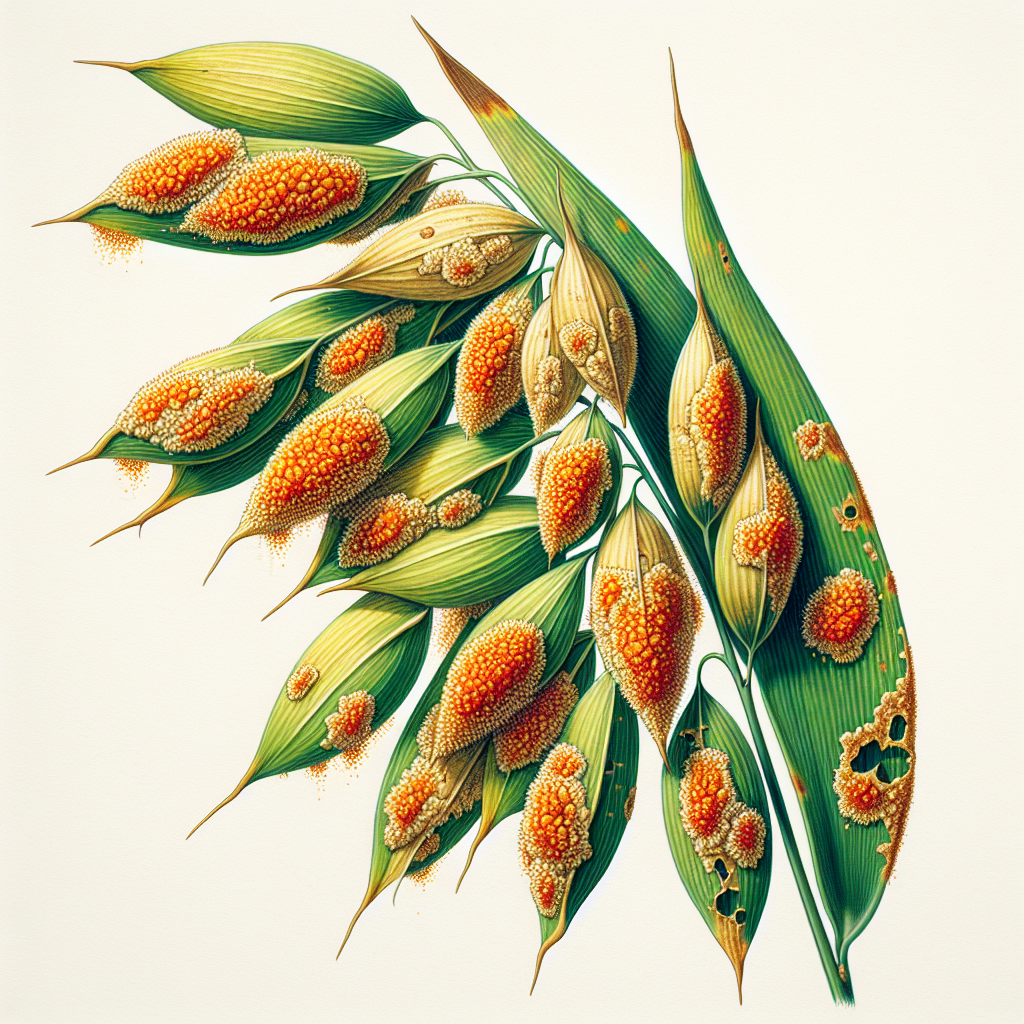
Crown rust announces its presence with striking, diagnostic symptoms that escalate from subtle chlorosis to overt devastation. Initial signs emerge 7-10 days post-infection as small, pale yellow flecks on upper leaf surfaces, primarily on young, expanding leaves where stomata are abundant. These evolve into pinpoint orange pustules (uredinia), erupting through the epidermis as powdery, cinnamon-colored masses of urediniospores. Under humid conditions, these pustules coalesce into elongated stripes, up to 1-2 cm long, encircling the leaf blade and imparting a rusty sheen—hence the name.
Examine leaves closely: pustules are most profuse on the upper surface, though underside eruptions occur in advanced stages. Severely affected leaves yellow from the tip downward, senesce prematurely, and shred, reducing photosynthetic area by 30-70%. On stems and sheaths, symptoms manifest as irregular orange patches, weakening culms and promoting lodging. Grain heads may show sparse pustules, leading to shriveled kernels and lightweight seeds. Differentiate from stem rust by pustule location—crown rust favors leaf crowns, while stem rust targets stems.
Damage quantification is straightforward: scout 20-50 plants per field quadrant, rating infection as percentage leaf area covered. Thresholds for action: 1% on lower leaves at tillering, 5% at flag leaf emergence. Yield losses correlate linearly—10% leaf infection at heading equates to 8-12% grain reduction. Forage quality plummets, with protein content dropping 2-4% and digestibility hindered by fungal toxins. In mixed stands with rye or sorghum, symptoms mimic but pustules lack the brick-red hue of other rusts. Use a 10x hand lens to confirm spore morphology: elliptical, echinulate urediniospores (20-30 x 15-22 μm) are pathognomonic.
Secondary effects include heightened susceptibility to Septoria and drought stress. In organic systems, distinguishing from nutrient deficiencies (e.g., iron chlorosis) is vital—rust pustules rupture easily, releasing spores that stain fingers orange. Digital imaging apps aid remote diagnosis, but field verification ensures accuracy.
Lifecycle and Progression of Crown rust
Puccinia coronata's lifecycle epitomizes rust complexity, spanning five spore stages across graminaceous hosts (oats, barley) and barberry (Berberis spp.). It initiates with teliospores overwintering in oat debris, germinating in spring to produce basidiospores infecting barberry leaves. There, pycnia form flask-like structures exuding nectar-like pycniospores, facilitating wind/bee-dispersed mating. Aeciospores then erupt from barberry undersides, dispersing up to 500 km to infect oats.
On cereals, urediniospores drive epidemics, liberating billions per pustule in uredinia chains. Each cycle spans 10-14 days at 15-20°C, with optimal infection at 100% RH for 6-8 hours. Aecial stage on barberry (April-May) precedes uredinial on oats (May-July), culminating in telial stage (late summer). Telia appear black, producing overwintering teliospores. In mild climates, urediniospores overwinter directly, fueling year-round cycles.
Progression accelerates post-flag leaf: boot stage infections halve yields. Latent period: 5 days to pustule visibility. Sporulation peaks at dew, waning in dry heat >25°C. Systemic spread via windblown urediniospores (up to 50 km/day) demands regional monitoring. Lifecycle truncation in resistant varieties halts uredinial proliferation. Understanding this enables precise timing—eradicate barberry within 1 km of fields to sever aecial inoculum. For detailed rust dynamics, check our Leaf Rust wiki page.
Environmental Triggers & Risk Factors
Crown rust flourishes in cool (12-22°C), moist regimes, with free water on leaves >6 hours triggering 90% infection. Nighttime temps 10-15°C with daytime fog optimize uredinial germination. High nitrogen fertility boosts susceptibility, thickening leaves for spore havens. Dense canopies trap humidity, elevating risk 3-fold. Volunteer oats and clover serve as green bridges.
Risk factors: continuous oat culture (>20% rotation), susceptible cultivars like older Oats varieties, and proximal barberry. Overhead irrigation mimics dew, spiking epidemics. Regional inoculum from southern latitudes seeds northern outbreaks. Climate models predict 20% incidence rise with wetter springs. Assess via disease forecasting: >20 uredinia/cm² leaf signals intervention.
Organic Control & Treatment Plans
Organic management hinges on cultural, biological, and resistant tactics. Deploy certified resistant cultivars (e.g., 'HiFi 1', 'Madelaine') reducing infection 70-90%. Crop rotation: 2-3 years sans oats/grasses starves inoculum. Eradicate barberry volunteers. Enhance airflow via 20-30 cm rows, timely N (pre-tillering).
Biologicals: Pseudomonas fluorescens (2-5 kg/ha seed treatment) suppresses 40%. Compost teas with Trichoderma antagonize uredinial germination. Potassium phosphite (3-5 L/ha foliar) boosts SAR, curbing spread 50%. Sulfur burns (post-dewfall) limit sporulation. Scout weekly; rogue 5%+ infected tillers.
Integrated plan: Seed treated varieties; rotate; monitor via sticky traps. Threshold breach: apply phosphite + sulfur weekly until milk stage. Yields rebound 25%. Pair with powdery mildew vigilance. Read our blog on Spring Pest Patrol: Organic AI Strategies to Shield Your Crops from Common Invaders for tech-enhanced scouting.
Preventing Crown rust in the Future
Prevention orchestrates long-term resilience. Prioritize genetic resistance: stack major genes (Pc genes) via MAS breeding. Sanitize: deep plow residue (>15 cm) to bury telia. Rotation: intersperse legumes like peas, soybeans. Site selection: well-drained, sunny slopes minimize dew.
Forecasting apps integrate weather/spore data for spray windows. Cover crops (clover, rye) suppress volunteers. Foliar nutrition: silica (50 ppm) fortifies cuticles. Quarantine new seed; rogue barberry. Annual audits track progress. Resistant hybrids + rotation yield 90% control sans sprays. Monitor adjacent wheat, barley.
Crops Most Affected by Crown rust
Oats top the list, with 80% global cultivars susceptible. Barley, rye, and wild grasses (e.g., Holcus lanatus) serve as amplifiers. Forage grasses like timothy suffer in pastures. Minor hosts: quinoa, amaranth. Barberry anchors sexual cycle. In rotations, impacts wheat via inoculum carryover.