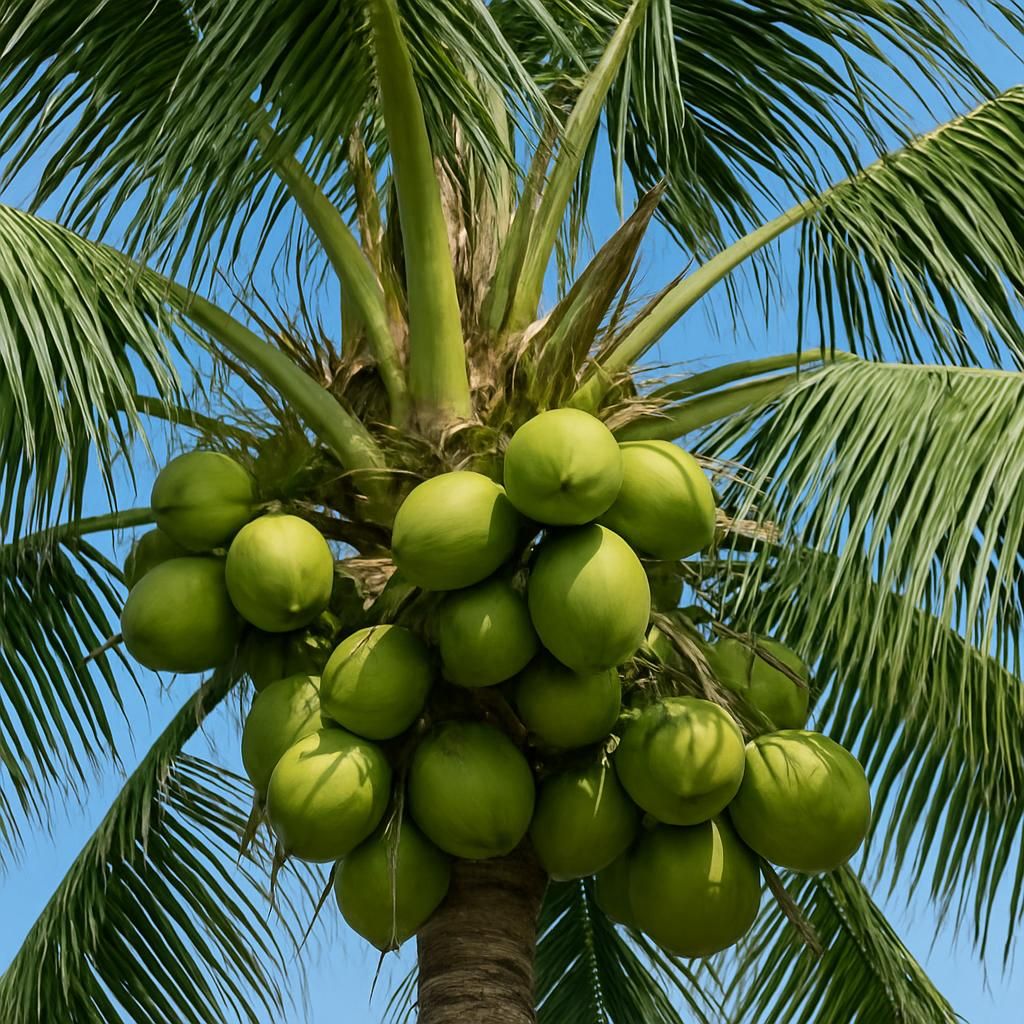
Introduction to Coconut (Maypan Hybrid)
The Maypan Hybrid coconut palm (Cocos nucifera 'Maypan') represents one of the most successful breeding achievements in tropical agriculture. Developed to combine the early bearing and high copra yield of the Malayan Dwarf with the robust trunk and wind resistance of the Panama Tall, this hybrid has become a cornerstone cultivar for both commercial estates and small farms. Growers value its consistent production of large nuts, resistance to Lethal Yellowing, and adaptability to a range of coastal and inland tropical environments.
Maypan palms typically begin fruiting within four to five years after planting, significantly earlier than traditional tall varieties. The hybrid produces nuts averaging 1.2–1.8 kg each, with thick kernels that yield high-quality copra and oil. Its semi-dwarf stature (reaching 15–20 m at maturity) makes harvesting safer and more economical compared to tall palms that can exceed 30 m. Because of these traits, Maypan has been widely adopted in the Caribbean, Central America, Southeast Asia, and parts of West Africa.
Beyond economic returns, Maypan palms provide multiple ecosystem services. Their extensive root systems help stabilize coastal soils against erosion, while the fronds supply thatching material and livestock fodder. The hybrid’s relatively compact canopy also allows greater light penetration for companion planting systems, increasing overall farm biodiversity and resilience.
Botanical Profile of Coconut (Maypan Hybrid)
The Maypan Hybrid belongs to the Arecaceae family. It exhibits a single unbranched trunk that develops a swollen base over time, supporting a crown of 30–40 pinnate fronds. Each frond measures 4–6 m in length with 200–250 leaflets. The inflorescence consists of both male and female flowers; Maypan palms are predominantly cross-pollinated but can set fruit through self-pollination under favorable conditions.
Nuts develop from fertilized female flowers and reach full size in approximately 12 months. The mature nut comprises a fibrous husk (mesocarp), hard shell (endocarp), and white kernel (endosperm) surrounded by coconut water. Maypan kernels typically contain 55–65% oil on a dry-weight basis, making them prized for both culinary and industrial uses.
The hybrid’s genetic background confers moderate tolerance to drought once established, although young palms remain sensitive to prolonged water stress. Leaf morphology shows intermediate characteristics between dwarf and tall parents, with slightly broader leaflets than pure Malayan Dwarfs.
Soil, pH, and Climate Requirements for Coconut (Maypan Hybrid)
Maypan thrives in well-drained sandy loam to loam soils with good organic matter content. It tolerates mild salinity but performs poorly in heavy clay or waterlogged conditions. The following table summarizes optimal growing parameters:
| Parameter | Ideal Range | Notes |
|---|---|---|
| Soil Type | Sandy loam to loam | Good drainage essential; avoid heavy clays |
| Soil pH | 5.5 – 8.0 | Slightly acidic to mildly alkaline |
| Temperature | 21–32 °C (70–90 °F) | Growth slows below 18 °C |
| Annual Rainfall | 1,500–2,500 mm | Evenly distributed; supplemental irrigation needed in dry periods |
| Relative Humidity | 70–90 % | High humidity supports nut development |
| Elevation | 0–600 m | Best yields at low to mid elevations |
| Sunlight | Full sun (minimum 6 hours direct) | Partial shade reduces flowering |
Site selection should prioritize locations with consistent wind but protection from cyclonic gusts exceeding 120 km/h. Coastal sites benefit from natural salt spray tolerance, while inland plantings require windbreaks when exposed to strong monsoon winds.
Step-by-Step Planting & Propagation
Maypan is propagated exclusively from seed nuts selected from high-performing mother palms. Follow these steps for successful establishment:
- Seed Nut Selection: Choose mature, disease-free nuts weighing at least 1.2 kg with no visible cracks or insect damage. Soak selected nuts in clean water for 24–48 hours to initiate germination.
- Nursery Preparation: Prepare raised beds or polybags (40 × 50 cm) filled with a 3:1:1 mix of topsoil, sand, and well-rotted manure. Place nuts horizontally with the broadest side down, covering half the nut with soil.
- Germination Period: Maintain 28–32 °C and consistent moisture. Sprouting occurs in 60–90 days. Seedlings are ready for field transplanting when they reach 1.0–1.2 m height (usually 8–12 months).
- Field Layout: Dig planting holes 60 × 60 × 60 cm at 8–9 m triangular spacing (approximately 140–150 palms/ha). Incorporate 10–15 kg compost or well-rotted manure plus 200 g rock phosphate per hole.
- Transplanting: Plant seedlings at the same depth as in the nursery during the onset of the rainy season. Stake young palms and apply a 1 m radius mulch layer to conserve moisture.
- Initial Irrigation: Provide 20–30 L water per palm weekly for the first 6–8 weeks if rainfall is insufficient.
Care & Maintenance regimes for Coconut (Maypan Hybrid)
Consistent care during the first five years determines long-term productivity. The table below outlines recommended schedules:
| Age/Stage | Watering Schedule | Fertilizer Application (per palm/year) | Pruning Schedule |
|---|---|---|---|
| 0–12 months | 20–30 L/week during dry spells | 0.5 kg NPK 14-14-14 split into 2 applications + 5 kg manure | Remove dead fronds only |
| 1–3 years | 40–60 L/week in prolonged drought | 1.0 kg NPK 14-14-14 + 0.5 kg potassium sulfate + 10 kg manure | Annual removal of 2–3 oldest fronds |
| 3–5 years | 80–100 L/week during peak dry season | 2.0 kg NPK 14-14-14 + 1 kg potassium sulfate + 15 kg manure | Biannual sanitation pruning |
| Mature (>5 yr) | 120–150 L/week split into 2–3 irrigations | 3.0 kg NPK 14-14-14 + 2 kg potassium sulfate + 20 kg manure | Remove only dead or diseased fronds |
Apply fertilizers in two equal splits (pre- and post-monsoon) at the canopy drip line. Maintain a 1.5–2 m weed-free circle around each palm; inter-row areas can be planted with legumes for nitrogen fixation and ground cover.
Pests, Diseases & Organic Management
Maypan’s resistance to Lethal Yellowing is a major advantage, yet it remains susceptible to several pests and pathogens. Key threats include:
- Rhinoceros beetle (Oryctes rhinoceros): Adults bore into the growing point. Control with pheromone traps and application of Metarhizium anisopliae.
- Red palm weevil (Rhynchophorus ferrugineus): Larvae tunnel into the trunk. Early detection via acoustic sensors and trunk injection of entomopathogenic nematodes.
- Coconut mite (Aceria guerreronis): Causes scarring on nuts. Regular spraying of neem oil (2 %) at 15-day intervals during dry seasons reduces populations.
- Bud rot (Phytophthora palmivora): Water-soaked lesions on spear leaf. Improve drainage and apply copper-based fungicides at first sign.
- Stem bleeding (Thielaviopsis paradoxa): Dark liquid oozing from trunk cracks. Remove affected tissue and apply Bordeaux paste.
Regular monitoring, sanitation, and biological controls form the foundation of an integrated pest management program suitable for organic certification.
Harvesting, Curing & Optimal Storage
Maypan palms produce 80–120 nuts per palm annually under good management. Harvesting begins when nuts reach full size and the husk begins to turn brown (approximately 11–12 months after flowering). Skilled climbers or mechanical harvesters collect nuts every 45–60 days.
After harvest, nuts are dehusked using a specialized tool or machine. For copra production, split nuts and sun-dry kernels for 4–6 days until moisture drops below 6 %. Store dried copra in well-ventilated jute bags at 25–30 °C with relative humidity under 70 % to prevent mold. For fresh market, whole nuts can be stored up to 4 weeks at 12–15 °C.
Companion Planting for Coconut (Maypan Hybrid)
Strategic intercropping maximizes land-use efficiency and farm income. Recommended companions include Banana, Pineapple, Cacao, and leguminous cover crops such as Pigeon pea. These species occupy different canopy layers and root zones, reducing competition while improving soil fertility. A common system plants bananas at 3 m spacing between palms during the first 4–5 years, followed by cacao or coffee once the coconut canopy closes. Aromatic herbs such as lemongrass planted in the understory help repel insect pests and provide additional revenue streams.