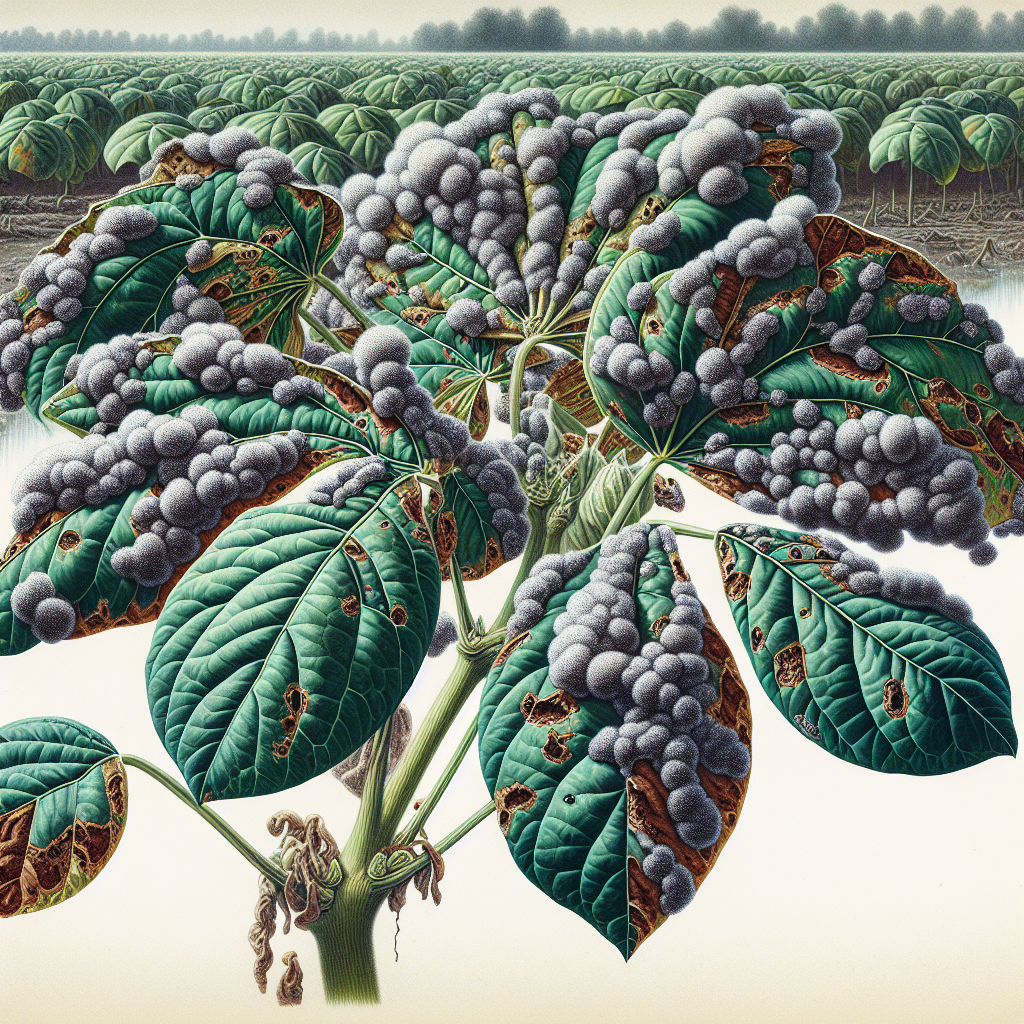
Introduction to Chocolate spot
Chocolate spot, caused by the fungus Botrytis fabae, is one of the most economically important foliar diseases impacting legume crops worldwide, particularly faba beans (Vicia faba). First identified in the early 20th century, this disease has become a persistent challenge for farmers in temperate regions, leading to yield reductions of up to 50-100% in severe epidemics. The name 'chocolate spot' derives from the characteristic dark reddish-brown to chocolate-colored lesions that appear on leaves, stems, and pods, often coalescing to cover entire plant surfaces.
As a necrotrophic pathogen, B. fabae kills host tissues to feed on the dead cells, distinguishing it from biotrophic fungi that require living tissue. It is closely related to Botrytis cinerea, the gray mold pathogen, but shows host specificity towards legumes like peas, chickpeas, and field beans. Global warming has extended its range, with outbreaks now reported in warmer climates during periods of high humidity. Early detection and integrated management are crucial, as unchecked infections can devastate crops, especially in dense plantings or following mild winters. This guide provides professional-grade diagnostic criteria, lifecycle insights, and proven organic and conventional strategies to safeguard yields. For small farms struggling with disease identification, tools like those in Why Misidentifying Plants Costs Small Farms Thousands - And How AI Camera Diagnosis Fixes It Fast can accelerate accurate scouting.
Identifying Symptoms & Damage
Accurate diagnosis begins with recognizing the hallmark symptoms of chocolate spot, which typically emerge 4-6 weeks after planting during cool, wet weather. Initial signs appear on lower leaves as small, circular to irregular spots (1-5 mm diameter) with a reddish-brown center surrounded by a grayish-white halo. These lesions expand rapidly under favorable conditions, turning dark chocolate-brown to black, often with a zonate pattern due to alternating rings of fungal growth.
As the disease progresses, lesions coalesce, covering up to 50-80% of leaf area, leading to necrosis and premature leaf drop. Stems develop elliptical brown lesions, particularly at nodes, causing girdling and lodging. Pods show dark brown spots that may penetrate to infect seeds, rendering them unmarketable. In humid conditions, sparse grayish sporulation (conidia) may appear on lesion surfaces, aiding microscopic confirmation.
Differentiate chocolate spot from look-alikes: Alternaria spots are smaller with yellow halos (Alternaria); rusts produce pustules; downy mildew shows white sporangia on leaf undersides. Yield impacts are profound: foliar infection reduces photosynthesis by 30-60%, pod infection cuts seed yield by 20-50%, and stem lesions increase lodging losses. Scout weekly from vegetative stages, using a 10x hand lens to check for mycelium. Economic thresholds: 5-10% leaf area affected pre-flowering warrants action.
Lifecycle and Progression of Chocolate spot
Botrytis fabae follows a polycyclic lifecycle, completing 5-10 cycles per season. Primary inoculum overwinters as sclerotia or mycelium in crop debris, soil, or on weed hosts like clover (clover). In spring, sclerotia germinate under cool (10-20°C), moist conditions, producing apothecia that release ascospores, though conidia from infected debris drive most epidemics.
Conidia, airborne pinkish masses, infect leaves via wounds or stomata during prolonged leaf wetness (>12 hours). Optimal infection occurs at 15-20°C with high relative humidity (>90%). Latency period: 3-5 days to lesion appearance, followed by sporulation in 2-3 days. Secondary spread accelerates in dense canopies, with spores traveling kilometers on wind.
Progression peaks at flowering when petals senesce, providing entry points. Late infections hit pods and stems. Sclerotia form in senesced tissues, perpetuating the cycle. Disease gradients follow a logistic model, with R0 (basic reproduction number) of 2-5 in susceptible varieties. Understanding this enables predictive modeling for spray timing.
Environmental Triggers & Risk Factors
Chocolate spot epidemics hinge on the 'disease triangle': susceptible host, virulent pathogen, and conducive environment. Cool temperatures (8-22°C), especially 15°C nights, combined with leaf wetness from dew, rain, or irrigation, trigger outbreaks. High humidity (>85% RH) for 48+ hours promotes sporulation and infection.
Risk factors include narrow-row spacing (<30 cm) creating humid microclimates, excessive nitrogen favoring lush foliage, and minimum tillage leaving debris. Volunteer plants and weed reservoirs like vetch amplify inoculum. Mild winters reduce sclerotial decay, while dense planting (>20 plants/m²) hastens canopy closure. Clay soils retaining moisture exacerbate issues. Regional hotspots: UK, Australia, Ethiopia during wet springs. Monitor forecasts; avoid overhead irrigation. Crop rotation with non-legumes like wheat or corn breaks cycles.
Organic Control & Treatment Plans
Organic management emphasizes prevention and cultural IPM. Select resistant varieties like 'Wizard' or 'Divisa', which show 50-70% less severity. Rotate with cereals (2-3 years), destroy debris via deep plowing or flaming. Space rows 45-60 cm, plants 15-20 cm for airflow.
Enhance plant vigor with balanced nutrition: 30-50 kg/ha phosphorus, avoid excess N. Companion planting with marigold or thyme suppresses via volatiles. Biologicals: Trichoderma spp. or Bacillus subtilis (e.g., Serenade) applied at 7-10 day intervals from vegetative stage reduce infection by 40%. Bicarbonates (potassium/sodium) at 5 g/L + sticker provide protectant action.
Scout-based sprays: Start at first spots, repeat every 7-14 days during high risk. Neem oil (2-3 ml/L) or garlic-chili extracts deter sporulation. For outbreaks, remove infected lower leaves. Post-harvest, mulch residues to accelerate decomposition. Integrate with Soil Health Mastery: 5 Proven Strategies for Small Farms to Build Fertile Ground Without Breaking the Bank for resilient crops. Yields recover 20-40% with diligent IPM.
Preventing Chocolate spot in the Future
Long-term prevention builds resilient systems. Breed/choose multi-resistant cultivars, certified disease-free seed. Implement 3-year rotations: legumes-cereals-brassicas like cabbage. Site selection: well-drained loams, avoid low-lying frost pockets.
Sanitation: harvest residues, rogue volunteers, control weeds. Windbreaks reduce spore dispersal. Foliar nutrition (micronutrients like Mn, Zn) boosts tolerance. Forecasting apps track spore traps, wetness hours for precise timing. Cover crops like hairy vetch off-season suppress soil inoculum. Monitor adjacent fields; buffer zones help. Climate-adaptive practices: raised beds, drip irrigation minimize wetness. Annual soil tests guide amendments. Community efforts: regional debris management cuts inoculum 70%. Track progress with field maps.
Crops Most Affected by Chocolate spot
Faba bean (Vicia faba) suffers most, with losses up to 90% in epidemics. Other legumes vulnerable: field pea (Pisum sativum), lentil (Lens culinaris) lentils, chickpea (Cicer arietinum) chickpeas, vetch (Vicia spp.). Minor hosts: broad bean, lupin. Non-legumes rarely affected due to specificity. Global impact: 10-20% annual faba bean losses in Mediterranean, Europe, North Africa. In polycultures, isolate faba from peas. Resistant crops like soybeans in rotation minimize carryover.