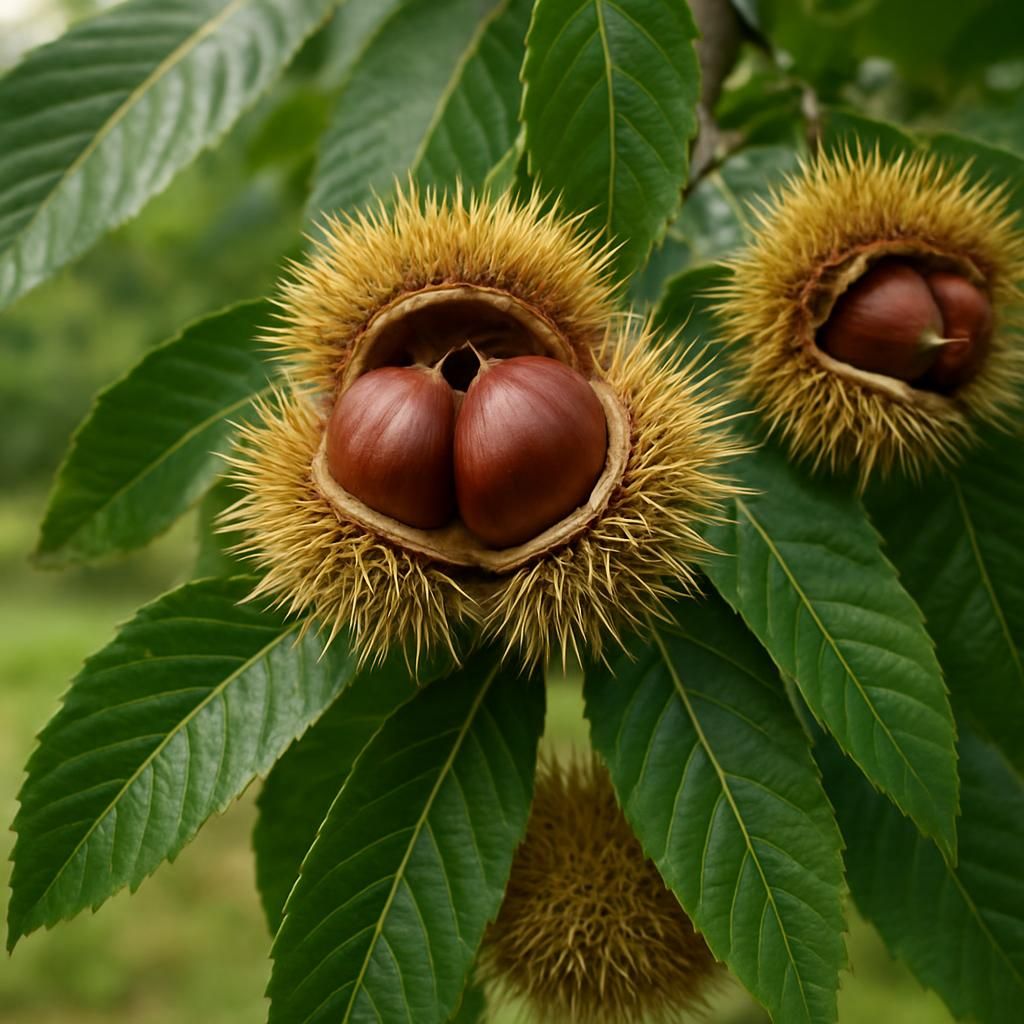
Introduction to Chestnut (American - Castanea dentata)
The American chestnut (Castanea dentata) was historically one of the most important hardwood trees in eastern North America, often called the “bread tree” for its reliable annual nut crop. Mature trees could reach 100 feet tall with trunks exceeding 10 feet in diameter, producing nuts that sustained wildlife, livestock, and human communities. Chestnut blight, caused by Cryphonectria parasitica, devastated populations beginning in the early 1900s, reducing the species to root sprouts that rarely reach maturity. Modern growers focus on blight-resistant hybrids while preserving genetic diversity of the original species. This guide provides professional-grade, science-based advice for establishing productive American chestnut plantings.
Botanical Profile of Chestnut (American - Castanea dentata)
Castanea dentata belongs to the Fagaceae family and is a large, deciduous tree with alternate, simple leaves featuring prominent teeth along the margins. The species is monoecious, producing both male catkins and female flowers on the same tree. Nuts develop inside spiny burs that split open at maturity, typically containing two to three shiny, dark-brown nuts per bur. American chestnut exhibits strong apical dominance in youth but develops a broad, rounded crown with age. The tree is fast-growing on good sites, often adding 3–5 feet of height annually under optimal conditions. Root systems are deep and extensive, conferring excellent drought tolerance once established.
Soil, pH, and Climate Requirements for Chestnut (American - Castanea dentata)
American chestnut thrives on well-drained, acidic soils typical of its native Appalachian range. The species performs best on sandy loam to loam textures with good aeration and moderate fertility. Heavy clay or poorly drained sites should be avoided or heavily amended.
| Parameter | Ideal Range | Notes |
|---|---|---|
| Soil Texture | Sandy loam to loam | Excellent drainage critical |
| Soil pH | 5.0 – 6.5 | Avoid alkaline soils above 7.0 |
| Organic Matter | 3 – 6 % | Incorporate compost at planting |
| USDA Hardiness Zones | 4 – 8 | Requires 800–1,200 chill hours |
| Annual Precipitation | 35 – 55 inches | Supplemental irrigation first 2–3 years |
| Full Sun Exposure | Minimum 6–8 hours daily | Partial shade reduces nut production |
Step-by-Step Planting & Propagation
- Site Selection: Choose south- or southeast-facing slopes with good air drainage to minimize frost pockets.
- Soil Testing: Conduct comprehensive soil analysis including pH, macro- and micronutrients, and nematode counts.
- Site Preparation: Clear competing vegetation and incorporate 2–3 inches of well-aged compost or aged manure.
- Propagation Methods: Growers typically plant grafted blight-resistant seedlings or direct-seed stratified nuts. Stratify nuts at 34–38 °F for 60–90 days before spring planting.
- Planting Timing: Plant bare-root or container-grown trees in early spring as soon as soil can be worked. Fall planting is acceptable in zones 6–8 with adequate mulch.
- Spacing: Standard orchard spacing is 20–25 feet between trees and 25–30 feet between rows. Wider spacing (30 × 40 ft) is recommended for timber-plus-nut silvopasture systems.
- Planting Depth: Set trees at the same depth they grew in the nursery; do not bury the graft union.
- Initial Watering: Apply 5–10 gallons of water per tree immediately after planting and maintain consistent moisture for the first growing season.
Care & Maintenance regimes for Chestnut (American - Castanea dentata)
Young trees require diligent weed control, irrigation, and formative pruning. Once established, maintenance focuses on annual fertilization, structural pruning, and monitoring for pests and disease.
| Growth Stage | Watering Schedule | Fertilizer Schedule | Pruning Schedule |
|---|---|---|---|
| Year 1–2 | 1 inch/week; deep soak every 7–10 days | 0.25 lb 10-10-10 per tree at bud break and mid-summer | Remove only dead or damaged wood; train central leader |
| Year 3–5 | 0.75 inch/week during dry spells | 0.5–1 lb 10-10-10 split into two applications | Develop scaffold branches at 45° angles |
| Mature Trees | Supplemental only during extreme drought | 2–3 lbs 10-10-10 or equivalent organic blend annually | Annual dormant pruning to maintain open canopy |
Mulch a 3–4 ft diameter circle around each tree with 3–4 inches of wood chips or shredded bark to conserve moisture and suppress weeds. Reapply mulch annually, keeping it 3–4 inches away from the trunk.
Pests, Diseases & Organic Management
Chestnut blight remains the primary threat, but several insects and secondary pathogens can also reduce yields. Integrated management combines cultural practices, resistant cultivars, and targeted organic controls.
- Chestnut Blight: Caused by Cryphonectria parasitica. Hypovirulent strains and breeding for resistance are the main long-term solutions. Remove and destroy heavily infected branches.
- Chestnut Gall Wasp: Tiny wasps produce galls on twigs and leaves. Prune and destroy galled tissue before adult emergence; release Torymus sinensis parasitoids where available.
- Nut Weevils: Larvae develop inside nuts. Collect and destroy fallen nuts promptly; floating nuts in water helps separate infested seed.
- Phytophthora Root Rot: Improve drainage and avoid over-irrigation. Apply beneficial Trichoderma and mycorrhizal inoculants at planting.
- Ink Disease: Similar to Phytophthora; maintain soil pH below 6.5 and avoid compaction.
- Japanese Beetles: Hand-pick or apply neem-based sprays during peak flight; use trap crops such as Elderberry (American) nearby.
Harvesting, Curing & Optimal Storage
American chestnut burs begin to split in late September through October depending on latitude. Harvest daily to prevent mold and rodent damage. Wear gloves to avoid spines. After collection, cure nuts by spreading in a single layer in a cool, dry location (50–60 °F, 60–70 % RH) for 7–14 days. Properly cured nuts can be stored at 32–38 °F and 80–90 % RH for 4–6 months. For longer storage, freeze at 0 °F in airtight containers. Quality testing involves cutting a sample; viable nuts show white, firm kernels without discoloration.
Companion Planting for Chestnut (American - Castanea dentata)
Strategic companions improve biodiversity, soil health, and pest management. Nitrogen-fixing species such as Clover and Hairy vetch build soil fertility while providing ground cover. Comfrey (not in wiki list—added to new_internal_links) accumulates nutrients and serves as dynamic mulch. Aromatic herbs including Thyme and Rosemary (not in wiki list—added to new_internal_links) deter insect pests. Understory plantings of Blackberry or Raspberry provide additional income and habitat for beneficial insects. Avoid planting shallow-rooted crops directly under the drip line to prevent competition for moisture during establishment.
Chestnut (crop) restoration programs increasingly incorporate diverse understory species to mimic historic forest structure. For additional guidance on soil biology and seasonal transitions, see The Truth About Fall Garden Transitions for Small Farm Resilience.