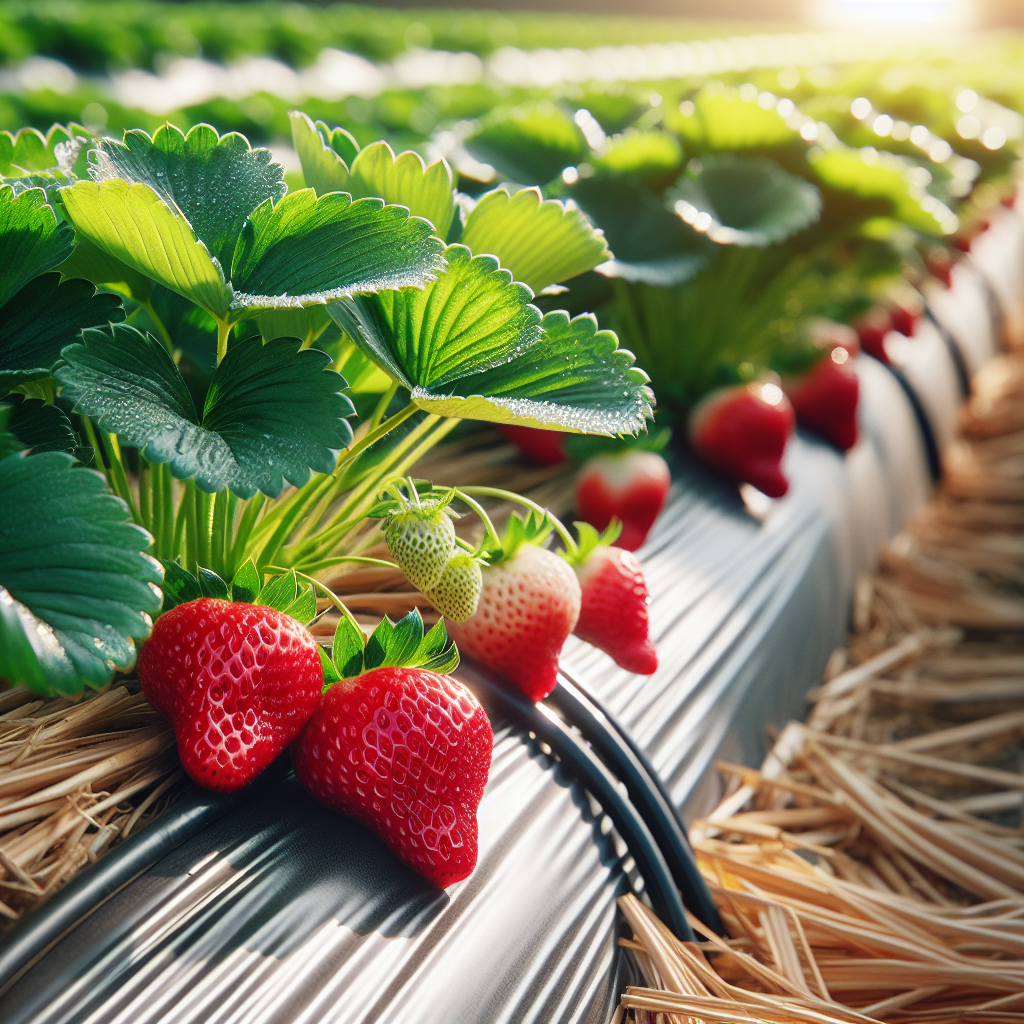
Introduction to Chandler Strawberry
Developed in California and released by the University of California breeding program in 1983, this cultivar became famous for combining commercial productivity with notably strong flavor, something not all high-yield strawberries achieve. It is a short-day type, meaning flower initiation is triggered as daylength shortens and temperatures cool, making it particularly valuable in regions with mild winters or in annual plasticulture systems where transplants are set in autumn for spring harvest.
What makes this variety distinctive is its fruit profile: berries are typically large to very large, conic to long-conic, bright red, glossy, and highly aromatic. Flesh is relatively soft compared with some shipping-oriented cultivars, so while it excels for local markets, U-pick, farm stands, and home gardens, it requires careful handling after harvest. Growers often choose Chandler when flavor, appearance, and customer appeal matter more than long-distance transport durability.
Plants are vigorous and productive, but they are not carefree. Chandler rewards precise irrigation, balanced fertility, and strong disease prevention. In well-managed beds it produces abundant spring fruit with excellent sugar-acid balance. For a broader overview of species-level strawberry cultivation, see the Strawberry guide.
Botanical Profile of Chandler Strawberry
This cultivar belongs to Fragaria × ananassa, the modern garden strawberry, a hybrid species derived historically from crosses between North and South American wild strawberries. Chandler is a herbaceous perennial typically grown as an annual in commercial systems, especially in warmer climates, though it may persist for multiple seasons in matted-row or perennial garden settings.
The plant forms a compact crown that produces trifoliate leaves, fibrous roots concentrated mostly in the upper 15-20 cm of soil, and stolons or runners used for vegetative spread. The shallow root system explains why strawberries respond quickly to both drought stress and overwatering. Chandler typically produces a dense canopy with moderate-to-strong vigor. Leaves are medium to large, and a healthy canopy should appear deep green without excessive rank growth.
Flower clusters emerge from the crown and bear white, five-petaled blossoms that are self-fertile, though insect activity significantly improves fruit set and berry symmetry. Poor pollination can lead to misshapen berries because the strawberry receptacle enlarges only where individual ovules are successfully fertilized. Each visible “seed” on the surface is actually an achene, and uniform achene development helps produce even, fully formed fruit.
Fruit is one of Chandler’s signature traits. Primary berries are often very large, sometimes oversized under high fertility, while secondary and tertiary berries remain commercially attractive if plants are not overstressed. Skin color is bright and appealing, but the fruit’s relative tenderness means it bruises more easily than firmer cultivars. Flavor tends to be strongest when plants receive full sun, moderate nitrogen, and consistent moisture without waterlogging.
In production behavior, Chandler is considered highly responsive to environment. In cool, bright spring conditions, fruit quality is outstanding. Under hot weather, however, berries may soften rapidly, color unevenly, or lose acidity. This is why the cultivar performs best where the main harvest occurs before sustained high heat.
Soil, pH, and Climate Requirements for Chandler Strawberry
This cultivar performs best in well-drained, friable sandy loam or loam rich in organic matter but not excessively heavy. Ideal soil pH is 5.8 to 6.5. Below pH 5.5, calcium and magnesium availability can become limiting and root growth may be less vigorous; above about 6.8, micronutrient issues such as iron chlorosis become more likely, particularly in calcareous soils.
Drainage is non-negotiable. Chandler is vulnerable to crown and root diseases in poorly aerated soils. If you squeeze a moist handful of soil, it should crumble apart with slight pressure rather than form a sticky, dense mass. Raised beds 20-30 cm high are strongly recommended, especially in regions with winter rain or clay subsoils. Beds improve oxygen around roots, reduce crown rot risk, warm faster in spring, and make harvest cleaner.
Target organic matter in the topsoil at roughly 3-5%. Excessively raw manure or unfinished compost should never be incorporated shortly before planting because it may increase salt levels, stimulate soft vegetative growth, and encourage disease. Well-finished compost can improve moisture buffering and structure, but too much can push nitrogen high, which in Chandler often means lush leaves and softer fruit.
Climate-wise, Chandler is best suited to temperate and Mediterranean-style regions with mild winters and cool-to-warm springs. It generally performs best where daytime temperatures during fruiting remain around 15-24°C and nighttime temperatures stay near 7-13°C. Flowering and fruit set decline in quality when temperatures rise consistently above 27-29°C, especially if nights remain warm. Hot spells often reduce berry firmness and can increase the proportion of small or misshapen fruit.
Winter chilling needs are moderate in practical terms, but because Chandler is widely used as a short-day annual crop, transplant type matters. Fresh-dug or plug plants established in autumn under cool conditions initiate flower buds for spring harvest. In colder continental climates, growers may plant in early spring, but fruiting pattern and total yield can differ from classic winter production systems.
Full sun is essential. Aim for at least 8 hours of direct light daily. Partial shade reduces sugar accumulation, delays drying of foliage, and increases foliar disease pressure. Good air circulation is equally important: strawberries should not be crowded into damp corners where dew lingers into late morning.
Soil moisture should remain consistently even in the upper root zone. As a field benchmark, strawberries generally perform well when soil is maintained near 70-80% of field capacity during establishment and fruit fill, never swinging between drought and saturation. In practical terms, soil 5-10 cm deep should feel cool and slightly moist, not powder-dry and not muddy. If leaves wilt by midday and recover at night, the bed is already too dry; if lower leaves yellow, crowns stagnate, and soil smells sour, irrigation is excessive.
Step-by-Step Planting & Propagation
Start with certified disease-free plants. Chandler is commonly planted from bare-root transplants or plug plants. Certified stock is especially important because strawberries readily accumulate viruses, crown diseases, and latent root problems that dramatically reduce performance.
Prepare beds 2-4 weeks before planting. Form raised beds about 60-75 cm wide at the top. Incorporate well-finished compost sparingly if needed for structure, and pre-plant phosphorus and potassium according to soil test results.
Install drip irrigation before laying mulch. One drip line may suffice for narrow beds, but two lines are often better in sandy soils or larger beds to distribute water evenly across the root zone.
Apply mulch. In commercial annual systems, black plastic is standard because it suppresses weeds, keeps berries clean, and warms soil. In garden systems, clean straw can be used, though it offers less weed suppression.
Plant at the correct depth. This is one of the most critical details. Set the crown exactly at soil level, with roots spread downward like a fan. If planted too deep, crowns rot; if too shallow, roots dry out and plants may heave upward. The midpoint of the crown should sit even with the bed surface.
Space properly. For annual plasticulture, space plants about 25-35 cm apart in double rows, with rows 25-35 cm apart on the bed. Wider spacing improves airflow and fruit size; closer spacing increases early yield but may intensify disease pressure.
Water immediately after planting. Bare-root plants need enough water to settle soil tightly around roots. For the first 7-14 days, irrigate lightly and frequently until new white root tips form and leaves regain turgor.
Remove early flowers if planting for long-term establishment. In perennial systems, pinching the first blossoms for several weeks helps roots and crown develop. In annual fruiting systems, this is usually unnecessary unless plants are weak.
Propagation is usually by runners. Select healthy mother plants with desirable fruit size, flavor, and vigor. Allow the first one or two runner plants per stolon to root into clean media or nursery soil; these are often more vigorous than later daughter plants. However, because strawberries can carry viruses and fungal pathogens invisibly, farm-scale propagation should be done cautiously. For top performance, buying certified plants each cycle is preferable.
If you are designing mixed beds, useful cultural insights can also be drawn from broader intercropping principles discussed in this companion planting article.
Care & Maintenance regimes for Chandler Strawberry
Irrigation must be precise. During establishment, keep the root zone uniformly moist but never saturated. After establishment, most field plantings need roughly 25-38 mm of water per week in cool weather, increasing to 40 mm or more during active fruit fill on sandy soils or in windy conditions. Drip irrigation is preferred because overhead watering increases disease risk and can damage blossoms.
The best way to judge irrigation is by both soil feel and plant response. Dry stress in Chandler first shows as dull leaf color, slight edge curl, reduced berry size, and fruit with pronounced seeds due to restricted receptacle expansion. Chronic underwatering leads to seedy, small, less juicy berries and fewer crowns. Overwatering shows as slow growth despite moist soil, lower leaf yellowing, increased Botrytis and root disease, softer fruit, and reduced flavor concentration.
Fertility should be moderate and staged. Chandler responds well to balanced nutrition but suffers when overfed with nitrogen. Too much nitrogen creates lush canopies, delays ripening, softens berries, and increases susceptibility to mites and gray mold. As a general program, supply modest pre-plant fertility based on soil tests, then fertigate lightly during vegetative expansion and early flowering. Once fruiting starts, avoid heavy nitrogen pulses. Potassium becomes especially important for berry size, firmness, and sugar movement.
Leaf tissue analysis is valuable in commercial plantings. Visually, nitrogen deficiency appears as pale older leaves and weak growth; potassium deficiency may show as marginal scorch on older leaves and poor fruit fill; calcium-related issues may contribute to softer tissues, especially under erratic watering.
Weed management should be aggressive early because strawberries are shallow-rooted and compete poorly. Hand weeding near crowns is safer than deep hoeing, which can sever feeder roots. Mulch sharply reduces weed pressure and keeps fruit off soil.
Runner management depends on production system. In annual fruiting beds, remove runners promptly so the plant directs carbohydrates into crowns, flowers, and berries. In matted-row systems, some runners are allowed to fill the row, but Chandler is more often managed for fruit quality in spaced plantings than for dense runner mats.
Mulching with clean straw around harvest can reduce soil splash and keep fruit clean if plastic is not used. In colder regions, winter straw mulch may be applied after dormancy to protect crowns from freeze-thaw cycles, then pulled back in spring.
Pollination support matters even though flowers are self-fertile. Encourage bees and other pollinators for better-shaped berries. Interplanting edges with Thyme or Yarrow can help attract beneficial insects while improving biodiversity near the bed.
Pests, Diseases & Organic Management
Chandler’s excellent fruit quality comes with moderate vulnerability to several common strawberry problems. Disease prevention is more effective than rescue treatments.
Botrytis fruit rot (gray mold) is among the most serious issues, especially in humid weather or dense canopies. Infected blossoms turn brown; fruit later develops soft tan lesions and gray fuzzy spores. To reduce risk, maintain spacing, avoid overhead irrigation, remove dead leaves, and harvest frequently. Straw or plastic mulch helps keep berries clean and dry.
Anthracnose can affect fruit, crowns, and runners, especially in warm, wet conditions. Look for sunken dark lesions on fruit and collapsing plants if crown infections occur. Start with certified clean stock, avoid moving workers through wet plantings, and remove infected plants promptly.
Powdery mildew appears as upward leaf cupping, purplish blotching, and whitish fungal growth on leaf undersides. It often flares under warm days and cool nights with high humidity. Improve ventilation and avoid excess nitrogen.
Phytophthora crown and root rots become severe in poorly drained soils. Plants may wilt despite wet ground, crowns may brown internally, and root systems shrink or blacken. Raised beds and careful irrigation are your best defenses.
Verticillium wilt is another major soilborne concern. Avoid planting strawberries after solanaceous crops such as Tomato, potato, pepper, or eggplant, as they can share disease pressure. Crop rotation of at least 3-4 years away from strawberries and susceptible hosts is ideal.
Common insect pests include Twospotted spider mites, Aphids, Tarnished plant bugs, Slugs, and Thrips. Spider mites thrive in hot, dry conditions and cause stippled leaves with bronzing on the undersides. Aphids cluster on tender growth and may vector viruses. Tarnished plant bugs feed on developing fruit and produce misshapen “cat-faced” berries. Slugs chew fruit resting near damp mulch.
Organic management relies on integration:
- Use certified disease-free plants.
- Rotate away from strawberries and susceptible vegetables.
- Keep beds weed-free, since weeds harbor insects and hold humidity.
- Encourage beneficial insects with flowering borders.
- Use insectary companions such as Clover in nearby alleys, not directly competing in the row.
- Apply insecticidal soap carefully for Aphids when beneficial pressure is insufficient.
- Release predatory mites where spider mites are chronic.
- Use iron phosphate baits for Slugs if needed.
- Remove overripe and diseased fruit at every picking.
Birds can also cause significant losses as berries redden. Netting is often the most effective non-chemical defense. Install it before fruit reaches full color, because once birds establish a feeding pattern, losses escalate quickly.
Harvesting, Curing & Optimal Storage
Harvest should be timed for market use because Chandler is best when fully colored but not overripe. Pick when berries are uniformly red and glossy, including the shoulder area near the calyx. Unlike some fruits, strawberries do not continue ripening after harvest, so undercolored berries will not develop full flavor off the plant.
Pick in the cool morning after dew dries but before midday heat. Wet harvests increase rot and shorten shelf life. Hold the stem between fingers and snap or cut with a short stem cap attached; pulling directly on the berry can bruise the fruit and tear skin near the calyx.
Harvest frequency is usually every 2-3 days during peak season, sometimes daily in warm weather. Frequent picking is essential because overripe Chandler berries soften rapidly and attract Botrytis, sap beetles, and Slugs.
There is no true curing step for strawberries in the way there is for onions or sweet potatoes. Instead, postharvest success depends on rapid field heat removal. Cool fruit to 0-2°C as soon as possible, ideally within one hour of harvest for best shelf life. Relative humidity should remain high, around 90-95%, to limit shriveling, but fruit surfaces should be dry before packing.
Use shallow containers to avoid compression. Stack gently, and never leave picked fruit in the sun. Chandler’s flesh is flavorful but comparatively tender, so rough handling can produce invisible bruising that turns into leakage within a day.
For short-term storage, refrigerate immediately. Under ideal conditions, berries may keep 3-5 days with acceptable quality, though peak flavor is best within 48 hours. Do not wash until just before use, as free moisture accelerates breakdown. For processing, berries can be frozen whole or sliced after hulling.
Companion Planting for Chandler Strawberry
The best companions are those that improve pollinator traffic, attract beneficial insects, suppress weeds lightly, or repel certain pests without competing heavily for water and nutrients. Low-growing aromatic herbs and insectary flowers tend to work better than large, aggressive vegetables.
Thyme is an excellent nearby companion because its flowers attract pollinators and beneficial insects while its compact habit avoids shading. Yarrow supports predatory insects and parasitic wasps that can help regulate Aphids and other soft-bodied pests. Clover can function as a living alley cover in wider systems, helping with soil structure and beneficial insect habitat, though it should be kept out of the immediate crown zone to prevent competition and excess humidity.
Alliums are often recommended around strawberry beds because their scent may help confuse some pests. If used, keep spacing generous so airflow is not restricted. Avoid large brassicas or sprawling cucurbits immediately adjacent to Chandler because they can crowd the bed, shade foliage, and interfere with harvest hygiene.
Companion planting should support the strawberry planting rather than turn it into a polyculture thicket. The guiding rule is simple: anything placed near Chandler must preserve sun, airflow, clean harvest lanes, and root-zone moisture stability. When those conditions are maintained, companion plants can enhance resilience without sacrificing berry quality.