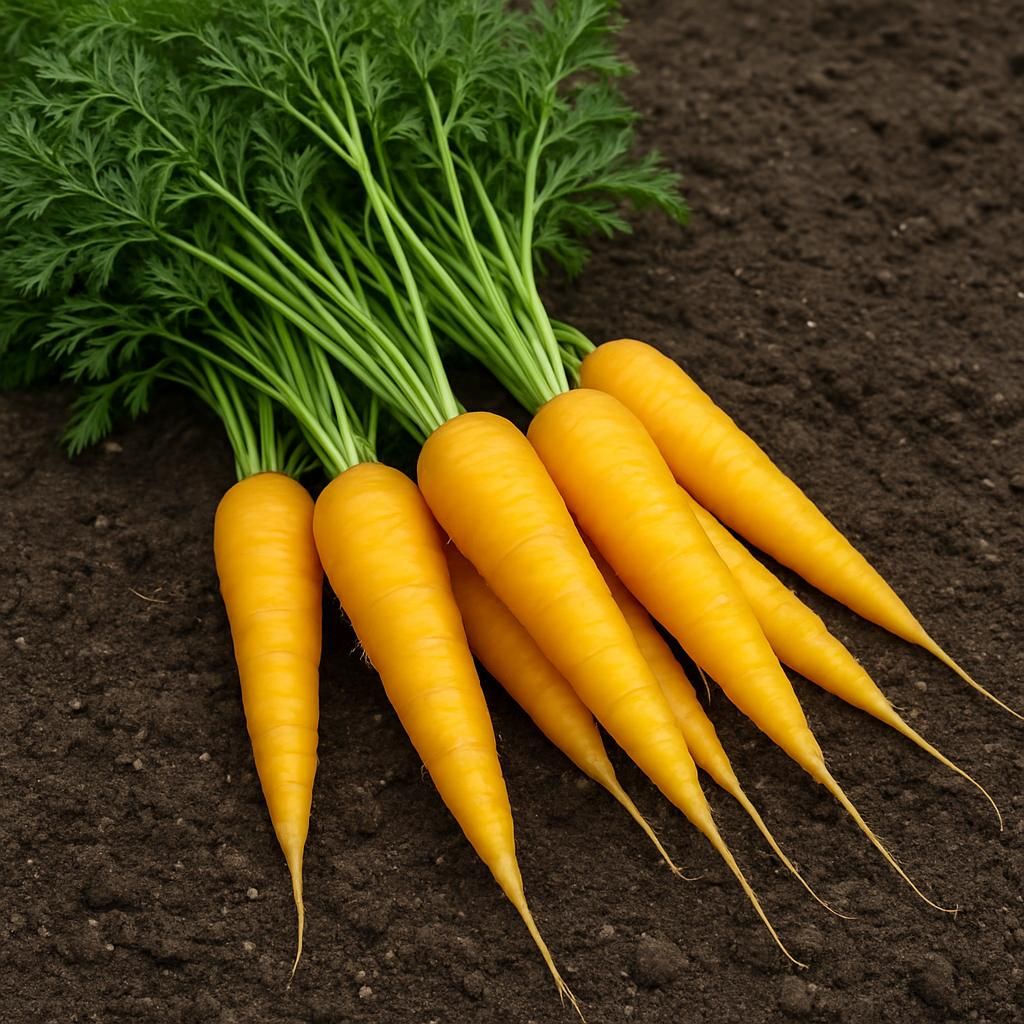
Introduction to Carrot (Solar Yellow)
Solar Yellow carrots stand out among root vegetables for their striking golden hue and exceptionally sweet taste. Developed through careful selection of traditional yellow carrot lines, this variety combines visual appeal with reliable garden performance. Home gardeners and market growers value its crisp texture and versatility in both fresh and cooked applications. Carrot production benefits from targeted variety selection like Solar Yellow when color diversity and flavor intensity are priorities.
Botanical Profile of Carrot (Solar Yellow)
Solar Yellow belongs to the Apiaceae family and shares the classic taproot morphology of cultivated carrots. The plant produces a rosette of finely divided, feathery leaves emerging from a central crown. Roots reach 15–20 cm in length with a tapered shape and smooth skin that retains its golden-yellow coloration even after cooking. The cultivar maintains the biennial life cycle typical of Daucus carota, completing vegetative growth in the first season and flowering in the second under appropriate vernalization.
Soil, pH, and Climate Requirements for Carrot (Solar Yellow) (MUST INCLUDE A MARKDOWN TABLE OF IDEAL CONDITIONS)
Successful Solar Yellow carrot production begins with precise management of soil texture, fertility, and climate parameters. Deep, loose, stone-free soils are essential to prevent root forking and ensure straight, marketable roots. The following table summarizes optimal conditions:
| Parameter | Ideal Range | Notes |
|---|---|---|
| Soil Type | Sandy loam to loam | Avoid heavy clay; incorporate organic matter for structure |
| Soil pH | 6.0–6.8 | Slightly acidic to neutral; test and amend if needed |
| Soil Temperature | 16–24 °C (seed zone) | Germination slows below 10 °C |
| Air Temperature | 15–25 °C daytime | Tolerates light frost; avoid prolonged heat above 30 °C |
| Spacing | 5–8 cm between plants, 30–45 cm rows | Thin seedlings early to prevent crowding |
| Organic Matter | 3–5 % | Well-rotted compost improves moisture retention |
Step-by-Step Planting & Propagation
- Select certified, disease-free seed of Solar Yellow. Perform a germination test if seed is more than one year old.
- Prepare beds by removing stones and breaking up compaction to a depth of 30 cm. Incorporate aged compost at 2–3 kg/m².
- Sow seed directly 6–12 mm deep in moist soil when soil temperature reaches 10 °C or higher. Use a seed tape or precision seeder for uniform spacing.
- Keep the seedbed consistently moist until emergence (7–14 days). Avoid crusting by applying a light mulch of fine compost.
- Thin seedlings to 5–8 cm when they reach 5 cm tall. Use the thinnings in salads.
Care & Maintenance regimes for Carrot (Solar Yellow) (MUST INCLUDE A MARKDOWN TABLE OF WATER, FERTILIZER, AND PRUNING SCHEDULES)
Consistent moisture and balanced nutrition produce the sweetest, most uniform roots. Over-fertilization, especially with nitrogen, leads to excessive foliage at the expense of root development. The schedule below provides a practical regime for temperate climates:
| Growth Stage | Watering Frequency | Fertilizer Application | Pruning/Thinning |
|---|---|---|---|
| Pre-emergence | Light daily misting to maintain moisture | None | None |
| Seedling (2–4 weeks) | 2–3 times weekly, 2.5 cm/week | Side-dress with 5-10-10 at 30 g/m row | Thin to 5–8 cm spacing |
| Vegetative (4–8 weeks) | Deep watering every 4–5 days | Apply compost tea or 10-10-10 at 40 g/m row | Remove weeds; no leaf pruning |
| Root Bulking (8+ weeks) | 2.5–4 cm/week, avoid water stress | Light potassium boost (0-0-20) at 20 g/m row | Maintain weed-free zone |
Pests, Diseases & Organic Management
Solar Yellow carrots face typical root-crop challenges. Aphids can transmit viruses while cutworms sever seedlings at soil level. Root-knot nematodes cause galling and stunting. Cultural practices such as crop rotation with Onion or Garlic, floating row covers, and beneficial nematodes provide effective organic control. For foliar diseases like Alternaria leaf spot, remove infected leaves promptly and avoid overhead irrigation.
Harvesting, Curing & Optimal Storage
Harvest Solar Yellow carrots when roots reach 1.5–2 cm diameter at the shoulder, typically 60–75 days after sowing. Loosen soil with a fork and pull gently to avoid breakage. Remove tops to 1 cm above the crown and wash roots in cool water. Cure briefly in a shaded, ventilated area for 1–2 hours before storage. Ideal storage conditions are 0–2 °C and 95–100 % relative humidity; roots retain quality for 4–6 months in perforated plastic bags or damp sand.
Companion Planting for Carrot (Solar Yellow)
Solar Yellow benefits from strategic pairings that improve soil health and deter pests. Lettuce and Radish mature quickly and help shade soil, reducing crusting. Onion and Garlic repel carrot rust fly when interplanted. Avoid planting near Dill or Parsley as these may attract similar pests. For deeper soil improvement, consider preceding the carrot crop with a green manure of Clover.