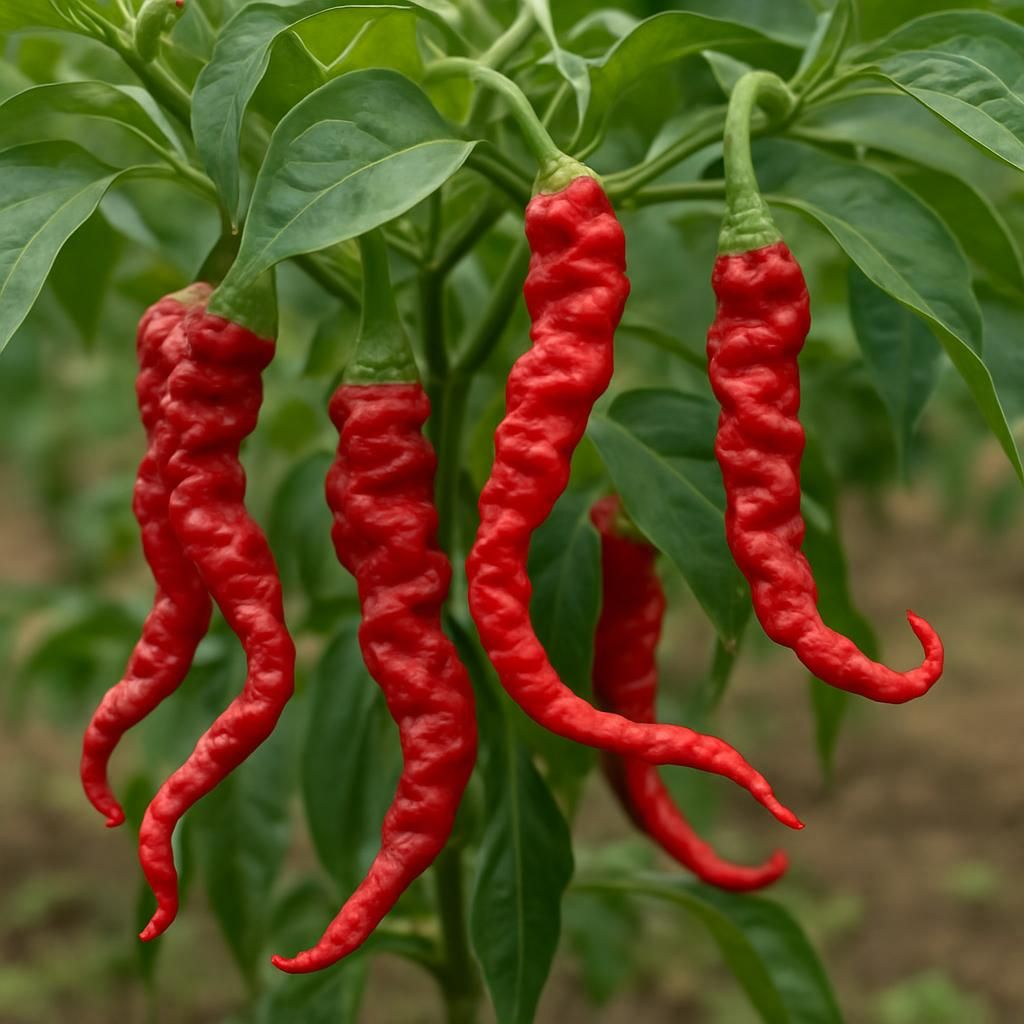
Introduction to Cabe Keriting
Cabe Keriting (Capsicum annuum var. acuminatum) is one of the most economically important chili varieties in Indonesia, valued for its wrinkled, curly pods that deliver both visual appeal and concentrated capsaicin content. Farmers grow it for fresh markets, dried spice production, and the processed-food industry because its thin skin dries rapidly and retains vibrant red color. With proper management, commercial yields of 8–12 tons per hectare are achievable under tropical lowland conditions.
Botanical Profile of Cabe Keriting
Cabe Keriting belongs to the Solanaceae family and exhibits an indeterminate growth habit reaching 60–90 cm in height. The plant produces small white flowers that develop into slender, wrinkled pods 5–8 cm long with a distinctive curled appearance. Fruit color transitions from green to deep red at physiological maturity. The cultivar is day-neutral and sets fruit continuously for 3–4 months under optimal nutrition and irrigation.
Soil, pH, and Climate Requirements for Cabe Keriting
Successful production requires well-drained sandy loam to loam soils with high organic matter. The crop performs best in regions with 24–32 °C daytime temperatures and consistent rainfall or irrigation.
| Parameter | Ideal Range | Notes |
|---|---|---|
| Soil Type | Sandy loam to loam | Good drainage prevents root diseases |
| Soil pH | 5.8–6.8 | Slightly acidic to neutral; lime if below 5.5 |
| Temperature (Day) | 24–32 °C | Optimal fruit set; above 35 °C causes blossom drop |
| Temperature (Night) | 18–24 °C | Maintains flower fertility |
| Annual Rainfall | 1,200–2,000 mm | Even distribution or supplemental irrigation required |
| Altitude | 0–800 m asl | Lowland to mid-elevation tropics |
| Light Requirement | Full sun (≥6 hours) | Partial shade reduces yield and pungency |
Step-by-Step Planting & Propagation
- Seed Treatment: Soak seeds in 1 % potassium nitrate for 12 hours to improve germination uniformity.
- Nursery Phase: Sow in 72-cell trays using sterilized cocopeat-vermicompost mix; maintain 28–30 °C and 70 % humidity. Seedlings emerge in 6–8 days.
- Hardening: Reduce water and expose to full sun 7–10 days before transplanting.
- Field Preparation: Incorporate 15–20 t ha⁻¹ well-decomposed compost plus 200 kg ha⁻¹ NPK 15-15-15 basal dose.
- Transplanting: Move 4–5-week-old seedlings at 4–6 true-leaf stage; spacing 50 cm × 50 cm on raised beds 30 cm high.
- Mulching: Apply 5–7 cm rice-straw mulch immediately after transplanting to conserve moisture and suppress weeds.
Care & Maintenance regimes for Cabe Keriting
Consistent moisture and balanced nutrition are critical during flowering and fruiting. The following schedule supports sustained production while minimizing nutrient runoff.
| Growth Stage | Watering Frequency | Fertilizer Application | Pruning & Training |
|---|---|---|---|
| Transplant–30 DAP | 3–4 L plant⁻¹ every 2 days | 50 kg N ha⁻¹ + 30 kg K₂O at 15 DAP | Remove lower leaves below first branch |
| 30–60 DAP (Vegetative) | Daily drip or furrow irrigation (soil moisture 60–70 %) | 40 kg N + 20 kg P₂O₅ + 30 kg K₂O at 35 DAP | Top at 30 cm to encourage branching |
| 60–90 DAP (Flowering) | Maintain even moisture; avoid water stress | Foliar 1 % calcium nitrate weekly; 30 kg K₂O at 60 DAP | Remove diseased or shaded branches |
| 90–120 DAP (Fruiting) | 4–5 L plant⁻¹ daily during dry spells | Side-dress 20 kg N + 40 kg K₂O every 20 days | Harvest-prune to maintain airflow |
Pests, Diseases & Organic Management
Major threats include Aphids, Thrips, Spider Mites, Fruit and shoot borers, Anthracnose, and Phytophthora. Implement weekly scouting and rotate modes of action.
Organic controls:
- Yellow sticky traps for aphids and whiteflies.
- Neem oil (0.5 %) or spinosad for thrips and borers.
- Bacillus subtilis and copper hydroxide rotations for bacterial and fungal leaf spots.
- Reflective mulch and overhead sprinklers to reduce mite pressure.
- Remove and destroy infected fruit to break anthracnose cycles.
Harvesting, Curing & Optimal Storage
Harvest begins 70–80 days after transplanting when 70–80 % of fruit reach full red color. Pick every 4–5 days during peak season. Cure pods on raised racks with good airflow for 3–5 days to reduce field moisture below 12 %. Store in ventilated crates at 10–12 °C and 85–90 % RH for up to 21 days. For dried spice, sun-dry or use forced-air dryers at 45–50 °C until moisture reaches 8–10 %; vacuum-pack to preserve color and pungency.
Companion Planting for Cabe Keriting
Interplant with Thai Basil and Marigold to repel aphids and nematodes. Pair with Tomato at 1:3 ratio for shared trellising and microclimate benefits. Avoid planting near Eggplant to reduce shared Verticillium wilt pressure. Include Clover as living mulch to fix nitrogen and improve soil structure.
Chili Pepper production principles are further explored in the blog post Summer Companion Planting: 10 Organic Pairings to Boost Small Farm Resilience.