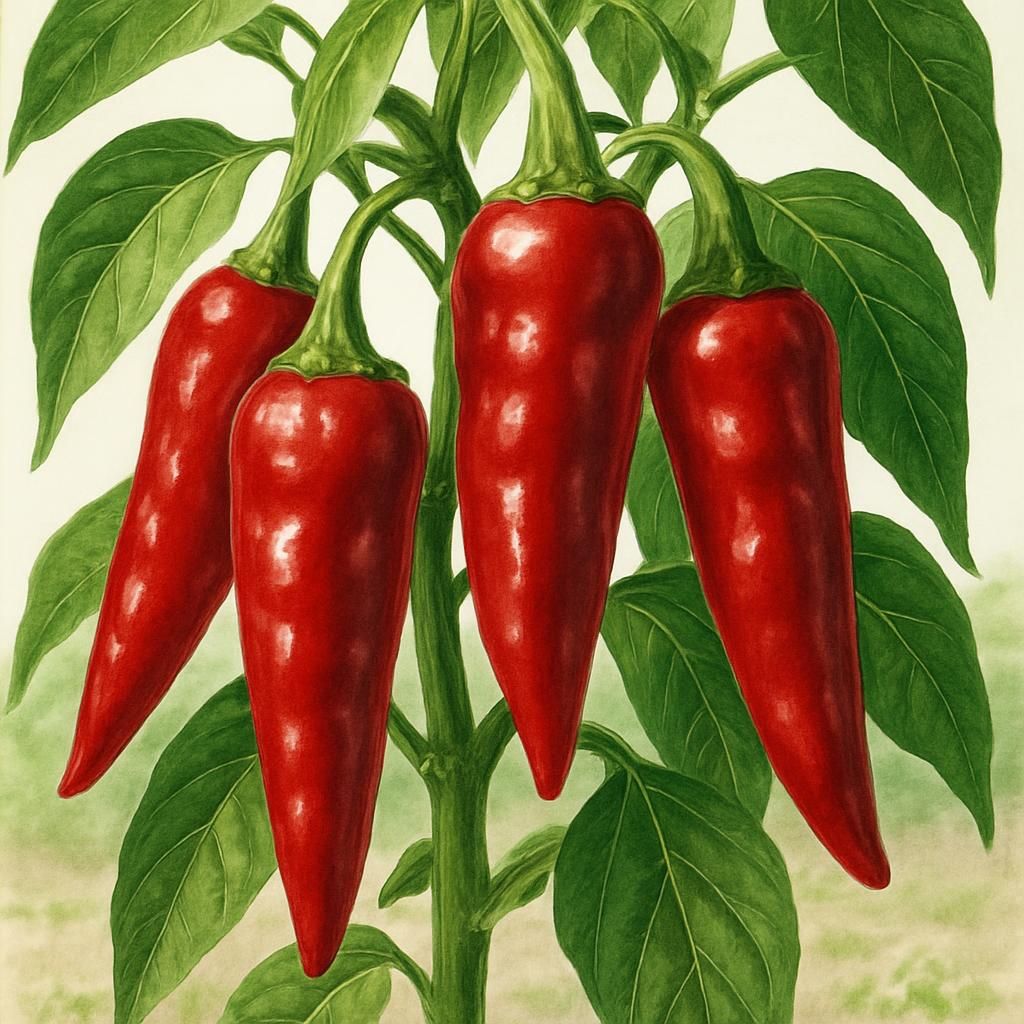
Introduction to Cabe Besar
Cabe Besar, often called “big chili,” is a high-value Capsicum annuum cultivar widely grown in Indonesia, Malaysia, and Thailand. Its elongated, blocky fruits reach 10–15 cm in length with thick, crisp walls and a Scoville rating of 1,000–5,000, making it milder than many local bird’s eye types. Commercial growers favor it for fresh-market sales, drying, and mild chili paste production because the large size reduces labor per kilogram harvested.
The crop performs best when daytime temperatures stay between 24 °C and 30 °C and nights remain above 18 °C. In lowland tropics it can be grown year-round, while higher elevations may require shade nets during peak heat. With proper management, yields of 15–25 t/ha are achievable in well-managed fields.
Botanical Profile of Cabe Besar
Cabe Besar belongs to the Solanaceae family. Plants are indeterminate, reaching 60–90 cm in height with a semi-erect habit. Leaves are ovate-lanceolate, dark green, and slightly pubescent. Flowers are perfect, white with yellow anthers, and self-pollinating, although bees improve fruit set. Fruits are pendant, glossy, and mature from green to bright red in 70–85 days after transplanting. The placenta contains the majority of capsaicinoids, while the pericarp remains relatively mild.
Soil, pH, and Climate Requirements for Cabe Besar
Successful production begins with matching the crop’s physiological needs to site conditions. The following table summarizes ideal parameters.
| Parameter | Ideal Range | Notes |
|---|---|---|
| Soil Type | Sandy loam to loam | Good drainage prevents root diseases |
| Soil pH | 6.0–6.8 | Slightly acidic optimizes nutrient uptake |
| Temperature (Day) | 24–30 °C | Growth slows below 18 °C or above 35 °C |
| Temperature (Night) | 18–22 °C | Prevents blossom drop |
| Rainfall / Irrigation | 600–900 mm evenly distributed | Supplemental drip irrigation recommended |
| Relative Humidity | 60–75 % | Higher humidity favors fungal diseases |
| Altitude | 0–800 m | Shade net useful above 35 °C ambient |
Step-by-Step Planting & Propagation
- Seed Treatment: Soak seeds in 1 % potassium nitrate for 24 hours to improve germination uniformity.
- Nursery Phase: Sow in 128-cell trays using sterilized cocopeat-vermiculite mix. Maintain 28 °C soil temperature; seedlings emerge in 5–7 days.
- Hardening: Reduce water and expose seedlings to full sun 7–10 days before transplanting.
- Field Preparation: Raise beds 20–25 cm high and 80 cm wide. Incorporate 15 t/ha well-rotted manure plus 200 kg/ha rock phosphate.
- Transplanting: Set seedlings at 4–5 true-leaf stage, 50 cm between plants and 60 cm between rows (double-row beds). Plant in late afternoon to reduce transplant shock.
- Mulching: Apply 5 cm rice-straw mulch immediately after transplanting to conserve moisture and suppress weeds.
Care & Maintenance regimes for Cabe Besar
Consistent nutrition and water management drive both yield and fruit quality. The schedule below provides a practical weekly framework.
| Week After Transplant | Watering Schedule | Fertilizer (NPK) | Pruning & Training |
|---|---|---|---|
| 1–2 | Light daily irrigation 3–4 L/plant | 10-20-10 at 50 kg/ha | Remove basal shoots |
| 3–4 | Every 2 days, 6–8 L/plant | Side-dress 15-15-15 at 80 kg/ha | Top at 4th node to encourage branching |
| 5–8 | Drip 10–12 L/plant every 2 days | 15-15-15 at 100 kg/ha + 20 kg K₂SO₄ | Remove suckers below first fork |
| 9–12 | 12–15 L/plant every 3 days | 12-12-17 at 120 kg/ha | Light leaf pruning for airflow |
| 13–harvest | Reduce to 8 L/plant every 3 days | Foliar calcium nitrate 2 % weekly | Remove diseased leaves only |
Pests, Diseases & Organic Management
Major insect threats include Aphids, Thrips, and Spider Mites. Weekly scouting and yellow sticky traps at 20 traps/ha provide early detection. Release predatory mites (Phytoseiulus persimilis) at 2 mites/m² when spider mite counts exceed 5 per leaf. For thrips, apply neem oil (0.5 %) + 0.1 % wetting agent every 7–10 days.
Common diseases are Anthracnose, Phytophthora, and Bacterial spot. Prevent soil-borne pathogens by using raised beds and crop rotation with Rice or Corn. Copper hydroxide (2 g/L) combined with mancozeb (2 g/L) applied at first fruit set offers effective organic-compatible control when alternated with Bacillus subtilis sprays.
Harvesting, Curing & Optimal Storage
Harvest green Cabe Besar at 65–70 days or wait until full red color develops (80–85 days) for higher capsaicin and market premium. Pick every 4–5 days using scissors to avoid stem damage. Sort fruit immediately: discard any with sunscald or insect scars. For fresh market, hydro-cool to 10 °C within 2 hours of harvest.
Curing for drying: spread single-layer on racks in a shaded, well-ventilated shed at 28–32 °C and 55 % RH for 5–7 days until moisture drops to 12 %. Store dried pods in hermetic bags with oxygen absorbers at 15 °C to maintain color and pungency for up to 12 months.
Companion Planting for Cabe Besar
Interplant with Thai Basil to repel aphids and improve flavor perception. Rows of Marigold every fifth bed suppress nematodes and attract pollinators. Avoid planting near Eggplant or Tomato to reduce shared disease pressure. Leguminous cover crops such as sunn hemp sown after final harvest restore soil nitrogen and break pest cycles.
For further reading on companion planting strategies, see Summer Companion Planting: 10 Organic Pairings to Boost Small Farm Resilience. Additional technical details on Capsicum cultivation can be found on the Chili Pepper wiki page.