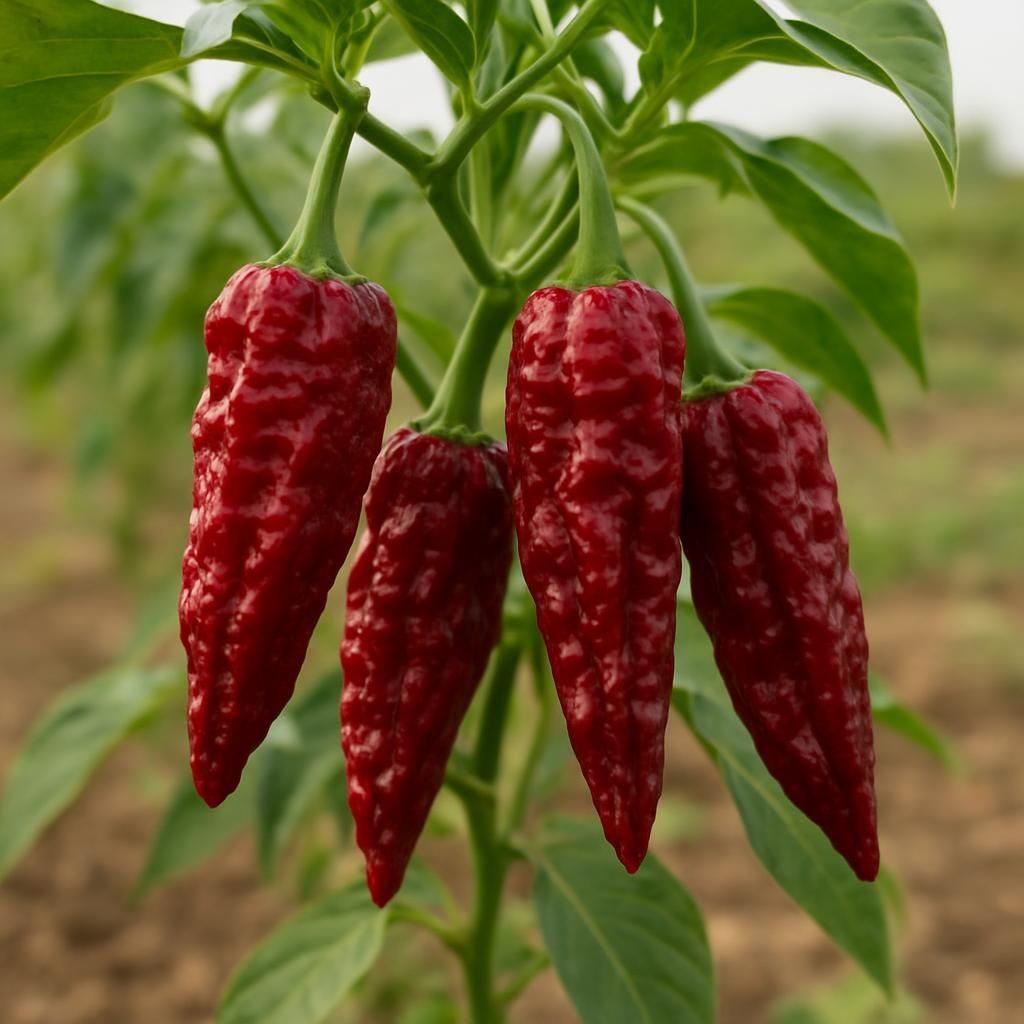
Introduction to Byadgi Chili
Byadgi Chili (Capsicum annuum var. Byadgi) is a signature crop of Karnataka, India, valued worldwide for its brilliant red hue and mild heat (Scoville Heat Units typically 8,000–15,000). Unlike hotter varieties, Byadgi is cultivated primarily for its color and flavor rather than pungency, making it indispensable in the production of high-grade chili powder, oleoresin, and natural food dyes. The variety is grown on over 80,000 hectares in Haveri, Dharwad, and Gadag districts, contributing significantly to both domestic spice exports and farmer incomes.
Farmers appreciate Byadgi for its drought tolerance once established and its ability to produce two crops per year in the right micro-climates. The first (kharif) crop is sown in June–July and harvested in October–November; the second (rabi) crop is planted in October–November and harvested in February–March. Average dry pod yields range from 1.5–2.5 t/ha under rainfed conditions and 3.0–4.0 t/ha with supplemental irrigation and balanced nutrition.
Botanical Profile of Byadgi Chili
The plant is an indeterminate, bushy annual reaching 60–90 cm in height with a spreading habit. Leaves are ovate-lanceolate, dark green, and slightly pubescent. Flowers are small, white, and solitary or in clusters of 2–3 at each node. Fruits are long (8–12 cm), slender, and wrinkled at maturity, turning deep scarlet-red when fully ripe. The thin pericarp and low capsaicin content give the variety its characteristic mild flavor and intense color. Seeds are cream-colored and number 80–120 per fruit.
Soil, pH, and Climate Requirements for Byadgi Chili
Byadgi Chili performs best on well-drained red loamy or black cotton soils with good organic matter. Heavy clay soils should be amended with sand or raised beds to prevent waterlogging. The crop is sensitive to salinity; electrical conductivity should remain below 1.5 dS/m.
| Parameter | Ideal Range | Notes |
|---|---|---|
| Soil Type | Red loamy / Black cotton | Well-drained, medium texture |
| Soil pH | 6.0–7.5 | Slightly acidic to neutral |
| Temperature (Day) | 25–35 °C | Optimal fruit set 28–32 °C |
| Temperature (Night) | 18–22 °C | Below 15 °C reduces fruit set |
| Annual Rainfall | 600–900 mm | Supplemental irrigation needed if <600 mm |
| Relative Humidity | 60–80 % | High humidity favors disease |
| Altitude | Up to 800 m | Best color development at 400–700 m |
Step-by-Step Planting & Propagation
- Seed Selection & Treatment: Use certified seed of high-color Byadgi strains. Treat with 2 g carbendazim + 3 g mancozeb per kg seed or hot-water treatment at 52 °C for 30 minutes.
- Nursery Preparation: Sow in raised beds (1 m × 3 m) or portray trays using a 1:1:1 mix of red soil, sand, and well-rotted FYM. Sow 1 cm deep; maintain 25–30 °C for 70–85 % germination in 7–10 days.
- Seedling Hardening: Reduce watering 7–10 days before transplanting; apply 0.5 % urea spray once at 20 days after sowing.
- Land Preparation: Plough 3–4 times, incorporate 10–15 t/ha FYM or compost. Form ridges and furrows 60 cm apart or raised beds 90–120 cm wide.
- Transplanting: 35–40-day-old seedlings with 4–5 true leaves are transplanted at 60 cm × 45 cm spacing (rainfed) or 60 cm × 30 cm (irrigated). Plant in the evening and irrigate immediately.
Care & Maintenance regimes for Byadgi Chili
Consistent moisture during flowering and fruit development is critical. Avoid water stress during fruit set and waterlogging at any stage. Fertilizer schedules should be adjusted based on soil tests; a general recommendation for medium-fertility soils follows.
| Stage | Water (mm/week) | Fertilizer (NPK kg/ha) | Pruning / Training |
|---|---|---|---|
| Transplant–Flowering | 25–30 | 40 N : 30 P₂O₅ : 20 K₂O | Remove basal branches up to 15 cm |
| Flowering–Fruit Set | 35–40 | 30 N : 15 P₂O₅ : 30 K₂O | Light tipping of growing tips |
| Fruit Development | 30–35 | 20 N : 10 P₂O₅ : 40 K₂O | Remove diseased leaves |
| Maturity & Harvest | 20–25 | Foliar 1 % KNO₃ twice | None |
Mulch with 5–7 cm paddy straw or plastic mulch to conserve moisture and suppress weeds. Earthing up at 45 and 75 days improves root anchorage.
Pests, Diseases & Organic Management
Major insect pests include Aphids, Thrips, Spider Mites, and Helicoverpa species. Diseases of concern are Chili leaf curl disease, Anthracnose, Powdery mildew, and Fusarium wilt.
Organic control begins with healthy seedlings and crop rotation. Yellow sticky traps at 20–25 per hectare monitor aphids and whiteflies. Spray neem oil (3 ml/L) or pongamia oil every 10–12 days during vegetative growth. For mites, release predatory mites (Phytoseiulus persimilis) or spray 2 % neem + garlic extract. For anthracnose and powdery mildew, apply 0.5 % wettable sulfur or Pseudomonas fluorescens (10 g/L) at 15-day intervals. Remove and destroy infected fruits and practice deep summer ploughing to reduce soil-borne inoculum.
Harvesting, Curing & Optimal Storage
Harvest when pods turn fully red but still retain slight flexibility (90–110 days after transplanting). Pick in the morning and avoid bruising. Sun-dry pods on clean tarpaulins or raised platforms for 6–8 days until moisture reaches 10–12 %. Turn pods 3–4 times daily for uniform drying. For premium color retention, dry in solar dryers at 45–50 °C. Store dried pods in jute bags lined with polythene or in hermetic cocoons at <65 % RH. Grading by color and size before packing increases market value by 20–30 %.
Companion Planting for Byadgi Chili
Intercrop with Marigold and Coriander to repel nematodes and aphids while attracting beneficial insects. Border rows of Sesame or Sunflower act as trap crops for thrips and jassids. Avoid planting near Tomato or Eggplant to reduce shared viral and wilt pressures. Leguminous cover crops such as Cowpea or Black Gram in rotation improve soil nitrogen and break disease cycles.
For more on timing harvests for maximum color and price, see The Overlooked Art of Seasonal Harvest Timing for Small Farm Profit.