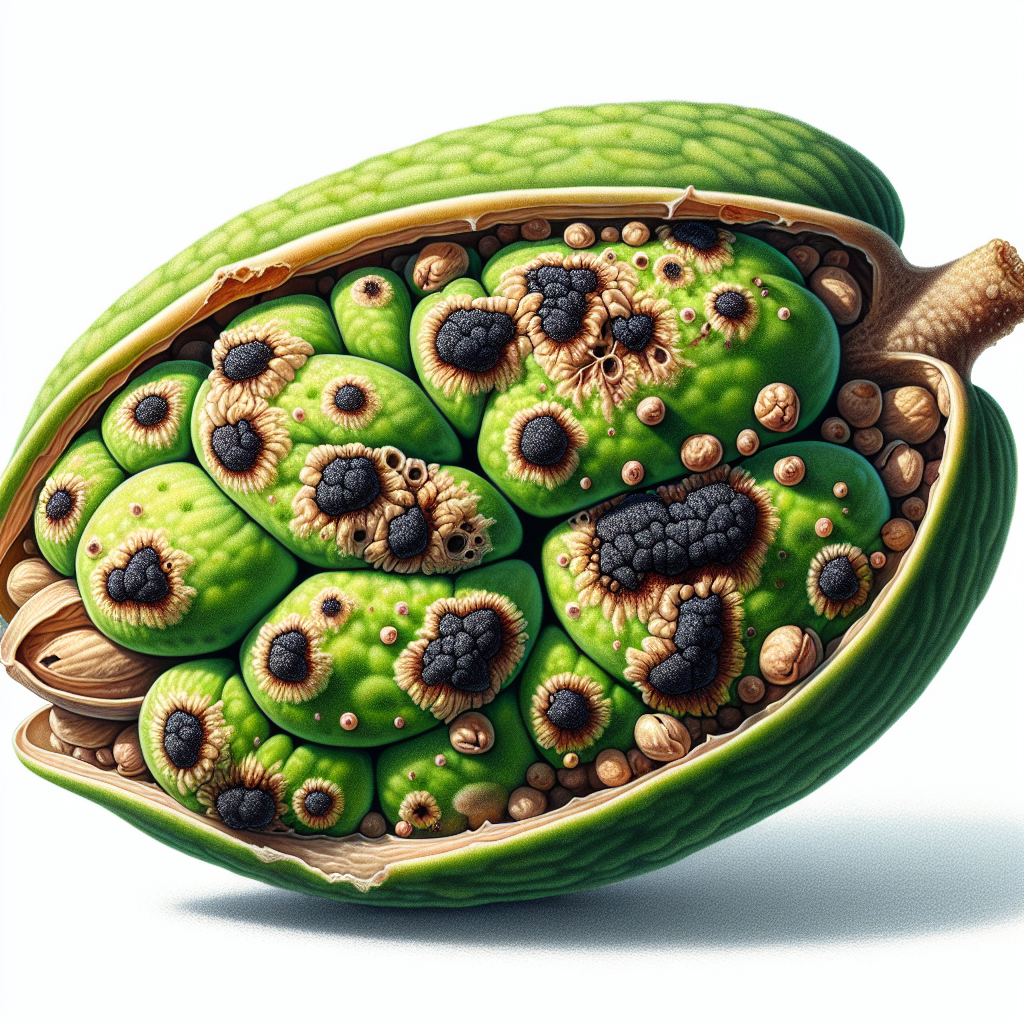
Introduction to husk spot
Husk spot, scientifically known as a disease caused by Phomopsis pistaciae, represents one of the most economically damaging fungal pathogens in pistachio orchards worldwide. This disease targets the husk—the outer fleshy layer enveloping the pistachio nut—leading to characteristic dark, necrotic spots that compromise nut development and marketability. First identified in California pistachio groves in the 1980s, husk spot has since spread to major production regions including Iran, Turkey, and Australia, where pistachio cultivation supports billions in agricultural revenue.
The pathogen thrives in warm, humid conditions typical of pistachio-growing areas, infecting through wounds or natural openings during bloom and nut set. Unlike many foliar diseases, husk spot directly impacts harvestable yield by causing premature husk splitting and nut abscission, often resulting in 20-50% losses in severe epidemics. Early detection is crucial, as infected husks produce pycnidia—fungal fruiting bodies—that release spores to perpetuate the disease cycle. This guide provides comprehensive diagnostic criteria, lifecycle insights, and proven management strategies to help growers protect their crops. Understanding husk spot's biology empowers farmers to implement integrated pest management (IPM) approaches, minimizing chemical inputs while maximizing nut quality and profitability.
Identifying Symptoms & Damage
Recognizing husk spot early is essential for limiting spread. Initial symptoms appear 4-6 weeks after petal fall as small, water-soaked spots on the husk surface, typically 2-5 mm in diameter. These lesions expand rapidly into irregular, dark brown to black necrotic areas with a yellowish halo, often coalescing to cover large portions of the husk. Advanced infection causes the husk to split prematurely, exposing the shell and leading to nut drop. Severely affected nuts may show internal discoloration, though the kernel often remains viable if harvested promptly.
Damage assessment reveals husk spot's dual impact: direct yield loss from dropped nuts and quality degradation in retained crop. Infected husks become leathery and brittle, complicating mechanical harvest and increasing debris in processing. Secondary issues include sooty mold growth on exuding sap and heightened susceptibility to hull-rot, exacerbating losses. Visual scouting during shell split (mid-July in California) is critical—check 100 nuts per tree from 20 trees per block, focusing on lower canopy where humidity persists. Confirm diagnosis via lab culture: isolate Phomopsis pistaciae from lesion margins on potato dextrose agar, where it produces alpha-conidia in pycnidia. Differentiate from bacterial blight by absence of oozing gum and from Alternaria spot by lesion morphology—Phomopsis lesions lack concentric rings. Economic thresholds hover at 5-10% incidence pre-harvest, triggering immediate action.
Lifecycle and Progression of husk spot
Phomopsis pistaciae follows a polycyclic lifecycle synchronized with pistachio phenology. Primary inoculum overwinters in infected husks, mummies, and branch cankers, releasing pycnidiospores during spring rains (March-April). These conidia splash-disperse to blossoms and developing nuts, germinating in free water at 15-30°C. Infection occurs via stomata or wounds, with latent periods of 2-4 weeks before symptoms emerge.
Secondary cycles amplify during summer, as new pycnidia form in expanding lesions, producing conidia amid dew or irrigation. Optimal sporulation happens at 25°C with 12+ hours leaf wetness. By hull split, 80% of epidemic progression occurs, with spores spreading via wind, rain, and machinery. Disease progression models (e.g., based on temperature and wetness duration) predict peaks: fast-track (14 days to symptoms at 28°C) vs. slow-track (35 days at 18°C). Overwinter survival exceeds 70% in buried husks, underscoring sanitation's role. Understanding this lifecycle informs timing: protect during early nut fill (May-June) when inoculum builds.
Environmental Triggers & Risk Factors
Husk spot epidemics correlate strongly with environmental cues. High humidity (>80% RH) and temperatures of 20-28°C during nut development drive infection—conditions prevalent in San Joaquin Valley fog belts or irrigated orchards. Prolonged leaf wetness from overhead irrigation or poor canopy airflow accelerates spore germination, with 48-hour durations tripling disease severity. Soil moisture excess promotes splash dispersal, linking deficit irrigation avoidance to risk reduction.
Risk factors amplify vulnerability: dense canopies from excessive nitrogen foster microclimates; wounding from shothole borers or mechanical injury provides entry points. Susceptible cultivars like 'Kerman' suffer 2x losses vs. resistant selections. Prior crop stress—drought, Phytophthora root rot, or nutrient imbalance—compromises defense, with potassium-deficient trees showing 30% higher incidence. Regional patterns emerge: coastal California faces early outbreaks from marine fog, while inland sites peak post-heatwave rains. Monitor via weather stations; disease forecasting apps integrate wetness hours and temperature to issue alerts, enabling preemptive sprays.
Organic Control & Treatment Plans
Organic management emphasizes cultural, biological, and minimal-intervention tactics. Start with sanitation: post-harvest, flail chop and disk infected husks to reduce overwintering inoculum by 90%. Promote airflow via 8-10 ft between-tree spacing and summer pruning—remove 20-30% interior growth. Copper-based fungicides (e.g., fixed copper at 4-6 lbs/acre) applied at 50% bloom and nut set provide 70-85% control; rotate with Bacillus subtilis for resistance avoidance. Timing aligns with phenology: first spray at petal fall, second 14-21 days later during early husk swell.
Biologicals like Trichoderma harzianum suppress soil inoculum; apply as drench pre-bloom. Companion planting marigold borders deters vectors via nematocidal roots. For active outbreaks, potassium bicarbonate sprays (3-5 lbs/100 gal) offer curative action, penetrating latent infections. Scout weekly; at 2% incidence, deploy. Integrate with blog insights on Spring Pest Patrol: Organic AI Strategies to Shield Your Crops from Common Invaders for tech-enhanced monitoring. Track efficacy: pre/post spray ratings ensure ROI. Organic yields match conventional with diligent IPM, sustaining certification while cutting costs 25%.
Preventing husk spot in the Future
Long-term prevention builds resilient orchards. Select resistant rootstocks and scions—'Golden Hills' shows 50% less severity than 'Kerman'. Optimize irrigation: micro-sprinklers minimize wetness vs. flood systems. Soil testing guides balanced nutrition; maintain 1.5-2% leaf K to bolster husk integrity. Annual sanitation removes 95% inoculum—burn or bury debris >500 ft from orchards.
Resistant cultivar programs and early-maturing varieties shorten exposure windows. Biofumigation with mustard cover crops releases isothiocyanates suppressing Phomopsis. Monitor via sticky traps for correlated thrips activity, as wounding synergizes infection. Consult extension services for regional models; forecast-driven prevention slashes sprays 40%. Future-proof via diversification—intercrop with clover for soil health, buffering monoculture risks. Annual audits track progress, ensuring husk spot remains sub-economic.
Crops Most Affected by husk spot
Pistachio (Pistacia vera) reigns as the primary host, with 'Kerman' on 'UCB-1' rootstock most vulnerable in commercial settings like Kerman Pistachio. Wild pistachios (P. atlantica) serve as reservoirs. Minor reports link to almond husks under wet conditions, though rarely economic. No significant spread to other nuts like walnut or pecan. Focus protection on pistachio blocks, isolating from feral trees.