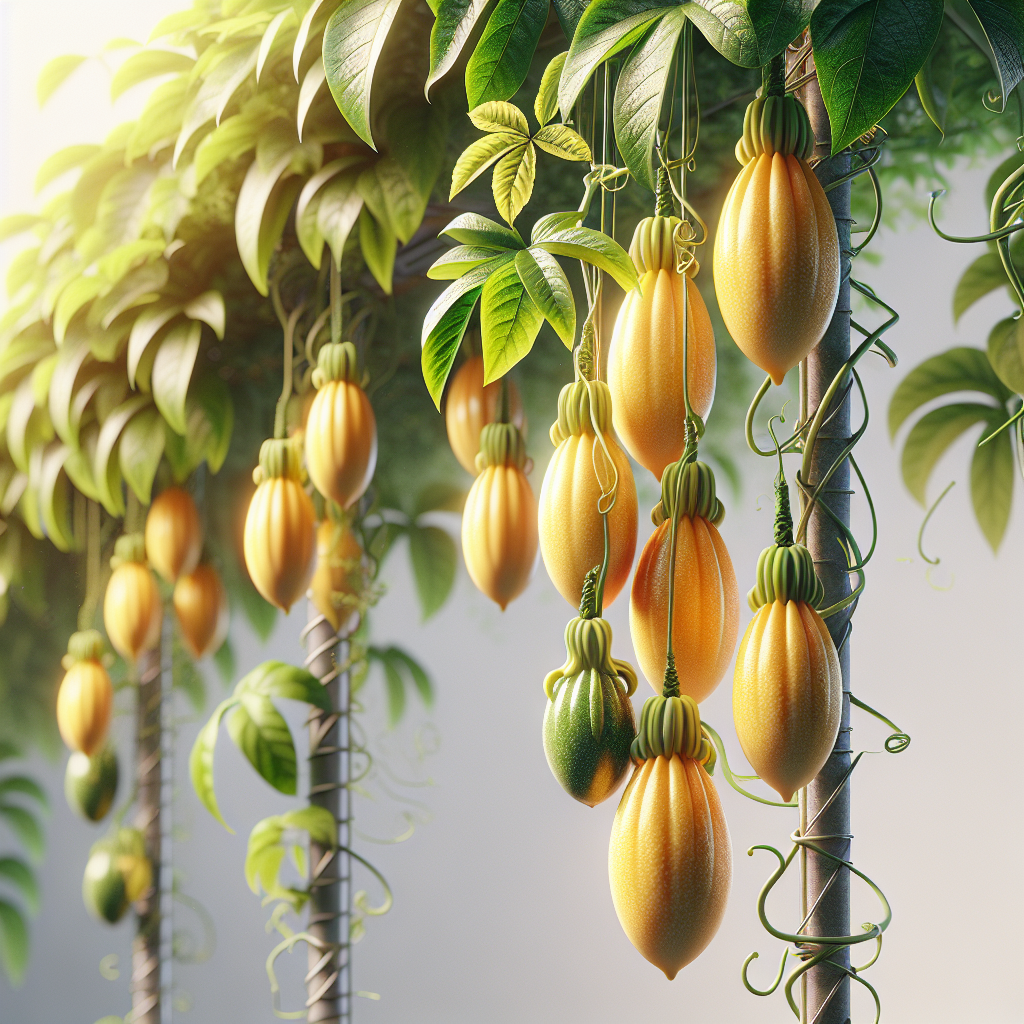
Introduction to Banana Passion Fruit (Passiflora tarminiana)
Banana Passion Fruit, scientifically known as Passiflora tarminiana, is a captivating subtropical vine native to the Andean regions of South America, particularly Ecuador, Colombia, and Peru. Unlike its more common relative, the purple passion fruit (Passiflora edulis), this species produces distinctive elongated, yellow-orange fruits resembling small bananas, typically 10-15 cm long. The fruits boast a tough, leathery skin enclosing juicy, seed-filled pulp with a uniquely sweet-tart flavor profile blending pineapple, banana, and citrus notes—ideal for fresh eating, juices, desserts, and even commercial processing.
This fast-growing perennial climber can reach 10-15 meters in height with robust support, making it perfect for arbors, trellises, or fences in home gardens and small-scale farms. It's increasingly popular in subtropical and tropical agriculture due to its high productivity (up to 50-100 kg per vine annually), disease tolerance, and adaptability to various soils. Growers appreciate its ornamental value too, with large, fragrant flowers featuring white petals, green bracts, and striking blue coronas that attract pollinators. For small farms, it represents a low-input crop with excellent market potential in health food markets, offering returns far superior to many annual fruits. Successful cultivation hinges on providing ample sun, support, and protection from frost, yielding fruits year-round in ideal conditions.
Botanical Profile of Banana Passion Fruit (Passiflora tarminiana)
Passiflora tarminiana belongs to the Passifloraceae family, characterized by its tendril-climbing habit and hermaphroditic flowers. The vine's stems are thick, woody at the base, with three-lobed leaves up to 15 cm long, covered in fine hairs. Flowers emerge year-round but peak in spring-summer, measuring 8-10 cm across with a white-green perianth and intricate blue-white filaments forming the corona—a beacon for bees and butterflies.
Fruits develop 2-3 months post-pollination, hanging in clusters from long peduncles. Immature fruits are green, ripening to glossy yellow-orange over 60-90 days. Each fruit contains 200-400 black seeds embedded in translucent, gelatinous arils bursting with flavor (Brix 14-18°). Nutritionally, it's a powerhouse: high in vitamin C (30-50 mg/100g), A, potassium, and fiber, with antioxidants like beta-carotene and polyphenols. The plant is mostly self-incompatible, benefiting from cross-pollination with Passiflora mollissima or hand-pollination for superior yields. It's cold-hardy to about -2°C briefly but thrives in USDA zones 9-11. Vines live 5-10 years productively, with pruning rejuvenating older specimens. For comparison, it's similar to Banana (crop) in tropical affinity but far easier for vertical spaces.
Soil, pH, and Climate Requirements for Banana Passion Fruit (Passiflora tarminiana)
Banana Passion Fruit demands well-drained, fertile soils rich in organic matter—loamy or sandy loams with 20-30% organic content perform best. Avoid heavy clays prone to waterlogging, which invite root rot. Optimal pH is 6.0-7.5; test soil and amend with lime for acidity below 6.0 or sulfur for alkalinity above 7.5. Incorporate compost or aged manure at 5-10 kg/m² pre-planting to boost microbial activity and nutrient retention.
Climatically, it flourishes in subtropical to tropical zones with average temperatures 18-28°C, tolerating brief dips to 10°C but suffering below 5°C. Full sun (6-8+ hours daily) is essential for fruit sweetness and vine vigor; partial shade reduces yields by 30-50%. Annual rainfall of 1000-2000 mm suits it, supplemented by 20-30 mm weekly irrigation during dry spells—drip systems prevent foliar wetting. High humidity (60-80%) aids flowering, but excellent drainage counters fungal risks. Wind protection is crucial for young vines; mature plants withstand moderate gusts. In marginal climates, use frost cloth or greenhouses. Mulch with 10 cm organic matter conserves moisture and suppresses weeds. For heatwave resilience, see Why Summer Heatwaves Are Silently Killing Small Farm Yields - And 7 Organic Strategies to Fight Back. Pair with Guava (crop) for similar tropical setups.
Step-by-Step Planting & Propagation
Propagation
Seed propagation is straightforward: extract seeds from ripe fruit, wash off arils, and sow fresh in 72-cell trays with seed-starting mix. Germination occurs in 2-4 weeks at 25-30°C under mist. Scarify seeds or use gibberellic acid for 80%+ rates. Cuttings (20-30 cm semi-hardwood) root in 4-6 weeks under high humidity with bottom heat. Grafting onto P. edulis rootstock enhances vigor.
Planting
Plant in early spring after frost risk. Space vines 3-4 m apart along sturdy trellises (T-posts with wires at 1.5m, 2m heights). Dig 50x50x50 cm holes, fill with 40% compost-soil mix. Set crowns 5-10 cm below soil, water deeply. For containers, use 50-100L pots with trellis support. Initial fertilizer: 10-10-10 NPK at 50g/plant. Train leaders vertically, prune laterals to 4-6 nodes. Expect first fruits in 12-18 months from seeds, 6-12 from cuttings.
Care & Maintenance regimes for Banana Passion Fruit (Passiflora tarminiana)
Water consistently to keep soil moist but not soggy—deficit irrigation boosts flavor but risks fruit drop. Fertilize monthly during growth with 20-10-20 (high N-P) at 50g/vine, switching to 10-30-20 bloom-booster. Prune annually post-harvest: remove 30-50% old canes to promote airflow and new fruiting wood. Thin clusters to 4-6 fruits for size. Mulch refreshes yearly. Monitor for nutrient deficiencies: yellow leaves signal nitrogen lack; treat with foliar sprays. Support structures must bear 50+ kg loads. In cooler zones, protect roots with 20 cm mulch. Yields peak years 3-5; rejuvenate by cutting to 1m stumps.
Pests, Diseases & Organic Management
Common pests include aphids, mealybugs, spider mites, and swallowtail larvae—blast with neem oil or introduce ladybugs. Leafminers and thrips respond to yellow sticky traps and spinosad. For diseases, watch powdery mildew, anthracnose, and fusarium wilt; ensure airflow and apply copper fungicide. Organic IPM: companion plant marigold for nematodes, use Bt for caterpillars. Check Why 90% of Small Farms Fail at Pest Management - And 8 Organic Fixes That Actually Work for strategies.
Harvesting, Curing & Optimal Storage
Harvest when fruits yellow fully and detach easily (color break stage), typically 60-90 days post-bloom. Twist or clip with shears; yield 20-50 fruits/vine weekly in season. Handle gently to avoid skin cracks. No curing needed—store at 10-15°C, 85-90% RH for 4-6 weeks. Refrigerate ripe fruits 7-10 days. Pulp freezes well for juices. Market fresh or process into puree.
Companion Planting for Banana Passion Fruit (Passiflora tarminiana)
Pair with nitrogen-fixers like pigeon pea for soil enrichment, thyme or nasturtium for pest repulsion. Avoid water-hungry corn. Thai Basil (crop) deters aphids; yarrow boosts pollinators. Vertical layering with low-growers like strawberries maximizes space.