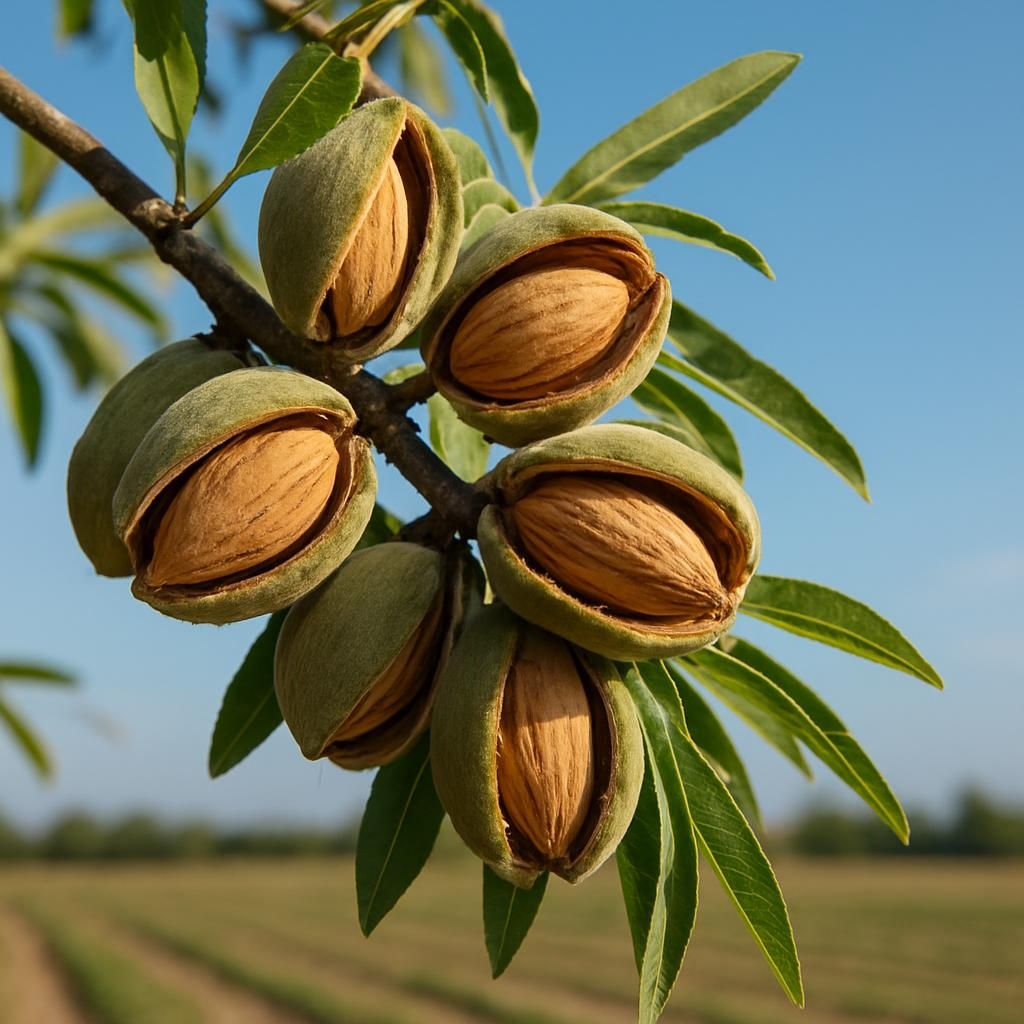
Introduction to Almond (Monterey)
The Monterey almond cultivar (Prunus dulcis 'Monterey') is a late-blooming, high-kernel-quality variety developed for California’s Central Valley. Its late flowering reduces frost risk compared with earlier cultivars such as Nonpareil, while its vigorous growth and consistent yields make it a reliable choice for both large orchards and smaller plantings. The tree produces large, well-filled kernels with a smooth, light-colored skin that commands strong market prices for both whole-nut and processing channels.
Botanical Profile of Almond (Monterey)
Monterey belongs to the Rosaceae family and is botanically a drupe whose outer hull splits at maturity to reveal the hard shell containing the edible seed. Trees reach 15–25 ft (4.5–7.5 m) at maturity with an upright-spreading canopy that benefits from annual pruning to maintain light penetration. Flowers are self-incompatible; cross-pollination with a compatible cultivar such as Nonpareil Almond or Mission Almond is essential. Leaves are lanceolate, glossy green, and deciduous; fruit development follows a classic double-sigmoid growth curve typical of stone fruit.
Soil, pH, and Climate Requirements for Almond (Monterey)
Monterey almonds perform best on deep, well-drained sandy loam to loam soils with good water-holding capacity yet rapid drainage to prevent root diseases. The cultivar tolerates a wide pH range but yields peak between 6.5 and 8.0. Climate must supply 400–600 chilling hours and a long, hot, dry summer; winter rainfall or irrigation must be supplemented to meet 3.5–4.0 acre-feet of water annually in arid regions.
| Parameter | Ideal Range | Notes |
|---|---|---|
| Soil Texture | Sandy loam to loam | Avoid heavy clays without drainage tiles |
| Soil pH | 6.5–8.0 | Lime if below 6.0 |
| Soil Depth | ≥ 4 ft (1.2 m) | Prevents waterlogging and root restriction |
| USDA Hardiness | Zones 7–9 | Protect young trees from temperatures <15 °F |
| Chill Hours | 400–600 | Late bloom reduces frost damage |
| Growing Season Temp. | 75–95 °F (24–35 °C) daytime | Requires long, hot, dry summers |
| Annual Water Need | 42–48 inches (107–122 cm) | ET-based scheduling recommended |
Step-by-Step Planting & Propagation
- Site Selection: Choose a location with full sun, good air drainage, and protection from prevailing winds. Conduct soil tests for pH, salinity, and nematodes.
- Land Preparation: Rip to 3–4 ft depth, incorporate 10–15 tons/acre of well-rotted compost, and level for flood or drip irrigation.
- Planting Density: Standard spacing is 18–22 ft between rows and 14–18 ft within rows (120–170 trees/acre). High-density hedgerow systems use 12–14 ft × 6–8 ft.
- Nursery Stock: Use certified disease-free, bare-root or potted one-year whips grafted on peach-almond hybrid rootstocks such as 'Hansen 536' or 'Bright’s Hybrid 5'.
- Planting Window: Late fall to early winter (Nov–Jan) in Mediterranean climates; early spring in colder regions after soil thaws.
- Planting Technique: Dig holes twice the root-ball width, set graft union 2–3 inches above grade, backfill with native soil, and water in thoroughly.
- Initial Training: Head the whip at 36–40 inches to encourage scaffold selection; install drip emitters within 12 inches of the trunk.
Care & Maintenance regimes for Almond (Monterey)
Consistent irrigation, balanced nutrition, and timely pruning are the three pillars of Monterey almond management. Use pressure-bomb or soil-moisture sensors to maintain midday stem water potential above –1.5 MPa during kernel fill. Fertigation programs should supply 150–200 lbs N, 40–60 lbs P₂O₅, and 150–250 lbs K₂O per acre annually, split across 4–6 applications. Pruning focuses on renewal of fruiting wood and canopy light management.
| Season | Water (ETc inches/week) | Fertilizer (N-P-K lbs/acre) | Pruning Action |
|---|---|---|---|
| Dormant | 0 | 0 | Remove dead/diseased wood; select scaffolds |
| Bloom–Petal Fall | 0.8–1.0 | 40-20-40 | None; avoid wounding |
| Nut Growth | 1.2–1.5 | 60-0-80 | Light tipping of vigorous shoots |
| Kernel Fill | 1.5–1.8 | 60-0-80 | Remove crossing/rubbing branches |
| Pre-Harvest | 1.0–1.2 | 0 | None |
| Post-Harvest | 0.6–0.8 | 40-20-50 | Structural pruning; hedging if needed |
Pests, Diseases & Organic Management
Key pests include Navel orangeworm, peach twig borer, and mites. Diseases of concern are hull rot, Alternaria leaf spot, and Phytophthora root rot. Implement integrated pest management: monitor with pheromone traps, release Trichogramma wasps for navel orangeworm, and apply Bacillus thuringiensis during petal fall for peach twig borer. Maintain orchard sanitation by flailing mummies and removing dropped nuts. For mites, predatory mites and overhead sprinklers for humidity spikes provide effective biological control.
Harvesting, Curing & Optimal Storage
Monterey almonds reach physiological maturity 180–200 days after full bloom when hulls split and kernels reach 5–6 % moisture. Shake trees with commercial trunk or limb shakers when 100 % of hulls have split; sweep and pick up nuts within 24–48 hours to minimize soil contamination. Field-dry on tarps or in windrows to 8–10 % moisture, then deliver to a huller or processor. For on-farm storage, cool nuts to 40 °F (4 °C) at 65–70 % RH in sealed bins or silos with aeration to preserve kernel quality for 12–18 months.
Companion Planting for Almond (Monterey)
Plant low-growing legumes such as clover or hairy vetch between tree rows to supply 40–60 lbs N/acre and improve soil structure. Flowering strips of yarrow, thyme, or marigold attract beneficial insects that suppress aphids and mites. Avoid planting tomato or potato near almonds because of shared susceptibility to Verticillium wilt. Tall windbreaks of olive or pistachio on orchard borders reduce wind damage and evapotranspiration without competing for water when properly spaced.