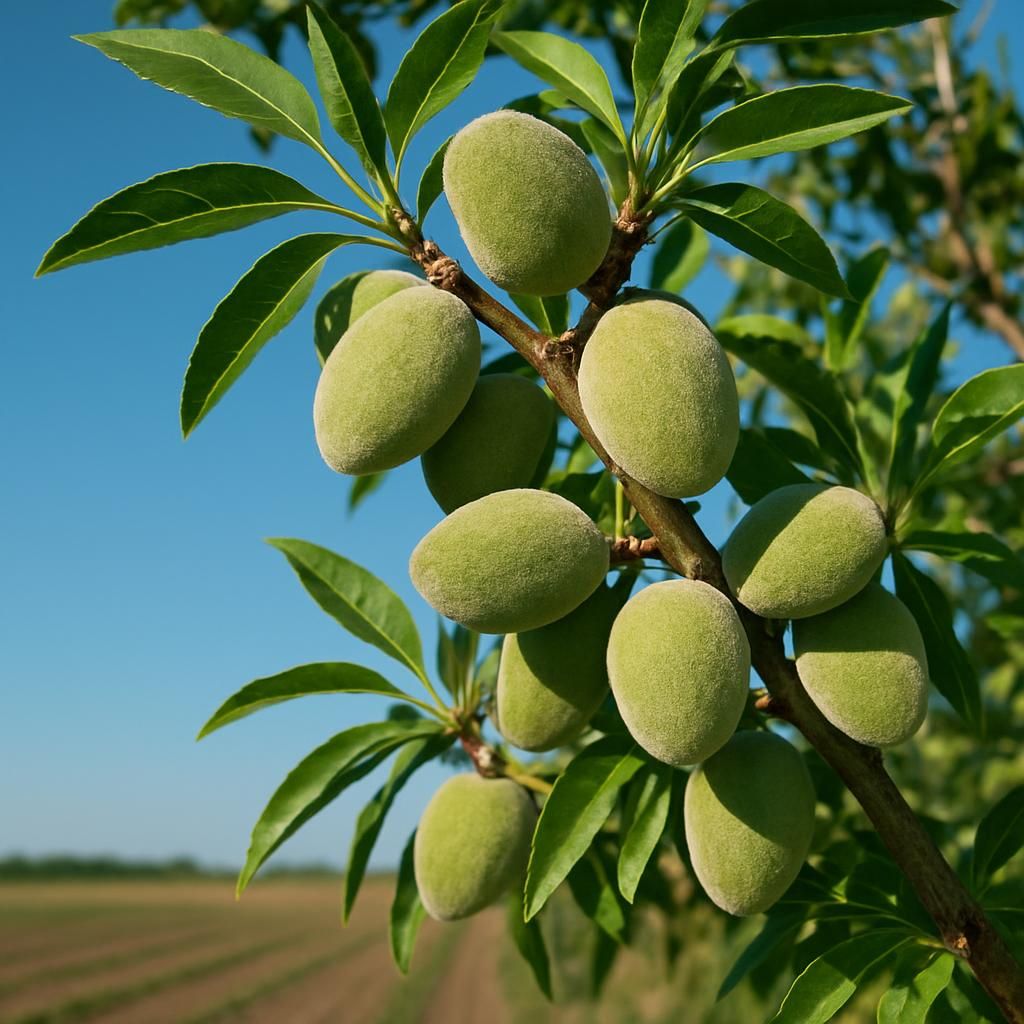
Introduction to Almond (Fritz)
Fritz is a late-blooming almond cultivar developed for regions where spring frosts threaten early-flowering varieties. Growers choose Fritz for its large, uniform kernels, high crack-out percentage, and strong market demand. The variety combines good productivity with relatively late flowering, reducing frost risk compared to earlier cultivars such as Nonpareil Almond.
Commercial producers value Fritz for its consistent yields and adaptability to both traditional flood irrigation and modern micro-sprinkler systems. Home gardeners and small-scale farmers appreciate the tree's manageable size and attractive spring bloom. With proper site selection, soil management, and integrated pest programs, Fritz orchards can remain productive for 25–30 years.
This guide synthesizes university research, extension service recommendations, and field-proven practices to deliver a complete, actionable resource for both new and experienced almond growers.
Botanical Profile of Almond (Fritz)
Almond (Fritz) belongs to the Rosaceae family and is botanically classified as a drupe rather than a true nut. The tree reaches 15–25 feet at maturity with an upright to spreading canopy. Leaves are lanceolate, 3–5 inches long, with serrated margins and a glossy green upper surface.
Flowers are self-incompatible, requiring cross-pollination from compatible varieties such as Nonpareil Almond or Mission Almond. Bloom occurs 7–10 days later than Nonpareil, typically in early to mid-March in California's Central Valley. The fruit is a hull-enclosed drupe that splits at maturity, exposing the hard shell containing the edible kernel.
'Fritz' kernels are large (approximately 1.1–1.3 g), elongated, and light-colored with excellent roasting characteristics. The variety shows moderate susceptibility to hull rot and low susceptibility to shot hole.
Soil, pH, and Climate Requirements for Almond (Fritz)
Almond (Fritz) performs best on deep, well-drained sandy loam to loam soils with good internal drainage. Heavy clay soils must be amended or planted on berms to prevent root asphyxiation. The ideal soil pH range is 6.5–8.0; values below 6.0 require liming.
| Parameter | Ideal Range | Notes |
|---|---|---|
| Soil Texture | Sandy loam to loam | Avoid heavy clays without drainage improvement |
| Soil pH | 6.5–8.0 | Lime if pH < 6.0 |
| Soil Depth | ≥ 5 ft (1.5 m) | Critical for root development |
| Salinity (ECe) | < 2.0 dS/m | Fritz shows moderate salt sensitivity |
| Climate Zone | USDA 7–9 | Requires 300–500 chill hours |
| Growing Season Temp | 75–95 °F (24–35 °C) day | Optimal nut fill occurs at these temperatures |
| Winter Chill | 300–500 hours below 45 °F | Insufficient chill reduces bloom uniformity |
| Frost Risk | Minimal after mid-March | Late bloom of Fritz reduces spring frost damage |
| Annual Rainfall | 15–30 inches (supplemental irrigation required) | Most production occurs in Mediterranean climates |
Step-by-Step Planting & Propagation
Site Preparation: Conduct soil tests for pH, salinity, and nutrient levels 6–12 months before planting. Rip or trench the field to 4–5 ft depth to break hardpans. Incorporate 2–3 tons/acre of compost or aged manure if organic matter is below 1.5%.
Pollination Planning: Plant Fritz at a ratio of 1:1 or 2:1 with a compatible pollenizer such as Nonpareil or Mission. Use solid blocks or alternate rows depending on orchard size.
Tree Spacing: Standard spacing is 18–22 ft between rows and 16–20 ft within rows (110–140 trees/acre). High-density plantings at 12×16 ft require more intensive pruning and irrigation management.
Planting Time: Plant bare-root or potted trees in late fall through early spring when soils are moist but not saturated. Soak bare-root trees in water for 1–2 hours before planting.
Planting Technique: Dig holes twice the width of the root ball. Position the graft union 2–3 inches above final soil grade. Backfill with native soil, tamp firmly, and water thoroughly to settle roots.
Initial Irrigation: Apply 5–10 gallons per tree immediately after planting. Maintain consistent moisture for the first 8–10 weeks while new roots establish.
Care & Maintenance regimes for Almond (Fritz)
Young trees require frequent light irrigations to promote rapid canopy development. Mature orchards shift to regulated deficit irrigation after kernel fill to improve water-use efficiency. Fertilizer programs are based on annual leaf analysis taken in July.
| Growth Stage | Irrigation Frequency | Fertilizer (N-P-K lbs/acre) | Pruning Action |
|---|---|---|---|
| Year 1 (establishment) | 2–3× per week, 3–5 gal/tree | 0.25 lb N split 4× | Minimal; remove only damaged wood |
| Years 2–3 | Weekly, 10–15 gal/tree | 0.5–1.0 lb N, 0.25 lb P, 0.5 lb K | Train to modified central leader |
| Years 4–7 | Every 7–10 days, 200–300 gal/tree | 60–80 lb N, 30 lb P, 80 lb K | Remove crossing limbs; open canopy |
| Mature (Year 8+) | Every 10–14 days, deficit post-hull split | 120–150 lb N, 40 lb P, 150 lb K | Annual dormant pruning; remove 15–20% wood |
Apply potassium sulfate or potassium nitrate in spring if leaf K falls below 1.4%. Boron foliar sprays (0.5 lb/acre) at pink bud improve nut set in boron-deficient soils.
Pests, Diseases & Organic Management
Key insect pests include navel orangeworm, peach twig borer, and mites. Monitor with pheromone traps starting at hull split. Degree-day models help time insecticide applications or mating disruption.
Major diseases are hull rot, shot hole, and Phytophthora root/crown rot. Maintain good orchard sanitation by removing mummy nuts before winter rains. Use resistant rootstocks and avoid over-irrigation to limit Phytophthora.
Organic options include Bacillus thuringiensis for peach twig borer, horticultural oils for mites and scale, and kaolin clay particle films for navel orangeworm oviposition deterrence. Cover crops such as clover improve soil biology and beneficial insect habitat.
Harvesting, Curing & Optimal Storage
Fritz reaches commercial maturity when 100% of hulls have split and kernels reach 5–6% moisture. Shake trees with trunk or limb shakers in late August to early September depending on location. Sweep nuts into windrows within 24 hours to reduce exposure to navel orangeworm.
Field-dry nuts to 8–10% moisture on the orchard floor or in forced-air dryers at 110–120 °F. Store in-shell almonds at 35–40 °F and 65–70% relative humidity for up to 12 months. Shelled kernels store best under modified atmosphere (low oxygen, 1–2% CO₂) at 32–38 °F.
Companion Planting for Almond (Fritz)
Almond orchards benefit from carefully selected companion species that improve soil health, attract beneficial insects, and suppress weeds. Leguminous cover crops such as clover or hairy vetch fix nitrogen and support pollinators during bloom.
Flowering strips of yarrow, thyme, and marigold provide habitat for predatory insects that help control aphids and mites. Avoid planting tall companions directly under the drip line to prevent competition for water and nutrients.
Spring Companion Planting: 8 Organic Pairings to Maximize Small Farm Yields offers additional strategies adaptable to almond systems.
The combination of Fritz's late bloom, large kernels, and strong market acceptance makes it an excellent choice for both commercial and diversified small-farm operations when supported by rigorous soil, water, and pest management.