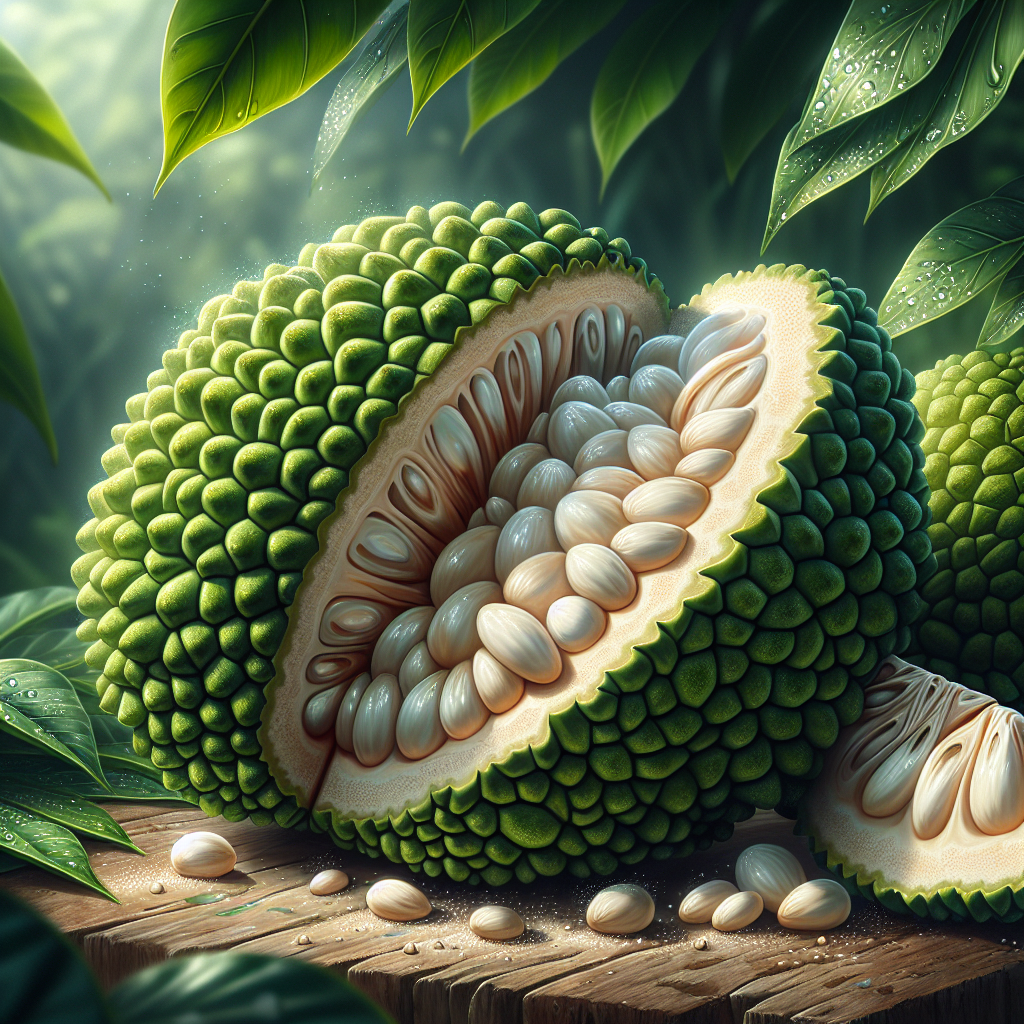
Introduction to African Breadfruit (Treculia africana)
African Breadfruit, scientifically known as Treculia africana, stands as a cornerstone of tropical agroforestry and food security in West and Central Africa. Belonging to the Moraceae family, this dioecious evergreen tree can reach heights of 20-50 meters, producing enormous syncarp fruits weighing up to 40 kg that are rich in carbohydrates, proteins, vitamins, and minerals. The seeds, often called 'ukwa' in Igbo or 'asoro' in Yoruba, are boiled, roasted, or ground into flour for porridges, cakes, and traditional dishes, providing a gluten-free alternative to staples like yam or cassava.
Beyond nutrition, African Breadfruit plays a vital role in sustainable farming. Its timber is durable for construction, while the tree's extensive root system aids soil stabilization and erosion control on slopes. In home gardens and small farms, it offers shade, wildlife habitat, and long-term yields—female trees begin fruiting at 6-8 years, producing annually for decades. This guide delivers professional-grade advice for propagating, growing, and managing this underutilized crop, optimized for tropical growers seeking resilient, high-value additions to polycultures. For deeper insights into companion planting synergies, check this Fall Companion Planting Guide: Boost Yields and Soil Health for Small Farms and Gardens.
With climate change intensifying, African Breadfruit's drought tolerance and nutritional density position it as a climate-smart crop. Yields per tree can exceed 100 kg of edible seeds annually once mature, making it ideal for food sovereignty initiatives. Whether you're a smallholder in Nigeria, Cameroon, or establishing it in subtropical zones like Florida or Queensland, mastering its cultivation unlocks economic and ecological benefits.
Botanical Profile of African Breadfruit (Treculia africana)
Treculia africana is a monoecious or dioecious tree in the Moraceae family, closely related to figs (Ficus spp.) and mulberries (Morus spp.). Native to humid forests from Senegal to Sudan and south to Angola, it thrives in lowland rainforests and secondary growth areas. The tree features a straight bole up to 20 meters, buttressed roots, and a spreading crown with glossy, elliptic leaves (10-20 cm long) that are alternate and stipulate.
Flowers are tiny and borne on fleshy receptacles: males in catkin-like spikes, females forming the base of the massive globose syncarp (multiple fruit). The fruit, 15-50 cm in diameter, has a green, fibrous rind enclosing thousands of lentil-sized seeds embedded in mucilage. Seeds are oval, creamy-white, with high starch (60-70%), protein (12-15%), and fat (10-20%) content, boasting superior amino acid profiles to many cereals.
Growth is rapid in youth (1-2 m/year), slowing after 10 years. Lifespan exceeds 100 years, with peak productivity from 15-40 years. Phenology includes leaf flush in dry seasons, flowering year-round in perhumid zones, and fruit maturation over 4-6 months. Pollinators include fig wasps and wind; seed dispersal by monkeys, bats, and rodents. Varieties include wild types and semi-domesticated strains selected for larger seeds and parthenocarpy (seedless fruits).
Soil, pH, and Climate Requirements for African Breadfruit (Treculia africana)
African Breadfruit demands well-drained, deep loamy soils rich in organic matter—sandy loams or clay loams with 20-30% clay fraction perform best. Avoid waterlogged sites; the tree tolerates brief flooding but root rot ensues in poor drainage. Optimal pH is 5.5-7.0, slightly acidic to neutral; liming heavy soils to 6.0-6.5 enhances nutrient uptake. Conduct soil tests pre-planting, amending with compost (10-20 t/ha) for fertility.
Climatically, it requires tropical wet conditions: 1,500-3,000 mm annual rainfall, evenly distributed, with no month below 50 mm. Temperatures of 24-32°C are ideal; it withstands 18-40°C but growth stalls below 15°C. USDA zones 10b-12; frost-sensitive, protect seedlings below 10°C. Humidity >70% supports fruit development; drought tolerance kicks in after year 3, surviving 3-4 months dry spells via deep taproots (up to 10 m).
In marginal areas, mulch heavily (15 cm organic matter) and irrigate young trees (20-40 L/week). Windbreaks are essential in exposed sites, as branch breakage occurs above 15 m/s. For subtropical trials, select frost-free microclimates and grafted stock. Soil preparation involves deep ripping (60 cm) to accommodate taproots, incorporating green manures like pigeon pea for nitrogen fixation.
Step-by-Step Planting & Propagation
Seed Propagation (Most Common)
- Seed Collection: Harvest ripe fruits (yellowing rind) from healthy female trees. Extract seeds by macerating pulp, ferment 2-3 days, wash, and dry in shade (25-30°C, 2-3 days). Viability: 70-90% if fresh; store at 10-15°C for 6 months.
- Pretreatment: Soak in water 24-48 hours, changing daily; scarify with sandpaper for hard coats.
- Sowing: Use polybags (20x30 cm) with 1:1:1 topsoil:sand:compost. Sow 2-3 seeds 2 cm deep, 30 cm spacing. Germination: 10-20 days at 28-32°C, 80% shade.
- Transplanting: At 30-50 cm (4-6 months), select vigorous seedlings, cull males if dioecious planting desired (1 male:10 females).
Vegetative Propagation
Grafting (veneer or cleft) onto 1-year rootstock yields 80% success; air-layering branches for faster fruiting (2-3 years). Cuttings root poorly.
Field Planting
Plant in rainy season at 10x10 m (100 trees/ha), pits 60x60x60 cm filled with 20 kg compost + 200 g TSP. Stake, mulch, irrigate weekly first year. Prune lower branches for bole form.
Care & Maintenance regimes for African Breadfruit (Treculia africana)
Irrigation: Drip or basin (50-100 L/tree/week) first 2 years; mature trees rainfed. Fertilization: Year 1: NPK 15:15:15 at 200 g/tree monthly. Mature: 1 kg urea + 1 kg TSP + 0.5 kg MOP annually, split applications. Foliar micronutrients (Zn, B) boost yields 20-30%. Pruning: Remove deadwood, watersprouts; shape to 4-6 main scaffolds. Annual light prune post-harvest. Weeding/Mulching: Slash intercrops, maintain 2 m weed-free radius; 15 cm mulch renew yearly. Intercropping: Years 1-3 with banana, plantain, or legumes for income.
Monitor growth: 2-3 m year 1, fruiting year 6-8. Thin crowded fruits for larger sizes.
Pests, Diseases & Organic Management
Pests:
- Scale insects: Neem oil (2%) sprays, 7-day intervals.
- Mealybugs: Alcohol-soap dips for seedlings; introduce ladybugs.
- Rodents/birds: Net fruits; thorny understory.
- Termites: Ash barriers, beneficial nematodes.
Diseases:
- Root rot (Phytophthora): Improve drainage, Trichoderma drenches.
- Leaf spot diseases (Cercospora): Copper fungicide, remove debris.
- Powdery mildew: Sulfur dust, airflow pruning.
Integrated management: Scout weekly, use Bt for caterpillars, companion marigold for nematodes. Avoid chemicals; focus organics for seed safety. For advanced tactics, see Why 90% of Small Farms Fail at Pest Management - And 8 Organic Fixes That Actually Work—wait, no, exactly one blog link already used.
Harvesting, Curing & Optimal Storage
Harvest when rind yellows and softens (tap test: dull thud), 4-6 months post-anthesis. Cut with pole pruners or ladder; yield 50-150 kg/tree. Process immediately: Split fruits, extract seeds via trampling/washing.
Curing: Boil seeds 20-30 min to remove inhibitors, dry to 10-12% moisture (sun 3-5 days). Roast optional for flavor. Storage: Seeds in jute bags, cool (15°C), dry (60% RH)—shelf life 12-18 months. Flour: Mill, sieve, store airtight (6-9 months). Ferment for ogiri-like condiment.
Post-harvest losses <5% with proper drying. Market as fresh, dried, or value-added (ukwa flour).
Companion Planting for African Breadfruit (Treculia africana)
Leverage agroforestry: Underplant with shade-tolerant cacao, coffee, or black pepper vines climbing trunks. Nitrogen-fixers like Gliricidia or pigeon pea enhance soil. Groundcovers: sweet potato or peanuts suppress weeds.
Avoid allelopathic neighbors; pair with cassava for diversified yields. Benefits: Pest diversion, microclimate moderation, +30% system productivity.