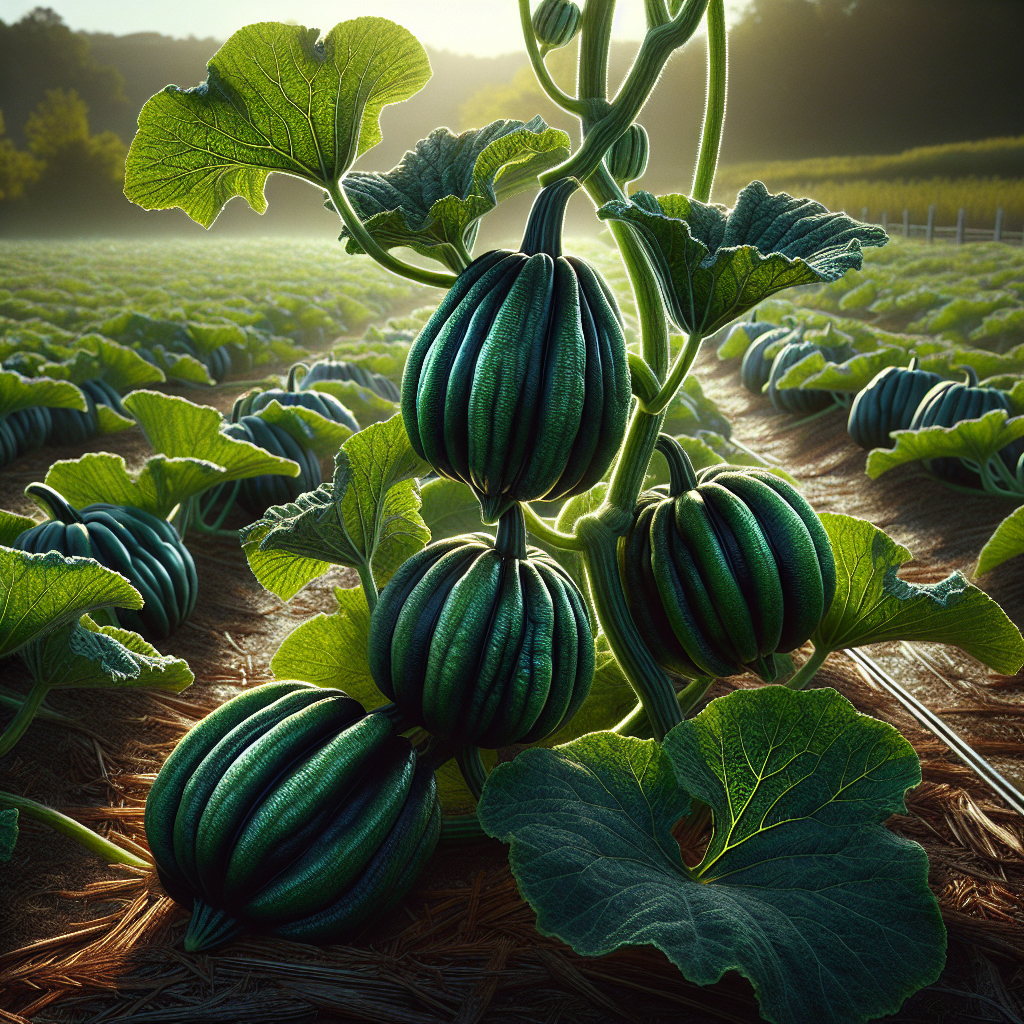
Introduction to Acorn Squash
A classic winter squash of North American gardens, this crop belongs to the highly variable species Cucurbita pepo, the same species that also includes many pumpkins, zucchini, and summer squashes. Unlike tender summer squash harvested immature, acorn squash is grown to full physiological maturity, when the rind hardens and the seed cavity fully develops. The fruits are typically dark green, deeply ribbed, and shaped like a rounded acorn, though modern cultivars may also show gold, cream, variegated, or nearly black coloration.
Historically, winter squashes were foundational crops in Indigenous agriculture across the Americas, valued for dependable yields, caloric density, and long storage life. Acorn types became especially popular in home gardens and small farms because they mature faster than many large winter squash, often in 80 to 100 days, making them suitable for shorter temperate growing seasons. Their manageable fruit size also suits fresh market sales and household cooking.
Growers choose this crop for three main reasons: compact-to-moderate vine vigor compared with sprawling giant squash types, relatively early maturity, and excellent culinary quality when harvested at the proper stage. Many older green acorn cultivars are productive and dependable, while newer selections improve sweetness, uniformity, Powdery Mildew tolerance, or semi-bush habit. If you already grow other cucurbits, it helps to understand cross-species differences; see the broader Squash guide for context on habit and rotation planning.
Botanical Profile of Acorn Squash
This crop is an annual, frost-sensitive cucurbit with a coarse, vining or semi-bush growth habit. Stems are angular and prickly, leaves are broad and lobed, and both male and female flowers are borne on the same plant. The species is monoecious, meaning separate male and female flowers occur on one plant. Male flowers appear first in most plantings, followed by female flowers identified by the miniature ovary, or tiny fruit, directly behind the petals.
Botanically, acorn squash fruit are pepos, a specialized berry with a hard rind. The species designation matters because Cucurbita pepo types can cross-pollinate with other C. pepo crops such as zucchini, some pumpkins, delicata, and many summer squashes. This does not affect the current season's fruit quality, but it does matter if you plan to save seed.
Typical fruit weight ranges from 1 to 3 pounds, though some hybrids exceed that. Flesh color is usually yellow-orange, with texture varying from dry and fluffy to moist and fine-grained depending on cultivar and harvest timing. Good acorn squash should have thick flesh, a relatively small seed cavity, and high dry matter. High sugar accumulation occurs late in development and continues slightly after harvest, so premature picking sharply reduces eating quality.
Cultivars differ significantly. Traditional heirloom strains often produce dark green fruits with modest sweetness but dependable yields. Modern hybrids may offer improved sweetness, deeper orange flesh, more uniform sizing, and better field holding. Bush or semi-bush cultivars suit smaller gardens, while vining types generally need more space but may yield over a longer window.
Soil, pH, and Climate Requirements for Acorn Squash
This crop demands warm soil, full sun, and a fertile but well-drained rooting zone. It is not tolerant of frost, prolonged cold soils, or chronic waterlogging. Ideal air temperatures for rapid growth are 21-30°C (70-86°F). Growth slows markedly below about 15°C (59°F), and flower drop or poor pollination becomes more likely when daytime temperatures remain cool. At the other extreme, sustained temperatures above 35°C (95°F), especially with hot nights, can reduce pollen viability and fruit set.
The best soil is a sandy loam or loam rich in organic matter, with enough structure to retain moisture but enough porosity to drain excess water after storms or irrigation. A target pH of 6.0-6.8 is ideal. Plants tolerate slightly wider conditions, roughly 5.8-7.2, but nutrient efficiency declines outside the preferred range. Below pH 5.8, calcium and magnesium issues become more common and root growth may be restricted. Above pH 7.2, iron, manganese, and zinc can become less available, leading to interveinal chlorosis on young leaves.
Before planting, aim for soil organic matter around 3-5% if possible. That level supports steady moisture retention and nutrient buffering without creating an overly lush, disease-prone canopy. Acorn squash is a moderate-to-heavy feeder, especially for nitrogen early and potassium during fruit fill. However, excessive nitrogen after flowering often produces rampant vine growth at the expense of fruit set and can worsen Powdery Mildew by creating dense humid foliage.
Drainage is critical. Roots need oxygen as much as moisture. If soil remains saturated for more than 24-48 hours after rainfall, the crop becomes vulnerable to root decline, damping issues in young plants, and later vine stress. Raised beds, broad mounds, or ridged rows are strongly recommended in heavy soils. Soil temperature at planting should be at least 18°C (65°F), with 21-29°C (70-85°F) being even better for quick, uniform emergence.
For growers improving soil health over multiple seasons, broad strategies such as compost use, reduced compaction, and cover cropping matter greatly; practical principles are summarized in soil health strategies.
Step-by-Step Planting & Propagation
Propagation is almost always by seed. Direct sowing is preferred in warm soils because cucurbits dislike root disturbance, though transplants are useful in short-season regions.
Choose the site carefully. Select a full-sun location with at least 8 hours of direct light. Avoid low pockets where cold air settles and fields with recent cucurbit history, ideally rotating out of cucurbits for 3-4 years to reduce disease carryover.
Prepare the bed. Incorporate finished compost at 1-2 inches across the bed, or about 5-10 tons per acre equivalent in field terms. If using a balanced preplant fertilizer, keep nitrogen moderate and ensure adequate phosphorus and potassium. Mounded hills 8-12 inches high warm faster and drain better.
Direct sow after frost danger passes. Sow seeds 1-1.5 inches deep. In hills, place 3-4 seeds per hill, then thin to the 1-2 strongest plants. For row culture, space plants 24-36 inches apart in rows 6-8 feet apart for vining types; semi-bush selections may fit 3-5 feet between rows depending on vigor.
For transplanting, start indoors only briefly. Sow in 3-4 inch biodegradable pots 2-3 weeks before transplant date. Maintain temperatures around 24-29°C (75-85°F) for germination. Transplant before roots circle the pot. Harden off for 5-7 days, then set plants out without breaking the root ball.
Thin aggressively. Crowding reduces airflow, increases mildew pressure, and lowers pollination efficiency. Thin once seedlings have 1-2 true leaves.
Mulch after establishment. Organic mulch such as clean straw helps suppress weeds and reduce soil splash, but apply only after soil has warmed. In cool climates, black plastic mulch can improve early vigor and earliness.
Support pollination habitat. Since fruit set depends on insect transfer of pollen, avoid broad-spectrum insecticides during bloom. If pollinator activity is poor, hand pollination in the morning can rescue yields.
Seed germination usually occurs in 5-10 days under warm conditions. Emergence is often patchy in cold or crusted soils, so never rush planting into marginal ground merely because the calendar suggests it.
Care & Maintenance regimes for Acorn Squash
Consistent moisture is the single most important management factor after establishment. Target about 1-1.5 inches of water per week from rainfall plus irrigation, increasing to as much as 2 inches during fruit bulking in hot weather on sandy soils. The practical goal is to keep the top 6-8 inches of soil evenly moist but never saturated. In volumetric terms, many loam soils should remain around 60-80% of field capacity. When squeezed by hand, soil from the root zone should feel cool and hold together lightly without dripping.
Underwatering shows first as midday wilting that does not recover well by evening, dull gray-green leaves, slowed vine extension, and misshapen or undersized fruit. Severe moisture stress during flowering can cause female blossoms to abort. Overwatering is equally damaging: leaves may look pale, growth becomes soft and lush, and plants wilt despite wet soil because oxygen-starved roots cannot function properly. Persistent sogginess can also lead to yellow lower leaves, stunting, and root disease.
Drip irrigation is preferable to overhead watering because it keeps foliage drier and reduces mildew risk. If overhead irrigation is unavoidable, water early in the day so leaves dry quickly. Maintain a wider wetting zone as roots spread; by midseason, roots often extend well beyond the crown area.
Nutrient management should match growth stage. Early growth benefits from steady nitrogen for leaf and vine development, but once flowering begins, potassium becomes especially important for fruit filling, sugar movement, and rind quality. A common mistake is overfeeding nitrogen after the first fruits form. This leads to abundant vine growth, delayed maturity, and less sweet fruit. Side-dress lightly when vines begin to run, then again only if foliage is pale or growth is weak. Tissue testing or soil testing is ideal for commercial precision.
Weed control matters most in the first 4-6 weeks, before vines cover the ground. Shallow cultivation is effective early, but stop once roots spread near the surface. Mulch reduces later weed pressure. Avoid deep hoeing around crowns because cucurbit roots are easily injured.
Pollination deserves deliberate attention. Female flowers are open for only a short period, usually one morning. Bees transfer pollen from male to female flowers, and inadequate visitation results in fruits that begin to enlarge then yellow and abort. Healthy fields typically show strong bee activity by midmorning. In low-pollinator settings, hand pollinate by removing a male flower, peeling back petals, and brushing the anther onto the stigma of a freshly opened female flower.
Pruning is generally unnecessary, but removing a few badly diseased leaves late in the season can improve airflow. Do not over-prune, as leaves are the plant's sugar factory and protect fruit from sunscald.
Pests, Diseases & Organic Management
The major insect pests are Squash Bugs, Cucumber Beetles, Squash Vine Borers in some regions, Aphids, and occasional Spider Mites. Cucumber Beetles are especially concerning in young plantings because they feed on cotyledons and may vector Bacterial Wilt. Floating row covers can protect seedlings early, but remove them at flowering unless you hand pollinate.
Squash Bugs often hide at the base of plants and underside of leaves. Their feeding causes stippling, yellowing, and eventual vine collapse in heavy infestations. Hand removal of bronze egg clusters, use of trap boards, and rigorous sanitation reduce pressure. Squash Vine Borers are more severe in susceptible summer squash, but can still damage acorn types by tunneling into stems, causing sudden wilting of runners. Wrapping lower stems with foil or fabric collars and timing plantings to avoid peak moth flight can help.
Aphids usually become problematic when plants are stressed or overly fertilized with nitrogen. They distort growth and may contribute to virus spread. Strong water sprays, insecticidal soap, and encouragement of beneficial insects help suppress outbreaks.
The most common disease issue is Powdery Mildew. It appears as white talcum-like patches on older leaves, usually after canopy closure and humid nights. Though often not lethal immediately, it reduces photosynthesis and can prevent full fruit ripening. Organic management depends on prevention: wide spacing, morning irrigation, balanced fertility, residue rotation, and resistant cultivars. Sulfur, potassium bicarbonate, or biological fungicides can slow spread if started early.
Downy Mildew, though less consistent by region, can progress rapidly under humid conditions and causes angular yellow lesions and gray-purple sporulation on leaf undersides. Good airflow and prompt removal of badly infected tissue are useful, but regional forecasting is important because this disease can arrive on wind currents.
Bacterial Wilt, transmitted mainly by Cucumber Beetles, causes irreversible vine collapse even when soil moisture is adequate. The best organic strategy is beetle exclusion early in the season. Viral diseases such as Zucchini Yellow Mosaic Virus, Cucumber Mosaic Virus, and Watermelon Mosaic Virus cause mottling, distortion, and reduced yield. Control Aphids and beetles as vectors, remove symptomatic plants when practical, and keep weed hosts down.
Root Rots and Stem Rots are strongly associated with poor drainage and excessive irrigation. If crowns appear sunken, soft, or cracked, reassess irrigation frequency immediately. A healthy prevention system includes crop rotation, mulching to reduce splash, sanitation after harvest, and avoiding field work when vines are wet.
Harvesting, Curing & Optimal Storage
Harvest at full maturity, not simply when fruits look large enough. A mature fruit has a hard rind that resists puncture by a fingernail, a dry corky stem, and developed ground color. In classic green cultivars, the rind becomes dull rather than glossy. The patch touching the soil often turns cream to orange depending on cultivar. Immature fruits have watery flesh, bland flavor, and poor storage life.
Use pruners or a sharp knife to cut fruits with 2-4 inches of stem attached. Never lift fruits by the stem alone, as stem breakage opens the way for rot. Handle gently; even minor bruising shortens storage life.
If frost threatens and fruits are nearly mature, harvest immediately. Light frost can damage rinds and compromise storage even if vines appear only slightly affected. Fruits harvested too early may still be edible soon after harvest but should not be expected to store well.
Curing improves keeping quality by drying the stem, hardening the rind, and allowing minor surface injuries to heal. Cure for 10-14 days at 24-29°C (75-85°F) with good airflow and relative humidity around 50-70%. Do not stack fruits densely during curing.
For storage, maintain 10-13°C (50-55°F) and relative humidity around 50-70%. Colder conditions can cause chilling injury, pitting, and poor flavor; warmer conditions speed dehydration and spoilage. Under ideal conditions, many acorn squash store about 4-8 weeks, though this is shorter than some butternut or hubbard types. In fact, acorn squash is best eaten within the first 1-2 months because sugars may decline in long storage even if the fruit still appears sound.
Inspect stored fruit weekly. Remove any showing soft spots, stem-end mold, leaking, or collapse. A single rotting fruit can quickly spread problems in closed storage.
Companion Planting for Acorn Squash
The classic ecological model is the "Three Sisters," where squash sprawls under taller crops and helps shade soil. Corn provides vertical structure and partial wind buffering, while beans or peas contribute biological diversity and can improve overall system function when managed well. In smaller gardens, the most useful companions are those that support pollination, reduce pest pressure, or occupy a different root and canopy niche.
Nasturtium is valuable nearby as a flowering trap and beneficial-insect plant, drawing pollinators and sometimes distracting Aphids or beetles from main crops. Radish can serve as a quick pre-canopy intercrop, harvested before vines spread, and may help break surface crust while using otherwise open early-season space. Peas work best as an early-season companion in rotational or edge plantings rather than mingled deeply into mature vines.
Avoid pairing with crops that create excessive shading or compete heavily for the same ground-level space at the same time. Dense cucumber or melon plantings can increase disease carryover and make scouting more difficult. Keep companions offset so air still moves through the canopy and pollinators can easily find blooms.
The best companion strategy is functional, not decorative: combine pollinator support, soil coverage, early weed suppression, and easy access for harvest. In market gardens, companion planting should never make irrigation lines, scouting, or disease sanitation harder than necessary.