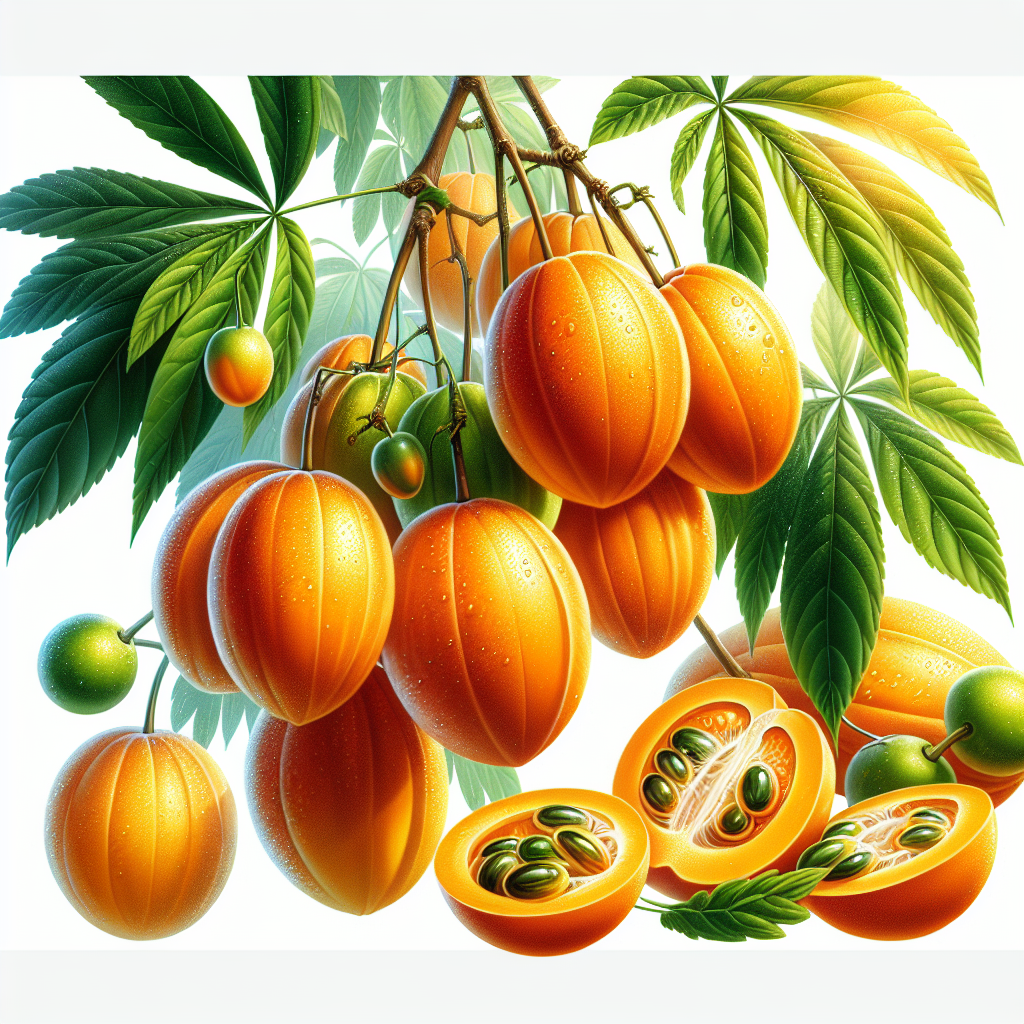
Introduction to Achacha (Achachairú)
Achacha, scientifically known as Garcinia prainiana and commonly referred to as Achachairú, is an exquisite tropical fruit tree originating from the Bolivian lowlands in South America. This underappreciated gem belongs to the Clusiaceae family, closely related to mango and mangosteen, and has gained popularity in recent years for its unique flavor profile—a delightful blend of sweet citrus, pineapple, and peach notes encased in a vibrant orange-yellow rind. The fruit's interior features juicy, translucent arils that pop with flavor, making it a standout in fresh markets, smoothies, and gourmet desserts.
Native to the humid, subtropical forests of Bolivia, Achacha trees thrive in warm, frost-free environments and can reach heights of 10-20 feet (3-6 meters) at maturity. They are dioecious, meaning separate male and female trees are required for fruit production, though some hermaphroditic cultivars exist. With a growing season that yields fruit from late spring to early summer, Achacha offers high market value due to its rarity outside South America. Small-scale farmers and home growers in USDA zones 10-11 or equivalent can expect 50-100 fruits per tree after 4-5 years, with proper management. This guide provides professional-grade, step-by-step advice to maximize yields while minimizing common pitfalls. For insights on heat management in tropical crops, check this blog post on summer heatwaves.
Beyond its taste, Achacha is packed with vitamin C, antioxidants, and dietary fiber, positioning it as a superfruit in health-conscious markets. Its low-calorie profile (about 60 kcal per 100g) and refreshing juiciness make it ideal for export to temperate regions. However, successful cultivation demands attention to humidity, pollination, and soil drainage—challenges that this deep-dive addresses comprehensively.
Botanical Profile of Achacha (Achachairú)
Achacha trees exhibit a slow to moderate growth rate, developing a dense, pyramidal canopy with glossy, evergreen leaves that measure 4-6 inches (10-15 cm) long. The leaves are dark green, leathery, and oppositely arranged, providing year-round shade and wind protection. New growth flushes are pinkish-red, adding ornamental appeal. Flowers are small (0.5-1 inch or 1-2.5 cm), white to pale yellow, and borne in clusters on 2-4 year-old wood. Female flowers develop into walnut-sized fruits (2-3 inches or 5-7.5 cm diameter) with a thick, leathery rind that turns golden-orange at maturity.
The fruit's unique structure features 4-6 large segments filled with seedless or single-seeded arils, which separate easily from the central core—much like eating a citrus without the bitterness. Seeds, if present, are large but non-viable for most commercial propagation. Trees are long-lived, potentially fruiting for 50+ years, and respond well to pruning for shape and productivity. Root systems are shallow and fibrous, sensitive to waterlogging but aggressive in nutrient uptake. In optimal conditions, a mature tree can produce 20-40 kg (44-88 lbs) of fruit annually, with aril recovery rates of 50-60% by weight.
Pollination is primarily insect-mediated, with bees favoring the nectar-rich blooms. Dioecy necessitates a 1:10 male-to-female ratio in orchards for reliable yields. Cultivars like 'Boliviana Select' offer improved fruit size and hermaphroditic tendencies. Compared to relatives like papaya, Achacha has superior shelf life but requires more consistent moisture.
Soil, pH, and Climate Requirements for Achacha (Achachairú)
Achacha demands well-drained, fertile soils rich in organic matter, ideally sandy loam or volcanic soils mimicking its Bolivian habitat. Heavy clays lead to root rot, so incorporate 20-30% compost or aged manure during preparation. Optimal pH ranges from 5.5-6.8; test and amend with dolomite lime if below 5.5 or sulfur if above 7.0. Soil depth should exceed 1.5 meters (5 feet) to accommodate the spreading roots.
Climatically, Achacha flourishes in USDA zones 10b-11, with minimum temperatures above 10°C (50°F) and no frost exposure. Ideal daytime highs are 28-35°C (82-95°F), with nighttime lows of 18-24°C (64-75°F). Annual rainfall of 1500-2500 mm (60-100 inches), evenly distributed, is perfect; supplement with drip irrigation during dry spells (500-800 mm/season). High humidity (70-90%) enhances fruit quality but risks fungal issues—ensure good airflow.
Full sun (6-8 hours daily) is essential, though young trees benefit from 30% shade cloth for the first 2 years. Wind protection via hedges or netting prevents flower drop. Elevations up to 1000 meters (3300 feet) work, but avoid coastal salts. Mulch with 10-15 cm (4-6 inches) of organic material to retain moisture and suppress weeds. For small farms, raised beds (1m x 1m x 0.5m) improve drainage in suboptimal soils.
Step-by-Step Planting & Propagation
Propagation: Seeds germinate in 4-6 weeks at 28-32°C (82-90°F) but result in variable offspring; use for rootstock only. Commercial growers prefer air-layering (marcotting) or grafting onto Garcinia mangostana rootstock for uniformity. Cuttings root in 8-12 weeks under mist with 3000 ppm IBA.
- Site Prep: Select a sunny, sheltered spot. Dig holes 1m x 1m x 1m (3ft x 3ft x 3ft), fill with 50% native soil + 50% compost + 200g superphosphate.
- Planting: Space trees 5-7m (16-23ft) apart. Plant grafted saplings (1-1.5m tall) at the same depth as nursery pots in early wet season. Water deeply post-planting.
- Staking: Use bamboo stakes for 1-2 years to prevent wind rock.
- Initial Care: Apply 10-10-10 fertilizer at 50g/tree monthly for first year. Mulch heavily.
Expect first flowers in 3-4 years. For detailed propagation, reference guava techniques, adaptable here.
Care & Maintenance regimes for Achacha (Achachairú)
Watering: Maintain consistent moisture—40-60 liters/tree/week, increasing to 100 liters during fruit swell. Drip systems prevent wet foliage.
Fertilization: Year 1-2: NPK 10-10-10 at 100g/tree quarterly. Mature: 1-2kg/tree/year split applications, emphasizing potassium (NPK 8-3-9). Foliar micronutrients (Zn, B, Mn) bi-monthly.
Pruning: Annually post-harvest, remove deadwood, watersprouts, and inward branches. Tip-prune to encourage bushiness. Thin canopy for light penetration.
Weed Control: Mulch + shallow cultivation. Organic herbicides like vinegar for spot treatment.
Pollination Boost: Introduce beehives; hand-pollinate isolated females with soft brushes.
Monitor growth: 1m/year initially, slowing to 30cm/year mature.
Pests, Diseases & Organic Management
Pests: Watch for aphids, mealybugs, and fruit flies. Neem oil (2%) weekly sprays deter. Beneficial insects like ladybugs control aphids. Scale insects on trunks—prune and horticultural oil.
Diseases: Anthracnose causes fruit rot; copper fungicide preventatively. Phytophthora root rot from poor drainage—solarize soil. Powdery mildew in low light—improve airflow, potassium bicarbonate sprays.
Integrated management: Crop rotation, resistant rootstocks, and sanitation. For more, see this blog on pest management. Avoid chemicals near harvest.
Harvesting, Curing & Optimal Storage
Harvest when rind fully orange and slightly soft—twist or clip with secateurs. Yield peaks 120-150 days post-flowering. Handle gently to avoid rind cracks.
Curing: Store at 15-20°C (59-68°F), 85-90% RH for 7-10 days to mellow acidity.
Storage: Fresh arils: 4°C (39°F), 90% RH for 4-6 weeks. Whole fruit: 10-13°C (50-55°F) for 3-4 weeks. Freeze arils for 12 months.
Market as premium—shelf life beats dragon fruit. Process into juice or sorbet.
Companion Planting for Achacha (Achachairú)
Pair with thyme and marigold for pest repulsion. Nitrogen-fixers like pigeon pea improve soil. Underplant with pineapple for ground cover. Avoid water-hungry crops like corn. Learn more in this companion planting guide. Benefits include biodiversity and microclimate moderation.