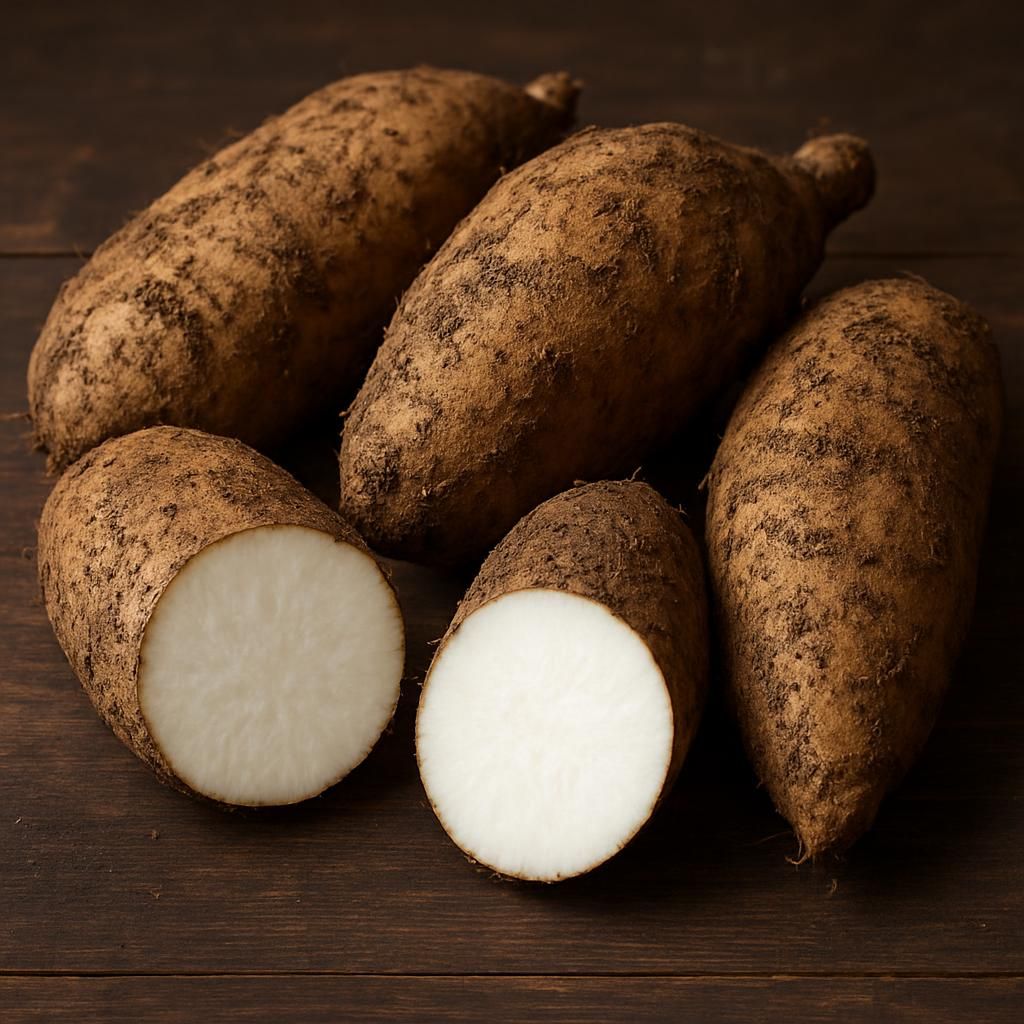
Introduction to Yam (Dioscorea rotundata - White Guinea)
White Guinea yam (Dioscorea rotundata) is the most economically important yam species in West Africa, accounting for over 90% of global production. Grown primarily for its large, white-fleshed tubers, it serves as a major carbohydrate source and cash crop for millions of smallholder farmers. Its deep dormancy and excellent storage qualities make it a critical food security crop during the dry season.
Botanical Profile of Yam (Dioscorea rotundata - White Guinea)
Dioscorea rotundata is a perennial climbing vine with annual above-ground growth. It produces heart-shaped leaves and twining stems that require support. Tubers develop underground from the base of the vine and can reach 1–3 kg each under optimal conditions. The species is dioecious, with separate male and female plants producing small, fragrant flowers.
Soil, pH, and Climate Requirements for Yam (Dioscorea rotundata - White Guinea)
White Guinea yam thrives in well-drained, fertile loamy soils with good organic matter. The crop is sensitive to waterlogging and compacted soils.
| Parameter | Ideal Range | Notes |
|---|---|---|
| Soil Type | Sandy loam to clay loam | Deep, loose structure for tuber expansion |
| Soil pH | 5.5 – 6.5 | Slightly acidic; avoid alkaline soils |
| Temperature | 25 – 32 °C | Daytime optimum; avoid frost |
| Rainfall | 1000 – 1800 mm/year | Well-distributed; supplemental irrigation in dry spells |
| Altitude | 0 – 1500 m | Performs best in lowland tropics |
| Growing Season | 7 – 10 months | Long photoperiod sensitivity |
Step-by-Step Planting & Propagation
- Select healthy, disease-free seed yams (200–500 g setts).
- Treat setts with wood ash or approved fungicide to prevent rot.
- Prepare mounds or ridges 1 m apart; incorporate 5–10 t/ha well-rotted manure.
- Plant setts 10–15 cm deep with the cut surface facing upward.
- Provide trellises or stakes 2–2.5 m high for vine support.
- Mulch immediately after planting to conserve moisture and suppress weeds.
Care & Maintenance regimes for Yam (Dioscorea rotundata - White Guinea)
Regular weeding, staking, and nutrient management are essential. The following schedule ensures optimal tuber development.
| Growth Stage | Watering Schedule | Fertilizer Application | Pruning & Training |
|---|---|---|---|
| Planting to 4 wks | Light irrigation every 3–4 days | 40 kg N/ha basal; 20 kg P₂O₅/ha | Remove weak shoots; train vines on stakes |
| 5–12 wks | 25–30 mm/week if rainfall <20 mm | 60 kg N/ha at 6 wks; 30 kg K₂O/ha | Continue training; remove lateral shoots |
| 13–20 wks | Reduce to 15 mm/week | Final 40 kg N/ha + 20 kg K₂O/ha | Minimal pruning; focus on canopy support |
| 21 wks to harvest | Withhold water 4 weeks before harvest | None | Cut back vines 2 weeks pre-harvest |
Pests, Diseases & Organic Management
Key threats include Yam nematodes, Aphids, Scale insects, Anthracnose, and Yam mosaic virus. Implement crop rotation with Cassava, use resistant varieties, and apply neem-based sprays. Soil solarization and incorporation of marigold residues help suppress nematodes.
Harvesting, Curing & Optimal Storage
Harvest when vines senesce (7–10 months after planting). Carefully dig tubers to avoid bruising. Cure at 28–32 °C and 85–90 % RH for 4–7 days to heal wounds. Store in well-ventilated barns at 15–18 °C; tubers can remain viable for 4–6 months.
Companion Planting for Yam (Dioscorea rotundata - White Guinea)
Interplant with Maize or Sorghum for vertical support and nitrogen contribution. Cowpea and Pigeon pea improve soil fertility and reduce pest pressure. Avoid planting near Tomato to minimize shared viral vectors.
Yam cultivation is detailed further in this comprehensive resource on tropical tuber crops. For additional strategies on soil health and resilience, see The Hidden Power of Mulching: 8 Organic Strategies to Transform Small Farm Soil.