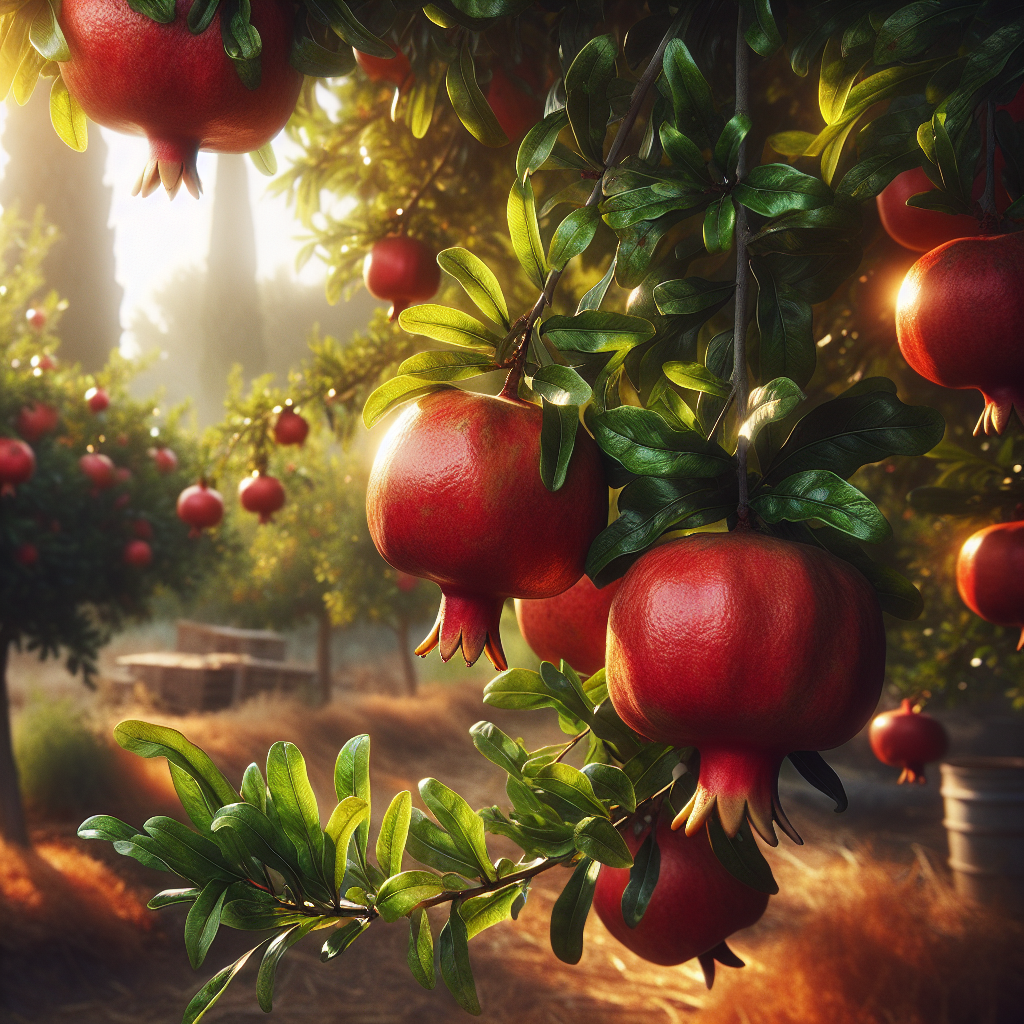
Introduction to Wonderful Pomegranate
A classic American commercial selection, this cultivar became famous through California plantings and remains the benchmark by which many red-fruited pomegranates are judged. It is valued for its vigorous growth, ornamental orange-red flowers, high juice content, balanced sweet-tart flavor, and striking crimson arils that color well under hot, bright conditions. Compared with softer, sweeter specialty cultivars, Wonderful is typically more tannic and acidic when grown in marginal climates, but in full sun with a long, hot season it develops the dense flavor and ruby pigmentation that make it ideal for fresh eating, juicing, and processing.
Wonderful is especially well adapted to semi-arid and Mediterranean-type regions. The tree tolerates drought better than many fruit crops once established, but drought tolerance should never be confused with optimum production. Commercial-quality fruit size, rind integrity, aril fill, and sugar development depend on consistent moisture from bloom through fruit enlargement. One of the most common mistakes growers make is allowing the root zone to swing from very dry to suddenly saturated; this erratic pattern is a major driver of fruit splitting.
The plant is naturally shrubby and sucker-prone, though it can be trained into either a multistem bush or a small single-trunk tree. For growers comparing orchard options, its water demand is lower than many subtropical fruit species and its salinity tolerance is better than some alternatives such as Citrus. For broader orchard floor strategies, see soil health tips.
Botanical Profile of Wonderful Pomegranate
This cultivar belongs to the Lythraceae family. Botanically, pomegranate fruit is a specialized berry called a balausta, characterized by a leathery rind and numerous seed-bearing arils separated by membranous internal partitions. Wonderful produces medium to large deciduous shrubs or small trees, commonly reaching 8-15 feet tall in home culture and potentially larger under low-pruning orchard conditions.
Leaves are opposite or sub-opposite, glossy, narrow, and bright green when actively growing. New shoots are often reddish. The wood can be spiny, especially on vigorous juvenile growth. Flowers are typically borne on short spurs and current-season shoots; they are thick-petaled, waxy, and brilliant orange-red. Pomegranates produce functionally male flowers and bisexual, fruiting flowers. The fruiting flowers are more urn-shaped, with a swollen base that develops into the fruit. Heavy bloom does not always equal heavy crop because non-fruitful flowers are common, especially on young or over-vigorous wood.
Wonderful is usually self-fertile, so a single planting can set fruit without a second cultivar. Even so, strong pollinator activity improves fruit set consistency. The tree flowers over an extended window, which can result in fruit maturing across several picks rather than all at once. This extended bloom is useful in home gardens but requires harvest discipline in commercial blocks.
Fruit is typically round to slightly angular, with a thick red rind that deepens in color as harvest approaches. Arils are dark red to crimson, juicy, and typically surround medium-hard seeds. Seed hardness is an important cultivar trait: Wonderful is not considered a soft-seeded pomegranate, so texture is firmer than dessert cultivars selected specifically for fresh spoon-eating. Juice is richly colored due to anthocyanin concentration, and acidity tends to remain noticeable, which is one reason the cultivar excels for juice and culinary use.
Soil, pH, and Climate Requirements for Wonderful Pomegranate
This cultivar performs best in deep, well-drained loam or sandy loam, though it can tolerate heavier soils better than many orchard fruits if drainage is corrected. The critical limit is not texture itself but oxygen availability around the roots. If water remains perched in the top 18-24 inches for more than a day or two after irrigation or rain, root stress and disease risk rise sharply. In poorly drained clay, roots often stay shallow, reducing drought buffering and making fruit size less consistent.
An ideal soil pH is about 5.8-7.2, though plants can remain productive from roughly 5.5-7.8 if nutrient balance is maintained. At pH above 7.8, iron, zinc, and manganese deficiencies become more likely, especially in calcareous soils. Iron chlorosis first appears as yellowing between veins on young leaves while veins remain green. Zinc deficiency often causes small, narrow leaves and shortened internodes. If these symptoms appear in alkaline ground, foliar micronutrient sprays are usually faster and more effective than soil applications.
Wonderful thrives where summers are hot, dry, and sunny, and winters are cool enough to induce dormancy but not so severe that wood is injured. Ideal summer temperatures for fruit quality often sit in the 85-95°F range, with strong day length and low humidity. The tree tolerates short drops below freezing during dormancy, but young trees can be injured around 18-20°F, and severe cold can damage scaffold wood or kill top growth. Spring frost is more dangerous than winter chill because flowers and new shoots are tender.
Heat is not merely tolerated; it is central to color and flavor development. In cooler maritime climates, trees may grow vigorously yet produce fruit with paler rind, weaker sweetness, and delayed maturity. High humidity also increases pressure from fungal diseases and can reduce rind finish.
Soil moisture management deserves special attention. Wonderful performs best when the active root zone stays evenly moist but never saturated. Practically, the top 2-3 inches may dry between irrigations, but moisture at 6-18 inches should remain moderately available during flowering and fruit swell. If soil taken from 8 inches forms a weak ball that just holds together before crumbling, moisture is usually near acceptable. If it is dusty and will not bind, irrigation is overdue. If it smears, smells sour, or remains sticky and anaerobic, watering is excessive or drainage is poor.
Step-by-Step Planting & Propagation
Start with disease-free nursery stock from hardwood cuttings or well-rooted container plants. Wonderful is commonly propagated clonally from cuttings because seed propagation does not preserve cultivar traits. Hardwood cuttings 8-12 inches long and pencil-thick, taken from mature dormant wood, root reasonably well when planted in a sterile, well-drained propagation medium and kept evenly moist but not wet.
For orchard or home planting, choose the hottest, sunniest site available. Full sun means at least 8 hours of direct light; less than this often reduces bloom intensity, sugar accumulation, and rind coloration. Avoid frost pockets, shaded north walls, and depressions where winter cold settles.
Prepare a planting hole no deeper than the root ball and about 2-3 times as wide. In most soils, avoid heavy amendment of the backfill with compost or potting media, since roots may circle in the improved pocket instead of extending outward. Break compacted sidewalls if planting into heavy soil. If drainage is poor, plant on a mound or raised berm 8-18 inches high.
Set the plant so the top of the nursery root ball sits level with or slightly above the surrounding soil. Planting too deep is a common error and can encourage crown problems. Backfill firmly to remove large air pockets, then water deeply to settle soil around the roots.
Spacing depends on training system. For backyard multistem shrubs, 10-12 feet apart is common. For more formal tree training, 12-15 feet apart within rows and 15-18 feet between rows allows better equipment access, spray coverage, and sun penetration. In tight plantings, expect more pruning labor and increased humidity within the canopy.
After planting, head the top back lightly if needed to balance root loss, then decide on training. For a multistem form, select 3-5 vigorous basal shoots and remove excess weak shoots. For a single-trunk form, choose one central leader and remove competing basal suckers repeatedly during the first two years. Because Wonderful naturally suckers, maintaining a tree form requires regular attention.
Mulch with 2-4 inches of coarse organic material, keeping it 4-6 inches away from the crown. Mulch moderates soil temperature, reduces evaporative loss, and buffers against surface crusting, but mulch piled against the trunk can invite rot and rodent damage.
Care & Maintenance regimes for Wonderful Pomegranate
Irrigation should change with age and season. Newly planted trees need frequent root-zone establishment. During the first 6-8 weeks in warm weather, water deeply 2-3 times weekly in fast-draining soils or every 5-7 days in heavier soils, applying enough to moisten the root ball and the surrounding soil to about 12-18 inches deep. Once new growth is active, gradually extend the interval while increasing depth. Established trees generally perform best with deep irrigation that wets soil to 24-36 inches, followed by partial drying before the next cycle.
During flowering and fruit enlargement, the goal is steady moisture without saturation. Prolonged deficits at this stage reduce fruit size and can lead to internal stress that later shows up as rind cracking when water suddenly becomes available. Signs of underwatering include dull foliage, reduced shoot extension, premature leaf yellowing on older leaves, and fruit that stops enlarging during hot periods. Signs of overwatering include limp but not dry leaves, persistent yellowing, weak pale shoots, leaf drop despite moist soil, algae or fungal growth on the soil surface, and a sour smell in the root zone.
Drip irrigation is strongly preferred over overhead watering. Place emitters around the canopy drip line rather than at the trunk once trees are established, because the most active feeder roots move outward as the tree matures. A young tree may need 2 emitters; mature trees often need a wider wetted pattern. Avoid tiny, frequent irrigation pulses that keep only the surface damp; shallow rooting makes the tree less resilient to heat.
Nutrient needs are moderate. Young trees benefit from split applications of nitrogen during spring and early summer to support canopy development, but excess nitrogen is counterproductive. Overfed Wonderful trees produce rank, succulent shoots, more suckers, more non-fruitful bloom, delayed fruit coloring, and softer rinds that may crack or sunburn more easily after pruning. Mature trees typically need nitrogen timed from budbreak through early fruit set, with rates adjusted to leaf color, shoot growth, and crop load. If annual extension growth is excessively long and leafy with poor fruiting, reduce nitrogen. Potassium becomes increasingly important as crop load rises because it supports fruit sizing, sugar movement, and rind integrity.
Pruning is one of the defining management tasks for this cultivar. Fruit is borne on short spurs and mature wood, so pruning should open the canopy without removing all fruitful structure. In the first 2-3 years, build a framework of well-spaced scaffolds. Thereafter, remove dead wood, rubbing branches, inward growth, and excessive suckers. Thin congested interior shoots enough to allow filtered light and air movement. Severe pruning stimulates vegetative regrowth at the expense of cropping, so annual moderate pruning is usually better than infrequent hard cuts.
For mature trees, winter dormant pruning is standard, with light summer touch-up only if watersprouts or dense shade become problematic. Keep lower skirts high enough to improve airflow and reduce fruit contact with wet soil, but do not over-limb the tree so aggressively that exposed fruit suffers sunscald.
Fruit thinning is not always practiced, but in heavy-setting years it can improve size and reduce limb breakage. Remove damaged, misshapen, clustered, or late-set fruit early. Support overloaded branches if necessary.
Weed control is important because shallow competition near the root zone can reduce establishment and create water stress. Maintain a vegetation-free strip around young trees at least 2-3 feet wide. In mature systems, low-growing beneficial understory can be used outside the immediate root crown area.
Pests, Diseases & Organic Management
Wonderful is relatively tough, but not pest-proof. The biggest recurring production issues are often physiological, especially fruit cracking and sunburn, yet insect and fungal problems can still reduce marketable yield.
Aphids commonly attack tender spring growth and flower clusters. Low to moderate populations may be tolerated, especially where beneficial insects are active, but heavy infestations distort shoots and encourage Sooty mold through honeydew accumulation. Strong water sprays, conservation of lady beetles and lacewings, and insecticidal soaps can manage outbreaks if applied when temperatures are moderate and pollinators are not active on blooms.
Whiteflies, Mealybugs, and Scale can appear in warm regions, particularly in dense, nitrogen-rich canopies. Scale often colonizes stems and can weaken trees gradually. Horticultural oils applied during dormant or low-heat periods help suppress these pests, but coverage must be thorough.
Leaf-footed bugs and Stink bugs may feed on developing fruit, leaving discoloration, rind blemishes, or internal damage. Orchard sanitation, weed management, and monitoring during fruit development are important. Bagging fruit on small plantings can reduce damage.
Common diseases include Alternaria fruit rot, Cercospora leaf spot, Anthracnose, and crown or Root rots in poorly drained soils. Alternaria is particularly frustrating because fruit can look sound externally while internal arils blacken or decay. Good airflow, balanced irrigation, clean orchard floors, and prevention of rind injury reduce risk. Avoid overhead irrigation late in the day. Remove mummified fruit and prunings that can harbor inoculum.
Fruit cracking deserves special emphasis. It is often caused by fluctuating soil moisture, but calcium imbalance, excessive heat after drought, late irrigation surges, and varietal rind stress all contribute. Wonderful can crack near maturity if trees are allowed to dry severely between irrigations or if rains arrive after a dry spell. Maintain uniform moisture from fruit set onward, mulch the root zone, and avoid sudden heavy watering before harvest.
Sunburn or sunscald appears as bleached, browned, or leathery patches on exposed fruit, especially after hard pruning or heat spikes. Leave enough leaf cover to shade fruit naturally. In very hot inland climates, reflective kaolin clay sprays may help reduce heat load.
Organic management works best as an integrated system: open canopy, stable irrigation, moderate nutrition, fruit and leaf sanitation, beneficial insect habitat, and close scouting. Border plantings of Yarrow, Thyme, and Clover can support pollinators and natural enemies, while Nasturtium may function as a trap and nectar source in diversified plantings.
Harvesting, Curing & Optimal Storage
Wonderful is generally a late-season cultivar. Harvest timing depends on climate, but fruit is usually picked in autumn once full external color develops and the fruit reaches mature size and weight. Unlike some fruits, pomegranates do not continue to improve meaningfully after harvest, so picking too early sacrifices sugars, juice color, and flavor complexity.
Reliable maturity indicators include full varietal rind color, a heavy feel for size, a change from glossy to slightly more matte skin, and a metallic sound rather than a soft immature note when tapped. The calyx may also begin to open slightly. Soluble solids testing is useful in commercial settings; flavor balance matters more than color alone.
Harvest with hand clippers, leaving a very short stem. Never pull fruit off the branch, as tearing damages the rind and creates entry points for rot organisms. Handle gently; even though the rind is tough, impacts can bruise internal arils.
Sort immediately after harvest. Separate cracked, sunburned, insect-damaged, or undersized fruit. Sound fruit with intact rind stores well. There is no true curing stage like onions or sweet potatoes, but a short period of drying surface moisture in a shaded, airy packing area is beneficial before cold storage.
Optimal storage is generally around 40-45°F with high relative humidity, ideally 85-90%. At these conditions, fruit may keep for 2-3 months, sometimes longer if harvested at the right stage and kept free from rind injury. Lower humidity causes shriveling and weight loss. Temperatures that are too cold can induce chilling injury, especially with extended storage.
For home storage, a refrigerator crisper works if fruit is not packed so tightly that condensation accumulates. Inspect weekly and remove any fruit showing soft spots, mold, or rind collapse. Arils can also be extracted and refrigerated for about 5-7 days or frozen for longer preservation.
Companion Planting for Wonderful Pomegranate
Companion planting around this crop should support three goals: pollination, beneficial insect recruitment, and soil moderation without severe root competition. The best companions are generally low-growing or border species that do not shade the canopy or demand heavy irrigation near the trunk.
Clover is one of the most useful companions in orchard alleys because it suppresses weeds, protects soil from erosion, adds organic matter, and contributes biologically fixed nitrogen when managed properly. Keep it mowed low and avoid allowing it to grow densely right against the crown of young trees.
Thyme is excellent near the edge of the drip zone in dry climates. It attracts pollinators, tolerates lean soils, and does not create the humid, rank conditions that taller herbs can produce. It also fits the low-water philosophy that suits pomegranate orchards.
Yarrow is especially helpful for attracting hoverflies, parasitic wasps, and other predatory insects that assist with aphid suppression. Its deep-rooting habit can also help improve soil structure over time, though it should be managed so it does not become overly competitive in very young plantings.
Nasturtium can be used selectively in home gardens as a beneficial flowering groundcover and trap plant, but in wetter climates it should be spaced carefully to avoid excess humidity around the lower canopy. Avoid pairing pomegranate with thirsty annual vegetables that require frequent shallow watering, since that irrigation pattern often conflicts with the deep, periodic watering Wonderful prefers.